Reading recovery, attendance and attribution beyond the first 75 cases.
Reading Library · Anesthesia Epochs · 中文版
Watch the education video (for clinicians)
1912: Hedonal Infusion Anaesthesia — The 1912 Reports · Anesthesia Epochs Education Series
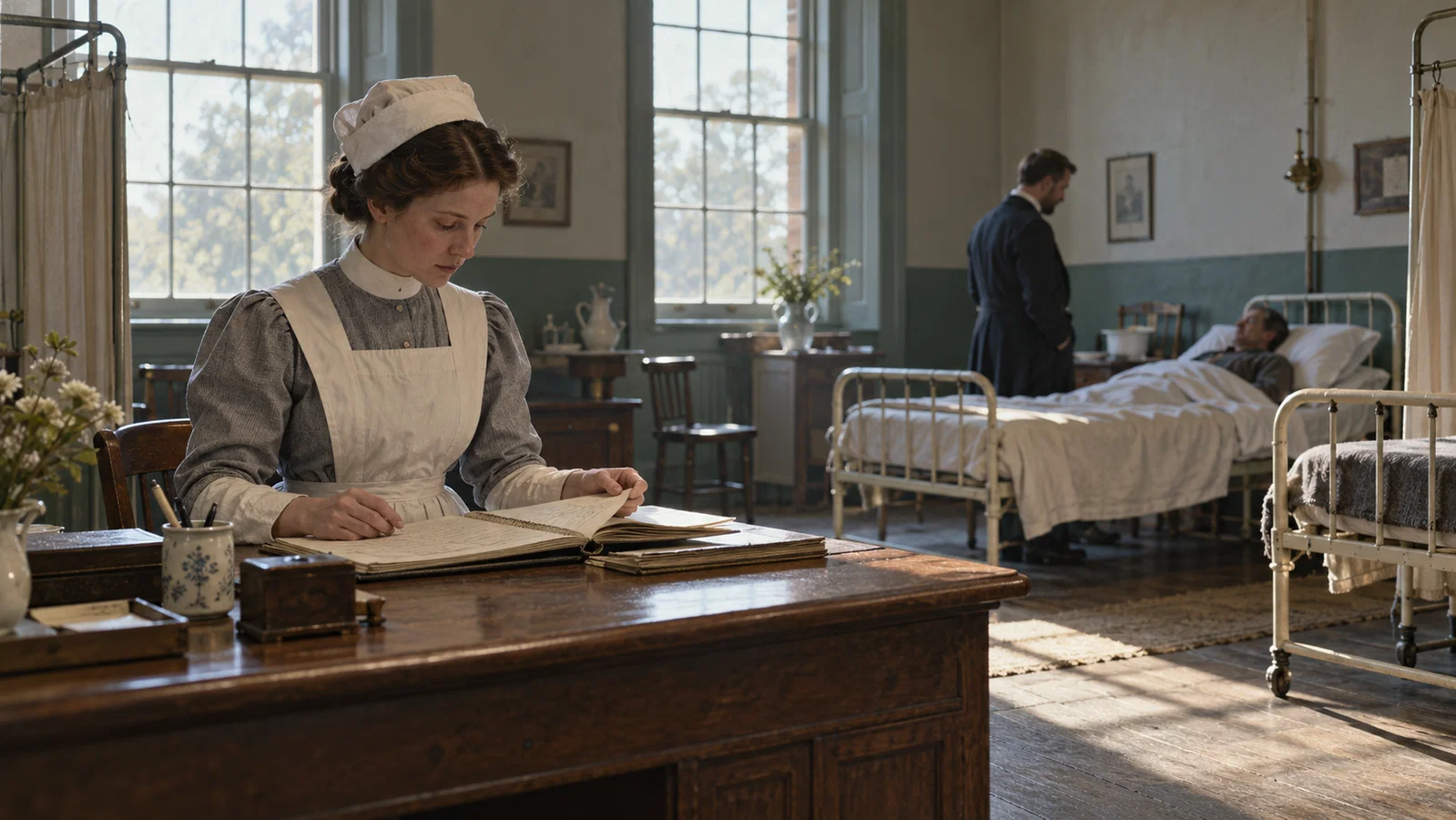
An operation could end while the anesthetic story continued. In C. M. Page’s 1912 report on hedonal infusion, patients commonly slept for six to twelve hours after the anesthetic had ceased. That detail takes the reader from the operating table back to the ward. Enabling an operation did not settle every question about a drug.[1, p. 88]
Page described the first 75 cases at St Thomas’ Hospital, while explaining that the hospital had already used the method more than 100 times.[1, p. 85] Those figures refer to different things. The Russian experiences he summarized, and cases other physicians contributed during discussion, cannot simply be added to the same denominator.
The date belongs to the reports
This article uses 1912 because its directly read evidence consists of Page’s contemporary report and discussion, together with Rawdon A. Veale’s report of complications in the same year. It does not assign a new date to hedonal’s discovery or its first intravenous use worldwide.
Page referred to earlier Russian and German work and listed Dreser’s 1899 report among his references.[1, pp. 84–85, 92] Those earlier originals were not independently read here. A reference to 1899 therefore cannot become the beginning of clinical infusion, and retrospective dating cannot supply an exact first-use claim.

Maintaining an operation, observing recovery
Alongside his account of continuous infusion, Page recorded airway obstruction, cyanosis and problems during recovery. He associated most of six episodes of cyanosis during operations with airway obstruction; in case 54, rapid infusion also figured in the account. An intravenous route did not make these observations disappear.[1, pp. 85, 87–89]
Recovery involved more than the moment of awakening. Continued sleep, excitement, vomiting and headache appeared in the report, alongside concerns about prolonged anesthesia and aspiration.[1, pp. 88–90] Reading these observations historically means keeping them distinct from the author’s explanations. They do not provide a method to reproduce in present practice.
There is a specific comparison with the Pantopon article of 1909. Sahli distinguished improvements in formulation from clinical advantages that still required further experience. Page’s account takes the question into the operating room and beyond: what happened to the patient while the infusion was being used, and afterwards?[3, pp. 5–6; 1, pp. 87–91] The drugs and problems differed. The connection concerns how complete observation supports a clinical judgment.

Recording a death and attributing it
Page recorded five postoperative deaths in hospital within his series, while judging that they could not be attributed to the anesthetic. He added a further death occurring after the report had been written.[1, p. 91] An accurate account must preserve both the recorded deaths and the fact that causal attribution was the author’s judgment. Reducing this to “no deaths in 75 cases” would erase important evidence.
The discussion brought a separate account from Barrington Ward: an eight-year-old child who died during an operation at Great Ormond Street. This was another hospital’s case, not one to insert into Page’s 75. Its explanation invoking status lymphaticus belongs to the historical report; it is not a modern diagnosis established here.[1, p. 93] The president’s call for full recording of deaths during and after anesthesia widened the question beyond whether an operation could be completed.
The discussion also needs careful attribution. Rood and several speakers were discussing intravenous ether, so their cases, apparatus and technical comments cannot all be assigned to hedonal. Harold Low clarified that it was the apparatus that could be moved away from the head, not the person responsible for anesthesia.[1, pp. 94–99, especially 95 and 97] Changing the route of administration did not remove the need for continuing attendance.
Another hospital continued the record
Writing in the BMJ in August 1912, Veale stated that hedonal had been used more than 300 times in Leeds. He described skin edema and blistering, pulmonary problems and venous thrombosis, and discussed possible contributions from pressure, trauma, prolonged immobility or the amount of fluid administered.[2, pp. 347–348] These were historical observations and proposed explanations, not controlled estimates of risk.
Veale explicitly stated in his summary that the technique was essentially Page’s.[2, p. 348] That provides a documented connection between the reports. It does not turn their patients into comparable treatment groups. Differences in case selection, observation and reporting prevent the numbers from yielding a defensible pooled safety rate.

These writings extend the view of anesthesia history: from getting an operation started, to who remained beside the patient, to whether later events entered the record. Their value includes the questions their authors left unresolved.
Material and image limits: All 17 original page images of the Page report and discussion, and both Veale page images, were read, with article and speaker boundaries retained. The cited early Russian and German originals were not independently read. All four images are AI editorial illustrations: an anonymous historical ward scene and modern reading aids, not authenticated patients, original charts or apparatus. Historical mixing instructions, doses and administration steps are excluded; these reports are not presented as current clinical guidance.
Sources and reading limits
[1] Page CM. Hedonal Infusion Anæsthesia; a Report on Seventy-five Cases. Proceedings of the Royal Society of Medicine. 1912;5(Sect Anaesth):84–100. DOI:10.1177/003591571200501313. PMID:19976305. Original page images. All 17 images, pp. 84–100, read, including the shared discussion and replies. The preceding article’s conclusion at the top of page 84 is excluded. Discussion of intravenous ether is not counted as hedonal experience. Earlier works listed in the references were not independently read.
[2] Veale RA. Complications Following the Administration of Hedonal. BMJ. 1912 Aug 17;2(2694):347–348. DOI:10.1136/bmj.2.2694.347. PMID:20766269. Original page images. Both pages read, limited to Veale’s article. The neighboring stovaine and syphilis articles are excluded. Veale explicitly identifies Page’s technique.
[3] Sahli H. Über Pantopon … Therapeutische Monatshefte. 1909;23:1–6. Original journal scan. The six-page report was read for the companion Pantopon article. The comparison rests on pp. 5–6 and their reservations about clinical advantage and storage, not a claimed direct lineage between the drugs.
Continue exploring
Related reading connects shared questions and contexts; it does not by itself establish historical influence.
Anesthesia Epochs · The Source Room · About & Editorial Method
Updated October 30, 2026. Sources and reading limits are stated above. Illustrations are labelled as original source images or AI-made. Historical accounts are educational; they are not current treatment instructions.