In 1880 Albert Ladenburg named hyoscin, an alkaloid left in the mother liquor of hyoscyamine, and in 1881 described its crystalline salts and their availability from Merck.
Reading Library · Anesthesia Epochs · 中文版
Watch the education video (for clinicians)
1880–1881: Ladenburg's Hyoscine — A Name Before a Structure · Anesthesia Epochs Education Series

An imagined late nineteenth-century laboratory, with an anonymous researcher, seen from behind, holding a glass bottle. This is neither a portrait of Ladenburg nor a reconstruction of a documented experiment.
In an 1880 report, A. Ladenburg described obtaining a brown, viscous, syrup-like material from Merck in Darmstadt. It remained in the mother liquor after hyoscyamine had crystallized and was sometimes sold as “amorphous hyoscyamine.” The question concerned what was left behind: did that uncrystallized material contain another alkaloid? [1, p. 1549]
The report did not take its reader into a delivery room. Most of its pages moved among salts, crystals, analytical results and decomposition products. For the early history of scopolamine, those comparisons preserve work that disappears inside a single date of isolation.
A name already present in 1880
Ladenburg’s Ueber das Hyoscin appeared in volume 13 of the Berichte der deutschen chemischen Gesellschaft in 1880, on pages 1549–1554. Its heading recorded receipt on 26 July; the volume title page specified July–December 1880. Receipt is not an exact publication date. [1]
Ladenburg did not treat the purchased brown material as a single pure substance. The crude product still contained a substantial amount of crystalline hyoscyamine. Ladenburg compared gold salts by solubility, luster, crystal form and melting point, while continuing efforts at purification. [1, pp. 1549–1551]
On page 1551 Ladenburg introduced Hyoscin as the name for the accompanying alkaloid. A footnote, however, acknowledged that Höhn and Reichardt had already proposed that name for a basic decomposition product of hyoscyamine. Ladenburg considered the name available for reuse because that earlier product had been identified as tropine. The word itself had a history before this assignment. [1, p. 1551 and note]
Modern editorial cards for 1880 and 1881 identify the publication years of two reports. They are not historical specimen labels or evidence of one continuous experiment.
Separation still left questions
Chemical identity did not settle with the first analysis. On page 1550, the figures did not closely fit the formula under comparison. The following page identified another difficulty: hyoscyamine already present in the crude material could contribute decomposition products and confuse the interpretation of the other alkaloid. [1, pp. 1550–1551]
Further work included purification, examination of the resulting base and comparison of its crystalline salts. Ladenburg used these findings to argue for the chemical interpretation presented in the paper, grouping hyoscin, hyoscyamine and atropine as isomers. [1, pp. 1552–1554]
That was an interpretation made in 1880, not a modern confirmation of molecular identity. The opening of Hatcher’s 1910 report linked the names hyoscin and scopolamin and explicitly described Ladenburg’s formula as incorrect. Only that opening is used here; it is not a basis for summarizing the full report’s clinical conclusions. [3, publisher opening]
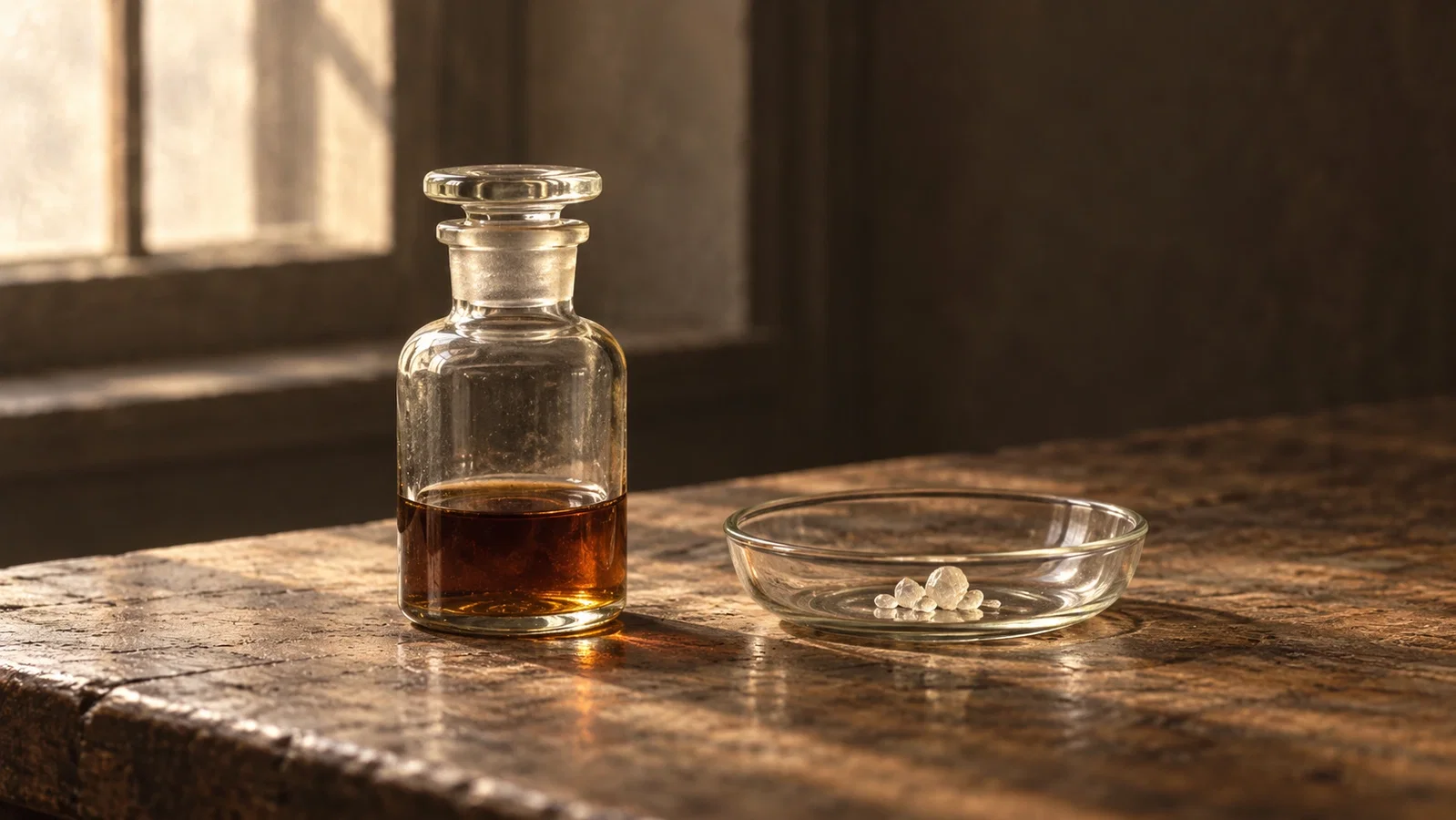
A glass bottle containing a little brown viscous liquid and a glass dish holding a few pale crystals represent contrasting material forms. The crystals do not reproduce a particular salt’s morphology, and the illustration gives no preparation procedure.
The first paper’s physiological conclusion was brief. Ladenburg attributed pupil-dilation observations to a colleague, Völckers, and said that other physiological and therapeutic investigations were still in progress. These lines cannot establish obstetric analgesia, amnesia or modern clinical safety. [1, p. 1554]
What the 1881 follow-up added
The next paper carried the explicit designation “second communication.” Published in volume 14 in 1881, on pages 1870–1872, it recorded receipt on 15 August. Its opening identified the starting extract as Hyoscyamus niger and referred back to the 1880 paper. [2, p. 1870]
Ladenburg mentioned Edlefsen’s report on therapeutic effects and said favorable results had renewed Ladenburg’s interest. The paper itself then concentrated on crystalline salts that could facilitate preparation and use. It described the hydriodide and hydrobromide and acknowledged collaboration in measuring their crystals. [2, pp. 1870–1872]
The closing paragraph added a commercial detail. According to Ladenburg, Merck had prepared larger quantities of hyoscin preparations at Ladenburg’s request, and these were already available for purchase. That supports a statement about reported availability in 1881, without establishing an exact launch date, widespread adoption or consistent product quality. [2, p. 1872]
Edlefsen’s original clinical report is not covered here. Ladenburg’s favorable reference does not supply those cases or allow their outcomes to be assessed independently.
Where this article belongs on the timeline
The ASA’s 2024 timeline places the first isolation of scopolamine, or hyoscine, in 1881 and associates it with Scopolia carniolica. [4, PDF p. 24] The two original papers require a more precise account: naming and chemical comparisons were published in 1880; crystalline salts and availability were discussed in 1881. The latter paper explicitly identified Hyoscyamus niger extract. [1–2]
This article therefore belongs under 1880–1881. It records two publications without judging priority or assigning the still-unexamined clinical history of twilight sleep to 1881.
Brown mother liquor, a reused name and commercially available preparations mark distinguishable steps. What happened when a drug entered clinical practice requires evidence beyond the chemistry that made it available.
Sources and reading limits
Read: Ladenburg’s two papers “Ueber das Hyoscin” in the Berichte der deutschen chemischen Gesellschaft (1880, pp. 1549–1554; 1881, pp. 1870–1872), in full; the opening of Hatcher’s 1910 JAMA paper; the 1881 row of the Australian Society of Anaesthetists’ 2024 timeline.
Not covered: Ladenburg’s earlier 1880 notice (Berichte XIII, 910) and the Annalen paper; Edlefsen’s clinical report; Schmidt’s chemical papers; the rest of Hatcher’s paper; later twilight-sleep cases. No dosing or preparation guidance is given, and priority is not judged. The three illustrations are AI-made interpretive images, not historical evidence.
- Ladenburg A. Ueber das Hyoscin. Ber Dtsch Chem Ges. 1880;13(2):1549–54. HathiTrust
- Ladenburg A. Ueber das Hyoscin. Zweite Mittheilung. Ber Dtsch Chem Ges. 1881;14(2):1870–2. HathiTrust
- Hatcher RA. Scopolamin and morphin in narcosis and in childbirth. JAMA. 1910;54(6):446–51. JAMA
- Australian Society of Anaesthetists. Anaesthesia history timeline. 2024. ASA
Continue exploring
Related reading connects shared questions and contexts; it does not by itself establish historical influence.
- 1831: Mein's Crystalline Atropine, a Sample Before the Paper
- 1867: Atropine, the Stimulus Remained and the Slowing Faded
- 1872: Heidenhain's Salivary Experiments, Where Blood Still Flowed
Anesthesia Epochs · The Source Room · About & Editorial Method
Updated October 30, 2026. Sources and reading limits are stated above. Illustrations are labelled as original source images or AI-made. Historical accounts are educational; they are not current treatment instructions.