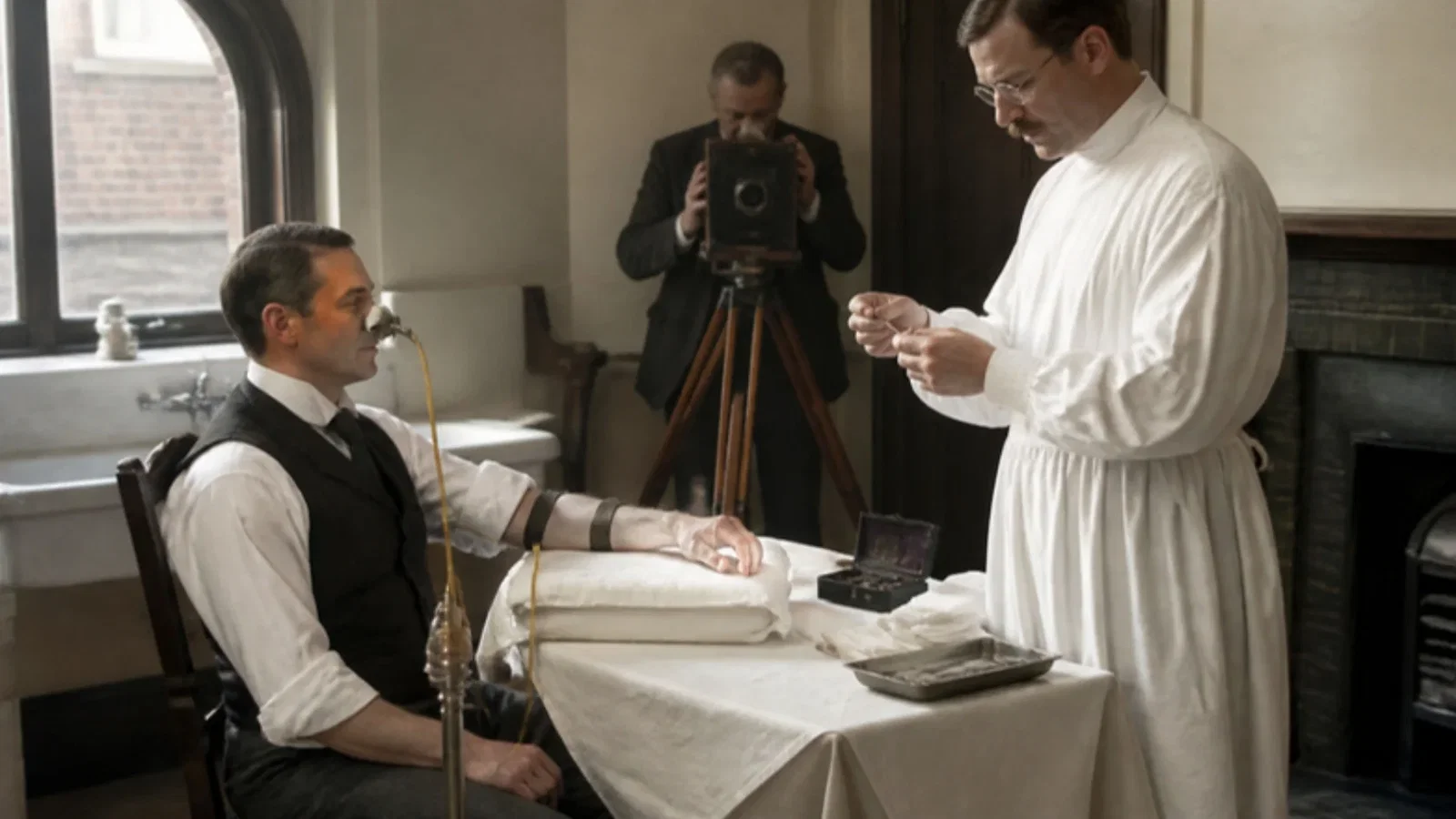
Australia's first full-time specialist anaesthetist put on a nasal inhaler and let a colleague cut and stitch his forearm.
Reading Library · Anesthesia Epochs · 中文版
Watch the education video (for clinicians)
1913: Hornabrook's Album — An Anaesthetist as His Own Subject · Anesthesia Epochs Education Series
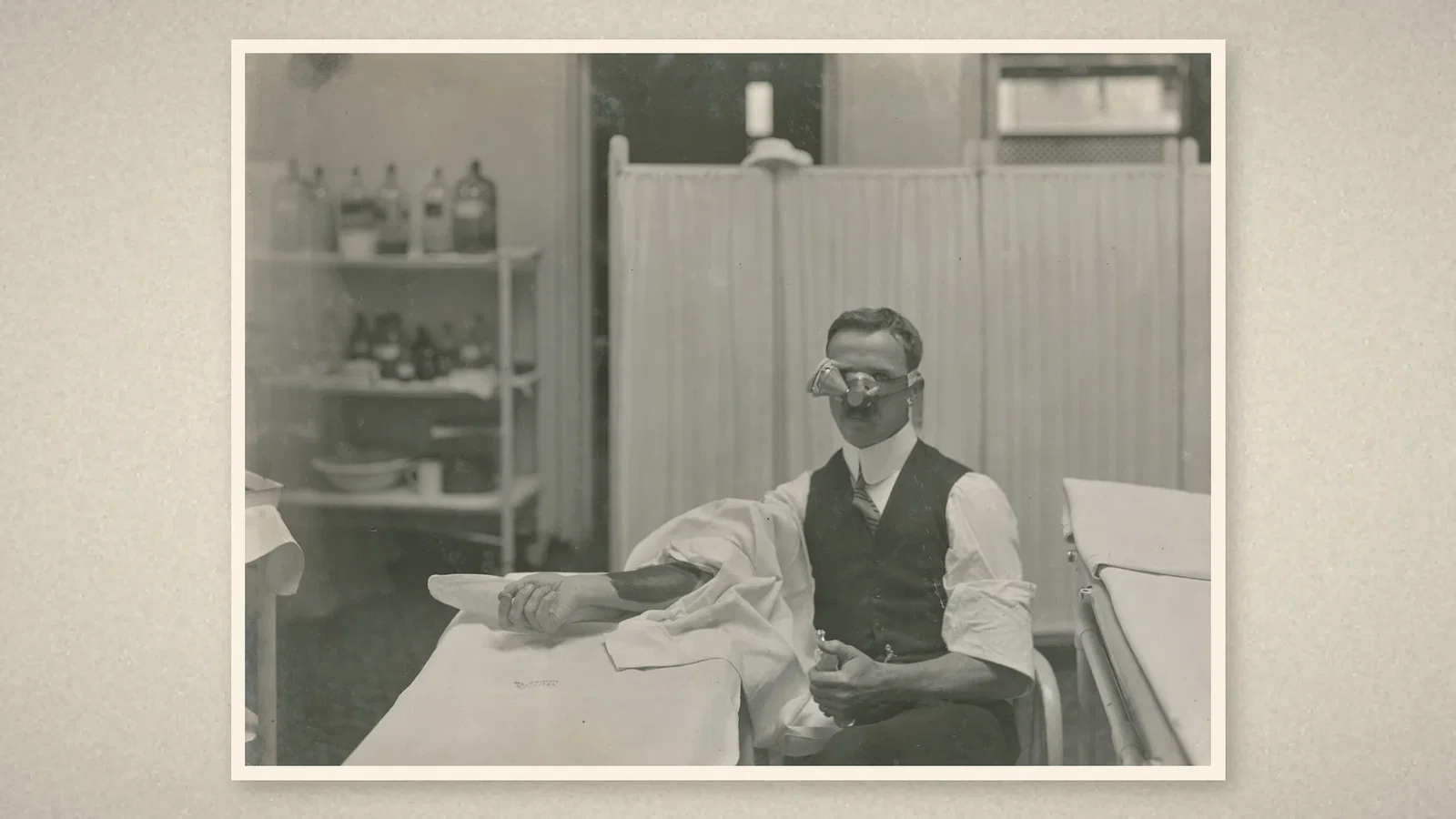
The sitter in the photograph wears a waistcoat and a high collar, sleeves rolled to the elbow, and sits in a room lined with bottles, an inhaler strapped over the nose, a small bottle in the right hand, the left forearm laid on a draped table. [1] The picture comes from an album in the Geoffrey Kaye Museum of Anaesthetic History, catalogued as the "Photographic album of Dr Rupert Hornabrook, 1913, Darge Photographic Company", VGKM6580. [2]
A full-time anaesthetist
The museum's exhibition text describes Rupert Walter Hornabrook as Australia's first full-time specialist anaesthetist. [2] In 1999 Pemberton published a biography of Hornabrook in Anaesthesia and Intensive Care. Its abstract says that Hornabrook, born in 1871, was the first physician in Australia to devote a medical practice solely to anaesthesia, and was appointed to the Royal Melbourne Hospital in 1909, after an adventurous earlier career that ran from plague hospitals in India to the Boer War in South Africa. [3]
The abstract adds that Hornabrook's work included popularizing the ethyl chloride–ether sequence in the first years of the twentieth century, when chloroform and closed inhalers were the norm, and that Hornabrook campaigned vigorously for the recognition of anaesthesia as a branch of medicine in its own right. [3]
His own research subject
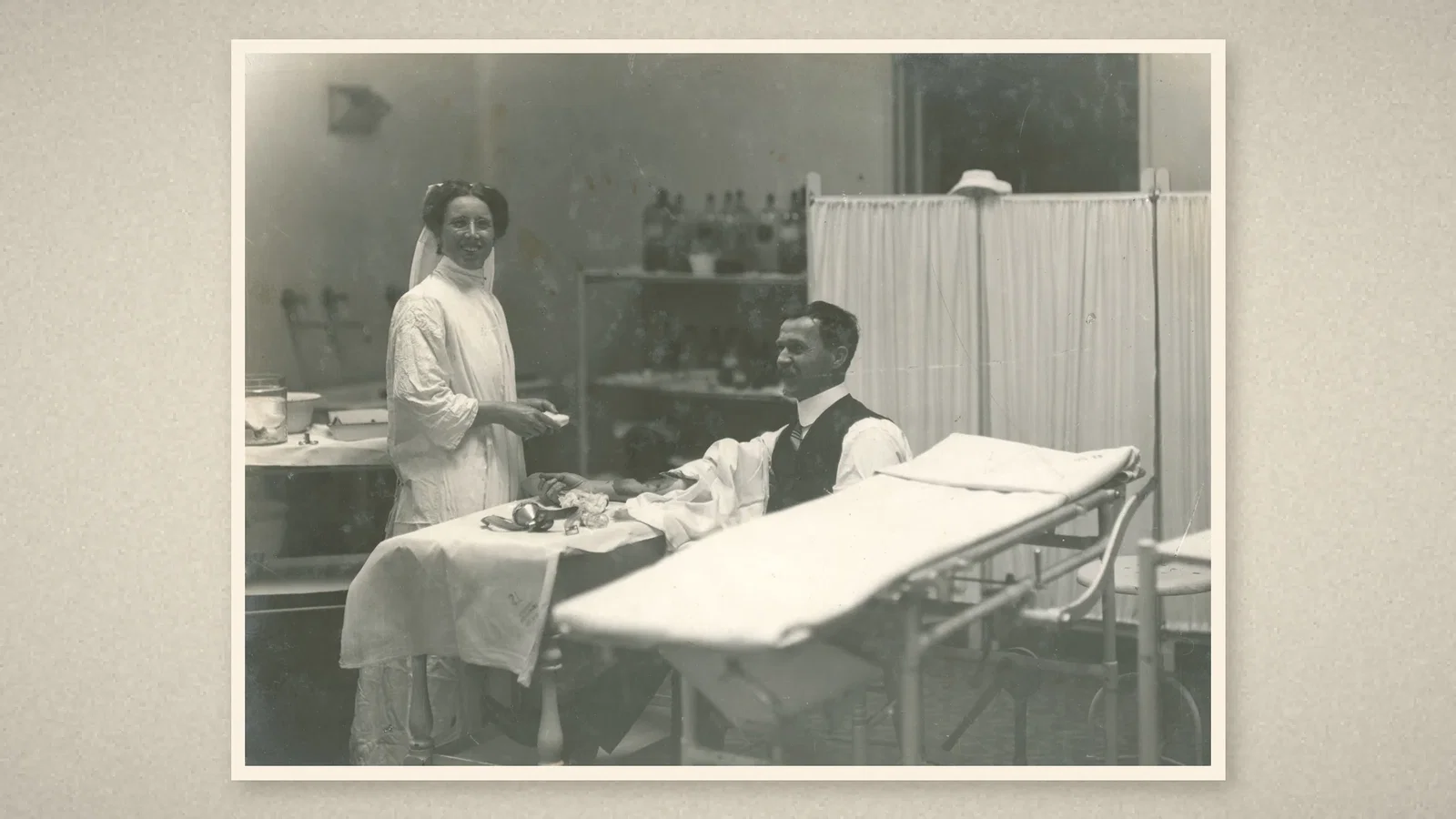
The most striking passage in the museum's text is this. Hornabrook regularly served as the subject of Hornabrook's own research. While investigating the degrees and stages of anaesthesia, Hornabrook self-administered ether with a Parrett's nasal inhaler in front of an audience; once Hornabrook was anaesthetised, a colleague made and sutured a two-inch incision in Hornabrook's forearm. [2] Hornabrook also let other doctors administer anaesthetics for research, becoming both subject and patient, and the monitoring during these experiments gave valuable information on pulse, blood pressure and other vital functions. [2]
The two album photographs match that description: in the first, the seated figure with the nasal inhaler and forearm on the table; in the second, a nurse alongside and dressings on the table. [1] The photographs themselves do not say which experiment they show or who else was present. This article describes them only as the museum catalogues the album, and does not interpret details such as the dark band on the forearm.
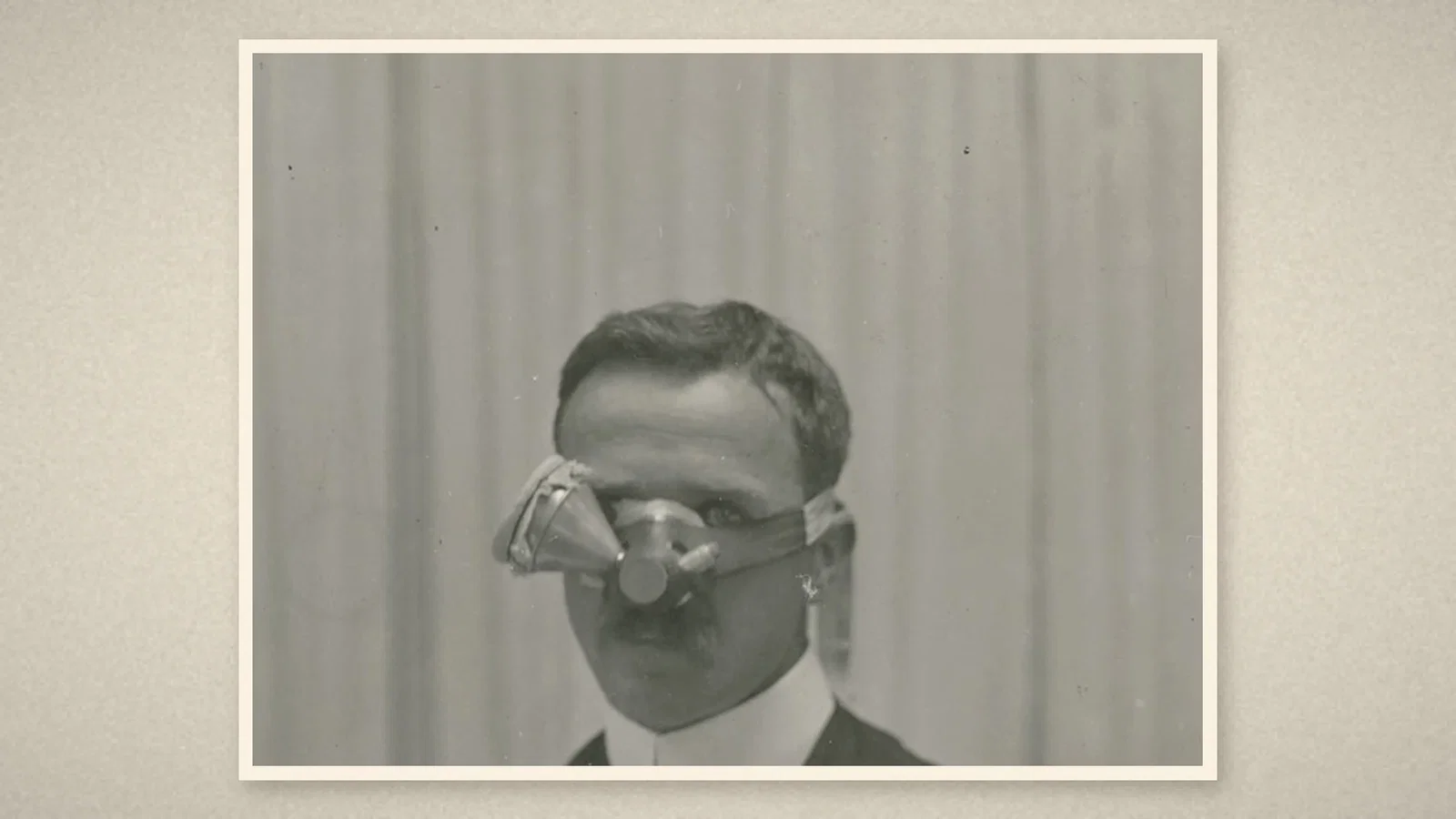
Parrett's nasal inhaler
The same exhibition describes the inhaler. George Parrett, who graduated in dentistry from the University of Melbourne in 1912, designed it for somnoform, a blended anaesthetic. [2] Hornabrook used it for ether.
The anaesthetist inside the experiment
Hornabrook's experiments look risky today, but they answer a concrete need: to study the stages of anaesthesia and watch how pulse and blood pressure changed, someone had to be willing to be anaesthetised repeatedly and to describe the experience afterwards. A doctor whose whole practice was anaesthesia went onto the table as the subject. That fits Hornabrook's campaign for anaesthesia as a branch of medicine: it deserved people dedicated to studying it, and Hornabrook was prepared to be the one it was tried on. [2; 3]
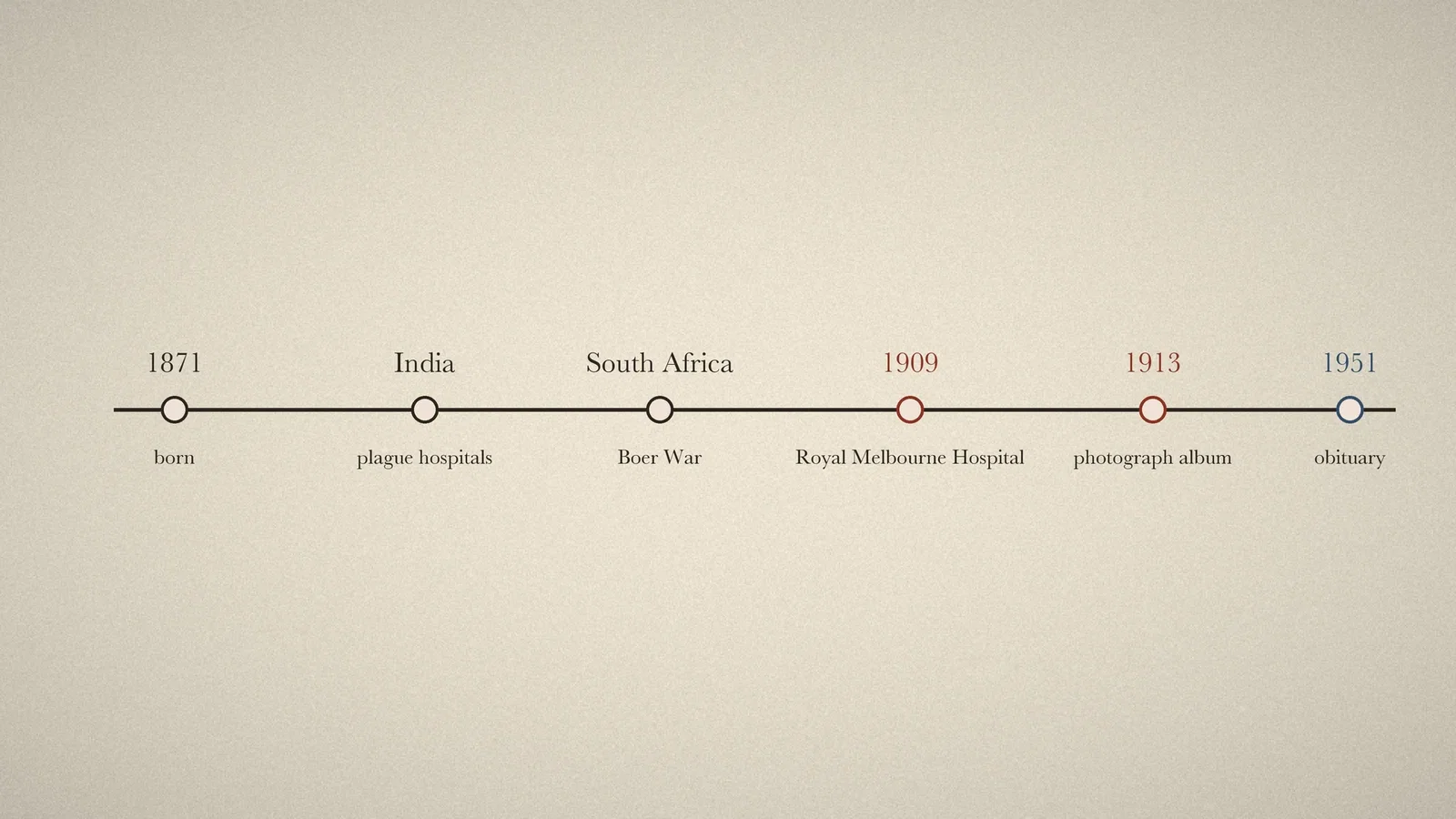
After Hornabrook's death, the Australian Journal of Dentistry published "Late Dr. R. W. Hornabrook" in 1951. [4]
What the record shows
A 1913 album, two photographs, a museum's paragraph. Together they preserve one side of Australia's first full-time anaesthetist: self-experiment to study the stages of anaesthesia, with the incision and the sutures made in Hornabrook's own forearm.
Sources and reading limits
Read: two photographs from Hornabrook's 1913 album (Geoffrey Kaye Museum VGKM6580); the museum's "Australia and New Zealand" exhibition text on Hornabrook and on Parrett's inhaler; the PubMed abstract of Pemberton's 1999 biography, and the PubMed record of a 1951 obituary in the Australian Journal of Dentistry.
Not covered: Pemberton's full article and the text of the 1951 obituary were not read, nor any paper by Hornabrook (the Australian papers of the 1910s are not online; the volumes of the Australasian Medical Gazette on the Internet Archive mention Hornabrook only in South Australian branch notices of 1903–1908). The museum does not say when in 1913 or where the photographs were taken, or who made the incision; this article does not identify the people in the photographs or explain the dark area on the forearm.
Of the four illustrations, three are the museum's album photographs (one as an enlarged detail) and one is a diagram drawn for this article from the sources.
- Photographic album of Dr Rupert Hornabrook. 1913. Darge Photographic Company. Geoffrey Kaye Museum of Anaesthetic History, VGKM6580. GKM
- Geoffrey Kaye Museum of Anaesthetic History. Australia and New Zealand [online exhibition]. GKM
- Pemberton EJ. Rupert Walter Hornabrook--Australia's first full-time anaesthetist. Anaesth Intensive Care. 1999;27(5):519-22 [abstract]. PubMed
- Late Dr. R. W. Hornabrook. Aust J Dent. 1951;55(4):305-9 [bibliographic record only]. PubMed
Continue exploring
Related reading connects shared questions and contexts; it does not by itself establish historical influence.
Anesthesia Epochs · The Source Room · About & Editorial Method
Published November 2, 2026. Sources and reading limits are stated above. Illustrations are labelled as original source images or AI-made. Historical accounts are educational; they are not current treatment instructions.