Publication, contemporary reviews and a later reassessment.
Reading Library · Anesthesia Epochs · 中文版
Watch the companion film
1953: John Bonica — A Book to Consult · Watch on YouTube
Historical anchor: 1953. Date details and source qualifications are explained below.
How could a busy doctor find the right page in a large book? Reviewing John J. Bonica's The Management of Pain in 1954, Dumont Staatz suggested marking the pain-syndrome section with coloured paper or a tab. It was advice to the reader, rather than a feature supplied with the book. Lea & Febiger had published the volume in Philadelphia in 1953.[2,pp.9–10;1]
A period-inspired scene about writing and reading. The person, desk and binding are imagined, not a portrait of Bonica or an authenticated first-edition cover.
From cases to pages
In his 1993 oral history, Bonica recalled incorporating his case series and individual examples into the book. He described discussions with William K. Livingston and help with reading the manuscript from Livingston and Frederick Haugen. These recollections, recorded forty years later, describe how he understood the writing process.[3,pp.72–73]
He remembered beginning with a shorter book for anaesthesiologists, then deciding that a broader account of the underlying knowledge was needed. The 1953 subtitle nevertheless gave special emphasis to analgesic block in diagnosis, prognosis and therapy. Broader coverage did not mean equal space for every method.[3,p.77;1;2,p.9]
What contemporary readers noticed
The April 1954 Bulletin of the Pierce County Medical Society printed three reviews. Staatz and W.H. Goering described three parts: fundamental considerations, methods of management and pain syndromes. Staatz noticed that smaller type held theory and reference material, allowing a reader to follow the larger type continuously. His proposed bookmark addressed the practical task of finding information in a substantial work.[2,pp.9–10]
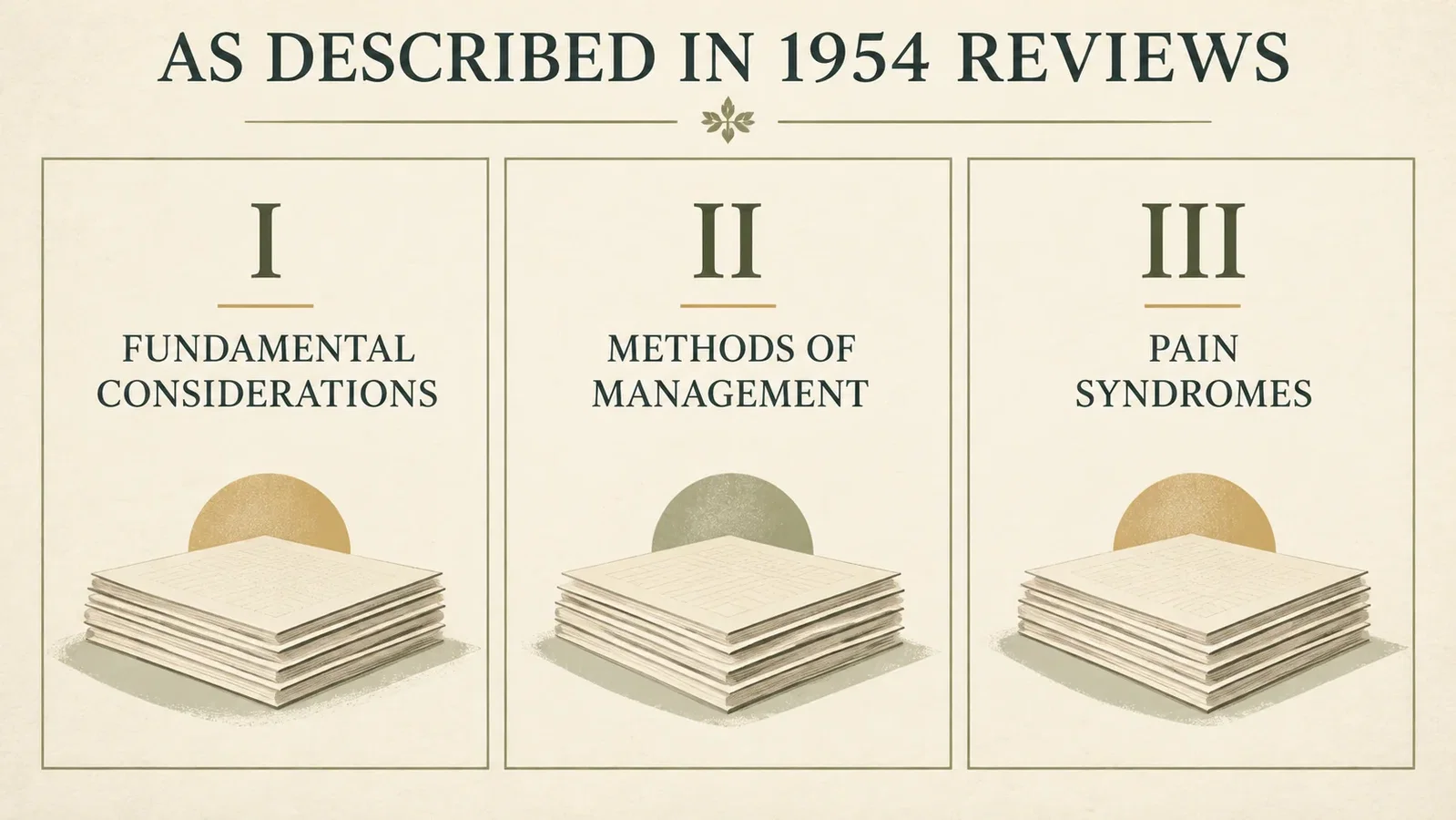
An overview based on the 1954 reviews, not a reproduction of the original contents pages.
The reviewers praised the coverage of blocks and mentioned psychological, physical and other specialist approaches. Dille recommended the book from an internist's perspective. Staatz saw the specialist chapters as reminders to relate appropriate medical treatment to the pain problem. Their reactions document reception within Bonica's local medical community. The Bulletin was explicitly celebrating a colleague and also printed selected extracts from letters, with his permission. This was neither a survey of medical opinion nor evidence that every treatment worked.[2,pp.9–11]

A still life inspired by Staatz's suggestion. The pages, tab and binding are invented.
Who takes responsibility for the patient?
Bonica discussed professional responsibility more explicitly in 1954. The journal placed his paper under the Section of Anaesthetics meeting of 7 May 1954 at the Royal Society of Medicine. It appeared that December. It distinguished a consultant providing diagnostic or therapeutic techniques from a physician responsible for the patient's overall management. Experience with anaesthetic drugs and nerve blocks helped with the former role; it did not automatically confer all the qualifications for the latter.[4,pp.1029–1030]
On page 1031, he described the limitations and risks of blocks, which often contributed only part of the solution. He then proposed a pain clinic involving several specialties. The list included neurology, neurosurgery, psychiatry, internal medicine, orthopaedics, radiology and physical medicine, alongside anaesthesia. This proposal is directly visible in his 1954 article.[4,p.1031]
An illustration of the collaborative approach discussed in 1954. It depicts no identified meeting or publication-day event.
Reading that article beside the publication record requires one further distinction. In 1993, Bonica said that the first edition had not emphasised the team concept enough: he should have devoted a chapter to it. The chapter he then pointed to was chapter 9 of the 1990 second edition. That later chapter does not belong in an account of the first edition.[3,pp.80–81]
The 1947: Bonica Brings Pain Consultations to the Same Table concerns collaborative practice; this article concerns the publication of a book. Bonica's recollections connect the two, while distinguishing clinical experience, writing and later reassessment. Publication did not itself establish a fully developed team system everywhere.[3,pp.72,79–81]
Staatz's proposed bookmark gives us a specific reader: a doctor approaching a book with a problem to investigate.[2,p.10] Read beside Bonica's 1954 discussion of professional responsibility, it connects the use of reference material with the demands of caring for the whole patient. That connection is an editorial interpretation of these records.[4,pp.1029–1031]
Sources and reading limits
The complete text of the 1953 first edition is not covered. Statements about its organisation are attributed to contemporary reviews. The 1954 paper and 1993 recollections are dated separately; neither is presented as a reading of the book itself.
- Bonica JJ. The Management of Pain: with special emphasis on the use of analgesic block in diagnosis, prognosis, and therapy. Philadelphia: Lea & Febiger;1953. First-edition catalogue record. Bibliographic body read, not the book's text. OL6135974M;LCCN53009577.
- Dille R, Staatz D, Goering WH. Book Reviews: “The Management of Pain,” by Dr. John Bonica. Bulletin of the Pierce County Medical Society.1954Apr;24(8):9–11, including subsequent published letter extracts. Original annual volume. All three review pages read in text and scans, with cover and contents checked. The whole annual volume was not read. The introductory page count,1533, differs from Staatz's1553; this narrative does not rely on the count.
- Bonica JJ. Oral History Interview,9–12March1993,by John C. Liebeskind. UCLA Ms.Coll.127.7,transcript prepared2005. Transcript preserved by IASP · Archived copy. Front matter and pp.71–73,77–81:11 selected pages read. The whole transcript was not read; audio was not heard.
- Bonica JJ. The Role of the Anæsthetist in the Management of Intractable Pain. Proc R Soc Med.1954Dec;47(12):1029–1032. DOI:10.1177/003591575404701202;PMID13237186. Original article and scans. All four original page images read, including summary and references. Historical treatment statements are not used as current clinical advice.
Continue exploring
Related reading connects shared questions and contexts; it does not by itself establish historical influence.
The Source Room · About & Editorial Method
Sources and reading limits are stated above. Illustrations are labelled as original source images or AI-made. Historical accounts are educational; they are not current treatment instructions.