A Tacoma team in 1947, recalled and documented.
Reading Library · Anesthesia Epochs · 中文版
Watch the companion film
1947: Bonica—Bringing Pain Specialists to the Same Table · Watch on YouTube
Historical anchor: 1947. Date details and source qualifications are explained below.
John J. Bonica joined Tacoma General Hospital in 1947. He later recalled assembling a team with an orthopedic surgeon and a psychiatrist within a month of his arrival. John D. Loeser's memorial also describes physicians meeting regularly to discuss patients with chronic pain whom they shared. These accounts describe a way of organizing care; they do not establish a worldwide ranking of the first pain clinics. [1,p.79;2]
The people and room are editorial inventions, not a portrait of Bonica, a Tacoma staff roster or a reconstruction of a recorded meeting.
Separate consultations, then conversation
The practice had a wartime antecedent. In his 1993 oral history, Bonica returned to Madigan Army Hospital. Some injured patients continued to have pain despite nerve blocks, prompting him to ask other specialists for help. Initially, each doctor saw the patient separately and supplied a written opinion. [1,pp.73–74]
Bonica recalled difficulty bringing those opinions together. He proposed discussing patients over lunch with the doctors who had examined them. Written notes were still required; the conversation added an opportunity to question and compare their assessments. The interview explicitly places these lunches at Madigan, where, he said, meetings had become fairly regular by early 1945. [1,pp.74–75]
The folders represent separate opinions brought into discussion. They contain no patient information; the image does not turn recalled efficiency into a measured study result.
A new setting in Tacoma
The local medical society's February 1947 bulletin announced that Bonica would arrive at the end of January. Decades later, he recalled returning to Tacoma in February. The announcement and recollection differ in their timing, while placing the career transition in the same year. The bulletin does not announce a pain clinic's opening or identify a pain team. [1,p.70;3]
Describing his Tacoma team, Bonica emphasized the place of personal history, family and relationships in pain. One physician's expertise could not cover everything. He also recalled the difficulty of including referring physicians in discussions when colleagues disagreed about a patient's care. Joint discussion required tact as well as different specialties. [1,p.79]
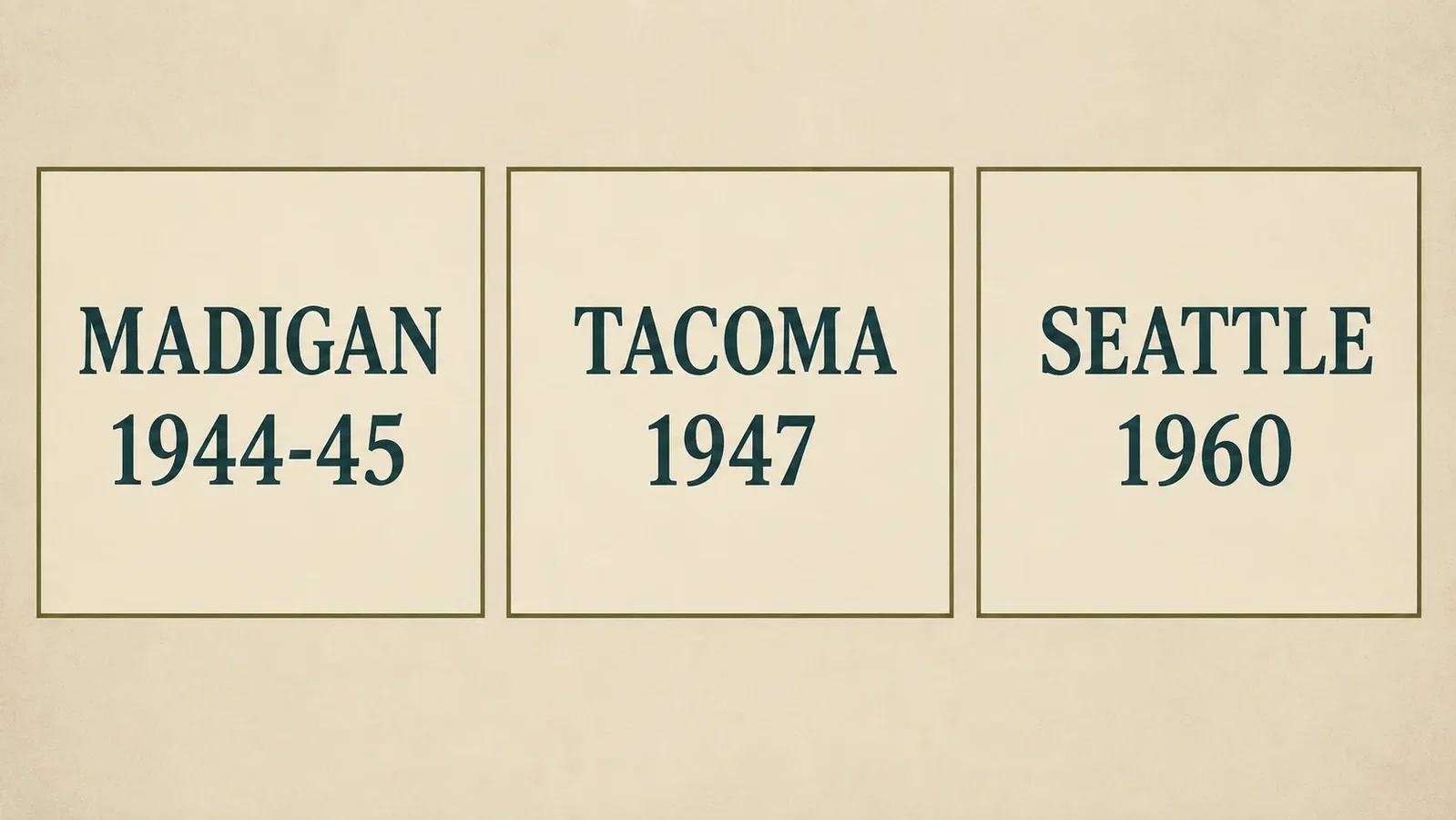
The places remain separate: wartime lunches, the 1947 Tacoma team and work in Seattle after 1960. The dates identify stages, not verified clinic opening days.
From clinical experience to writing
Bonica connected his clinical experiences and case material with the writing of The Management of Pain, published in 1953. In the interview, he recalled distinguishing a pain clinic from a nerve-block clinic, but felt that he had not emphasized the subject enough in the first edition. He thought it deserved a whole chapter. This is the author's later account of his writing; the textbook's pages have not been checked here. [1,pp.72,80–81;2]
His University of Washington appointment came in 1960. Loeser names nurse Dorothy Crowley and neurosurgeon Lowell E. White Jr. among the collaborators in the Seattle clinic. The university's establishment of the Multidisciplinary Pain Center in 1978 was another, later institutional step. These people and arrangements should not be placed retrospectively in the 1947 Tacoma team. [1,pp.84–85;2]

The book and folders are editorial props, not a reproduction of the 1953 textbook or patient records.
The interview and memorial help explain how the group worked, while retaining their authors' retrospective judgments. They do not supply comparative data from which to calculate an improvement in treatment outcomes. The concrete change in this account was to bring separately formed specialist opinions into a shared conversation, then put experience into writing. [1–3]
Sources and reading limits
- Oral History Interview with John J. Bonica, 9–12 March 1993 (Ms. Coll. no. 127.7). Interviewer: John C. Liebeskind. John C. Liebeskind History of Pain Collection, UCLA Biomedical Library; transcript prepared 2005. IASP-hosted original transcript · Archived copy. Front matter, printed pages 47–48 and 69–85 were read in text and page images, 22 pages total. The other 138 pages of the 160-page file and the audio were not read or heard. The file's metadata incorrectly names Howard Fields; its cover and dialogue identify Bonica. This is an edited retrospective interview. Neither edition of the textbook was read here.
- Loeser JD. In Memoriam: John J. Bonica. Signed Seattle, 21 August 1994; IASP identifies the original publication as PAIN. 1994;59(1). Full institutional republication. The complete memorial body was read. This is a colleague's retrospective account, not a contemporaneous clinic register or comparative outcome study.
- Pierce County Medical Society. Tacoma General Hospital News. Bulletin. February 1947;17(2):3. Digitized annual volume. The February cover and arrival notice were read from an archived copy. The rest of the 306-page volume was not read for this article; the notice predicts an arrival and does not establish a pain-clinic opening date.
Continue exploring
Related reading connects shared questions and contexts; it does not by itself establish historical influence.
The Source Room · About & Editorial Method
Sources and reading limits are stated above. Illustrations are labelled as original source images or AI-made. Historical accounts are educational; they are not current treatment instructions.