
A Bonn anaesthesia department turned multi-compartment pharmacokinetics into computer-driven infusion schemes; a decade later Glasgow anaesthetists called the method target-controlled infusion, and in 1997 the field agreed to use that name, partly so that it would not sound as if a computer, rather than the anaesthetist, was in control.
Reading Library · Anesthesia Epochs · 中文版
Watch the education video (for clinicians)
1981: Target-Controlled Infusion — Schwilden's Dosing Equations · Anesthesia Epochs Education Series
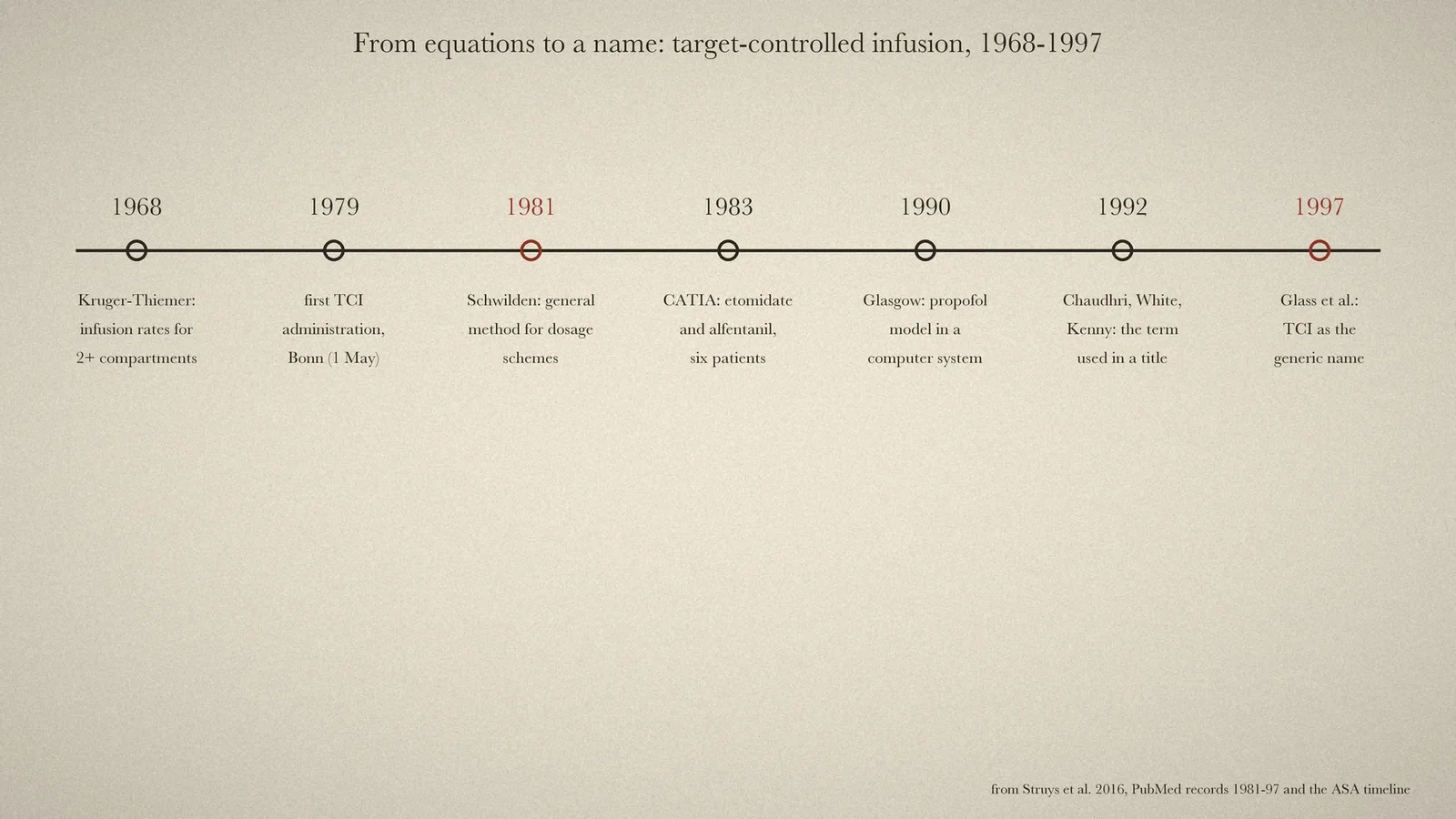
A fixed infusion rate does not give a fixed effect. A 2016 history of target-controlled infusion gives an example: a propofol infusion of 100 µg/kg/min "is associated with a nearly awake patient" three minutes into the infusion, and with a highly sedated or asleep patient two hours later, because the drug keeps accumulating in the tissues. [8, p. 56] Target-controlled infusion (TCI) reverses the question. The clinician sets the concentration wanted, a "user-defined" predicted target, and a computer works out the rates needed to reach and hold it. [8, p. 56] The Australian Society of Anaesthetists (ASA) timeline marks three steps: a pharmacokinetic-model-driven infusion pump in Bonn in 1981, the first use of the phrase "target controlled infusion" in 1992, and a recommendation in 1997 that the phrase should become the general name. [9, pp. 78, 83, 85] The 1996 Diprifusor, the first commercial system, has its own article in this series. This one covers how the method began and how it got its name.
The equations
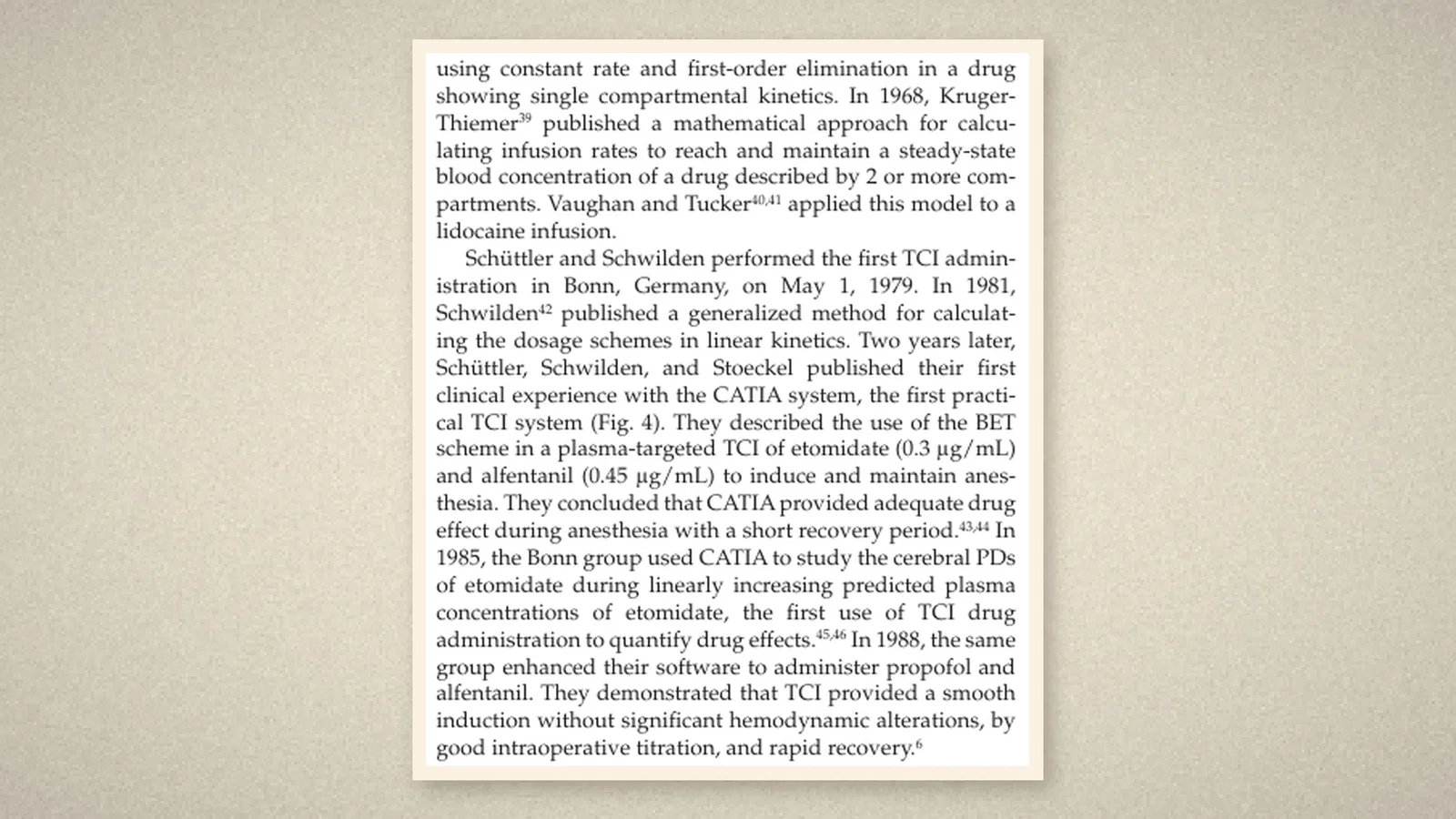
The mathematics came before the machine. In 1968, E. Krüger-Thiemer published a method for calculating the infusion rates needed "to reach and maintain a steady-state" blood concentration of a drug described by two or more compartments. [8, p. 60] The ASA timeline describes the Bonn system as built on those equations. It used "exponentially declining infusion schemes", and its developer was Dr (later Professor) Helmut Schwilden, then an assistant in the Department of Anesthesiology at the University of Bonn. [9, p. 78]
In 1981 Schwilden published "A general method for calculating the dosage scheme in linear pharmacokinetics" in the European Journal of Clinical Pharmacology. [1] Only the PubMed record of that paper was available here. A German paper from the same year, by Schwilden, Stoeckel, Schüttler and Lauven, gives the idea in its abstract. If the pharmacokinetic data are known, "the superposition principle of linear pharmacokinetics" allows blood levels and the amounts of drug in other compartments to be simulated for any dosage scheme. The authors used a two-compartment model to compare published etomidate regimens. [2]
Bonn: the first administrations
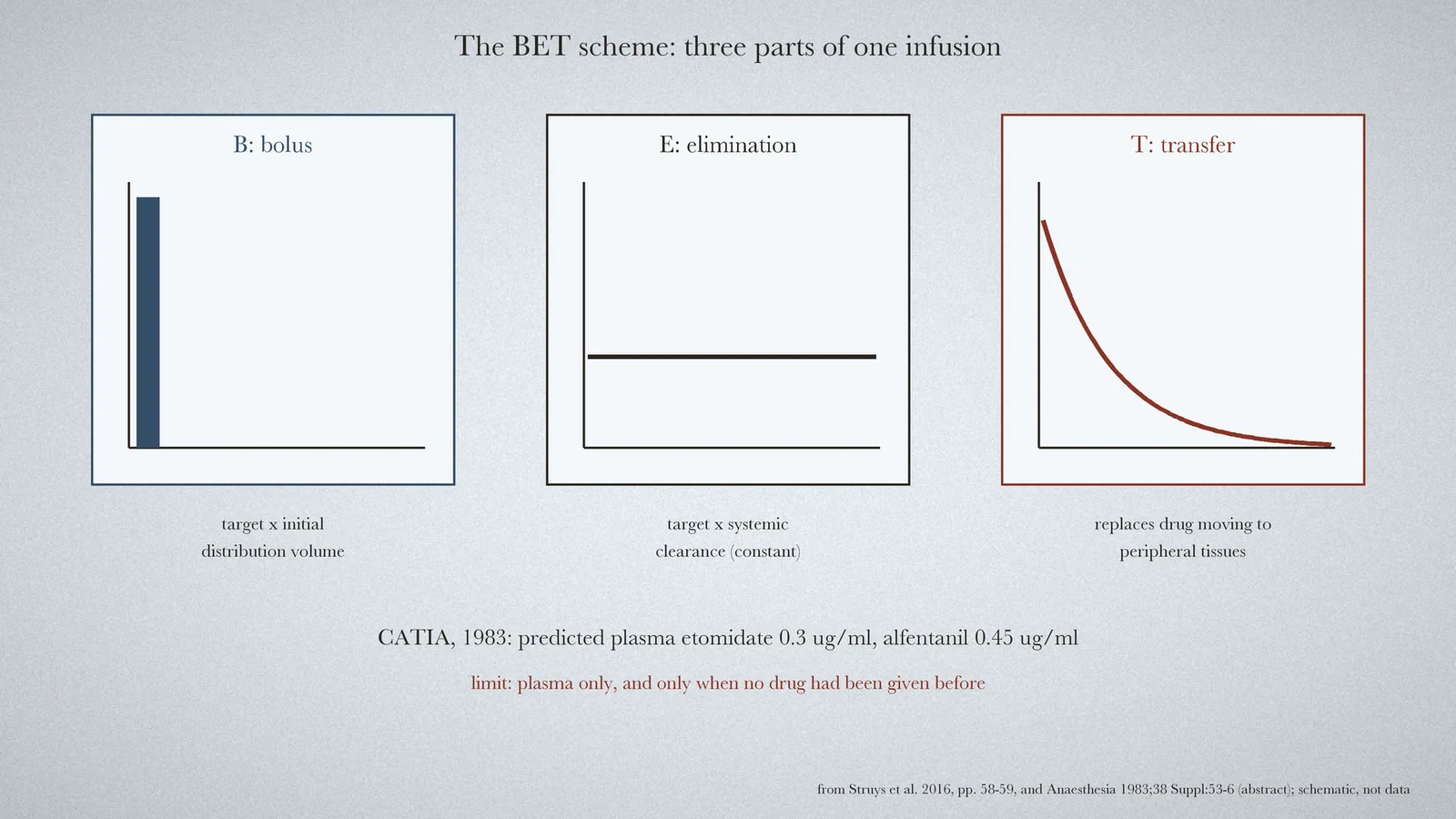
According to the 2016 review, Schüttler and Schwilden "performed the first TCI administration in Bonn, Germany, on May 1, 1979". Two years after the 1981 method paper they published their first clinical experience with CATIA, computer-assisted total intravenous anaesthesia, which the review calls "the first practical TCI system". [8, p. 60] The 1983 abstracts give the details. The theoretical paper names the problem: reaching a concentration "within the therapeutic range at the receptor site" using linear compartment models and the superposition principle. [3] The practical paper reports six patients having gynaecological surgery under CATIA with etomidate and alfentanil. Predicted plasma etomidate was held at 0.3 µg/ml "from the very beginning onwards", and alfentanil at 0.45 µg/ml from skin incision until 20 minutes before the end of surgery. Both used the "so called B.E.T. infusion scheme", and recovery was short. [4]
The BET scheme
The review explains BET, bolus-elimination-transfer, in three parts. A bolus fills the initial distribution volume to the target. A constant infusion equal to the target times the systemic clearance replaces drug that is eliminated. A third infusion, which declines exponentially, replaces drug moving into the peripheral compartments. [8, pp. 58-59] The scheme had two limits. It could target only the plasma concentration, and it worked only if no drug had been given beforehand, so it could not be used to titrate. Later algorithms replaced it. [8, p. 59]
Many systems, many names
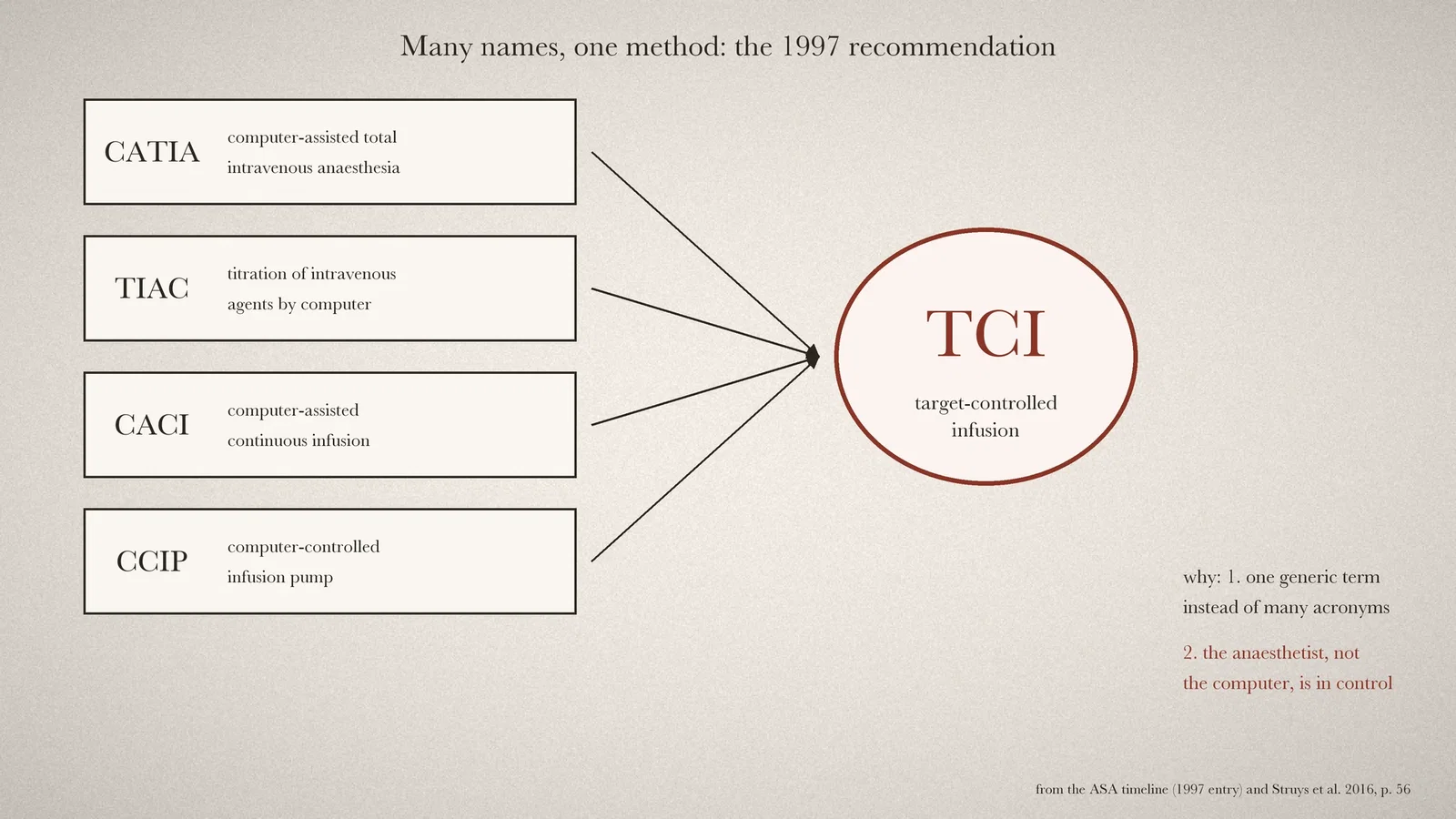
Other groups took up the idea and named their systems as they went. The review lists computer-assisted total IV anaesthesia (CATIA), titration of IV agents by computer (TIAC), computer-assisted continuous infusion (CACI) and the computer-controlled infusion pump. [8, p. 56] Jerry Reves, a visiting professor in Bonn who "saw the work of Schüttler and Schwilden", returned to the University of Alabama and built CACI with Alvis, a TCI system for fentanyl and sufentanil in cardiac surgery. [8, p. 60]
In Glasgow, M. White and G. N. C. Kenny reported in 1990 that a model of propofol's pharmacokinetics had been built into a computerised delivery system. It let the anaesthetist "achieve and maintain a target blood concentration of propofol and to manipulate this at will". They used it to anaesthetise 33 healthy patients having general surgery. [5] In 1990, ICI Pharmaceuticals also invited the international groups behind the research systems to a meeting about commercial development. That meeting and a TCI symposium at the 1992 World Congress of Anaesthesiology in The Hague convinced ICI that TCI could help the use of propofol for maintenance of anaesthesia. [8, p. 62]
1992: the phrase
In 1992 Chaudhri, White and Kenny of the University Department of Anaesthesia at Glasgow Royal Infirmary published "Induction of anaesthesia with propofol using a target-controlled infusion system" in Anaesthesia. [6] Sixty patients premedicated with temazepam were randomised to target blood propofol concentrations of 3, 4 or 5 µg/ml. Anaesthesia was induced within 3 minutes of reaching the target in 40%, 75% and 90% of patients. Apnoea and pain on injection were uncommon in all groups. [6] The ASA timeline dates the first use of the term to this article. [9, p. 83] The 2016 review adds that White and Kenny used "TCI" in their papers after 1992 at the suggestion of Iain Glen. [8, p. 56]
1997: one name
In 1997, P. S. Glass, J. B. Glen, G. N. Kenny, J. Schüttler and S. L. Shafer published "Nomenclature for computer-assisted infusion devices" in Anesthesiology. [7] The review says the active investigators reached a consensus that TCI should be the generic description of the technology. [8, p. 56] The ASA timeline gives two reasons. The first was to gather "a rag-bag of acronyms" (CATIA, TIAC, CACI and CCIP) under one term. The second was "to remove the implication that a computer, and not the anaesthetist," was controlling the anaesthesia. [9, p. 85]
What the record shows
Bonn turned compartment equations into an infusion pump that a computer could drive. The name that stayed came later, from Glasgow, and was agreed by the people who had built the systems. The name "target-controlled" puts the target first, and the target is chosen by the anaesthetist; the 1997 agreement was written partly to make that clear.
Sources and reading limits
Read: the 2016 review by Struys and colleagues, printed pp. 56, 58-60 and 62, by text and page image (repository PDF); the PubMed records of Schwilden 1981 (title only), Schwilden and colleagues 1981 (abstract), the two 1983 Anaesthesia supplement papers (abstracts), White and Kenny 1990 (abstract), Chaudhri, White and Kenny 1992 (abstract) and Glass and colleagues 1997 (title and authors); the ASA timeline entries for 1981, 1992 and 1997.
Not covered: the 1981 method paper, the 1983 papers, the 1992 article and the 1997 letter were not read in full. The publisher page for the letter redirected to the journal home page, so its two aims are given as the ASA timeline summarises them. The first administration on 1 May 1979 and Glen's suggestion of the term rest only on the 2016 review, which Glen co-wrote and which is not independent of the TCI work it describes. The CATIA photograph in the review was not reproduced. The commercial Diprifusor system of 1996 is covered in a separate article.
One illustration is a crop of the review's text; three are drawn from the sources. The BET curves are a schematic, not data.
- Schwilden H. A general method for calculating the dosage scheme in linear pharmacokinetics. Eur J Clin Pharmacol. 1981;20(5):379-86. PubMed
- Schwilden H, Stoeckel H, Schüttler J, Lauven P. [Comparison of various empirical dosage suggestions for etomidate infusions on the basis of pharmacokinetic data]. Anasth Intensivther Notfallmed. 1981;16(4):175-9. PubMed
- Schwilden H, Schüttler J, Stoekel H. Pharmacokinetics as applied to total intravenous anaesthesia. Theoretical considerations. Anaesthesia. 1983;38 Suppl:51-2. PubMed
- Schüttler J, Schwilden H, Stoekel H. Pharmacokinetics as applied to total intravenous anaesthesia. Practical implications. Anaesthesia. 1983;38 Suppl:53-6. PubMed
- White M, Kenny GN. Intravenous propofol anaesthesia using a computerised infusion system. Anaesthesia. 1990;45(3):204-9. PubMed
- Chaudhri S, White M, Kenny GN. Induction of anaesthesia with propofol using a target-controlled infusion system. Anaesthesia. 1992;47(7):551-3. PubMed
- Glass PS, Glen JB, Kenny GN, Schüttler J, Shafer SL. Nomenclature for computer-assisted infusion devices. Anesthesiology. 1997;86(6):1430-1. PubMed
- Struys MMRF, De Smet T, Glen JB, Vereecke HEM, Absalom AR, Schnider TW. The History of Target-Controlled Infusion. Anesth Analg. 2016;122(1):56-69. Repository PDF
- Australian Society of Anaesthetists. Anaesthesia History Timeline 2024. PDF
Continue exploring
Related reading connects shared questions and contexts; it does not by itself establish historical influence.
Anesthesia Epochs · The Source Room · About & Editorial Method
Published November 2, 2026. Sources and reading limits are stated above. Illustrations are labelled as original source images or AI-made. Historical accounts are educational; they are not current treatment instructions.