Targets, model predictions and measured concentrations.
Reading Library · Anesthesia Epochs · 中文版
Watch the companion film
1996: Diprifusor — Target-Controlled Infusion · Watch on YouTube
Historical anchor: 1996. Date details and source qualifications are explained below.
Commercial infusion pumps incorporating the Diprifusor module were launched in September 1996, according to Gray and Kenny’s 1998 technical paper.[1, Introduction] The pharmaceutical company involved at that stage was Zeneca; AstraZeneca was formed by merger in 1999.[1, module section;5] The date marks a commercial implementation of target-controlled infusion, or TCI, following earlier research systems.

TCI changed how a clinician instructed an infusion pump. The clinician selected a target concentration, while a computer used a pharmacokinetic model and patient information to calculate drug delivery. The model estimated distribution and elimination as administration continued.[3, p.56] The displayed concentration was therefore a calculation. It was distinct from both the selected target and a concentration measured in a blood sample.
Commercial implementation required an engineering system around the model. A 2016 historical review traced the transition from external computers connected to pumps to an electronics module that different pump manufacturers could incorporate. The main microprocessor used a mathematical solution, while a second processor independently checked the calculations using a numerical approximation.[3, pp.62–63] This addressed computation and delivery control; it did not make the system a physiological feedback loop that independently adjusted anesthesia from the patient’s measured anesthetic depth.

The drug presentation formed part of that system. This site’s 1986: Propofol Emulsion Moves from Reformulation to UK Approval concerns formulation and market introduction. Here, the same branded product enters a history of delivery control. Glen recalled electronically tagged prefilled syringes that allowed the pump to identify Diprivan and its concentration.[4, pp.7–8;3, pp.64–65] The relationship between these articles is concrete, but the earlier drug launch did not establish the performance of the later infusion system.

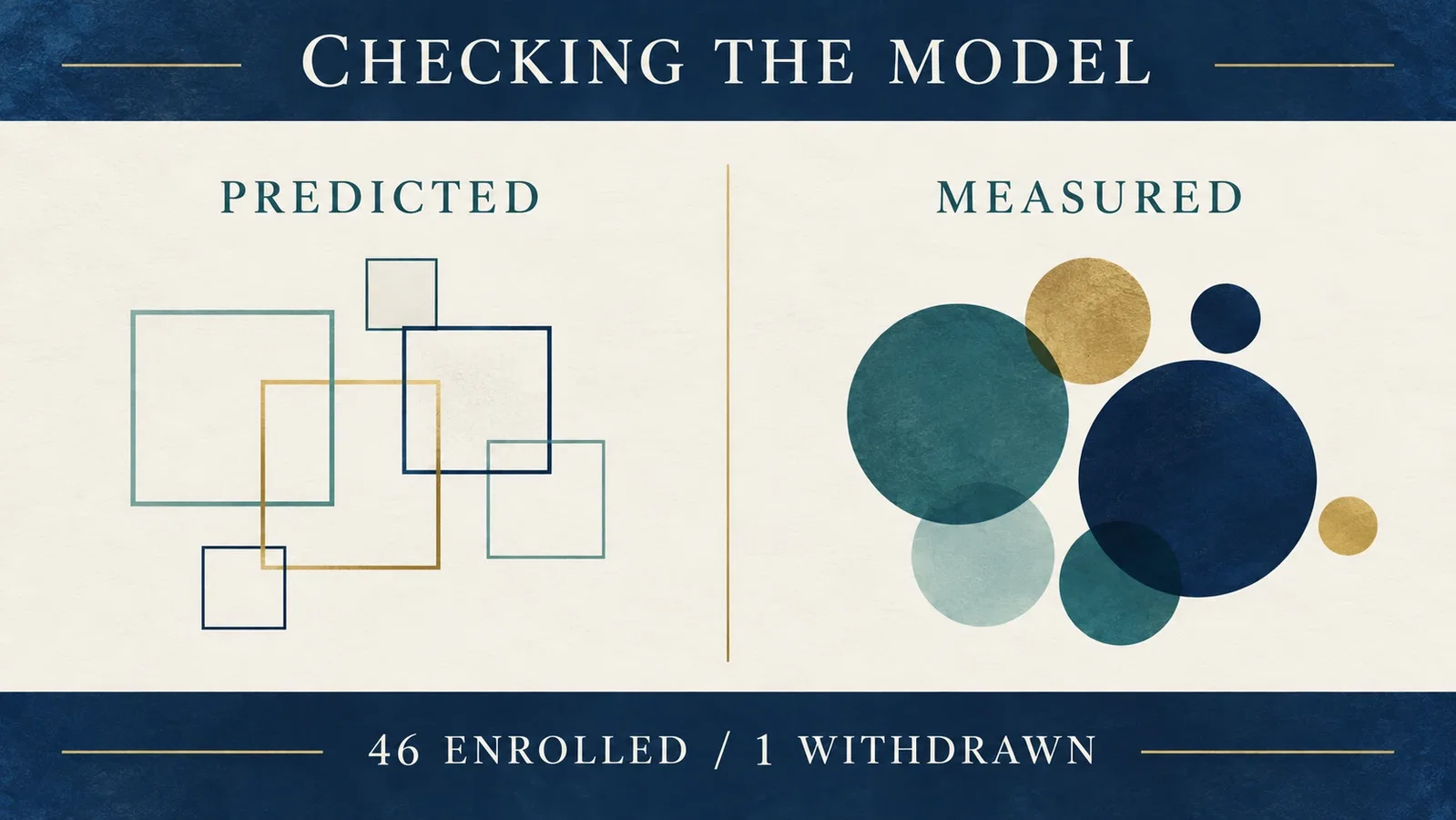
Predictions also required comparison with measurements. Swinhoe and colleagues’ 1998 paper described an open, non-comparative study enrolling 46 patients undergoing major surgery. Arterial propofol measurements were compared with system predictions; one patient was withdrawn after severe hemorrhage and massive transfusion. The investigators used a prototype external controller connected to a Graseby 3400 pump.[2, Methods and Results] This was not a randomized comparison between a commercial TCI pump and manual administration, nor did every enrolled patient complete the study.
Measured concentrations tended to exceed predictions, particularly after induction or an increased target.[2, Results and Discussion] The observation explains why a displayed estimate requires clinical interpretation. The study used descriptive analyses and does not establish general superiority over manual infusion. Agreement between predicted and measured concentrations is also a different question from improvement in patient outcomes.
Market introduction had geographical limits. The 2016 review listed the United Kingdom, Austria, Norway, Spain and Sweden as approving TCI guidance in Diprivan prescribing information in 1996; the original national authorization documents are not covered here.[3, p.64] The original plasma-targeting system, later effect-site functions and open TCI devices also belong to distinct stages.[3, pp.64–66] The launch date cannot stand for simultaneous worldwide authorization or every subsequent operating mode.
Diprifusor joined a clinician-selected target, a mathematical model, drug identification and pump operation in a commercial delivery system. Its history can be followed through technical development accounts, patient measurements and later recollections.[1–4] Several accounts share developer involvement and should not be counted as independent confirmations merely because they are separate publications. The 2016 review disclosed Glen’s former employment at ICI, Zeneca and AstraZeneca and his role in Diprifusor validation and commercial development. His 2019 recollection separately declared no conflict of interest.[3, p.67;4, p.8] Their value lies in documenting the particular steps while keeping prediction, delivery and clinical interpretation distinct.
Sources and reading limits
- Gray JM, Kenny GN. Development of the technology for ‘Diprifusor’ TCI systems. Anaesthesia. 1998;53 Suppl 1:22–27. Original article; PubMed 9640111. Publisher narrative and captions read; figure images not inspected, PDF not covered.
- Swinhoe CF, Peacock JE, Glen JB, Reilly CS. Evaluation of the predictive performance of a ‘Diprifusor’ TCI system. Anaesthesia. 1998;53 Suppl 1:61–67. Original article; PubMed 9640119. Publisher narrative and captions read; no visual inspection of figure images/table cells, PDF not covered.
- Struys MMRF, De Smet T, Glen JB, Vereecke HEM, Absalom AR, Schnider TW. The History of Target-Controlled Infusion. Anesth Analg. 2016;122:56–69. DOI 10.1213/ANE.0000000000001008. Published review in institutional repository. Selected printed pp. 56 and 62–68 read.
- Glen JB. Try, try, and try again: personal reflections on the development of propofol. Br J Anaesth. 2019;123:3–9. DOI; PMID 30982566. Printed pp. 7–8 read for this article. First-person development history, not an independent clinical trial.
- AstraZeneca. Company history. Selected 1999 merger record read; corporate historical account.
The two 1998 article narratives were read on the publisher’s site; their PDFs and figure images/table cells are not covered. Ten selected pages from the 2016 and 2019 accounts were viewed, not both complete articles. The separate Glen 1998 article was available only as NLM metadata and abstract. The later accounts give different US submission-withdrawal years, 2004 and 2002; this unresolved detail is omitted from the narrative. Several authors participated in development or disclosed industry relationships. Images are modern editorial concepts, without doses, benefit guarantees or historical device reconstructions.
Continue exploring
Related reading connects shared questions and contexts; it does not by itself establish historical influence.
- 1986: Propofol Emulsion Moves from Reformulation to UK Approval
- 1996: Remifentanil Brings Rapid Offset to Analgesia
The Source Room · About & Editorial Method
Sources and reading limits are stated above. Illustrations are labelled as original source images or AI-made. Historical accounts are educational; they are not current treatment instructions.