Formulation, clinical comparisons and regional approval have distinct evidence.
Reading Library · Anesthesia Epochs · 中文版
Watch the companion film
1986: Propofol — The Emulsion and UK Approval · Watch on YouTube
Historical anchor: 1986. Date details and source qualifications are explained below.
The Lasker Foundation’s historical account places UK approval of propofol in 1986. Developer John B. Glen’s recollections describe marketing approvals beginning that year.[1, p.7; 3] Reaching that stage as Diprivan required more than identifying a compound with anesthetic activity. It required a usable formulation. The familiar white emulsion was not the preparation used from the outset of the early human work.
Glen described an early Cremophor EL formulation followed by a search for other vehicles amid injection pain and adverse reactions. Candidate formulations had to undergo renewed pharmacological and toxicological assessment. A way to put the compound into a container did not necessarily preserve its desired effects or provide acceptable tolerance. The work eventually produced an emulsion based on soybean oil and egg phosphatide, followed by a new period of patient studies.[1, pp.5–6] Chemists, formulation scientists, animal researchers and clinical teams contributed to that work.
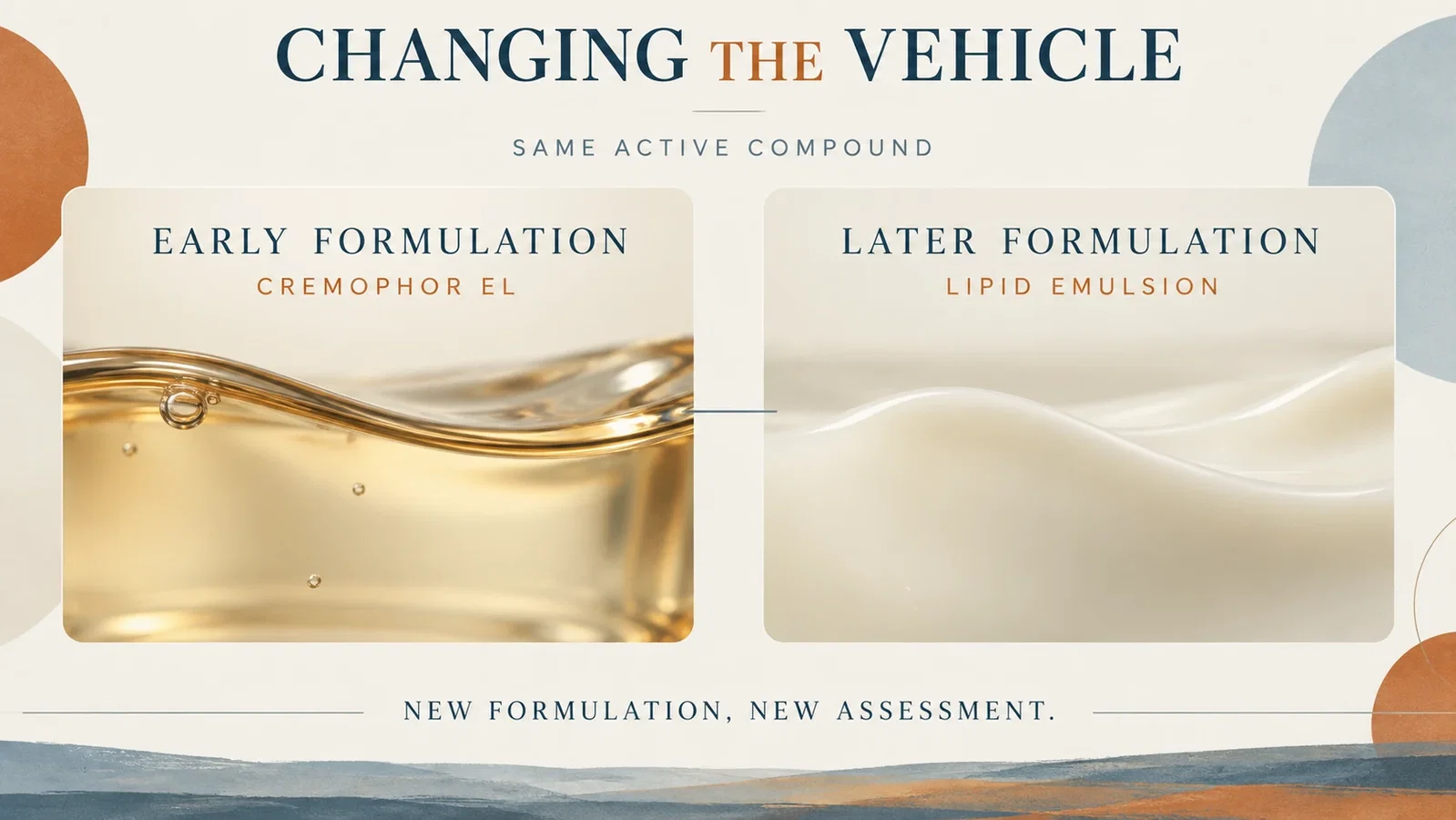
This site’s 1977 article connects here through these distinct stages of the same drug’s development. Glen’s account separates early human research from subsequent emulsion work; it does not suggest that one study in 1977 settled every later question.[1, pp.5–7] This article follows the formulation and clinical assessments leading toward market introduction, rather than reopening a claim about the first human administration anywhere.
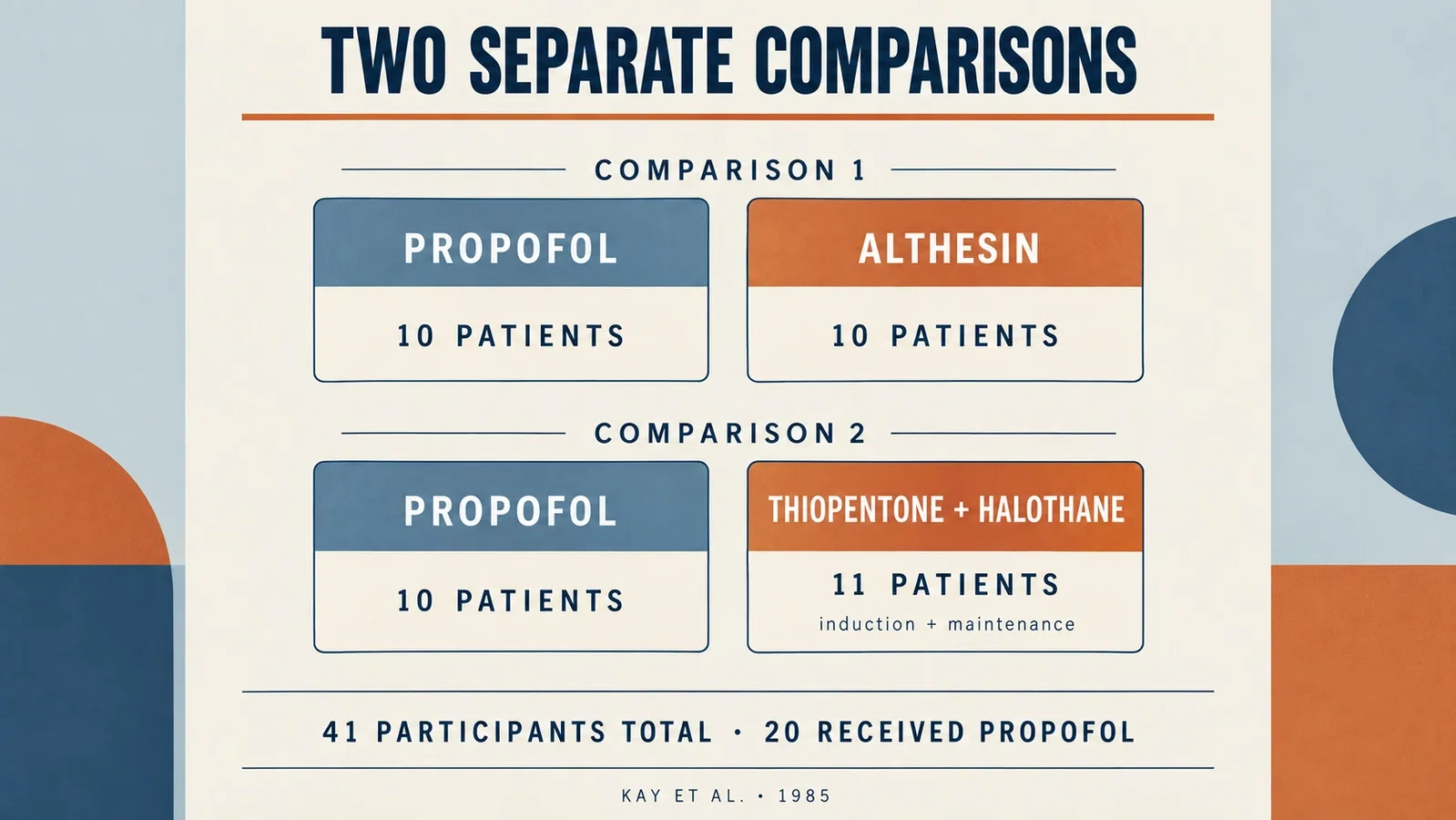
One contemporary prelaunch study was published in 1985 by N. H. Kay, Uppington, Sear and Allen. It contained two comparisons. Ten propofol recipients were first compared with ten receiving Althesin. After Althesin’s withdrawal, another ten propofol recipients were compared with eleven patients receiving thiopentone induction and halothane maintenance. There were 41 participants overall, of whom 20 received propofol.[2, pp.736–738] Other anesthetic and premedication drugs were used. This was neither a series of 41 propofol recipients nor a trial of anesthesia provided by propofol alone.
Faster recovery was a finding with defined limits. In the first comparison, investigators timed eye opening and the ability to state the correct date of birth. The latter interval was shorter with propofol; the eye-opening difference was not statistically significant. Table IV also excluded a propofol recipient who had a marked cardiovascular response, leaving nine participants compared with ten. The second comparison did not record the same precise recovery times.[2, pp.738–740, Table IV] Those details determine how broadly the recovery claim can be used.
The emulsion did not remove every problem. Nine of the 20 propofol recipients reported injection pain, and eight had apnea lasting more than 30 seconds after induction. The body of the article also described one marked hypotensive episode. The authors retained these concerns in their discussion and emphasized monitoring.[2, pp.738, 741] These counts belong to a small study under its particular treatment conditions. They are not general rates for present practice or proof that an emulsion is universally without risk.
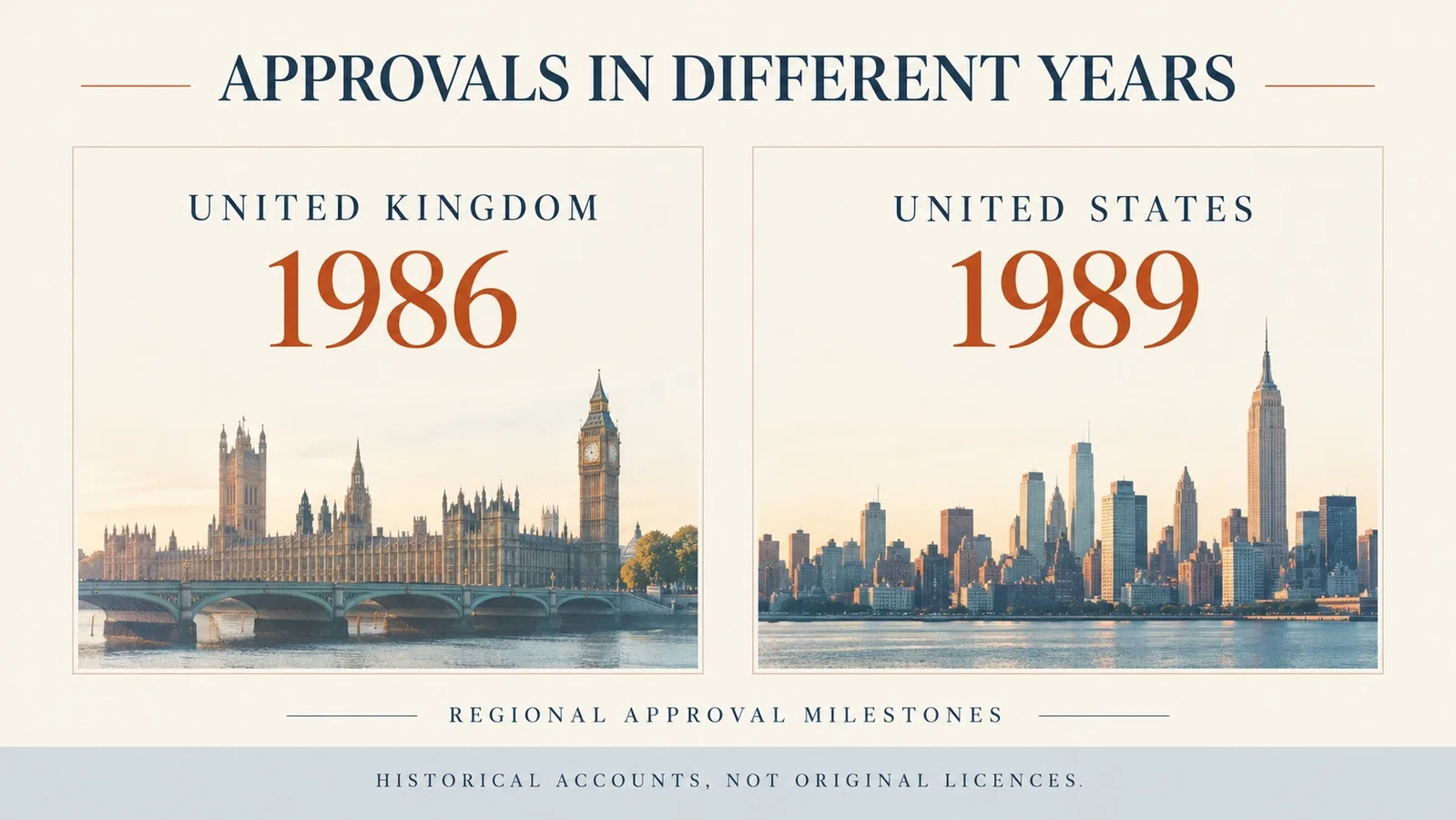
UK approval in 1986 should remain distinct from the US approval in 1989. Later indications and infusion devices had further development and assessment histories.[1, pp.7–8; 3] The original UK authorization document is not covered here, so the year is attributed to the historical accounts without inventing an exact approval date or a complete initial label. The route to market is visible across different records: the developer explains changes to the formulation, a contemporary study shows what investigators observed in patients, and regional approval marks another step in bringing the drug into use.
Image note: all four illustrations are modern editorial concepts. The container is not a reconstruction of 1986 Diprivan packaging, and the formulation image gives no preparation instructions. Group cards preserve the two comparisons and their separate counts. Approval dates distinguish the UK and US rather than implying a simultaneous global launch.
Sources and reading limits
- Glen JB. Try, try, and try again: personal reflections on the development of propofol. Br J Anaesth. 2019;123(1):3–9. DOI; PubMed. All seven original pages and three figures read afresh from the archived publisher copy. A developer’s retrospective, not the underlying patient records or regulatory files. Formulation changes are described on pp.5–6, the approval period on p.7, and later infusion-device work on pp.7–8.
- Kay NH, Uppington J, Sear JW, Allen MC. Use of an emulsion of ICI 35868 (propofol) for the induction and maintenance of anaesthesia. Br J Anaesth. 1985;57(8):736–742. DOI; publisher record. Complete seven-page original and all five tables read. Two separate comparisons, 41 participants overall and 20 receiving propofol; not described here as randomized. Table IV excludes one propofol recipient with a marked cardiovascular response. This is N. H. Kay, not B. Kay of the 1977 report.
- Strauss E. Discovery and development of propofol, a widely used anesthetic. Lasker Foundation, 2018 Clinical Medical Research Award account. Main essay and key-publication list read, 16 September 2026. Used for the retrospective identification of UK approval in 1986 and US approval in 1989; the original UK authorization document is not covered. Videos were not watched, and celebratory claims about universal use or safety are not adopted.
Continue exploring
Related reading connects shared questions and contexts; it does not by itself establish historical influence.
- 1977: Propofol Enters Early Human Anesthesia Research
- 1993: Taniguchi Reports Brief Cortical Pulse Trains
- 1996: Diprifusor Puts a Pharmacokinetic Model Inside the Pump
The Source Room · About & Editorial Method
Sources and reading limits are stated above. Illustrations are labelled as original source images or AI-made. Historical accounts are educational; they are not current treatment instructions.