Separating volunteer metabolism studies, patient anesthesia and the later emulsion.
Reading Library · Anesthesia Epochs · 中文版
Watch the companion film
1977: Propofol — Early Human Research · Watch on YouTube
Historical anchor: 1977. Date details and source qualifications are explained below.

A familiar white emulsion can obscure the earlier history of propofol. In John B. Glen’s 2019 account, work on ICI 35 868 passed through human metabolism studies, patient anesthesia research and changes of formulation before the later approval stage.[1, pp.4–7] These were distinct steps, with different questions to answer.
The development goal, Glen recalled, was to combine smooth, rapid induction comparable to thiopental with faster metabolism, making repeated administration or infusion more attractive.[1, p.4] His account places the compound within an alkylphenol screening program. It is the recollection of a participant in development, written decades later.
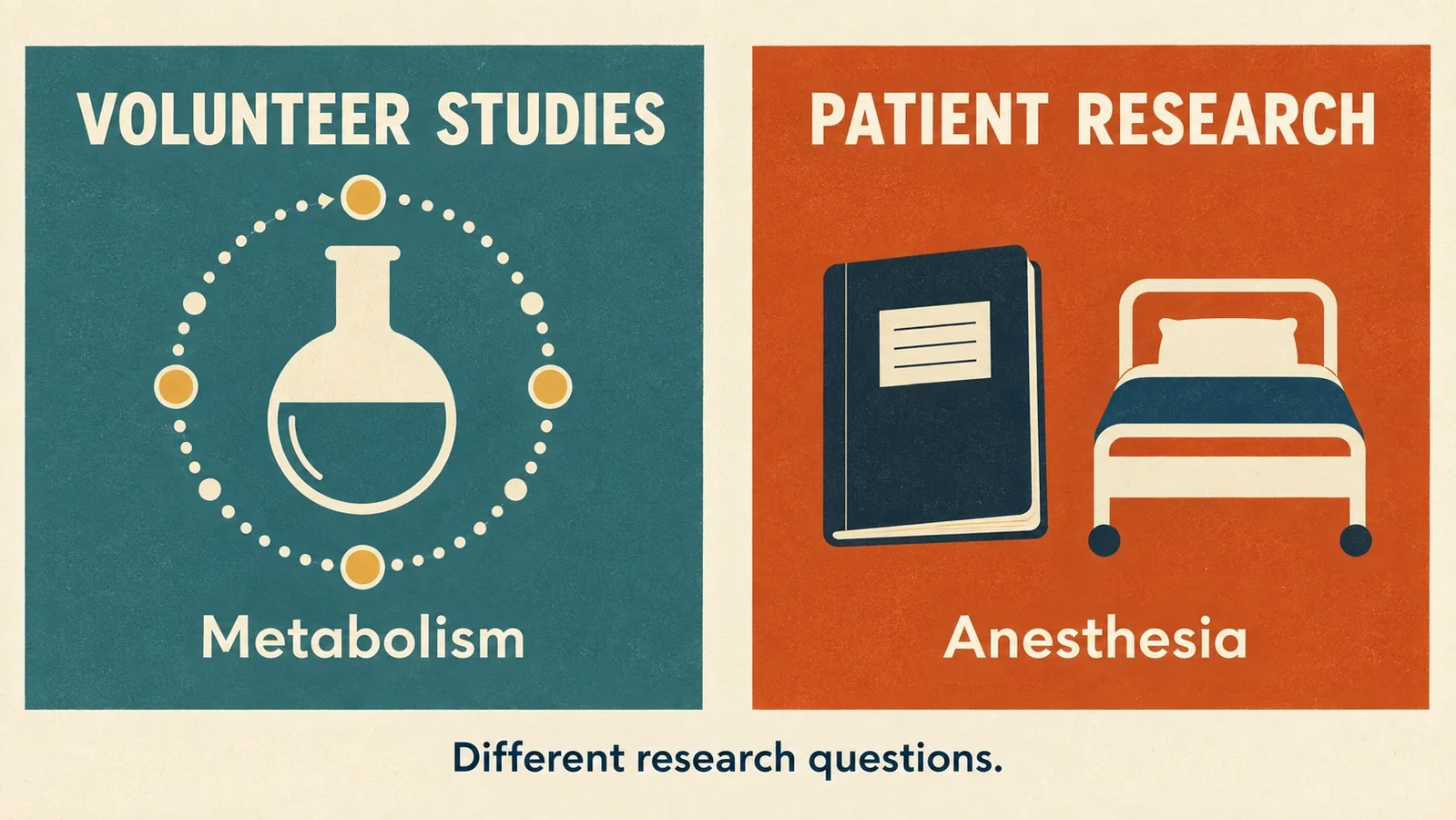
Earlier volunteer work in Derby used radiolabeled drug at subanesthetic doses to study metabolism. Glen then describes Brian Kay’s visit to Ghent in 1977 and his collaboration with Georges Rolly on anesthesia in patients.[1, p.5] The volunteer study should not be merged with that patient work into a single episode of “first anesthesia in human volunteers.”
Kay and Rolly’s report, “I.C.I. 35868, a new intravenous induction agent,” appeared in Acta Anaesthesiologica Belgica in 1977.[2] Its publication provides this article’s date. The fourteen-page report is not covered in full; the development narrative here rests chiefly on Glen’s fully read retrospective, rather than on an abstract treated as a trial record.
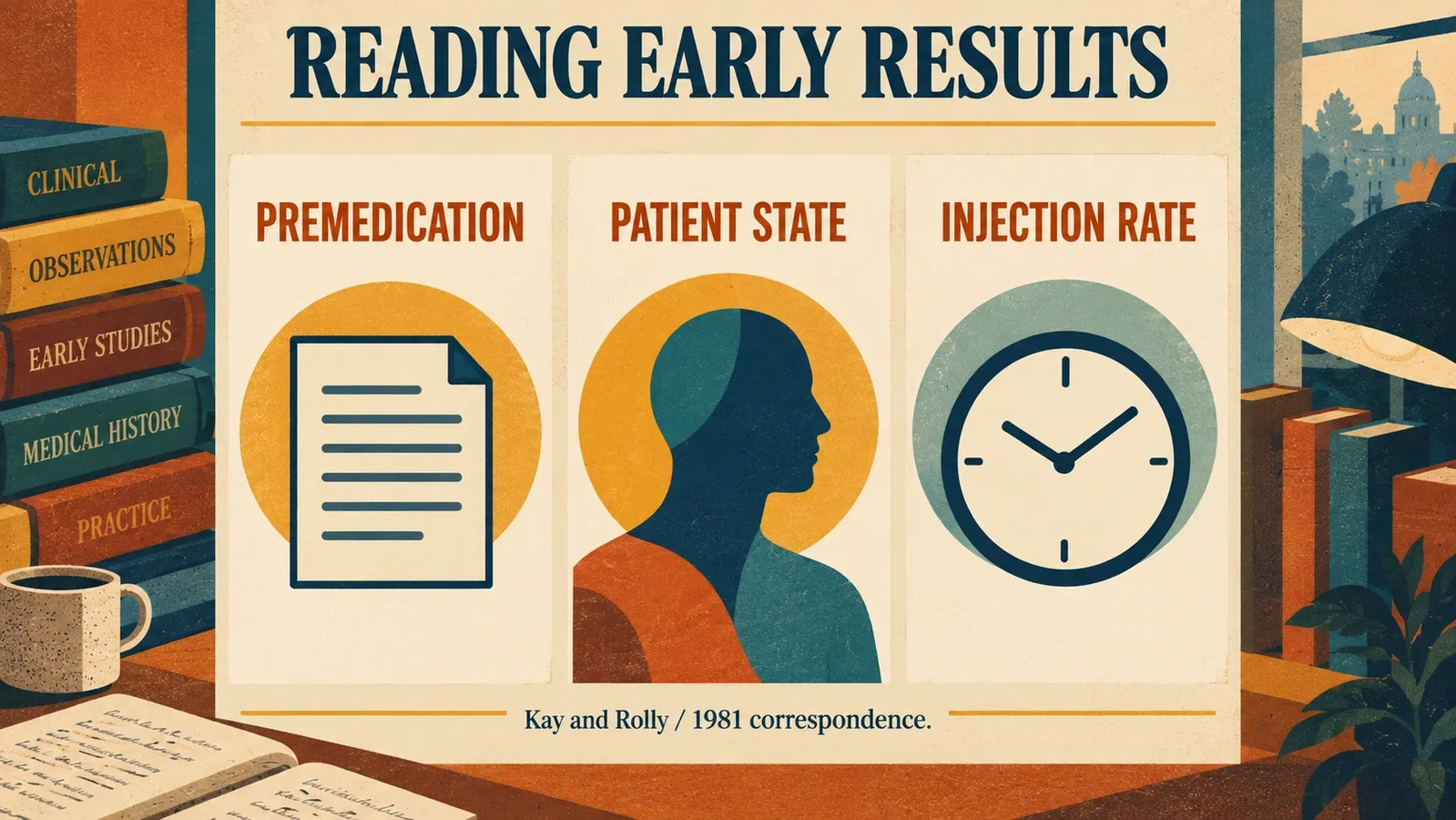
A contemporary exchange shows why the conditions of a study mattered. In a 1981 letter, Kay and Rolly addressed a difference between another group’s findings and their earlier experience. They emphasized premedication, apprehension and, especially, injection rate when discussing the onset and duration of sleep, and invoked rapid redistribution in their explanation.[3, p.192] Their argument is evidence of the debate at the time. It does not supply a present-day dose recommendation.
Formulation also changed. Glen described the early Cremophor EL preparation, concern about adverse reactions and further work on alternative vehicles. Moving to a lipid emulsion required renewed pharmacological and toxicological studies. He dated patient use of the emulsion in Oxford to 1983 and the beginning of subsequent approvals to 1986.[1, pp.5–7]
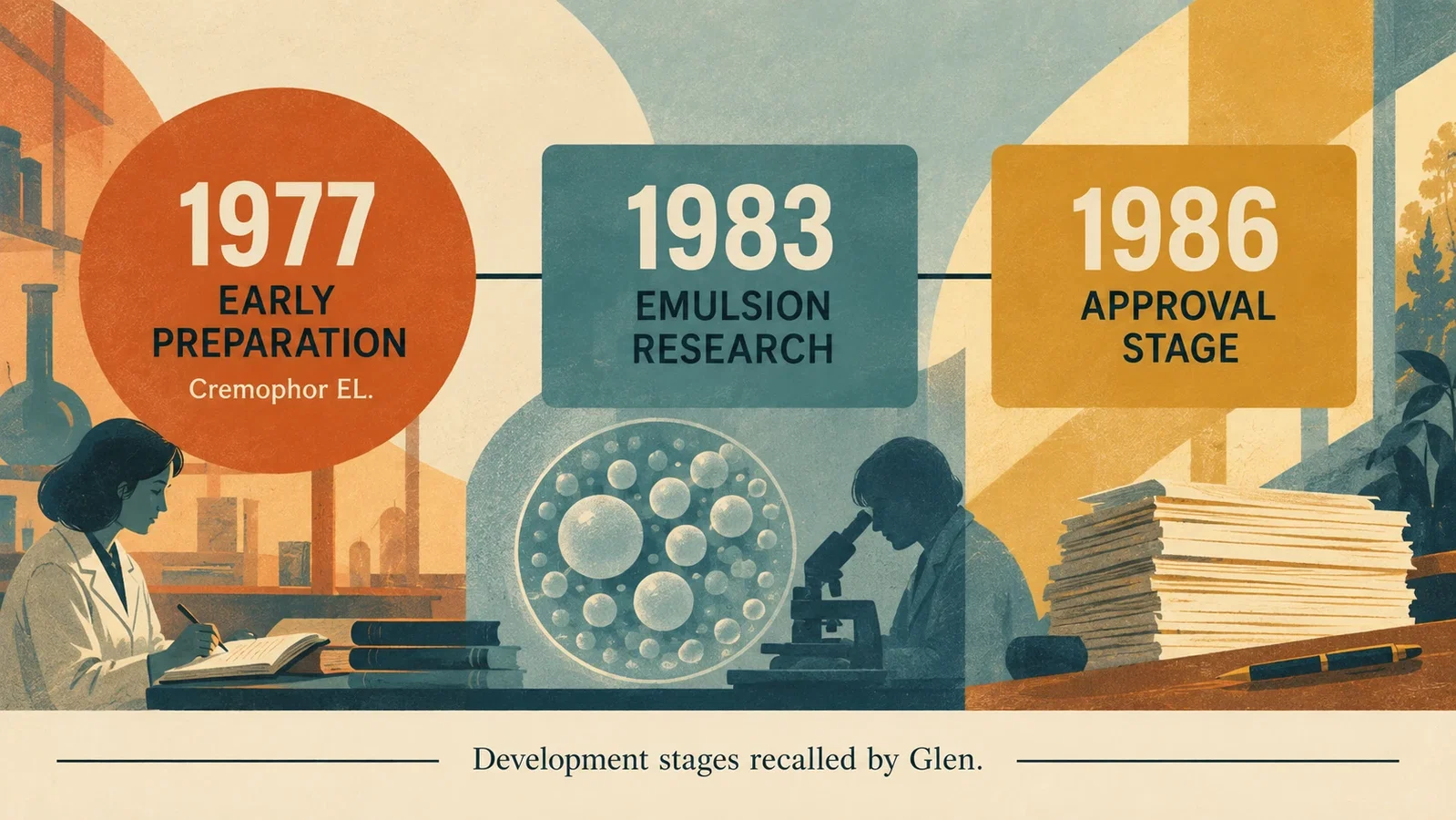
That account supports a connection to the later propofol commercialization article: the same drug, at different stages of formulation and development.[1, pp.6–7] It does not make the 1977 report equivalent to a finished commercial product. Keeping those stages visible gives the early patient research its place without erasing the work that followed.
Image note: all four images are modern editorial illustrations. People, workspaces, vessels and timeline graphics are conceptual, with no reconstruction of an actual research scene, original formulation container or authenticated portrait. No dose, injection technique or clinical instruction is shown.
Sources and reading limits
- Glen JB. Try, try, and try again: personal reflections on the development of propofol. Br J Anaesth. 2019;123(1):3–9. DOI. All seven original pages read; a development participant’s retrospective, not a contemporaneous trial record.
- Kay B, Rolly G. I.C.I. 35868, a new intravenous induction agent. Acta Anaesthesiol Belg. 1977;28(4):303–316. PubMed. Publication identity checked; the fourteen-page full text is not covered.
- Kay B, Rolly G. Dosage of ICI 35 868. Br J Anaesth. 1981;53(2):192. Original publisher page; DOI. The complete signed letter and its references were read in the publisher’s public original-page preview.
All seven original pages of Glen’s 2019 article and the complete original-page preview of the 1981 Kay–Rolly letter were read. The 1977 report was checked only for publication identity; no sample-size, first-patient chart or safety conclusion is independently verified from its full text. Retrospective and contemporary statements remain attributed. This account does not adjudicate global priority.
Sources and reading limits are stated above. Illustrations are labelled as original source images or AI-made. Historical accounts are educational; they are not current treatment instructions.
Continue exploring
Related reading connects shared questions and contexts; it does not by itself establish historical influence.