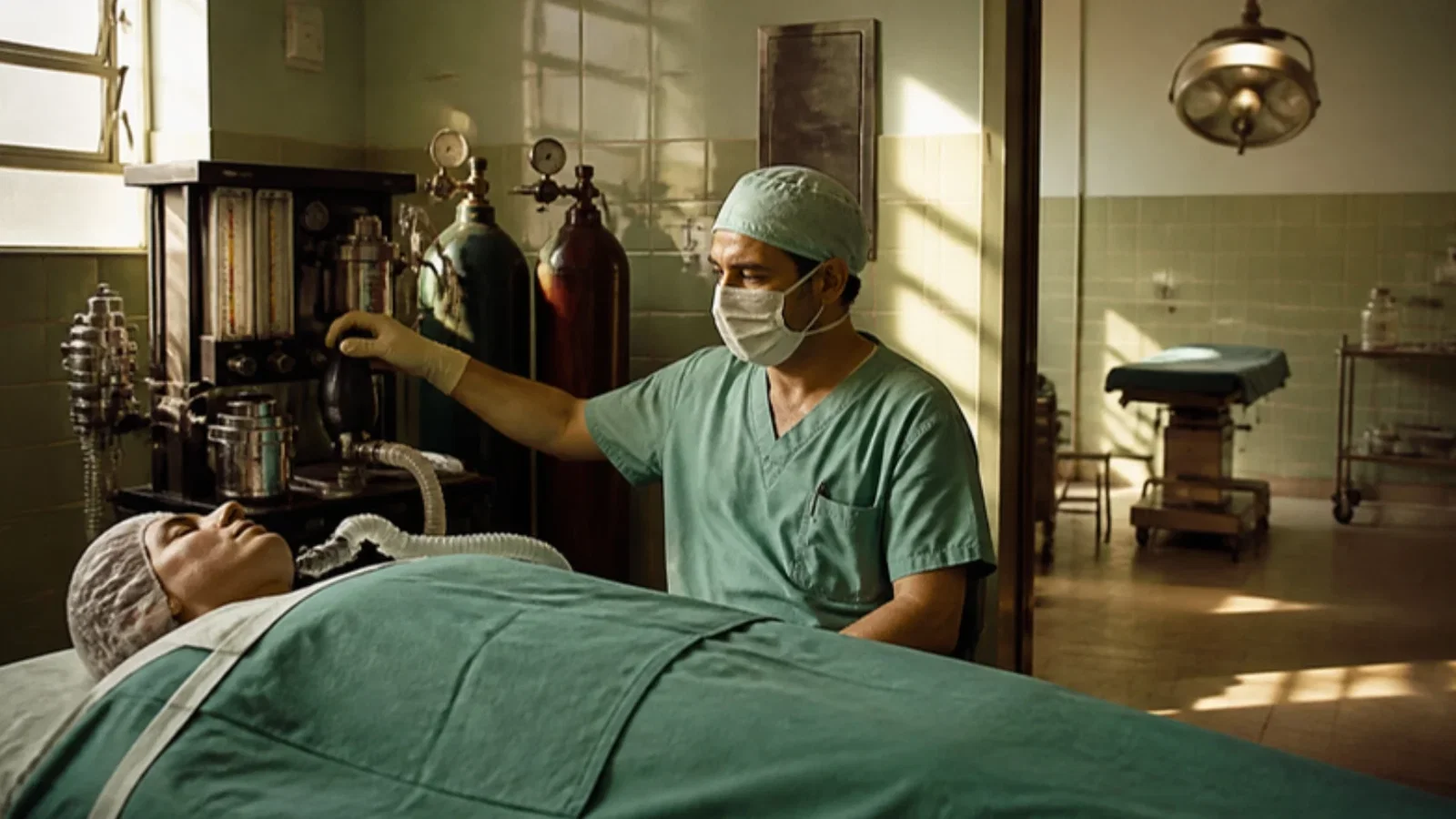
Brazil's Federal Council of Medicine declared in 1978 that giving simultaneous anaesthetics to different patients was an offence against medical ethics; the Brazilian Society of Anaesthesiology marks its opposition to the practice in 1989, and a joint commission's resolution of 1993 repeated the rule, which still stands.
Reading Library · Anesthesia Epochs · 中文版
Watch the education video (for clinicians)
1978: Simultaneous Anaesthesia in Brazil — One Patient at a Time · Anesthesia Epochs Education Series
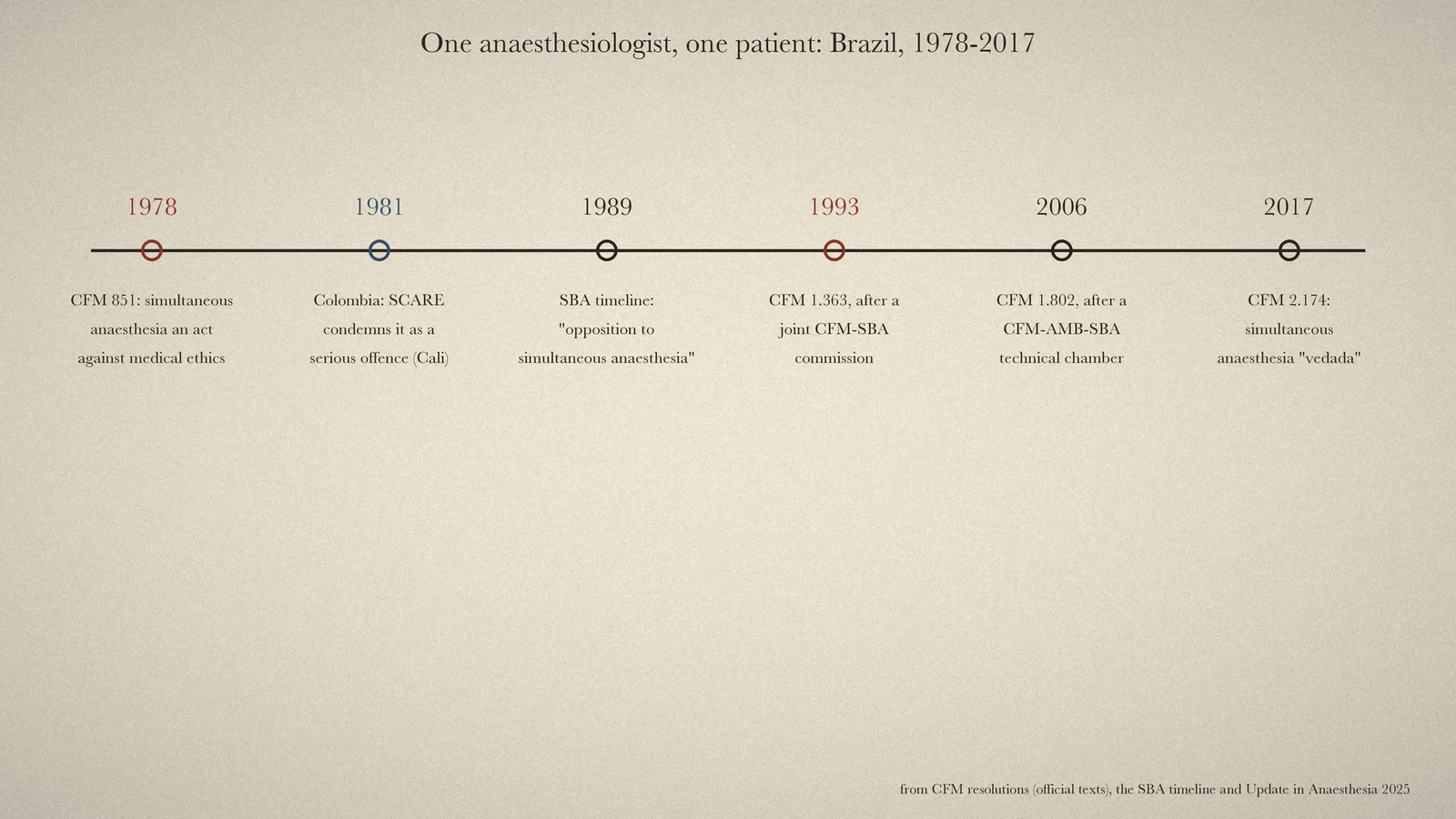
The history timeline of the Sociedade Brasileira de Anestesiologia (SBA) has an entry for 1989: "Oposição à prática de anestesia simultânea", opposition to the practice of simultaneous anaesthesia. [5] That is all the timeline says, and its linked page is empty. The practice it refers to is one doctor anaesthetising two or more patients at the same time. This article looks for the rule behind the entry. Brazil's Conselho Federal de Medicina (CFM), the federal council of medicine, had already written that rule down eleven years earlier, and it has been restated ever since. [1-4]
1978: an act against medical ethics
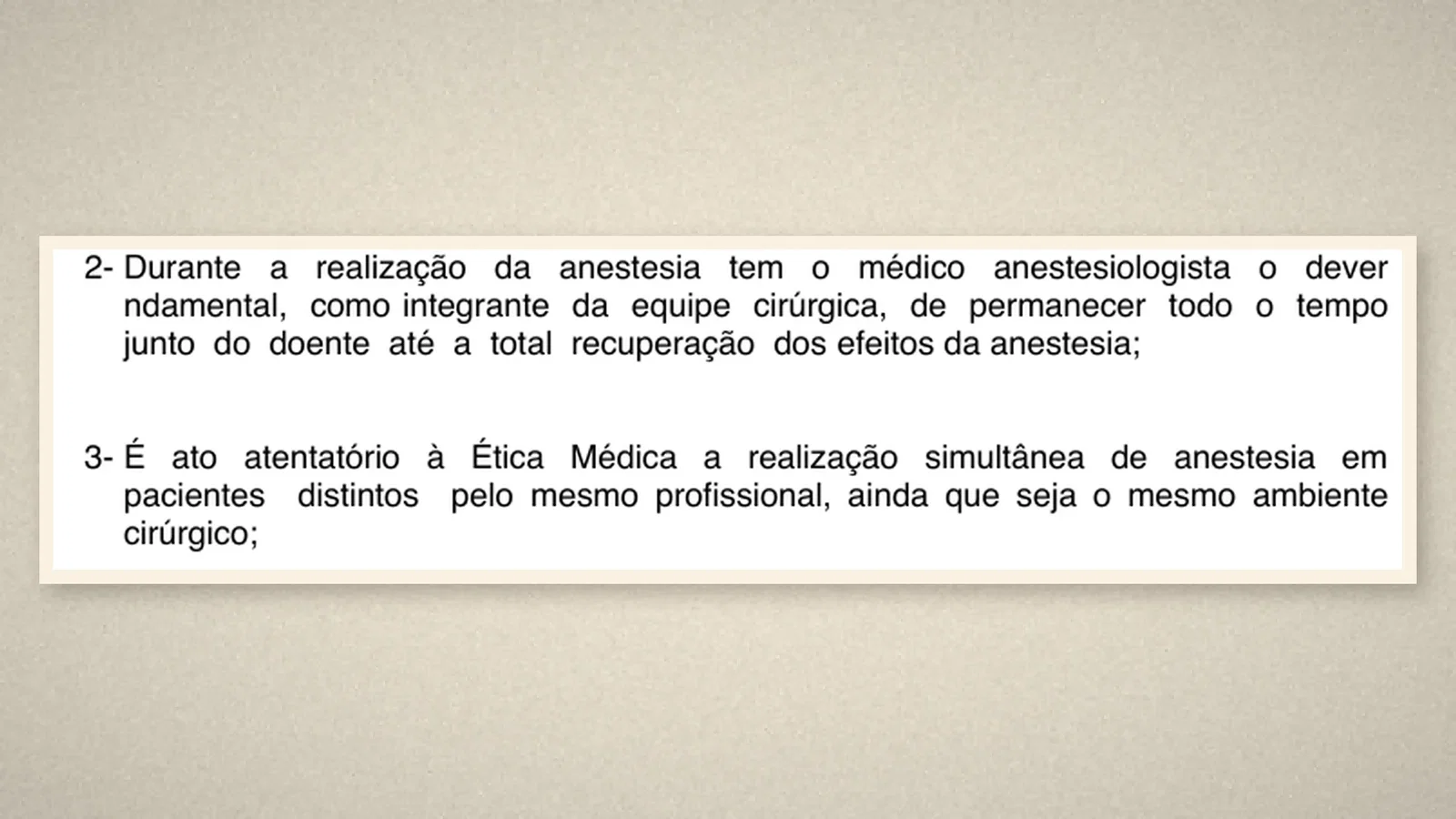
On 4 September 1978, in Rio de Janeiro, the CFM adopted Resolution 851, published in the Diário Oficial da União on 7 November 1978. [1] It set out what "doctors who practise anaesthesia" must do. Before any anaesthetic, the doctor had to know the patient's general condition and decide, "de modo soberano e intransferível", whether to proceed. During the anaesthetic the anaesthesiologist had a duty to stay with the patient "until full recovery from the effects of the anaesthesia". [1, p. 1] Item 3 read: "É ato atentatório à Ética Médica a realização simultânea de anestesia em pacientes distintos pelo mesmo profissional, ainda que seja o mesmo ambiente cirúrgico." Giving simultaneous anaesthetics to different patients was an act against medical ethics, even in the same surgical environment. [1, p. 1] The resolution also made the anaesthesiologist directly and personally responsible for every consequence of the anaesthetic, including signing the death certificate if the anaesthetic proved fatal. [1, p. 1]
A neighbouring society, 1981
The problem was not only Brazilian. In June 1981, according to the history of anaesthesia in Colombia published by the World Federation of Societies of Anaesthesiologists in 2025, members of the Colombian society of anaesthesiology (SCARE) meeting in Cali "approved a resolution considering the administration of simultaneous anaesthetics a serious offense and condemning such practice". [6, p. 25] This series' article on Colombia's road to its 1991 anaesthesia law covers that society.
1989 and 1993
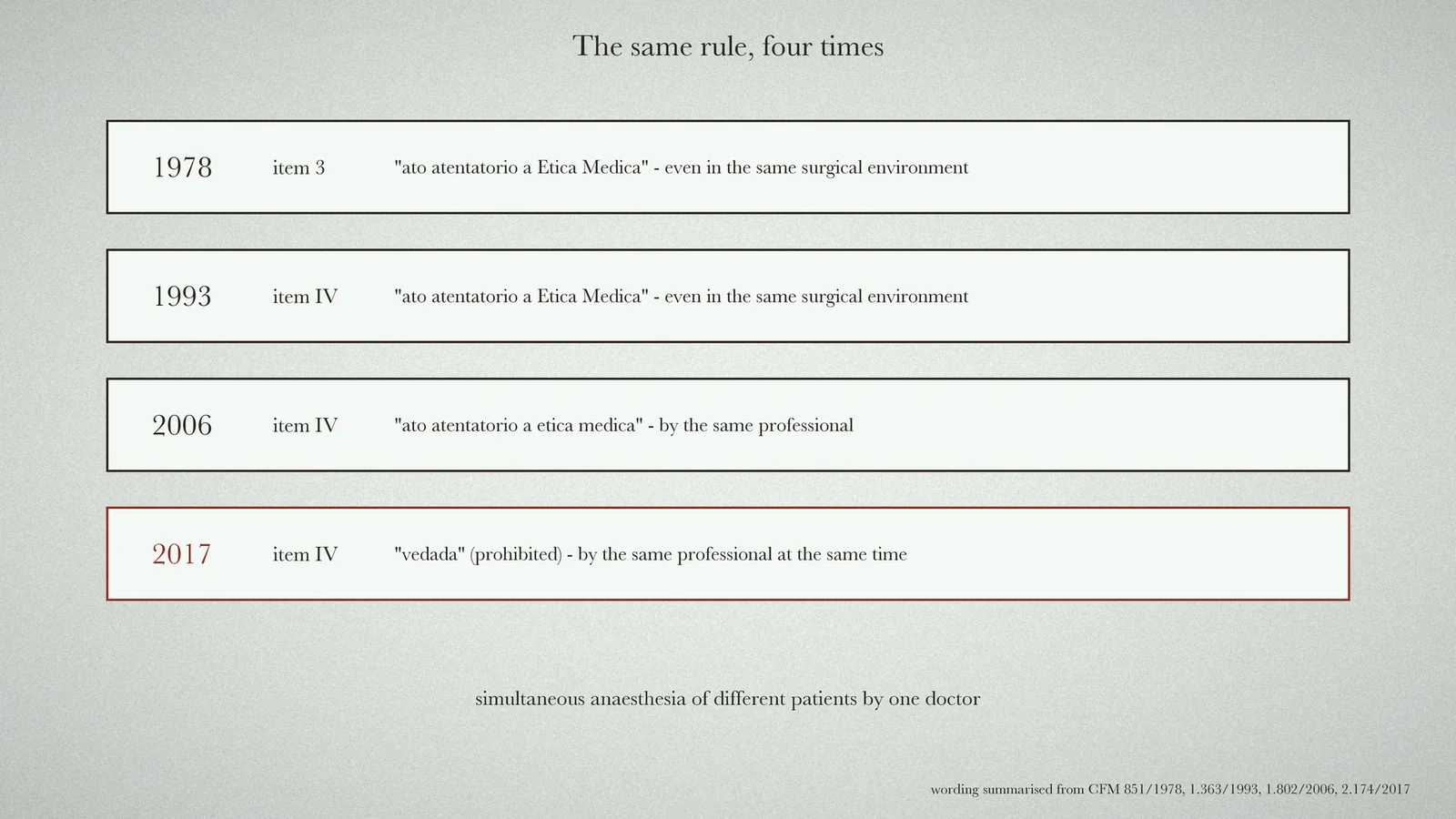
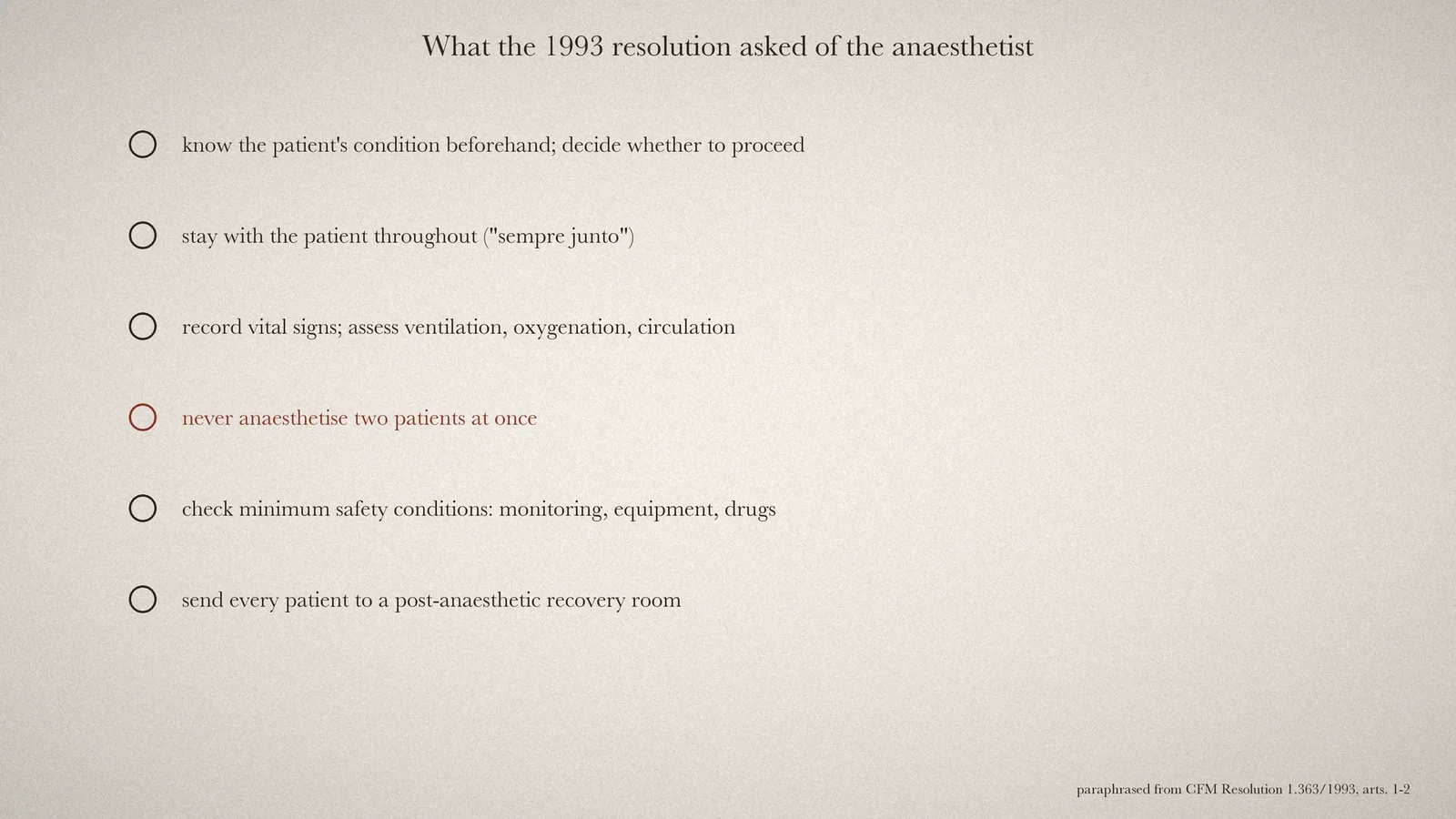
The SBA timeline places its "opposition" to simultaneous anaesthesia in 1989, followed in 1990 by the creation of a directorate for professional defence. [5] The sources read do not say what form the opposition took. Four years later the rule was rewritten. CFM Resolution 1.363, adopted in plenary on 12 March 1993 and published on 22 March, revoked Resolution 851/1978. Its preamble cites "what was proposed by the joint Special Commission of the Federal Council of Medicine and the Brazilian Society of Anaesthesiology". [2, p. 1] Item II required that, to conduct general or regional anaesthesia safely and keep the patient under constant watch, "o médico anestesista deve estar sempre junto a este paciente", always with the patient. Item IV repeated the 1978 rule almost word for word. [2, pp. 1-2] The 1993 text went further than its predecessor. It required vital signs to be recorded, listed minimum monitoring, required the equipment, gases and drugs needed for any anaesthetic and for resuscitation, and said that every patient should go to a post-anaesthetic recovery room. [2, p. 2]
Restated
Resolution 1.802 of 2006 revoked the 1993 text. It was drafted after the proposal of a joint technical chamber of the CFM, the Associação Médica Brasileira and the SBA, and it kept the clause as item IV: simultaneous anaesthesia of different patients by the same professional is "ato atentatório à ética médica". [3] Resolution 2.174 of 2017, published in February 2018, revoked the 2006 text and changed the verb. "É vedada", it is prohibited, "a realização de anestesias simultâneas em pacientes distintos, pelo mesmo profissional ao mesmo tempo". [4, p. 3]
What the record shows
From 1978 onward, Brazil's medical council defined anaesthesia as the work of one doctor with one patient. The national society's own history marks 1989 as the year it opposed the alternative. The joint commission that followed wrote the rule into a resolution that also set minimum standards of safety. The clause has been kept, word for word or nearly, through every revision since.
Sources and reading limits
Read: the full texts of CFM resolutions 851/1978, 1.363/1993, 1.802/2006 and 2.174/2017; the SBA history timeline; the Colombia chapter of Update in Anaesthesia 2025;40, p. 25.
Not covered: any SBA document from 1989. The timeline gives only the title of the entry, and its story page is empty, so what the SBA did that year, and why, is not known from the sources read. The members and work of the 1993 joint commission are not described. How often the rule was broken, and how it was enforced, are also unknown. The 1978 resolution's text gives no reason for the rule beyond the duty to stay with the patient.
One illustration is a crop of the 1978 resolution; three are drawn from the sources. No patient or operating theatre is depicted.
- Conselho Federal de Medicina. Resolução CFM nº 851/1978. Diário Oficial da União, 7 nov 1978. PDF
- Conselho Federal de Medicina. Resolução CFM nº 1.363/1993. Diário Oficial da União, 22 mar 1993:3439. PDF
- Conselho Federal de Medicina. Resolução CFM nº 1.802/2006. Diário Oficial da União, 1 nov 2006:102. PDF
- Conselho Federal de Medicina. Resolução CFM nº 2.174/2017. Diário Oficial da União, 27 fev 2018:82. PDF
- Sociedade Brasileira de Anestesiologia. Nossa história - linha do tempo. Website
- Update in Anaesthesia. 2025;40 (History of anaesthesia issue), Colombia chapter, p. 25. PDF
Continue exploring
Related reading connects shared questions and contexts; it does not by itself establish historical influence.
Anesthesia Epochs · The Source Room · About & Editorial Method
Published November 2, 2026. Sources and reading limits are stated above. Illustrations are labelled as original source images or AI-made. Historical accounts are educational; they are not current treatment instructions.