The 1962 Declaration of Cúcuta claimed anaesthesia for medical specialists; after nearly thirty years, Law 6 of 16 January 1991 regulated the specialty, and in 1995 the Constitutional Court upheld it in substance.
Reading Library · Anesthesia Epochs · 中文版
Watch the education video (for clinicians)
1962: From Cúcuta to Law 6 — Colombian Anaesthesia · Anesthesia Epochs Education Series
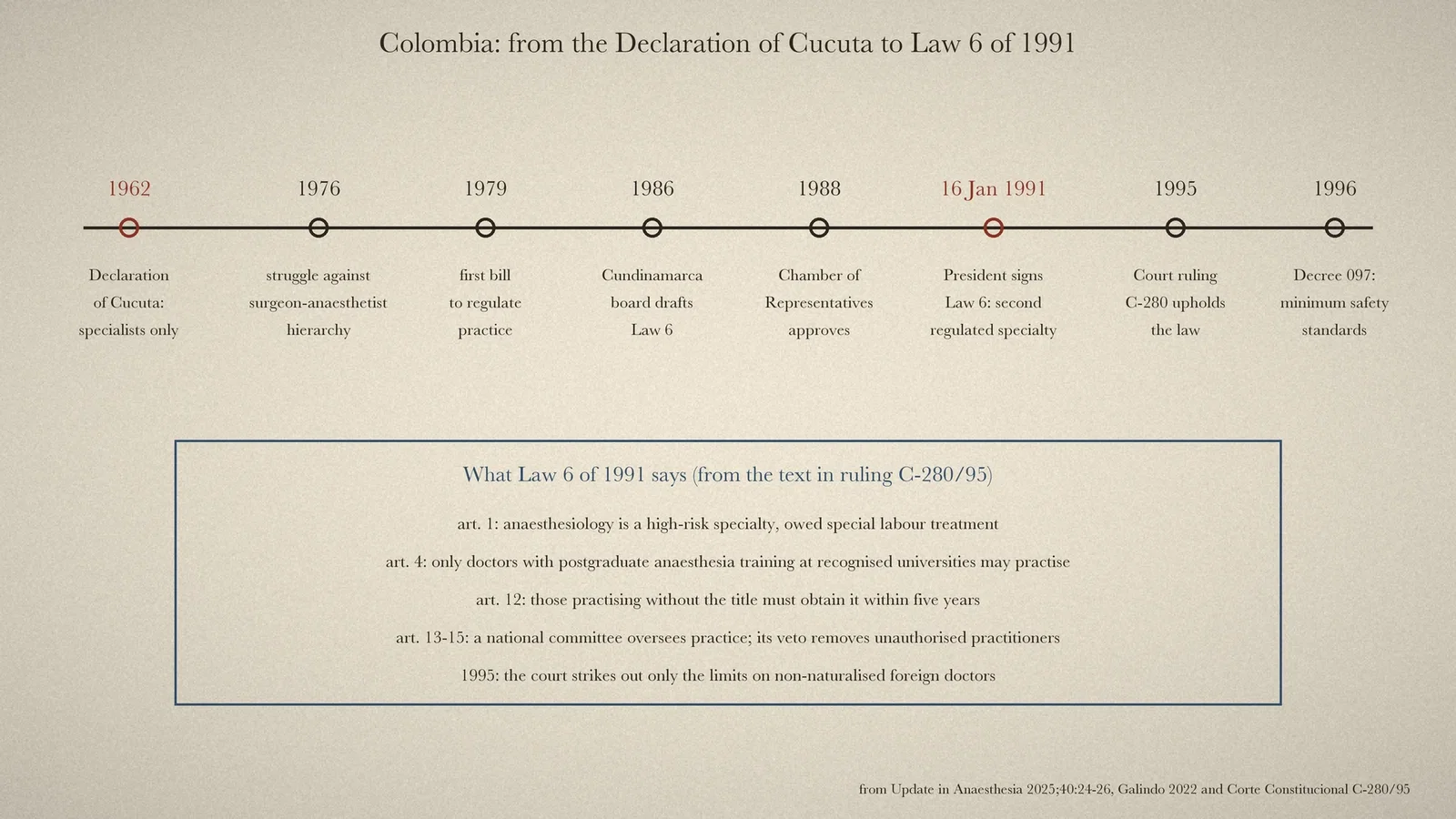
In many countries anaesthesia became a medical specialty through training, examinations and the slow change of hospital habits. In Colombia the specialists also went to the legislature. This article follows that path from a declaration made in 1962 in Cúcuta to a national law signed on 16 January 1991, and to the Constitutional Court ruling that upheld it in 1995. Three sources carry the story. One is the Colombia chapter of the WFSA's 2025 Update in Anaesthesia history issue. The second is an account of the law's passage by Manuel Antonio Galindo, who helped steer it. The third is the court's own ruling, which reproduces the law's text.
The Declaration of Cúcuta
The 2025 review describes a profession still being formed in the years around 1962. By 1958 four centres taught postgraduate anaesthesia. In 1963 minimum standards and curricula for postgraduate training began to be defined. [1, p. 25] Supplies were short: separate cuffs had to be fitted to endotracheal tubes, needles were sharpened and reused, and "telephone cable was used" as an epidural catheter after its copper core was pulled out. [1, p. 25]
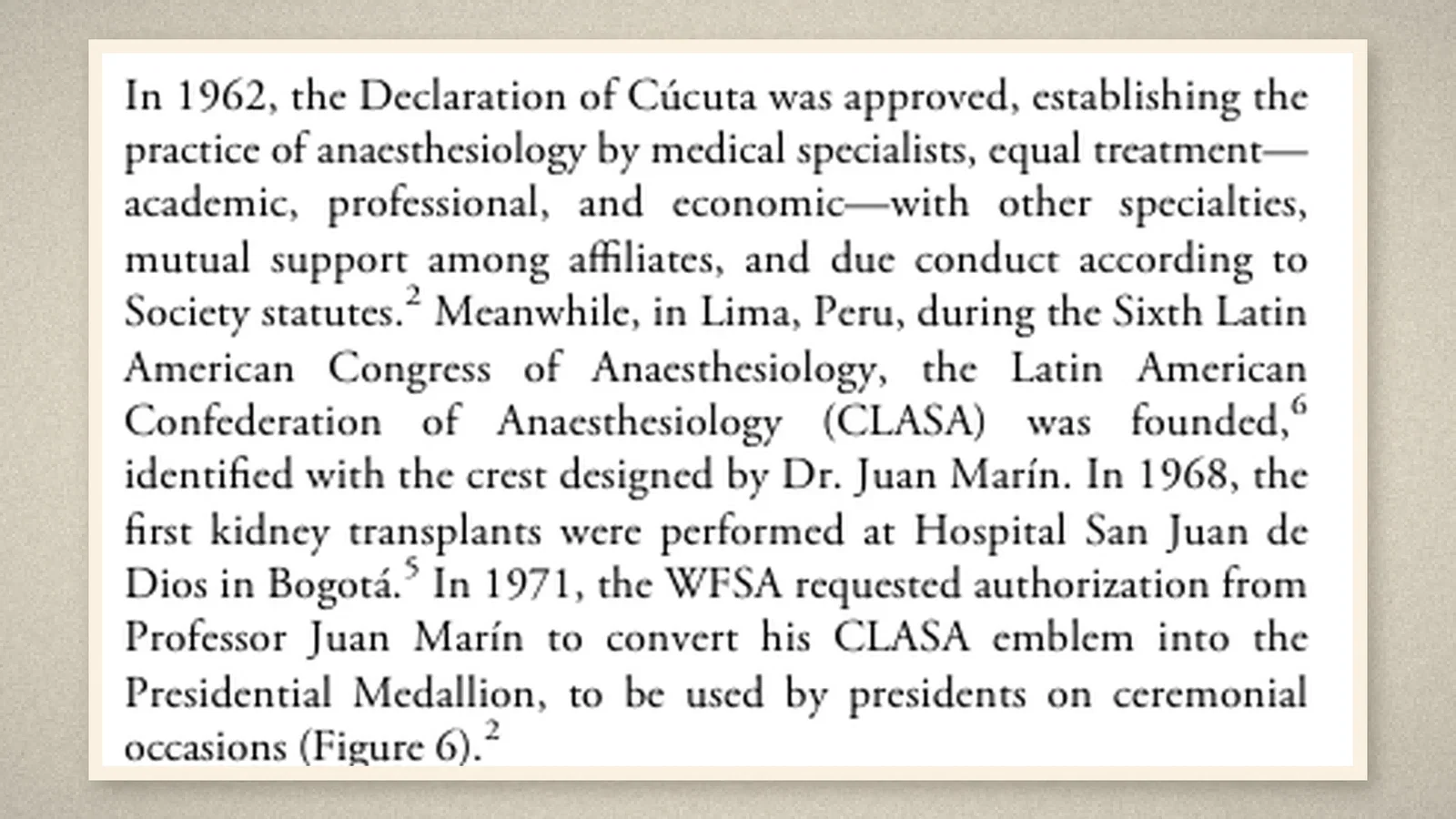
In 1962, the review says, "the Declaration of Cúcuta was approved", establishing the "practice of anaesthesiology by medical specialists", "equal treatment" (academic, professional and economic) with other specialties, mutual support among members and conduct according to the society's statutes. [1, p. 25] The text of the declaration itself was not found. Only this summary, which cites a 2012 history by Ocampo and Peña, is available here.
Autonomy, then a bill
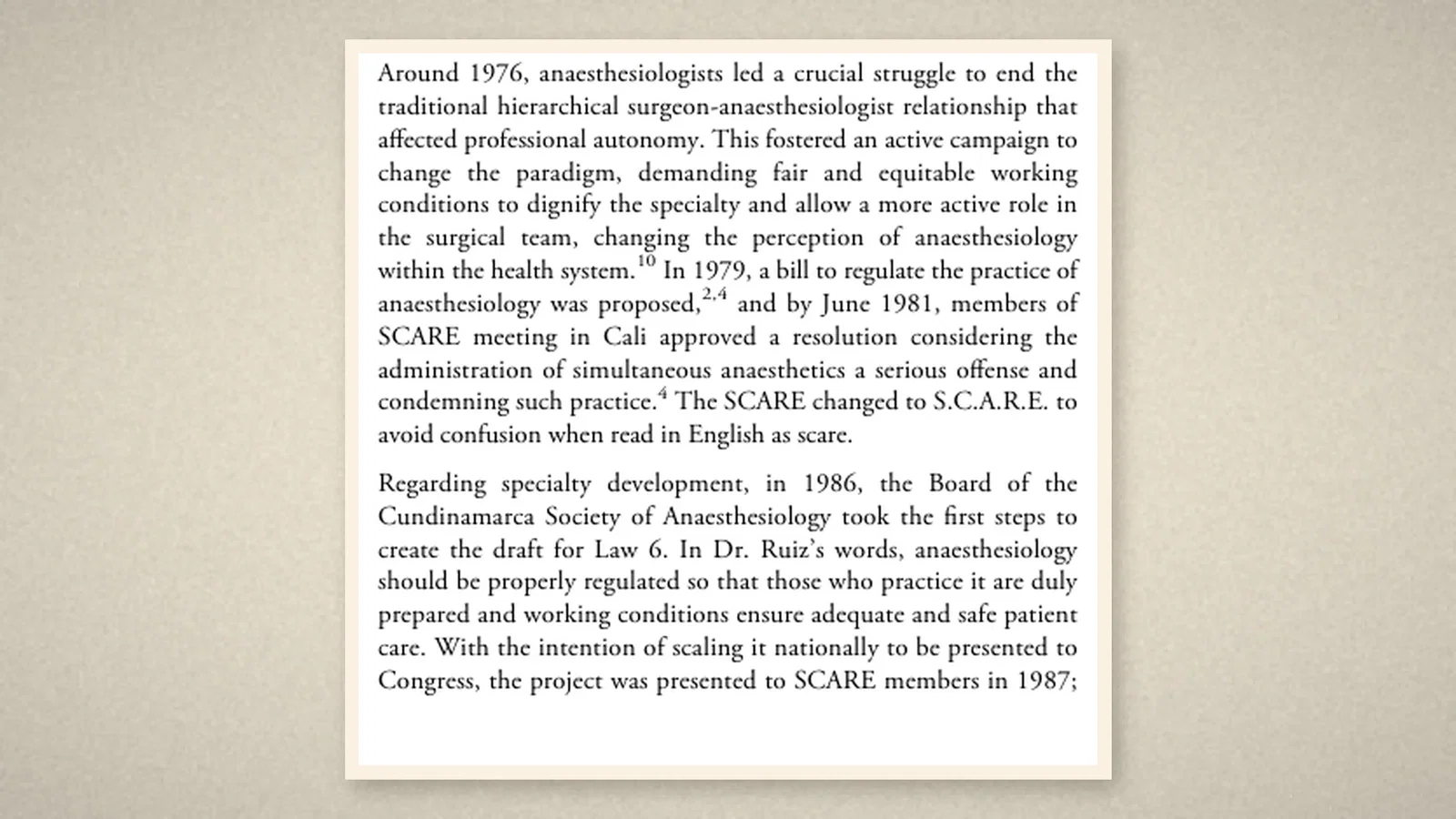
The claim made in 1962 took decades to turn into law. "Around 1976, anaesthesiologists led a crucial struggle" to end the "traditional hierarchical surgeon-anaesthesiologist relationship" that limited their autonomy, campaigning for fair working conditions and a more active role in the surgical team. [1, p. 25] "In 1979, a bill to regulate the practice" of anaesthesiology was proposed. In June 1981, members of the national society meeting in Cali approved a resolution calling the "administration of simultaneous anaesthetics a serious offense" and condemning the practice. [1, p. 25]
How Law 6 was passed
Galindo's account, published for the law's thirtieth anniversary in the Colombian Journal of Anesthesiology in 2022, gives the inside story. When Galindo trained, the specialty still carried the memory that anaesthesia had not long before been "administered by nuns", and Galindo "met technicians who administered" anaesthesia. [2, p. 2] The law was conceived by the "Board of directors of the Cundimarca Society" of anaesthesiology "in 1986", which Galindo chaired, with Ignacio Ruiz Moreno as secretary. "Ignacio Ruiz felt that anesthesiology" should be properly regulated, so that practitioners were properly prepared and working conditions made safe care possible. [2, p. 2]
At the national society's "1987 General Assembly, a committee" studied the draft and the assembly approved sending it to Congress. Galindo and Ruiz lobbied congressmen. The bill was introduced in the Sixth Commission "by doctor Remberto Burgos" and passed the Chamber of Representatives. "All of this happened in 1988." [2, p. 2] "During 1989 the project came to" a standstill. In 1990 the chairman of the Senate's Sixth Commission revived it, with the anaesthesiologist Carlos Celis Carrillo as its speaker. [2, p. 2]
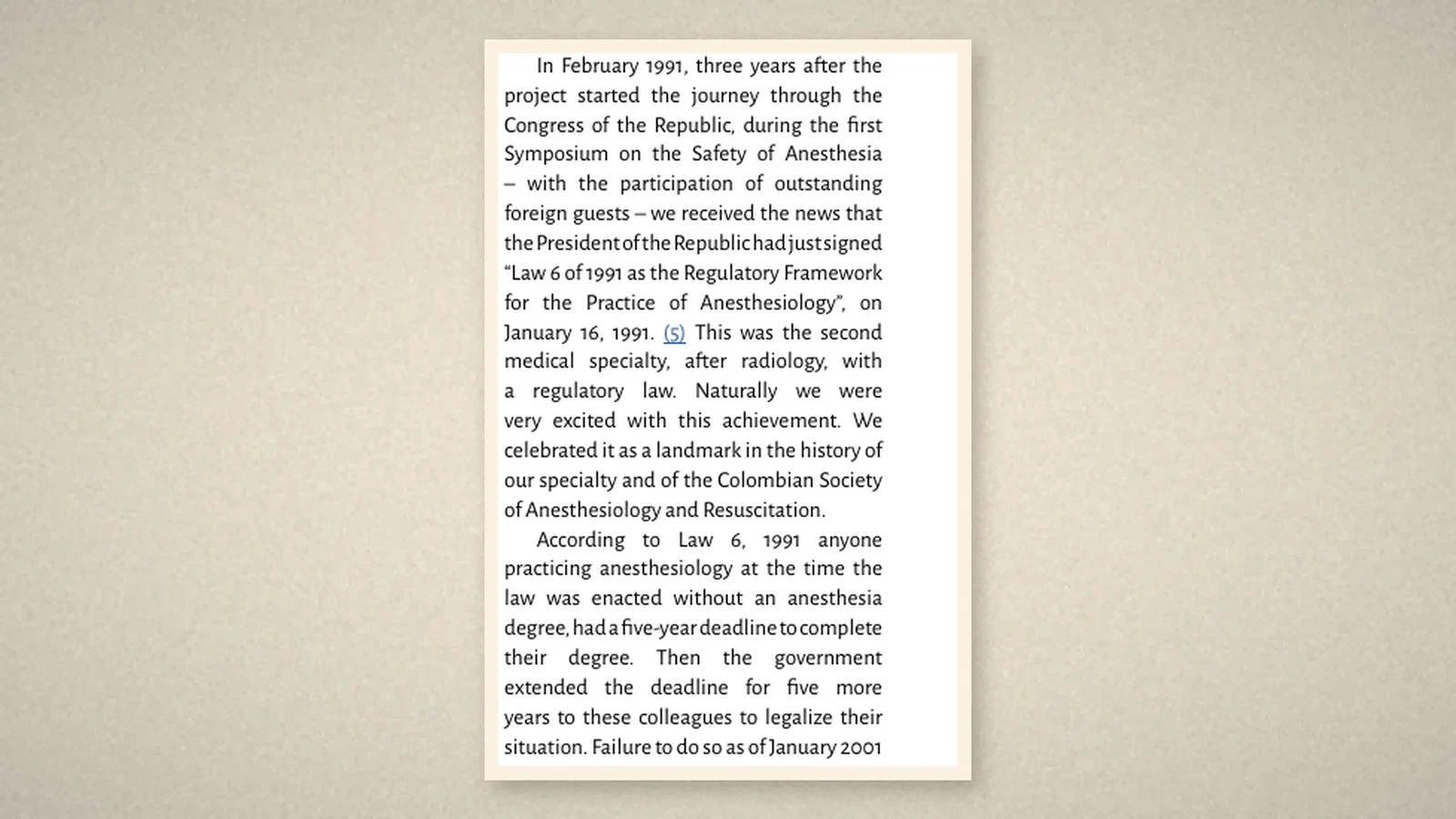
In February 1991, at the first Symposium on the Safety of Anesthesia, the society learned that "the President of the Republic had just signed" Law 6, on "January 16, 1991". It was, Galindo writes, the second "medical specialty, after radiology", with a law of its own. [2, p. 2] Anyone practising anaesthesia without the specialist degree had a "five-year deadline to complete" it, later extended by five years. "Failure to do so as of January 2001" ended their right to practise. [2, p. 2]
What the law said
The text of Law 6 survives in the Constitutional Court's ruling C-280 of 1995, which reproduces it as published in the Diario Oficial no. 39.631. Its title reads "Por la cual se reglamenta la especialidad médica de anestesiología", that is, a law regulating the medical specialty of anaesthesiology. [3] (Translations here are the author's.) Article 1 defines the specialty and adds that, because of the "potential risk" to patients and the anaesthetist's exposure to toxic gases, radiation and stress, anaesthesiology is "a high-risk specialty and must have special labour treatment". [3] Article 4 allows only doctors who trained in anaesthesia at the medical faculties of legally recognised universities to practise. Article 12 gives those practising without the title no more than five years to obtain it. Article 15 says that the veto of a national oversight committee "is sufficient" to remove anyone practising without authority. [3]
Opposition and the court
The law had opponents. Galindo names the Colombian Association of General Practitioners, who feared for their work, and two legal bodies that called it beyond the country's resources. [2, p. 3] The Constitutional Court held a public hearing "on November 30 1994". [2, p. 3] In "Ruling C-280 of 1995" it upheld the law, striking out only the words that limited practice to doctors "Colombian by birth or naturalised", and so the restriction on foreigners. [2, p. 3; 3] The law's regulations followed in Decree 097 of 12 January 1996, which made the society's minimum safety standards mandatory. [2, p. 3]
What the record shows
Colombian anaesthetists did not wait for hospitals to grant them standing. They declared in 1962 who should give anaesthesia, campaigned against the surgeon's authority from about 1976, drafted their own bill, and in 1991 had the state write into law that only trained specialists could practise. In 1995 the court accepted the argument that a high-risk specialty can require proof of training.
Sources and reading limits
Read: the Colombia chapter of Update in Anaesthesia 2025;40:24-26; Galindo's "History of Law 6, 1991" (English version, in full); the Constitutional Court's ruling C-280/95, including the text of Law 6 of 1991.
Not covered: the text of the 1962 Declaration of Cúcuta was not found, and it is known only from the review's one-sentence summary, which cites Ocampo and Peña's 2012 book (not read). The 1979 bill and the 1981 Cali resolution are known only from the review. Decree 097 of 1996 and the society's minimum safety standards were not read. Galindo writes as a participant, and the account of the passage through Congress is not checked against congressional records. The court's text was extracted with its accented letters damaged, and the translations from it are the author's.
One illustration is a timeline drawn from the three sources; three are crops of the review and of Galindo's article.
- Colombia chapter. In: History of anaesthesia. Update in Anaesthesia. 2025;40:24-6. PDF
- Galindo MA. History of Law 6, 1991. Colomb J Anesthesiol. 2022;50:e1034. DOI
- Corte Constitucional de Colombia. Sentencia C-280/95 (1995), with the text of Ley 6 de 1991. Website
Continue exploring
Related reading connects shared questions and contexts; it does not by itself establish historical influence.
Anesthesia Epochs · The Source Room · About & Editorial Method
Published November 2, 2026. Sources and reading limits are stated above. Illustrations are labelled as original source images or AI-made. Historical accounts are educational; they are not current treatment instructions.