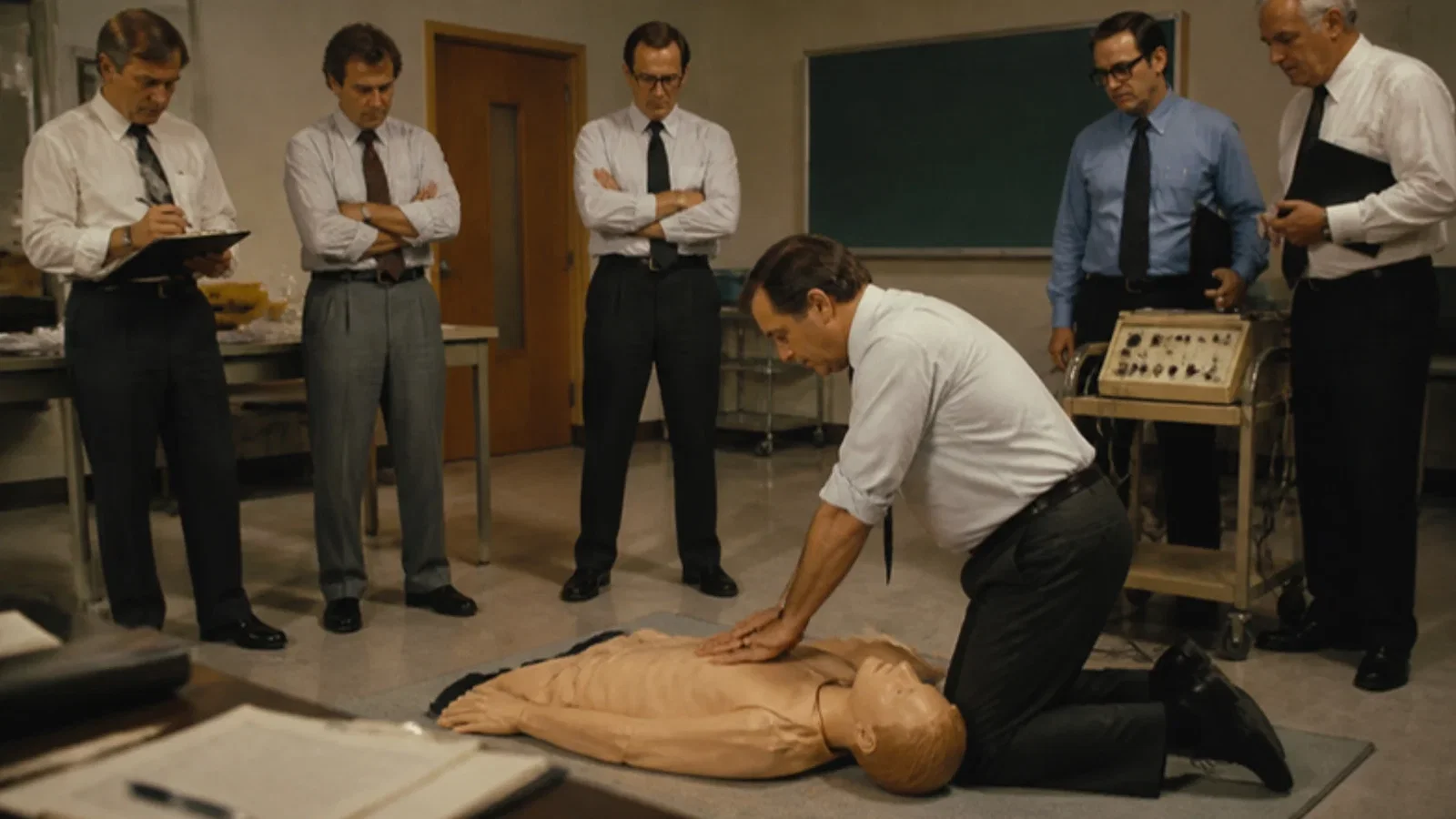
Nine founder members formed the Community Resuscitation Advisory Committee in August 1981 to review resuscitation standards; renamed the Resuscitation Council (UK) in July 1982, it set up an advanced life support working party in 1983 and ran its own ALS course from the early 1990s. Later sources date the founding to 1983.
Reading Library · Anesthesia Epochs · 中文版
Watch the education video (for clinicians)
1981: The Resuscitation Council (UK) — A Committee With No Name Yet · Anesthesia Epochs Education Series
The History of Anaesthesia Society's timeline has a one-line entry for 1983: "United Kingdom Resuscitation Council formed." [6] The Council's website today also says it was "Formed in 1983". [7] The Council's own history of its advanced life support (ALS) course, published in its newsletter in 2011, starts two years earlier, with a committee founded in August 1981 under a different name. [1, p. 1] This article follows that committee from its founding to the Council's first ALS courses, using the organisation's own account, and records where the dates disagree.
An American course seen from Britain
According to the 2011 supplement, modern resuscitation training in the UK began in the early eighties, when "a series of people visited the United States" to take the American Heart Association's Advanced Cardiac Life Support (ACLS) course. The versions they brought home were "imported and anglicised and subsequently unified" into what became ALS. [1, p. 1] The supplement says the AHA had run ACLS courses "since 1975", set up by Steve Carveth, a thoracic surgeon from Nebraska. [1, p. 2]
The committee, 1981-1982
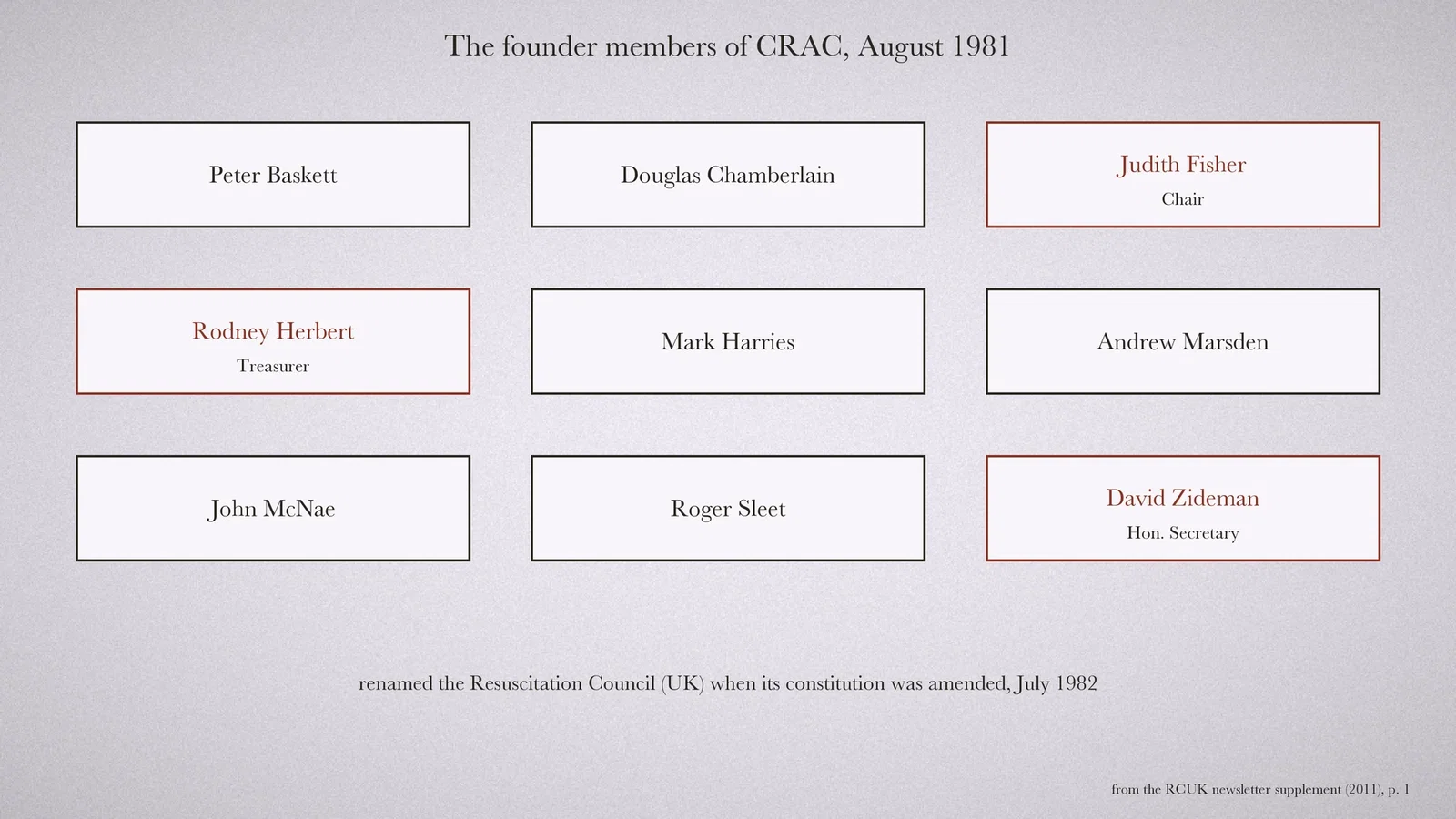
"The independent charity, known as 'The Community Resuscitation Advisory Committee' (CRAC) was formed in August 1981." Its primary aim was to review resuscitation standards. [1, p. 1] The founder members were Peter Baskett, Douglas Chamberlain, Judith Fisher (chair), Rodney Herbert (treasurer), Mark Harries, Andrew Marsden, John McNae, Roger Sleet and David Zideman (honorary secretary). "In July 1982, the constitution was amended and CRAC became the Resuscitation Council (UK)." One of the new body's main aims was the "education of doctors, nurses, ambulance personnel and other health workers". [1, p. 1]
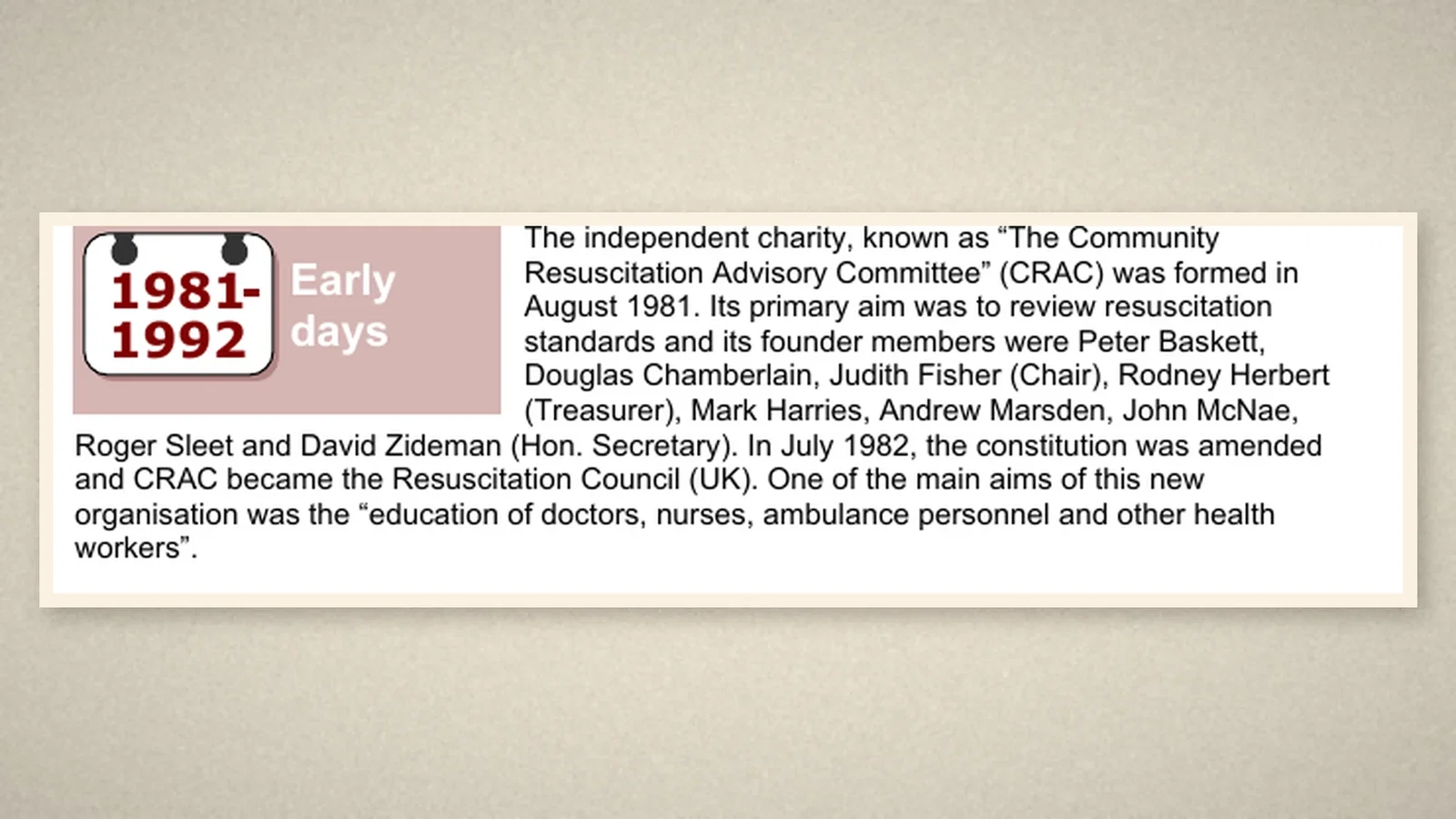
Pradeep Ingle's 2012 paper in the History of Anaesthesia Society's Proceedings gives the same sequence. CRAC was formed in August 1981, and in July 1982 "the constitution was amended and CRAC became the Resuscitation Council UK". Ingle describes the founders as a group of medical practitioners from different specialties, "with a vision to facilitate education of both lay people and healthcare professionals" in resuscitation. [2, p. 27]
First steps
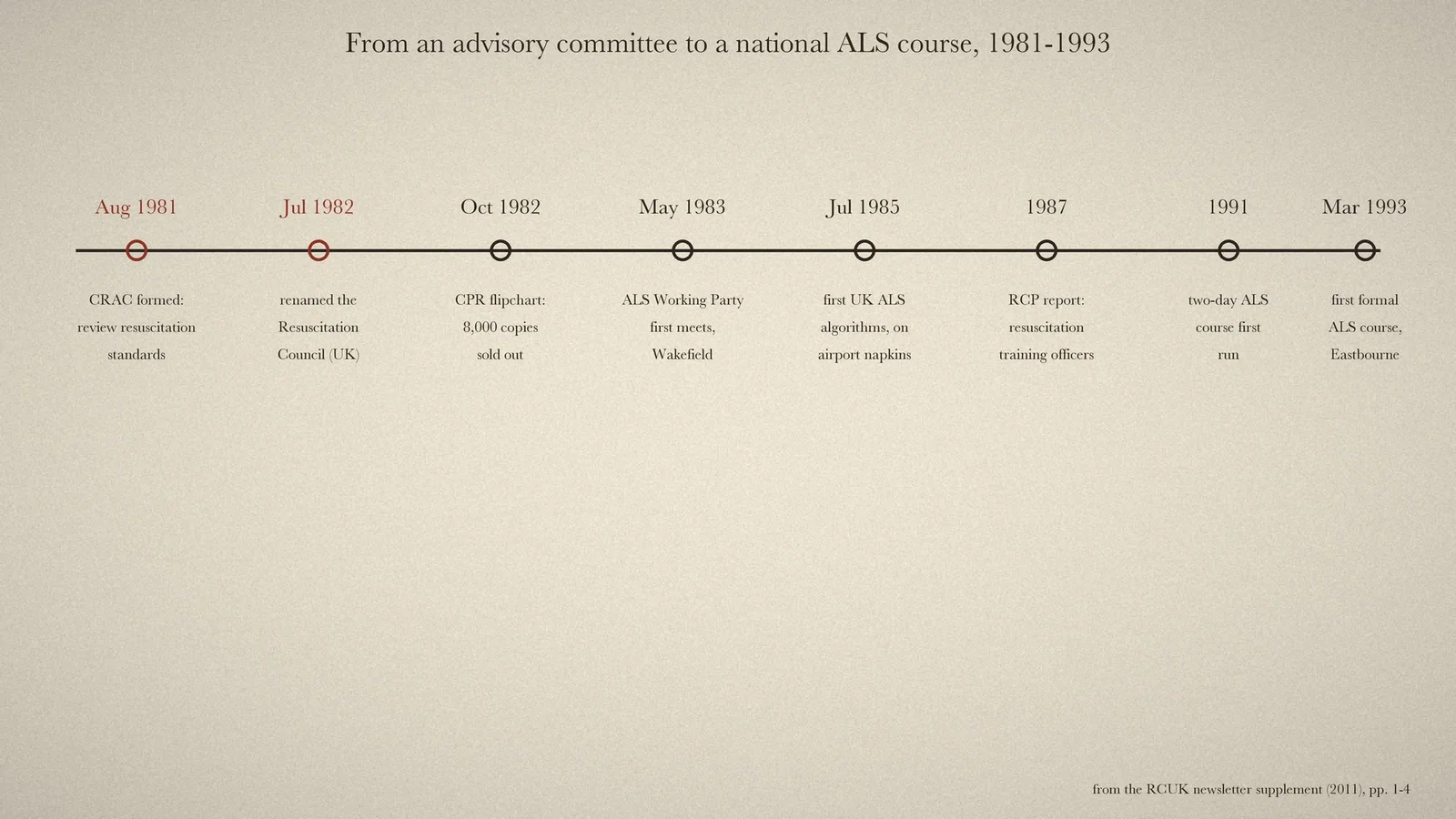
The AHA was "very supportive". On its behalf Bill Montgomery ran an "Emergency Cardiac Care" course at Runnymede in September 1982. Peter Baskett later recalled it as "an American style package with all its good and bad points". [1, p. 2] In October 1982 a CPR flipchart was launched at an international conference on cardiac arrest in Brighton, and "A modest initial print run of 8,000 copies swiftly sold out". [1, p. 2] In May 1983 Andrew Marsden set up an ALS Working Party to develop guidelines. "The first meeting was held in Wakefield on 13 May 1983." Douglas Chamberlain took over as its chair in 1985. [1, p. 2]
The Council sent six members to the AHA standards meeting in Dallas in July 1985. On the way home, at the Dallas-Fort Worth airport, they drew up the first UK ALS algorithms, which "were written on McDonalds napkins". [1, p. 2] Courses based on ACLS had begun to appear in Britain: Marsden took one to Wakefield in January 1985, and David Skinner's first course ran at St Bartholomew's Hospital in 1986. [1, p. 2] In 1987 a Royal College of Physicians report on resuscitation training recommended that every hospital should have a "Resuscitation Training Officer or equivalent". [1, p. 3; 3] In 1989 the BMJ published the Council's revised recommendations for basic and advanced life support, written up by Marsden and Chamberlain. [4, 5]
The Council's own course
The Council decided to build a course of its own. According to the supplement, there was a feeling that the American course was too detailed and theoretical and lacked practical skills teaching, and the new course was called ALS because the AHA was keen to bring ACLS into the UK at the time. The two-day course used the ABC of Resuscitation, first published in 1986, as its manual, and was "first run in 1991" by Tony Handley and Colin Robertson. [1, p. 4] An ALS Course Working Party followed in 1992, and the first edition of the Council's ALS manual appeared in November 1992. The first formal Resuscitation Council (UK) ALS course was held in Eastbourne in March 1993. In its first year, the supplement says, 50 courses at 20 centres trained 1,000 providers. [1, p. 4]
Which year?
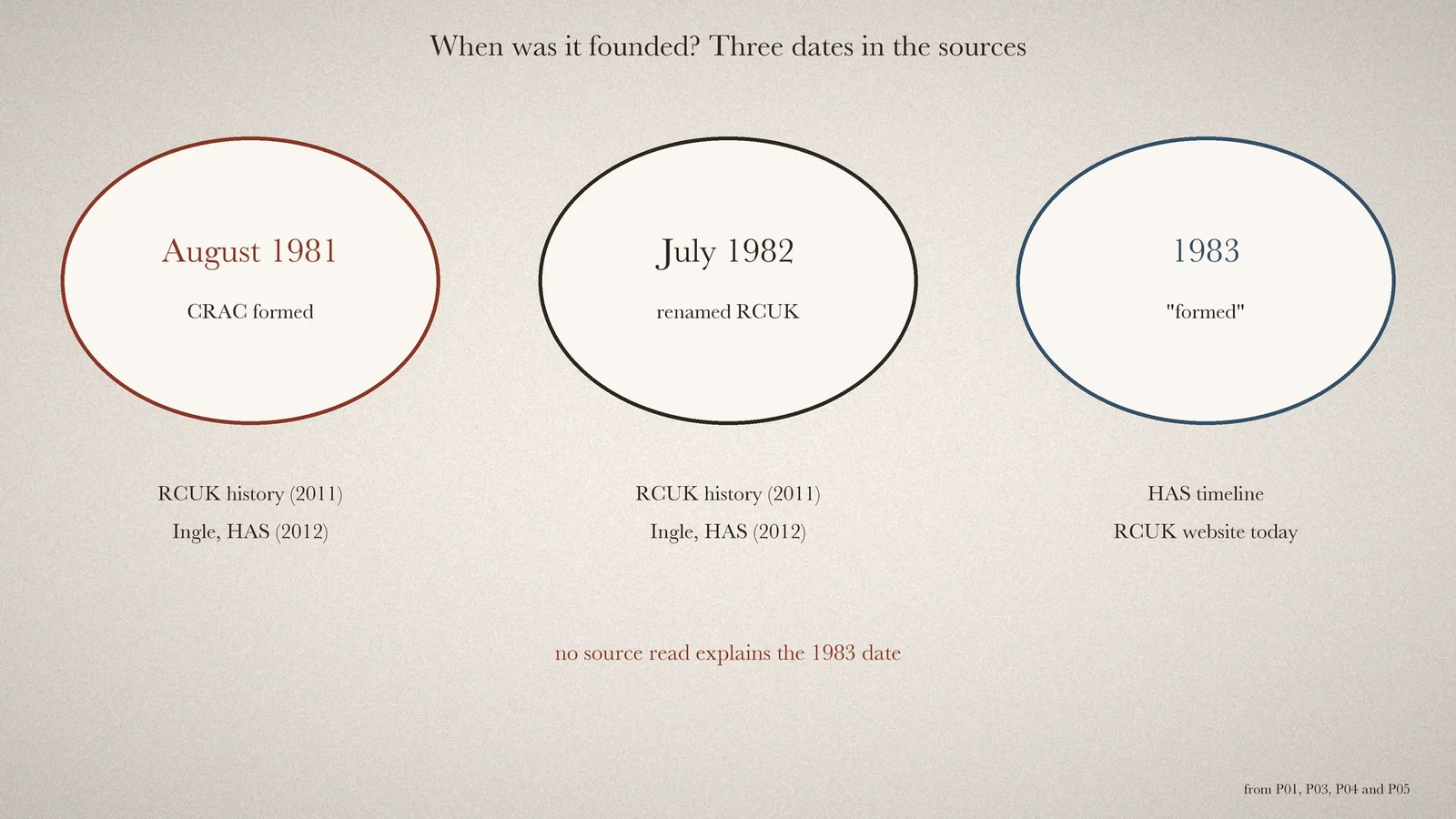
The sources give three dates. The Council's own 2011 history and Ingle give August 1981 for the committee and July 1982 for the new name. [1, p. 1; 2, p. 27] The History of Anaesthesia Society's timeline and the Council's present website give 1983. [6, 7] None of the sources read explains the 1983 date. That was the year of the first ALS Working Party meeting, but no source connects the two.
What the record shows
The Resuscitation Council (UK) began as a small advisory committee of clinicians who wanted common standards. It learned from an American course, rewrote that course for British hospitals, and by 1993 was running its own. The algorithms drawn on airport napkins in 1985 were an early version of the national guidelines the Council went on to publish.
Sources and reading limits
Read: the Resuscitation Council (UK)'s newsletter supplement of summer 2011 on the history of ALS, pp. 1-4 (Internet Archive copy), by text and page image; Ingle's 2012 paper in the HAS Proceedings, pp. 27-28; the HAS timeline; the Council's current website; the PubMed records of the 1987 Royal College of Physicians report and the two 1989 BMJ guidelines.
Not covered: CRAC's and the Council's founding documents and minutes; the full texts of the 1987 report and the 1989 guidelines, which could not be accessed. An archived Council information page with the same "formed in August 1981" wording could not be accessed, though Ingle quotes it. Where the founding meeting took place is not stated in the sources read. Most of the early history comes from the organisation's own retrospective, written by and about people who took part.
One illustration is a crop of the 2011 supplement; three are drawn from the sources. No patient or resuscitation scene is depicted.
- Resuscitation Council (UK). Advanced Life Support - the past to the present. Newsletter Supplement, summer 2011. Internet Archive
- Ingle P. Transformation of resuscitation in the lifetime of HAS. Proc Hist Anaesth Soc. 2012;45:27-34. PDF
- Royal College of Physicians. Resuscitation from cardiopulmonary arrest. Training and organization. J R Coll Physicians Lond. 1987;21(3):175-82. PubMed
- Marsden AK. Guidelines for cardiopulmonary resuscitation. Basic life support. Revised recommendations of the Resuscitation Council (UK). BMJ. 1989;299(6696):442-5. PubMed
- Chamberlain DA. Guidelines for cardiopulmonary resuscitation. Advanced life support. Revised recommendations of the Resuscitation Council (UK). BMJ. 1989;299(6696):446-8. PubMed
- History of Anaesthesia Society. Timeline. Website
- Resuscitation Council UK. Who we are. Website
Continue exploring
Related reading connects shared questions and contexts; it does not by itself establish historical influence.
Anesthesia Epochs · The Source Room · About & Editorial Method
Published November 2, 2026. Sources and reading limits are stated above. Illustrations are labelled as original source images or AI-made. Historical accounts are educational; they are not current treatment instructions.