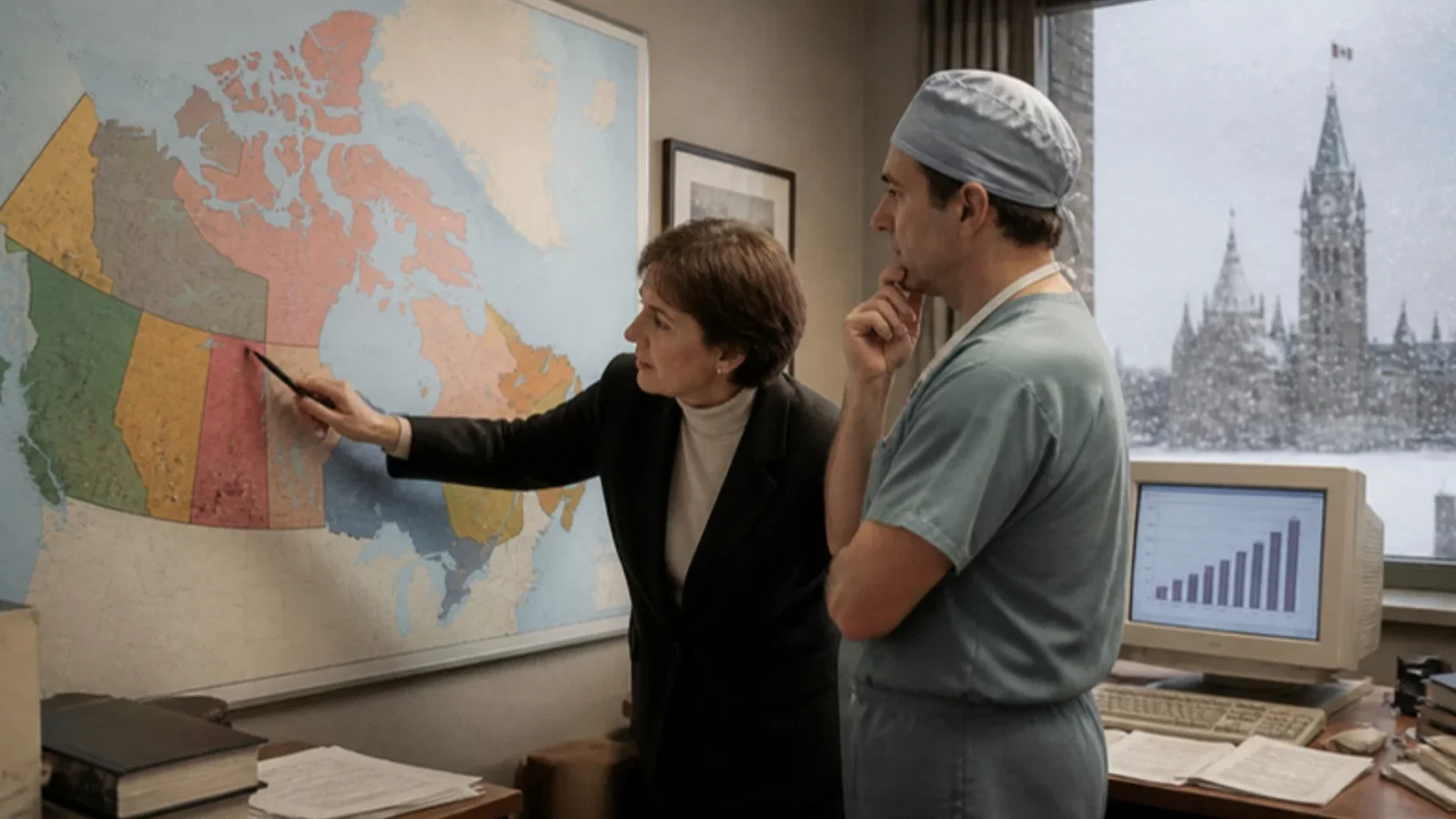
Commissioned by Canada's university anaesthesia departments, Eva Ryten built a model that turned Quebec billing data and population forecasts into the number of anaesthesiologists each province would need in 2016, and found the country already short.
Reading Library · Anesthesia Epochs · 中文版
Watch the education video (for clinicians)
2000: Canada's Workforce Model — Counting the Anaesthetists · Anesthesia Epochs Education Series
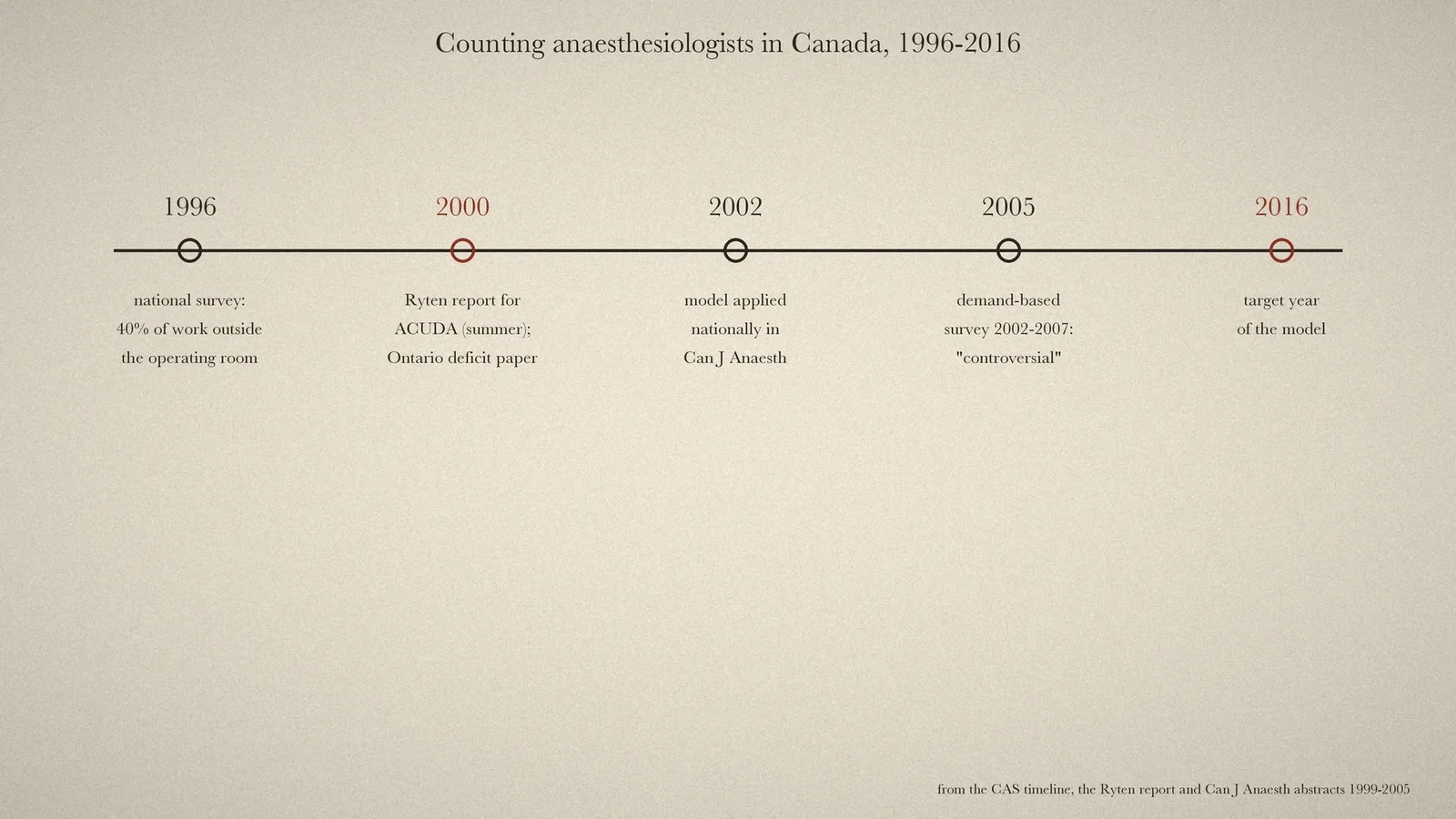
The Canadian Anesthesiologists' Society (CAS) history timeline lists among its events for 2000-2002 an ACUDA-sponsored report presented by Dr Eva Ryten, A Physician Workforce Planning Model for the Specialty of Anesthesia. The report included "a model for predicting province-specific anesthesiologist human resource requirements to the year 2016". [2] ACUDA is the Association of Canadian University Departments of Anesthesia. This article follows the report, which the CAS still hosts as a PDF, and the papers that applied it. [1]
Warnings before the model
Before 2000 Canadian anaesthetists were already worried. A national survey of 2,693 physicians who gave anaesthetics in 1996, 2,206 specialists and 487 family physicians, found that changes in practice meant 40% of anaesthesiologists' work now took place outside the operating room, while anaesthesia training positions had fallen by at least 15%. With Canada's population expected to grow by 33.8% between 1996 and 2026, the authors projected "0% increase in the number of specialist anesthesiologists" over the same period if policies did not change. [3] In 2000 a second paper estimated that Ontario's shortfall would grow from 40 anaesthesiologists to 68 by 2005. [4]
What a planning model is
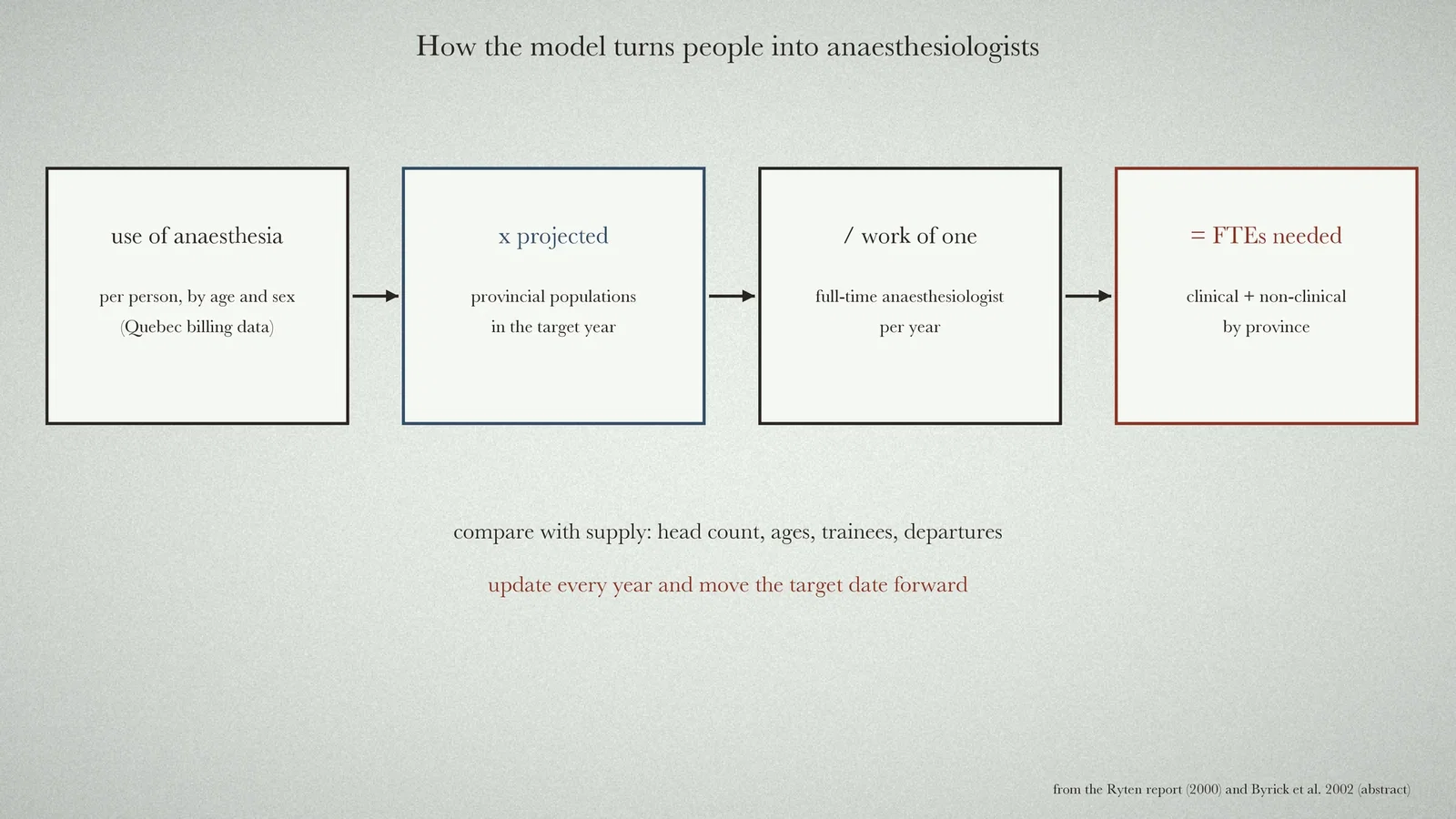
Ryten's report, written "summer of the year 2000", begins by defining a planning model as a mathematical model of how the physician workforce system works, used to decide how many physicians are needed and how many to train. [1, PDF pp. 3, 26] A model is "not a one-off affair". Its data and target dates should be updated every year, and "it makes little sense to think of a target date of less than 15 years from the base date". If the model were started in 2001, the target could be 2016, "with the base date as the year 2000". [1, PDF p. 11] Ryten also noted the usual reaction to a shortage: "The easiest solution to shortages of physicians is to import them from abroad", and in the summer of 2000 provinces across Canada were trying to do exactly that. [1, PDF p. 26]
Counting
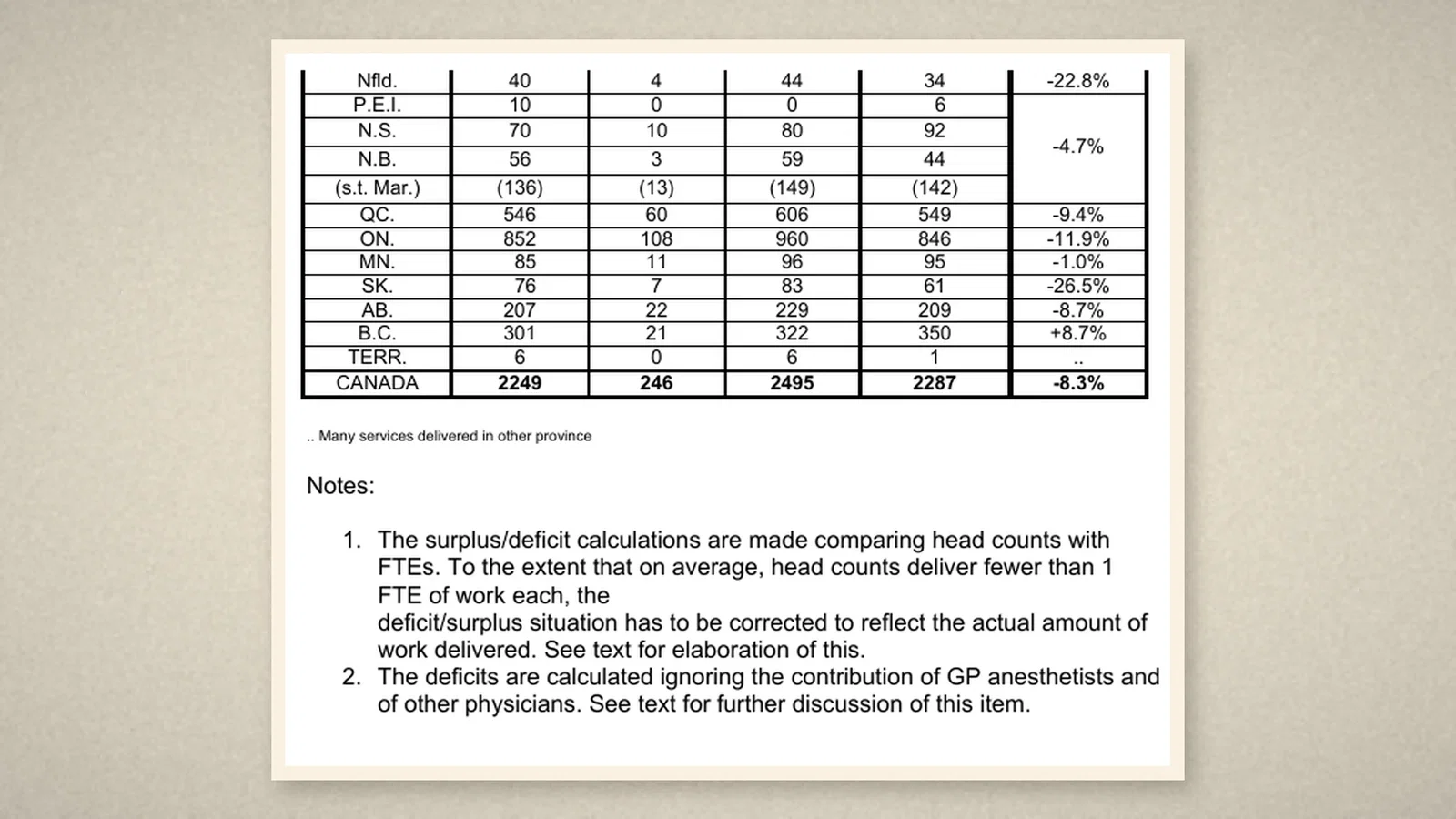
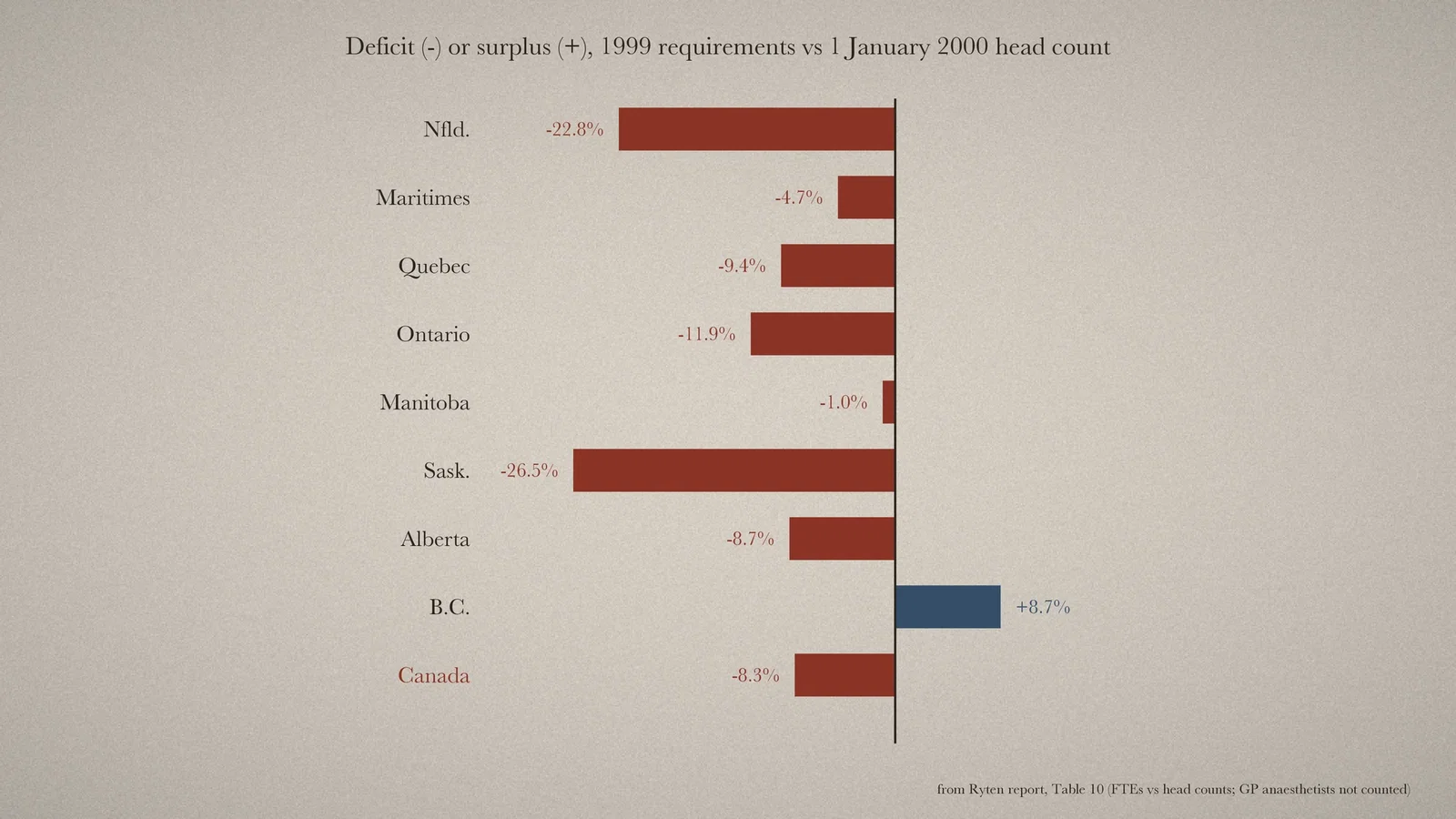
The model measured demand from Quebec's billing records: how much anaesthesia people of each age and sex used. It applied those rates to each province's projected population and converted the result into full-time equivalents (FTEs). [1, contents; 5] Ryten's Table 10 compared the FTEs needed in 1999 with the anaesthetists counted on 1 January 2000. Canada needed 2,495 FTEs, 2,249 for clinical and 246 for non-clinical work, and had 2,287 anaesthetists, a deficit of 8.3%. Saskatchewan's deficit was 26.5% and Newfoundland's 22.8%, while British Columbia had a surplus of 8.7%. [1, PDF p. 93] The report noted that these figures compared head counts with FTEs and ignored "the contribution of GP anesthetists and of other physicians". [1, PDF p. 93]
Into the journal
In 2002 R. J. Byrick, D. Craig and F. Carli published the model in two papers in the Canadian Journal of Anesthesia, using the same 1999 and 2000 figures. [5, 6] The first estimated that demand for clinical anaesthesiologists in Quebec would rise from 546 FTEs in 1999 to 669 in 2016. Nationally, the population would grow by 17.9% but demand for anaesthesiologists by 30.9%. The authors added that such models need "ongoing committed resources and personnel". [5] The second compared supply: 2,287 anaesthesiologists in 2000 against 3,265 FTEs needed in 2016, leaving "a deficit of at least 656 FTEs" between 2000 and 2016, about 41 a year, unless training expanded. [6] In 2005 a further survey began by noting that the number of providers Canada needed "remains controversial". [7]
What the record shows
Ryten's report gave Canadian anaesthesia a method rather than a single forecast. It said where the numbers came from, how often to recalculate them and how far ahead to look. Its first answer was that Canada was already short of anaesthesiologists and would become more so without more trainees.
Sources and reading limits
Read: the CAS history timeline; Ryten's report, selected pages (contents, pp. 3, 11 and 26, and Table 10 on pp. 92-93, by text and page image); the PubMed abstracts of five Canadian Journal of Anesthesia papers from 1999 to 2005.
Not covered: the rest of the 124-page report, whose PDF appears to repeat part of its text; the full texts of the journal papers; ACUDA's decision to commission the report; how governments and training programmes responded. The report's exact date is not given on the pages read. "Summer of the year 2000" is its own statement of when it was written, and the CAS dates its presentation to 2000-2002. That the 2002 papers summarise the report is inferred from their identical figures, not stated in their abstracts. Whether the predicted shortfall to 2016 came about is not assessed here.
One illustration is a crop of Ryten's Table 10; three are drawn from the sources.
- Ryten E. A Physician Workforce Planning Model for the Specialty of Anesthesia: Theoretical and Practical Considerations. Association of Canadian University Departments of Anesthesia; 2000. PDF
- Canadian Anesthesiologists' Society. History timeline. Website
- Donen N, King F, Reid D, Blackstock D. Canadian anesthesia physician resources: 1996 and beyond. Can J Anaesth. 1999;46(10):962-9. PubMed
- Yang H, Byrick R, Donen N. Analysis of anesthesia physician resources: projected Ontario deficit in 2005. Can J Anaesth. 2000;47(2):179-84. PubMed
- Byrick RJ, Craig D, Carli F. A physician workforce planning model applied to Canadian anesthesiology: assessment of needs. Can J Anaesth. 2002;49(7):663-70. PubMed
- Craig D, Byrick R, Carli F. A physician workforce planning model applied to Canadian anesthesiology: planning the future supply of anesthesiologists. Can J Anaesth. 2002;49(7):671-7. PubMed
- Engen DA, Morewood GH, Ghazar NJ, Ashbury T, VanDenKerkhof EG, Wang L. A demand-based assessment of the Canadian anesthesia workforce - 2002 through 2007. Can J Anaesth. 2005;52(1):18-25. PubMed
Continue exploring
Related reading connects shared questions and contexts; it does not by itself establish historical influence.
Anesthesia Epochs · The Source Room · About & Editorial Method
Published November 2, 2026. Sources and reading limits are stated above. Illustrations are labelled as original source images or AI-made. Historical accounts are educational; they are not current treatment instructions.