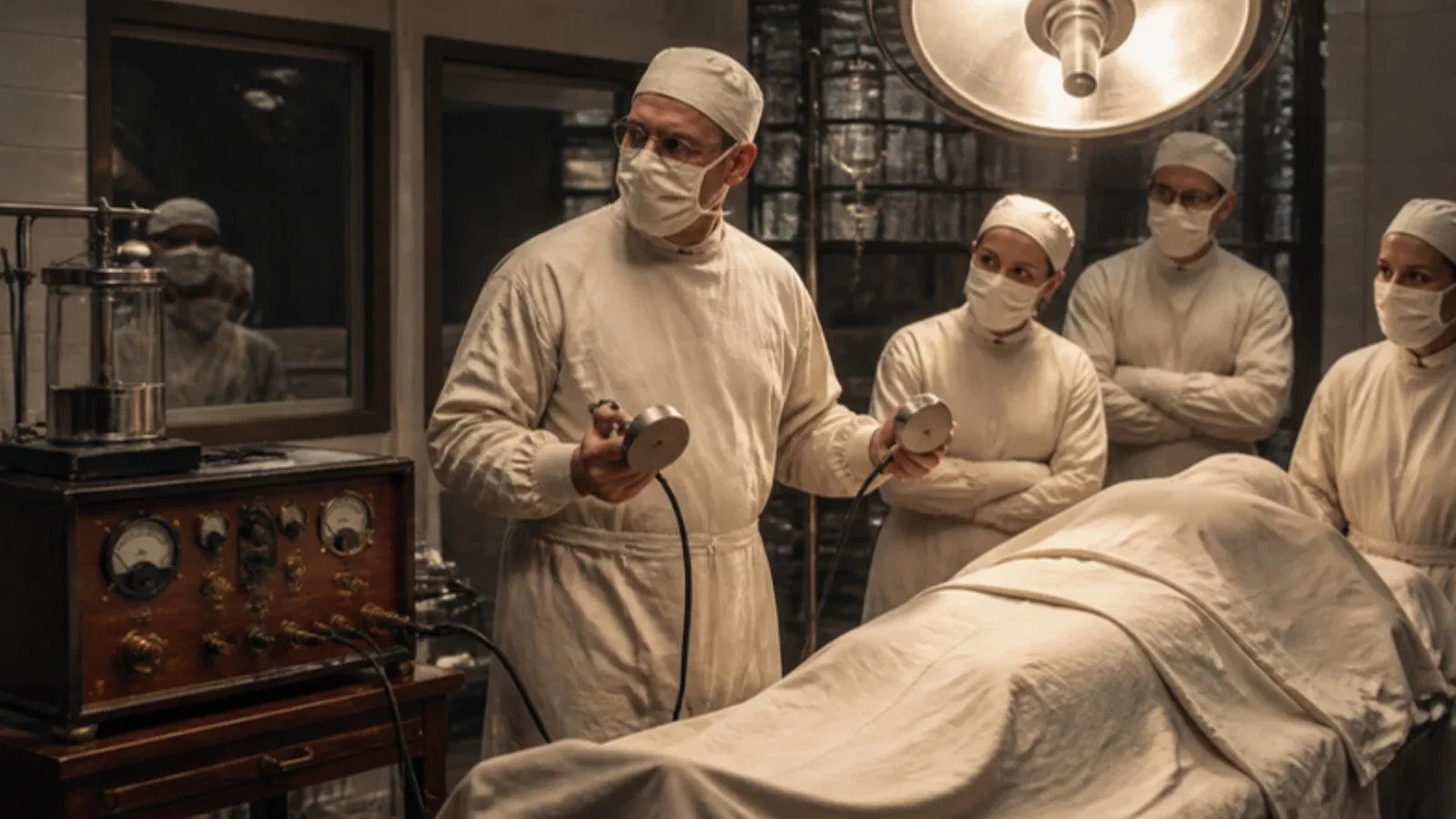
Beck, Pritchard and Feil report in JAMA how a 14-year-old boy who fibrillated during surgery for funnel chest recovered completely after cardiac massage, procaine and a 110-volt alternating-current shock.
Reading Library · Anesthesia Epochs · 中文版
Watch the education video (for clinicians)
1947: Beck's Defibrillation — Ending Fibrillation in Cleveland · Anesthesia Epochs Education Series
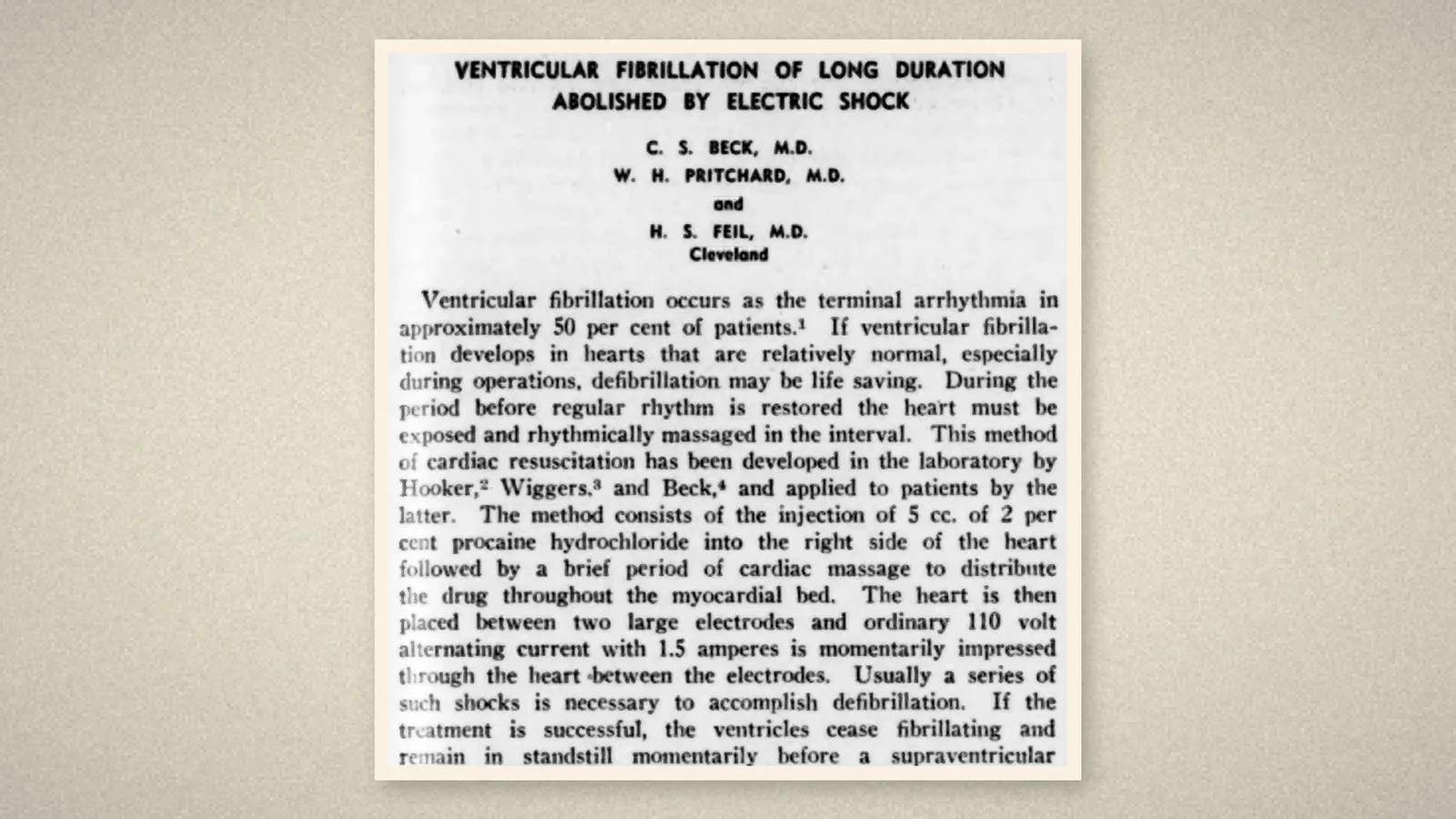
Defibrillators now stand in every operating theatre and ward, and staff are trained in resuscitation. In 1947 neither was true. On 13 December that year the Cleveland surgeon Claude S. Beck and the physicians W. H. Pritchard and H. S. Feil reported in the Journal of the American Medical Association a boy whose heart fibrillated on the operating table and who, after long direct cardiac massage and electric shock, recovered completely. This article reads that original report, and then the 1960 paper that took the first step of resuscitation outside the opened chest.
The method
"Ventricular fibrillation occurs as the terminal arrhythmia" in about half of patients, the authors began; in relatively normal hearts, especially during operations, defibrillation might save life, but until rhythm returned the heart had to be exposed and massaged. The method "has been developed in the laboratory by" Hooker, Wiggers and Beck, and applied to patients by Beck. "The method consists of the injection of 5 cc." of 2% procaine into the right heart, brief massage to spread it, and then, with the heart between two large electrodes, "ordinary 110 volt" alternating current at 1.5 amperes passed momentarily through it; "usually a series of" shocks was needed. If successful, the ventricles stopped fibrillating, stood still briefly, and then took up a supraventricular rhythm, and massage continued until the beat was strong. [1, p. 985]
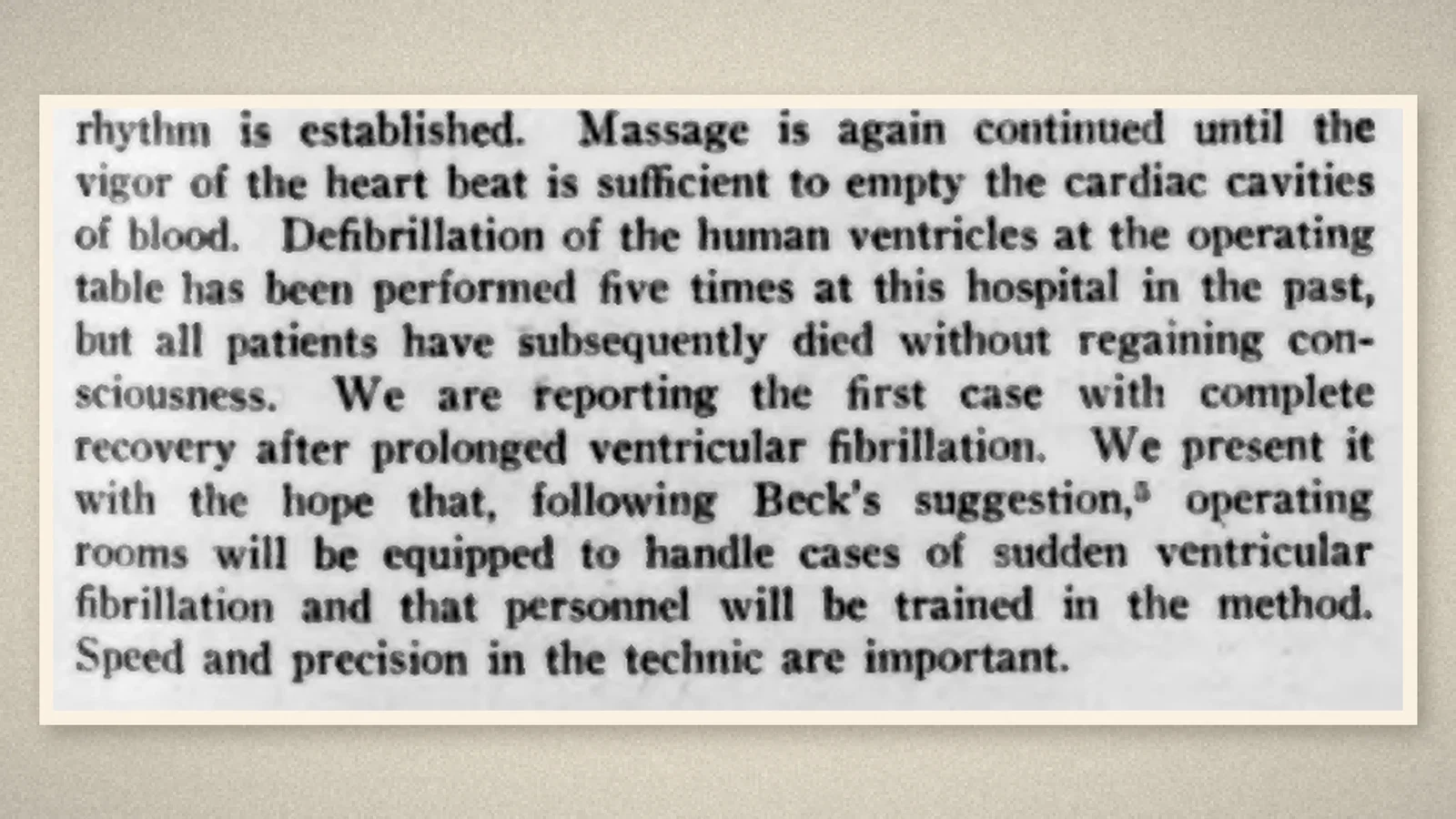
Defibrillation at the operating table "has been performed five times at this hospital" before, but every patient died without regaining consciousness. "We are reporting the first case with complete" recovery after prolonged fibrillation, they wrote, in the hope that "operating rooms will be equipped" for sudden ventricular fibrillation and staff trained in the method. "Speed and precision in the technic are important." [1, p. 985]
The case
The patient, "a white boy aged 14", was admitted to Beck's service for resection of the sternum for severe congenital funnel chest; his only symptom was breathlessness on effort, and vital capacity was reduced by about 30%. During induction of "nitrous oxide and ether anesthesia" the pulse rose to 160 for 45 minutes and fell to 80 after lanatoside C; the two-hour operation was otherwise uneventful. [1, p. 985]
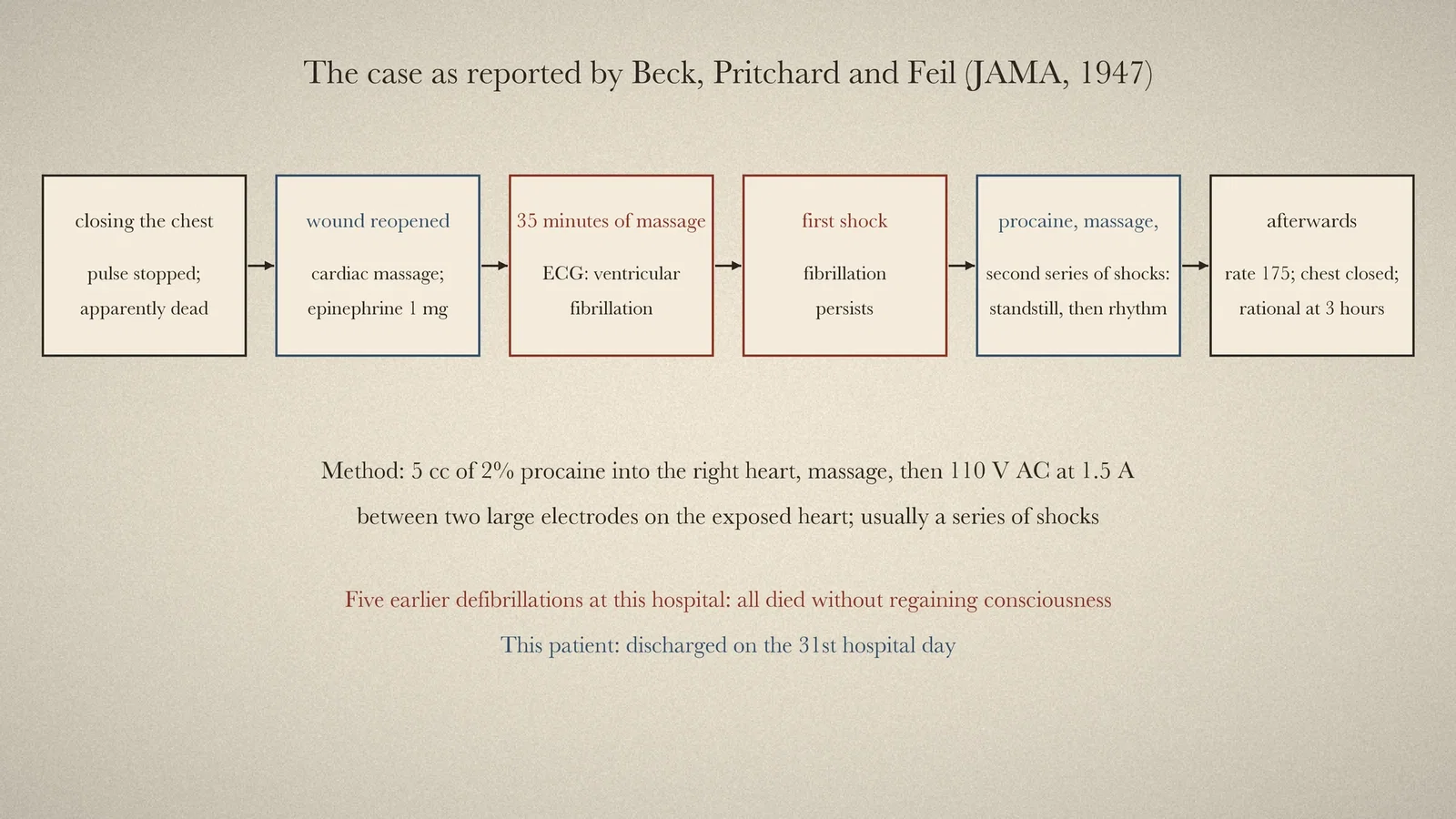
During closure of the chest the pulse suddenly stopped and "the blood pressure sounds could not be" heard; the patient was apparently dead. The wound was reopened, massage begun at once, epinephrine 1 mg given intravenously and more lanatoside, without effect. The respirator was attached to the tracheal tube and "cardiac massage continuously given for the next thirty-five minutes", when the electrocardiogram showed ventricular fibrillation. Ten minutes later, before the first shock, it still did, and after the shock too. "Since the first shock was" unsuccessful, procaine was injected into the right auricle, the heart massaged, and a second series of shocks given; the heart stood still. [1, p. 985–986]
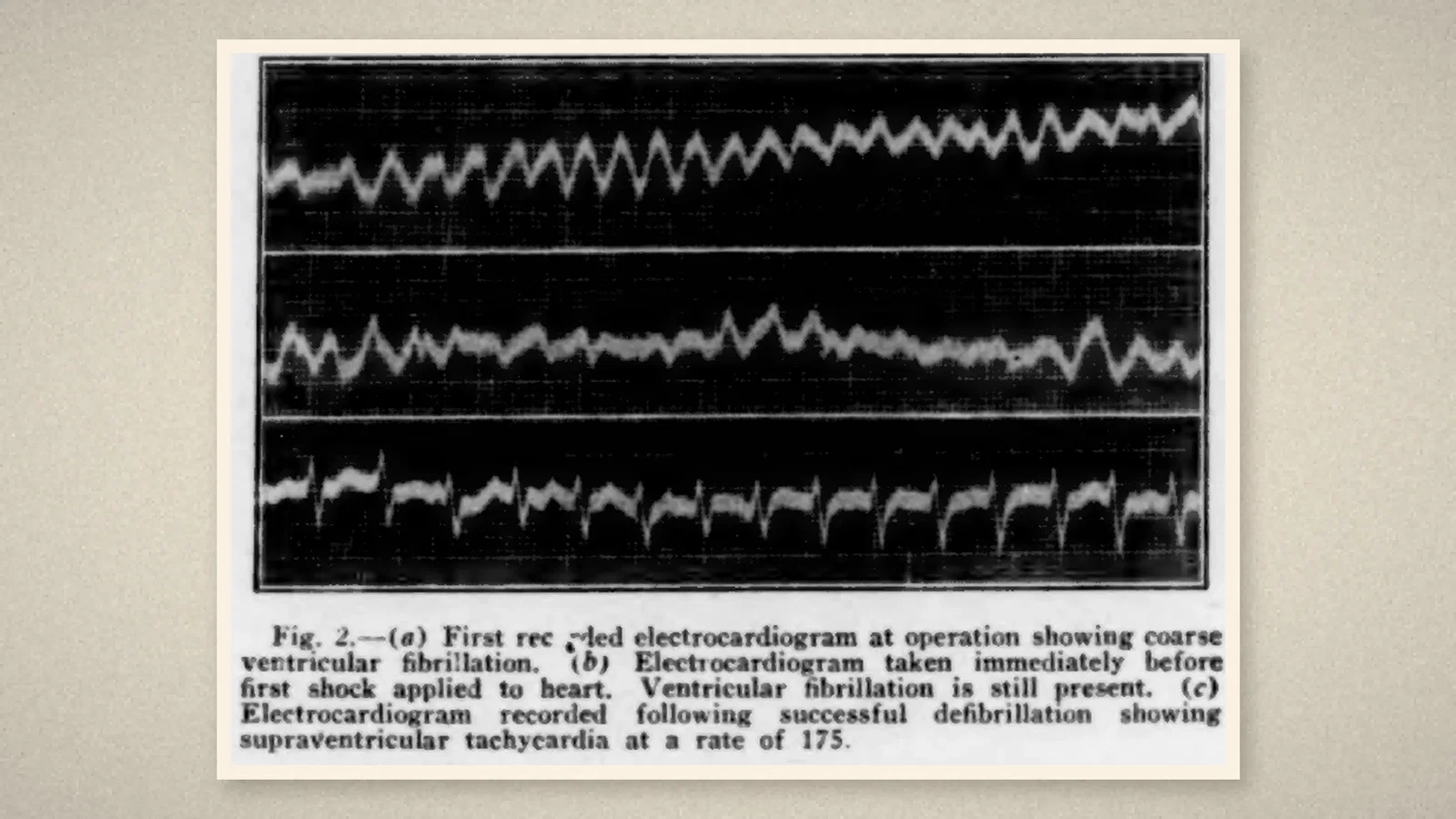
Almost at once feeble, regular, fairly rapid contractions appeared; after five more minutes of massage they were coordinated and vigorous, a "supraventricular tachycardia at a rate of 175". In spite of the crisis, "at no time was" there cyanosis or pupillary dilatation; the massage had kept the circulation going. The chest was closed after twenty minutes of coordinated beating, and within ten minutes the tracheal tube came out and breathing resumed. "Three hours after defibrillation of the" ventricles the boy answered questions rationally. Digitalis intoxication and azotaemia followed but cleared within eight days; with no sign of nervous-system injury, he was "discharged on his thirty-first hospital day", and three months later his electrocardiogram was normal. [1, p. 986]
The authors' conclusions
Because arrhythmias often cannot be judged by eye, "easy access to an" electrocardiograph was necessary. "Wiggers found that failure to recover" depended less on failure to defibrillate than on a myocardium too starved to beat strongly again, which is why massage mattered; the recovery here owed as much to "effective cardiac massage which prevented general anoxia" as to the defibrillation itself. The kidneys had suffered a fairly severe "temporary ischemic injury", so blood pressure and fluids had to be supported after defibrillation. [1, p. 986] Their summary: fibrillation was probably present during the "one hour and ten" minutes in which hand massage kept the boy alive, 35 of them shown on the electrocardiogram, and he recovered without detectable neurological or cardiac damage. [1, p. 986]
Thirteen years later: without opening the chest
In 1960 W. B. Kouwenhoven, James R. Jude and G. Guy Knickerbocker of the Johns Hopkins University School of Medicine described another way to keep the circulation going. Cardiac resuscitation, they wrote, "has been limited by the need for open thoracotomy and direct cardiac massage". [2, p. 1064] Their laboratory's closed-chest defibrillator worked, but external defibrillation was not likely to restore a heartbeat unless the shock came within three minutes of the onset of fibrillation; they wanted a way to extend that limit without opening the chest. In more than 100 dogs they developed one. [2, p. 1064]
The method needed only hands. With the patient supine, preferably on a rigid support, the heel of one hand with the other on top was placed on the sternum just above the xiphoid, and firm pressure was applied vertically downward about 60 times a minute, enough to move the sternum 3 or 4 cm toward the spine. [2, p. 1065] They had at first thought it would work only in children, whose ribs are flexible, but the chest of an unconscious adult was "found to be remarkably flexible". [2, p. 1065] In ten months it had been used on 20 patients aged from 2 months to 80 years; systolic pressures during massage ranged from 60 to 100 mm Hg. All 20 were resuscitated, and at the time of writing 14 were alive without central nervous system damage and without thoracotomy. [2, p. 1066] Three had been in ventricular fibrillation and were defibrillated through the closed chest. In one of the reported cases, a 35-year-old woman who became pulseless when intubation failed, massage was given without artificial respiration and a pulse returned within two minutes. [2, p. 1066]
The paper's summary set out what had changed since 1947: "Anyone, anywhere, can now initiate cardiac resuscitative procedures. All that is needed are two hands." [2, p. 1064] Massage could now keep the heart and brain supplied until a defibrillator was brought, "whether that is in or out of the hospital". [2, p. 1067]
What the record shows
The report breaks resuscitation into its parts: massage to keep the circulation going, the electrocardiogram to confirm the rhythm, drug and shock to defibrillate, and care for the other organs afterwards. The authors did not credit the shock alone; they credited the 35 minutes of unbroken massage just as much. Their call, equipped operating rooms and trained staff, is routine today.
Sources and reading limits
Read: Kouwenhoven, Jude and Knickerbocker, "Closed-chest cardiac massage", JAMA 1960, pp. 1064–1067, in full from a PDF of the published article, used only for the section on 1960; and Beck, Pritchard and Feil, "Ventricular fibrillation of long duration abolished by electric shock", JAMA 13 December 1947, pp. 985–986, in full (case report, electrocardiograms, comment and summary).
Not covered: Beck's earlier papers and the laboratory work of Hooker and Wiggers cited in the paper, and the history of external defibrillation and mouth-to-mouth ventilation, are not covered. "The first case with complete recovery" is the authors' statement about their hospital's experience and is attributed to them. The patient is described as in the paper (a boy of 14, initials R. H.), with nothing added.
Three illustrations are crops of the paper; one is a sequence drawn from it.
- Beck CS, Pritchard WH, Feil HS. Ventricular fibrillation of long duration abolished by electric shock. JAMA. 1947;135(15):985-6. Internet Archive
- Kouwenhoven WB, Jude JR, Knickerbocker GG. Closed-chest cardiac massage. JAMA. 1960;173(10):1064-7. doi:10.1001/jama.1960.03020280004002
Continue exploring
Related reading connects shared questions and contexts; it does not by itself establish historical influence.
Anesthesia Epochs · The Source Room · About & Editorial Method
Published November 2, 2026. Sources and reading limits are stated above. Illustrations are labelled as original source images or AI-made. Historical accounts are educational; they are not current treatment instructions.