Three regimens, a replacement primary sample and neonatal findings.
Reading Library · Anesthesia Epochs · 中文版
Watch the companion film
2001: COMET — Low-Dose Mobile Epidurals in Labour · Watch on YouTube
Historical anchor: 2001. Date details and source qualifications are explained below.
July 7, 2001 · Low-concentration regimens and mode of delivery
The COMET report in The Lancet compared traditional epidural analgesia with two low-dose techniques. Its question extended beyond relief of labour pain to how women delivered and how their newborns fared. The main results came from 1,054 nulliparous women requesting epidural analgesia at two British maternity units: 353 were assigned to traditional epidural, 351 to low-dose combined spinal–epidural analgesia and 350 to low-dose epidural infusion.[1, pp.19–21;2]
Those 1,054 participants require an explanation. In the earlier COMET1 sample, an error in the computer allocation program produced an imbalance in age and ethnic origin, with more older women assigned to traditional epidural. Following independent expert advice, the investigators recruited another complete sample, COMET2, and prespecified it as the primary dataset. The paper also presented the first sample and combined results. The February 1999–April 2000 recruitment period in the abstract concerns the primary sample; the earlier starting date in the full methods also encompasses COMET1. The two samples should not be collapsed into one, nor should the initial allocation problem disappear from the trial's history.[1, pp.19–20,23]
The regimens differed in both concentration and delivery. Traditional epidural used intermittent boluses of 0.25% bupivacaine. The epidural mixture in both low-dose techniques contained 0.1% bupivacaine with fentanyl. The combined technique began with an intrathecal injection and continued with epidural top-ups; the infusion technique used epidural initiation followed by continuous delivery. The 0.1% concentration therefore describes the epidural mixture, not every step of combined spinal–epidural analgesia. Excluding top-ups for operative procedures, mean cumulative bupivacaine use was similar in the traditional and low-dose infusion groups. A lower concentration did not necessarily mean a smaller total amount of local anaesthetic.[1, pp.20,22]
Mode of delivery was the primary outcome, analysed by intention to treat. Normal vaginal delivery occurred in 124/353, 150/351 and 150/350 women: 35.1%, 42.7% and 42.9%. Compared with traditional epidural, the absolute differences were 7.6 and 7.8 percentage points, with P=0.04 for each comparison. The difference was largely accounted for by fewer instrumental vaginal deliveries: 131, 102 and 98 respectively. Caesarean deliveries numbered 98, 99 and 102, without a significant difference. These findings support a delivery-outcome advantage for the regimens studied; they do not establish a reduction in caesarean delivery. The trial was also not designed to determine which of the two low-dose techniques was better.[1, pp.21–22, table 3]
The analgesia assessment has its own limits. Postpartum recollections of pain after block insertion produced median scores of 14, 10 and 12 on a 0–100 visual analogue scale, without a significant difference. This was not a formal demonstration of equivalent analgesia at every time point. Women and attending staff could not be blinded to technique. Investigators did not make obstetric-management decisions, and research midwives were not told the allocation before postpartum interviews, but these safeguards did not make the whole trial double-blind. Mode-of-delivery data were obtained for everyone; 13 women were not interviewed postpartum.[1, pp.20–22]
Neonatal findings belong alongside the delivery results. In Table 4, five-minute Apgar scores of seven or less were numerically more frequent in both low-dose groups, but neither individual comparison with traditional epidural reached statistical significance. High-level resuscitation, however, was recorded in 16 newborns in the low-dose infusion group and five in the traditional group, P=0.02. The paper defined this category as one or more of bag-and-mask ventilation, intubation or naloxone; it does not mean that all 16 newborns were intubated. Fentanyl was discussed as a possible explanation, without establishing a specific mechanism of harm. Long-term follow-up was still in progress when the report appeared.[1, pp.20,22–23, table 4]
This provides a concrete comparison with the 1953: Virginia Apgar Gives the Newborn a Common Language. Apgar's original paper included comparison of maternal pain-relief methods among the score's purposes and used an observation time of 60 seconds after birth. COMET used the five-minute score in its prespecified neonatal assessment. Reading the two papers together shows how a common measurement method can enter comparisons of analgesic regimens. This is an editorial comparison of documented uses, not evidence of a direct research lineage or a reason to merge the different observation times.[3, pp.260–261;1, pp.20,22]
The word “mobile” also needs the trial's actual observations. In the two low-dose groups, 133 and 128 women stood or walked during labour, approximately 38% and 37%. COMET randomized analgesic techniques; it did not separately randomize walking against remaining still. It therefore did not establish that walking caused the increase in normal vaginal delivery. Its historical contribution was to bring motor function, delivery outcomes and newborn condition into the same comparison, making both advantages and possible disadvantages open to examination. This account describes that historical evidence rather than offering the regimens as an individual treatment prescription.[1, pp.21–23]
Images

Modern editorial reconstruction of a circa-2001 research desk and portable infusion pump; not a historical photograph of a particular maternity unit.
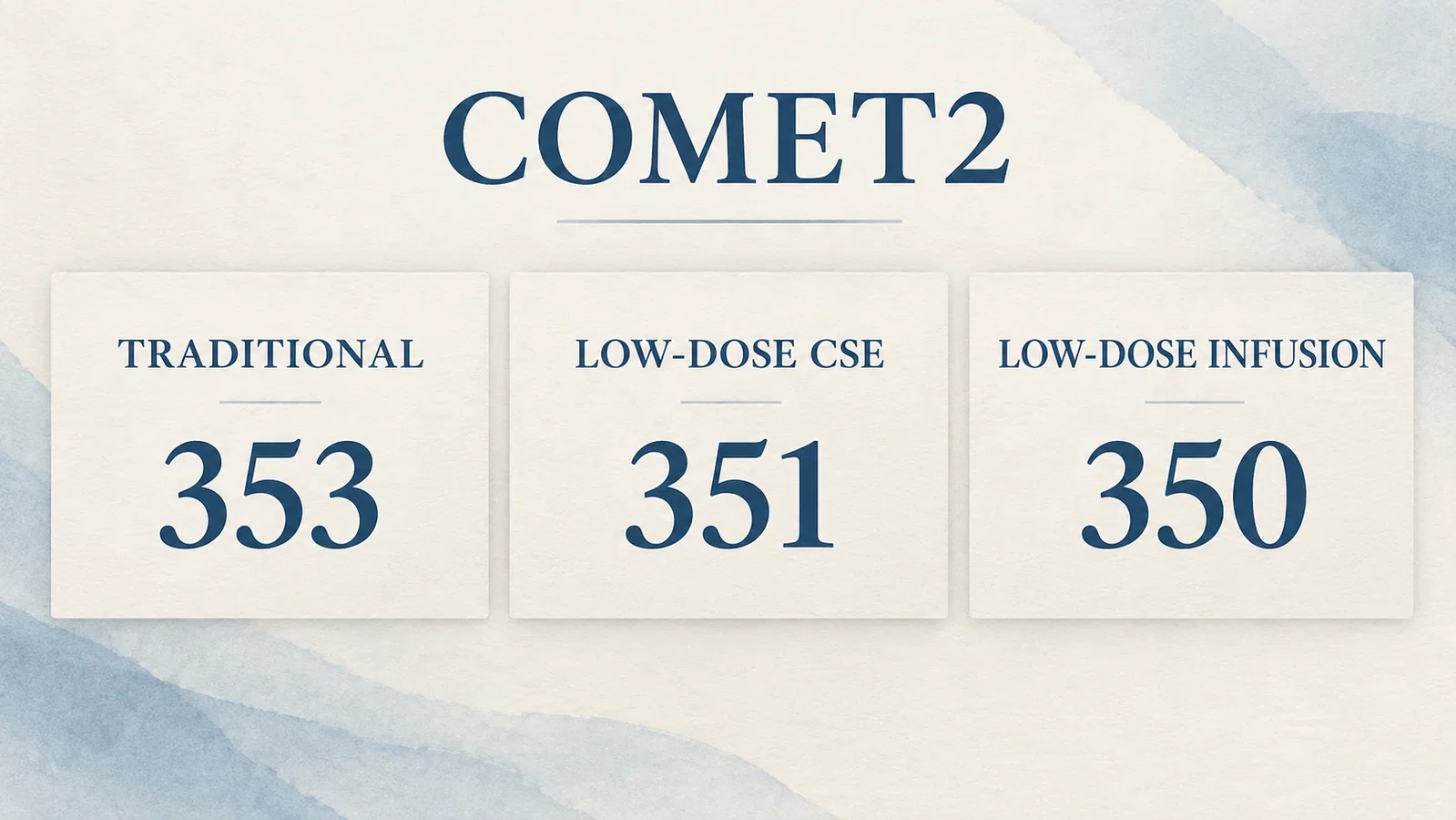
The three group sizes in COMET2, kept separate from the earlier COMET1 allocation problem.

Delivery mode and neonatal outcomes must be read together. The illustration does not suggest that every outcome improved significantly.
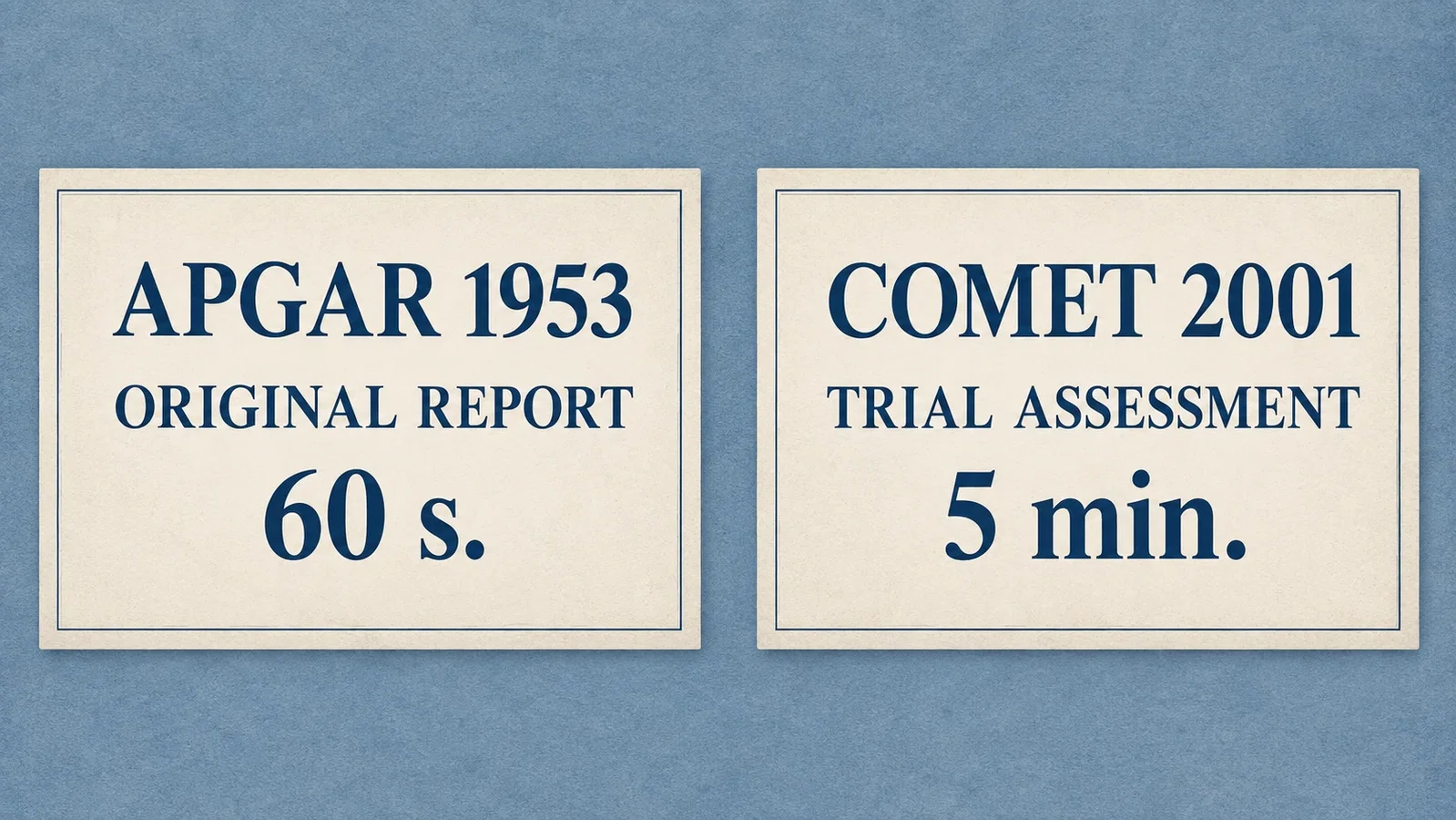
The 60-second observation in the 1953 report and COMET's five-minute assessment are distinguished; this is not a clinical resuscitation timer.
Sources and reading limits
- Comparative Obstetric Mobile Epidural Trial (COMET) Study Group UK. Effect of low-dose mobile versus traditional epidural techniques on mode of delivery: a randomised controlled trial. Lancet. 2001;358(9275):19–23. DOI:10.1016/S0140-6736(00)05251-X. Original journal PDF in a public archive. All five pages, including figures and tables, read; not a publisher-direct download.
- NLM PubMed 11454372. Bibliographic and abstract cross-check, not independent trial evidence.
- Apgar V. A proposal for a new method of evaluation of the newborn infant. Curr Res Anesth Analg. 1953;32:260–267. NLM original scan. Read from an archived copy; only pp.260–261 were read for this article.
Reading scope: five original COMET pages and two selected Apgar pages, seven different source pages. The bodies of four comments listed by NLM were not read. A later university impact statement was consulted, but its long-term findings and numerical impact estimates are not presented as results of the 2001 paper. The four images are modern editorial illustrations in the original landscape format.
Sources and reading limits are stated above. Illustrations are labelled as original source images or AI-made. Historical accounts are educational; they are not current treatment instructions.
Continue exploring
Related reading
Related reading connects shared questions and contexts; it does not by itself establish historical influence.