Notices, an editorial and a report in the British Journal of Anaesthesia, 1959-1960, and a BMJ notice: a faculty spanning both parts of Ireland, its first Dean, T. J. Gilmartin, the ceremony of 8 July 1960 and a first scientific meeting on the levels of anaesthesia.
Reading Library · Anesthesia Epochs · 中文版
Watch the education video (for clinicians)
1959: The RCSI Faculty of Anaesthetists — Two Routes In · Anesthesia Epochs Education Series
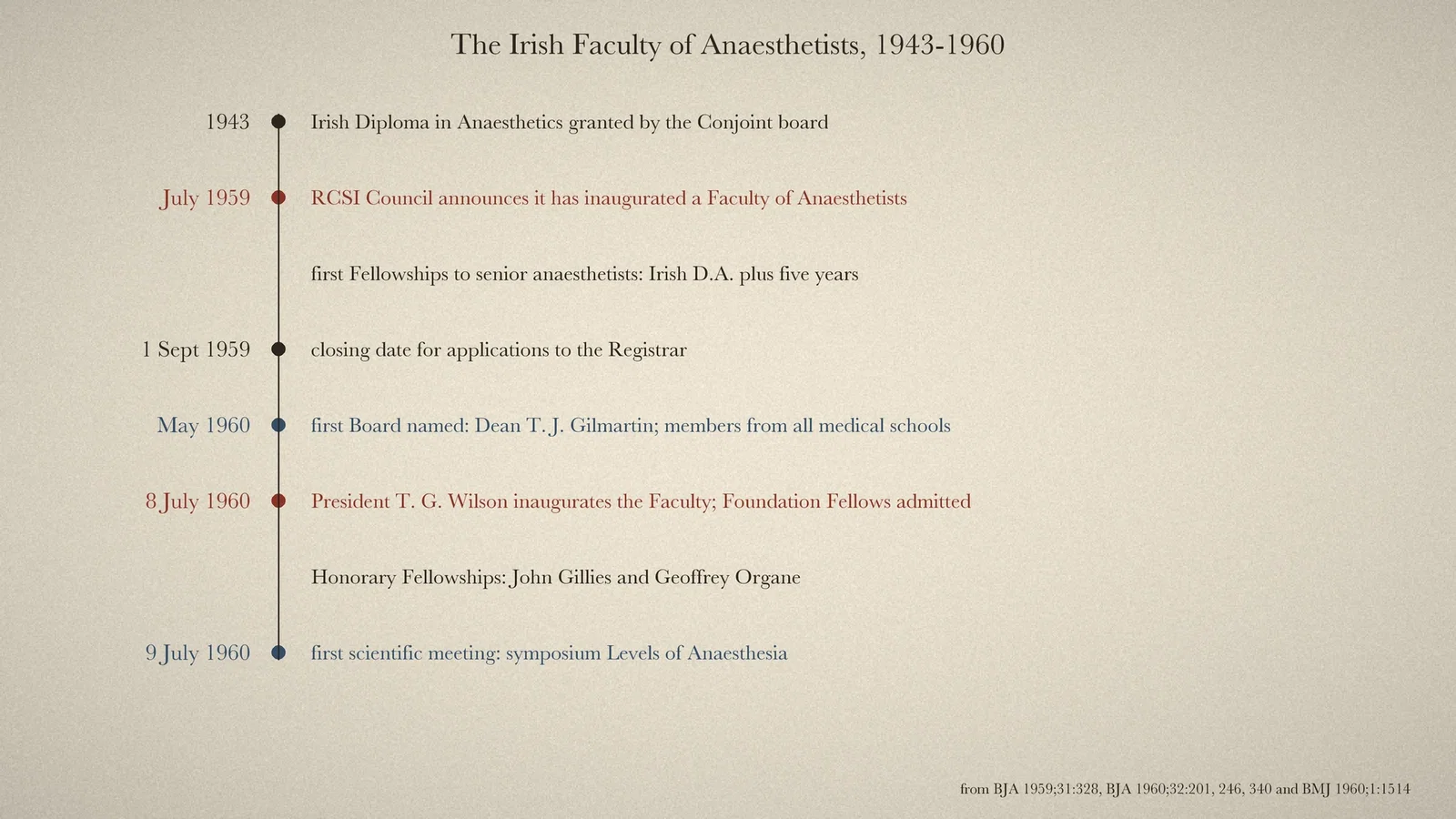
England's College of Surgeons had a Faculty of Anaesthetists that was twelve years old by 1960, and Australasia followed in 1952; this series covers the Australasian faculty. Ireland came next. The British Journal of Anaesthesia announced the Irish faculty in 1959, gave it an editorial in 1960 and reported its inauguration that summer. These short pieces show a faculty set up for a small country divided by a border and drawing its members from both sides.
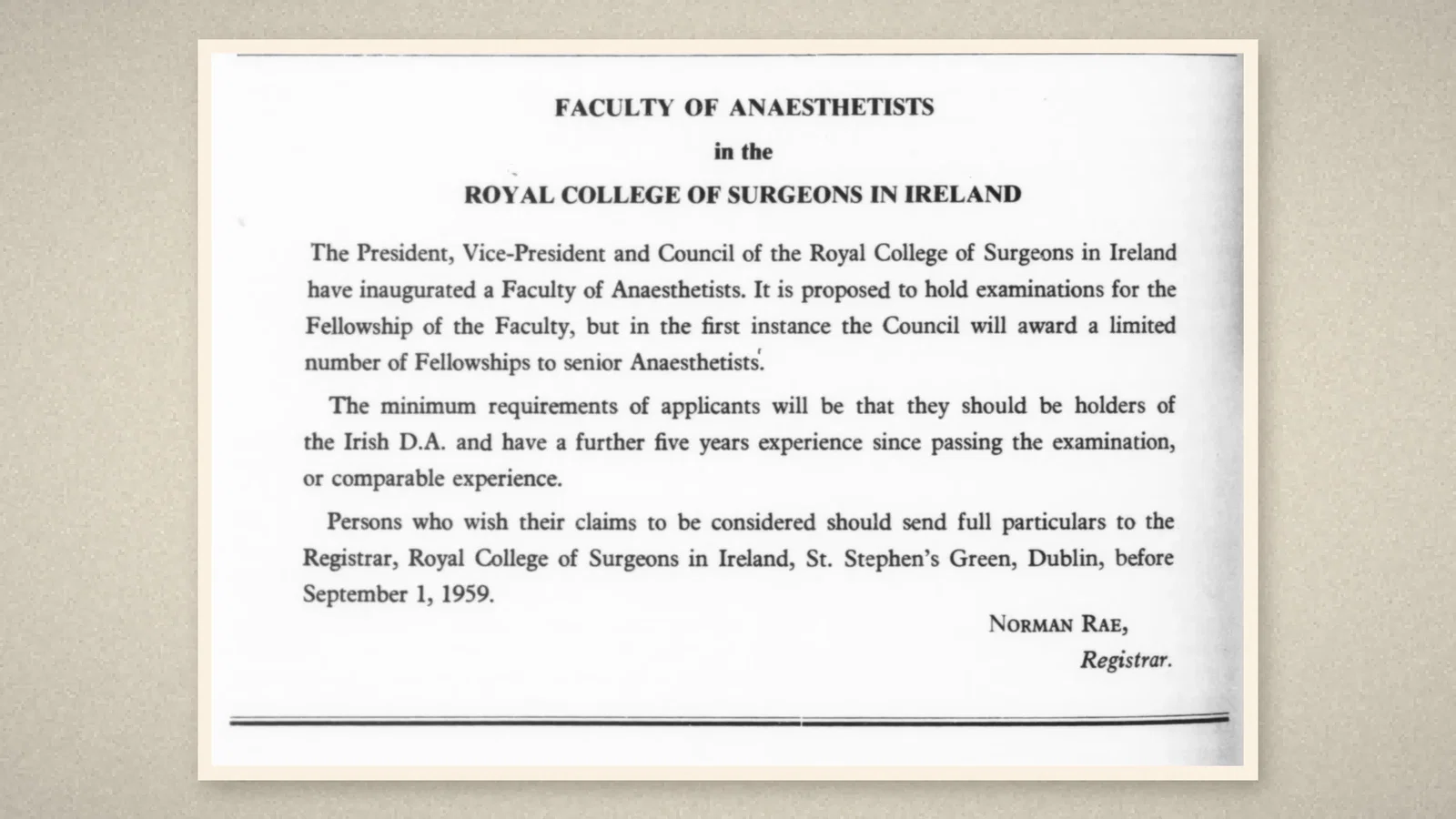
The announcement
In July 1959 the journal printed a notice signed by the College's Registrar, Norman Rae. "The President, Vice-President and Council of the Royal College of Surgeons in Ireland have inaugurated a Faculty of Anaesthetists." Examinations for the Fellowship were proposed, but "in the first instance the Council will award a limited number of Fellowships to senior Anaesthetists". [1, p. 328] Applicants had to hold "the Irish D.A. and have a further five years experience since passing the examination, or comparable experience". Applications were due at St Stephen's Green by 1 September 1959. [1, p. 328]
The editorial
In May 1960 the journal explained the background. A Diploma in Anaesthetics had been granted by the Conjoint board of the Royal Colleges of Physicians and Surgeons in Ireland "since 1943". It required a longer period of whole-time practice than the English diploma, with an alternative route for part-time anaesthetists who had given "more than 600 anaesthetics", half of them major. [2, p. 201] The English examination had changed twice since its start in 1935; the Irish one had not. [2, p. 201] The new Faculty's objects and constitution were "similar to those of its English predecessor", which had existed for twelve years. Its first Board was elected by the College Council and drew members from all the medical schools in the country. [2, p. 201]
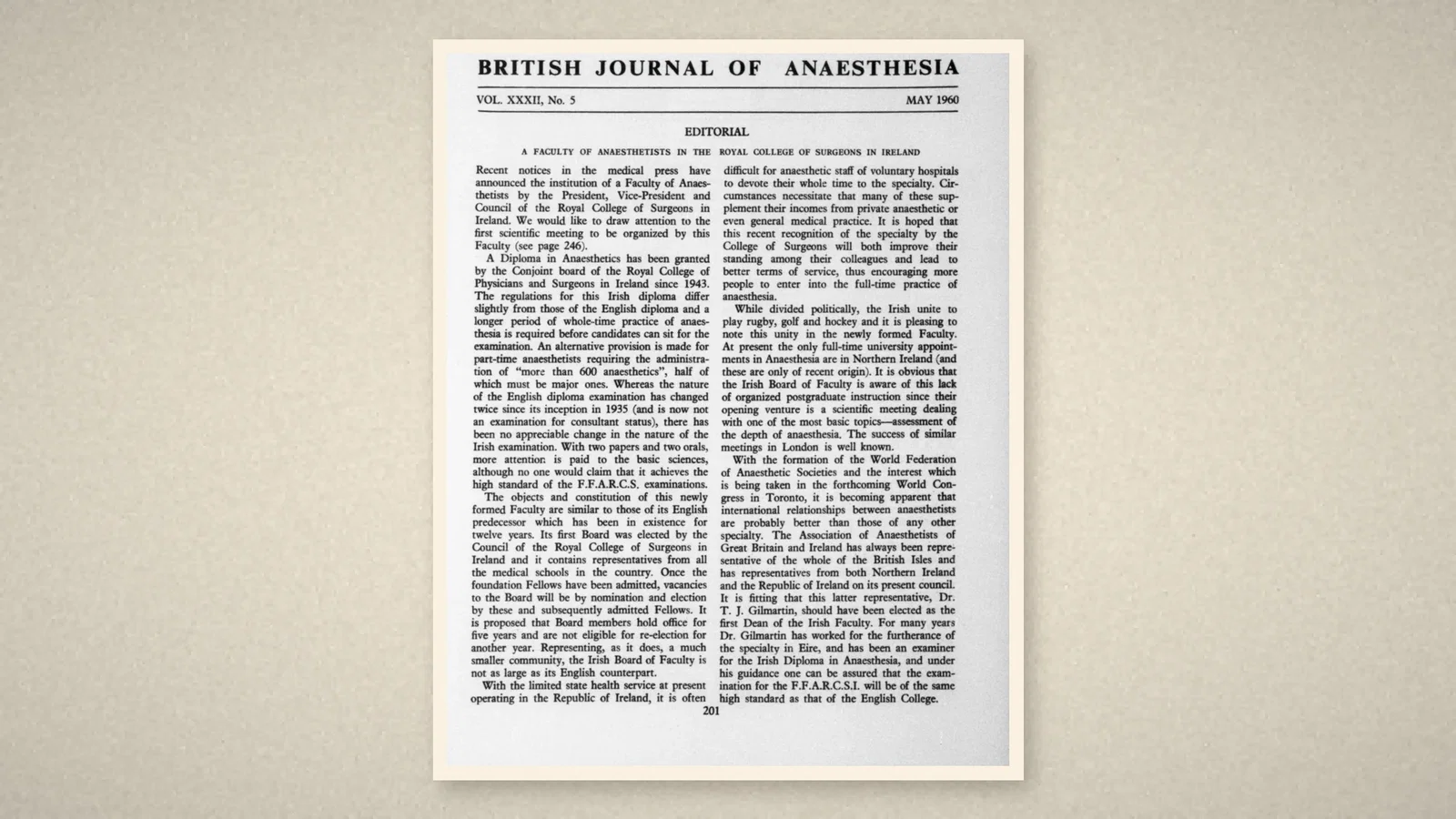
The editorial also described the working conditions. "With the limited state health service at present operating in the Republic of Ireland", many anaesthetists in voluntary hospitals had to supplement their incomes from private anaesthetic work or even general practice. It hoped that "this recent recognition of the specialty" would improve their standing and terms of service and bring more people into full-time anaesthesia. [2, p. 201] "While divided politically, the Irish unite to play rugby, golf and hockey", the editorial observed, and it was pleasing to see the same unity in the Faculty. At the time the only full-time university posts in anaesthesia were in Northern Ireland. [2, p. 201] The first Dean was T. J. Gilmartin, the Republic's representative on the council of the Association of Anaesthetists of Great Britain and Ireland and an examiner for the Irish Diploma. [2, p. 201]
The first Board and the inauguration
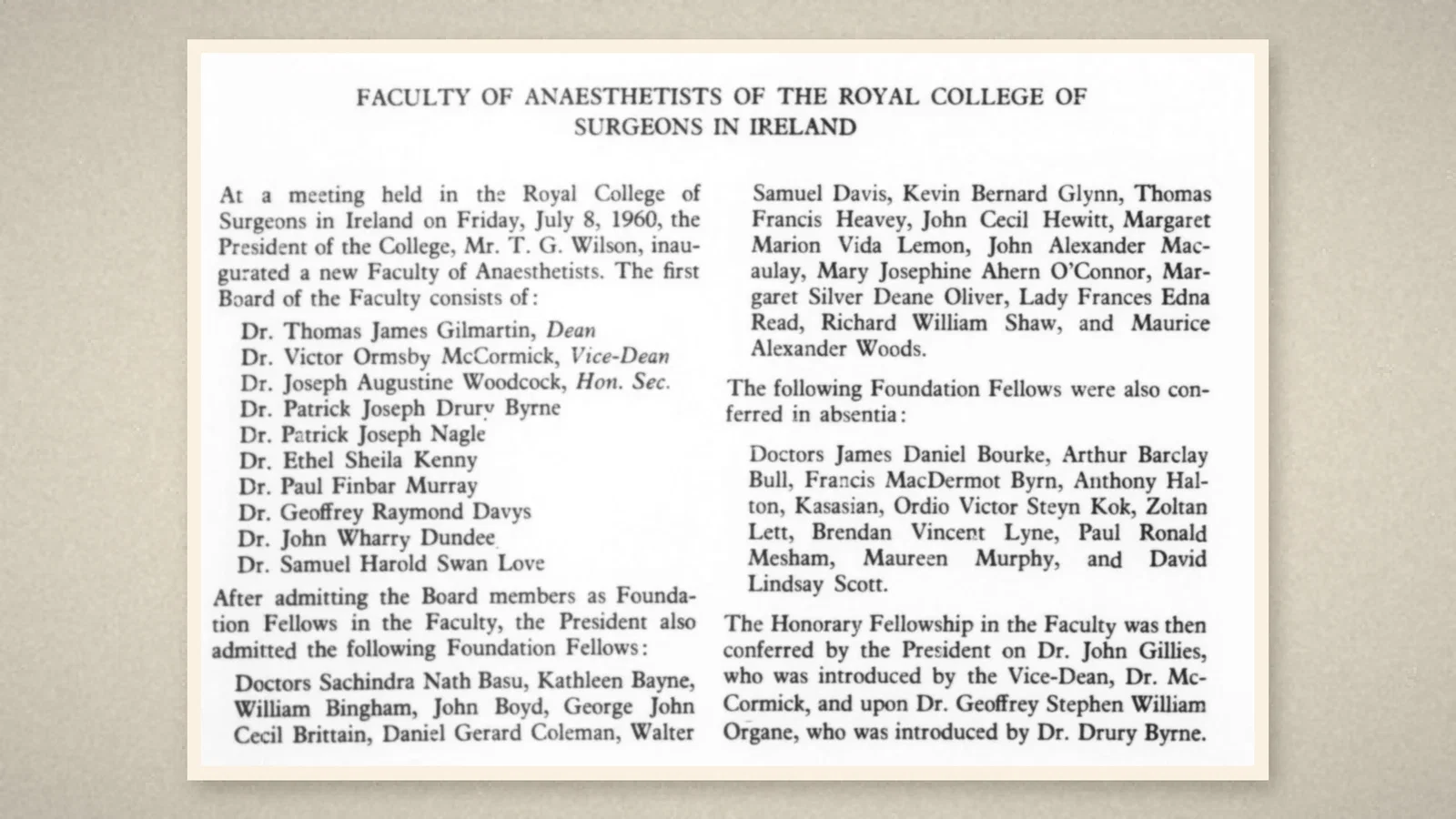
The British Medical Journal listed the first Board in May 1960. T. J. Gilmartin was Dean and V. C. McCormick Vice-Dean, with members who included J. W. Dundee and S. H. Love from Belfast. The Foundation Fellows were to be admitted on Friday 8 July 1960. [3, p. 1514] The BJA reported the event. On 8 July 1960 the President of the College, T. G. Wilson, "inaugurated a new Faculty of Anaesthetists". [4, p. 340] The Board, including Dr Ethel Sheila Kenny, was admitted first as Foundation Fellows. More Foundation Fellows were then admitted in person, and others in absentia. Honorary Fellowships went to John Gillies and Geoffrey Organe. [4, p. 340]
A first meeting on depth
The editorial noted that the Board seemed aware of the lack of organised postgraduate teaching, since its first venture was a scientific meeting on "the depth of anaesthesia". [2, p. 201] The programme announced a symposium, "Levels of Anaesthesia", at the College on Saturday 9 July 1960, the day after the inauguration. [2, p. 246] Speakers included Professor Cecil Gray of Liverpool on "Changing Concepts of the Levels of Anaesthesia", B. D. Wyke on the "Neurological Analysis of the Stages of Anaesthesia" and J. W. Dundee on the pharmacology of anaesthetics. [2, p. 246]
What the record shows
The Irish Faculty began by awarding fellowships to senior anaesthetists on the strength of a diploma Ireland had granted since 1943. Its Board was drawn from both parts of the island. Its first academic act was a day spent on the old question of how deeply a patient is anaesthetised.
Sources and reading limits
Read: the BJA notice of July 1959 (p. 328); the BJA editorial of May 1960 (p. 201) and the meeting programme (p. 246); the BMJ notice of 14 May 1960 (p. 1514); the BJA report of July 1960 (p. 340). All were read in full.
Not covered: the College's Council minutes, the Faculty's constitution, the Irish Journal of Medical Science (behind a publisher's bot check) and the College's own histories are not covered, and the symposium papers were not traced. The 1959 notice says the Council "have inaugurated" the Faculty; the formal ceremony was on 8 July 1960, and both dates are given. The BMJ prints the Vice-Dean's initials as "V. C."; the BJA gives the name as Victor Ormsby McCormick.
One illustration is a timeline drawn from the notices; three are crops of the journal pages.
- Faculty of Anaesthetists in the Royal College of Surgeons in Ireland. Br J Anaesth. 1959;31(7):328. Internet Archive
- A Faculty of Anaesthetists in the Royal College of Surgeons in Ireland [editorial]; Inaugural scientific meeting. Br J Anaesth. 1960;32(5):201, 246. Internet Archive
- Royal College of Surgeons in Ireland: Faculty of Anaesthetists. Br Med J. 1960;1(5184):1514. Internet Archive
- Faculty of Anaesthetists of the Royal College of Surgeons in Ireland. Br J Anaesth. 1960;32(7):340. Internet Archive
Continue exploring
Related reading connects shared questions and contexts; it does not by itself establish historical influence.
Anesthesia Epochs · The Source Room · About & Editorial Method
Published November 2, 2026. Sources and reading limits are stated above. Illustrations are labelled as original source images or AI-made. Historical accounts are educational; they are not current treatment instructions.