
An announcement in the British Journal of Anaesthesia, a BMJ news item and two society histories: negotiations between the Australian Society of Anaesthetists and the College, the inauguration of 25 August 1952, and where the sources disagree.
Reading Library · Anesthesia Epochs · 中文版
Watch the education video (for clinicians)
1952: The RACS Faculty of Anaesthetists — Who Was Invited? · Anesthesia Epochs Education Series
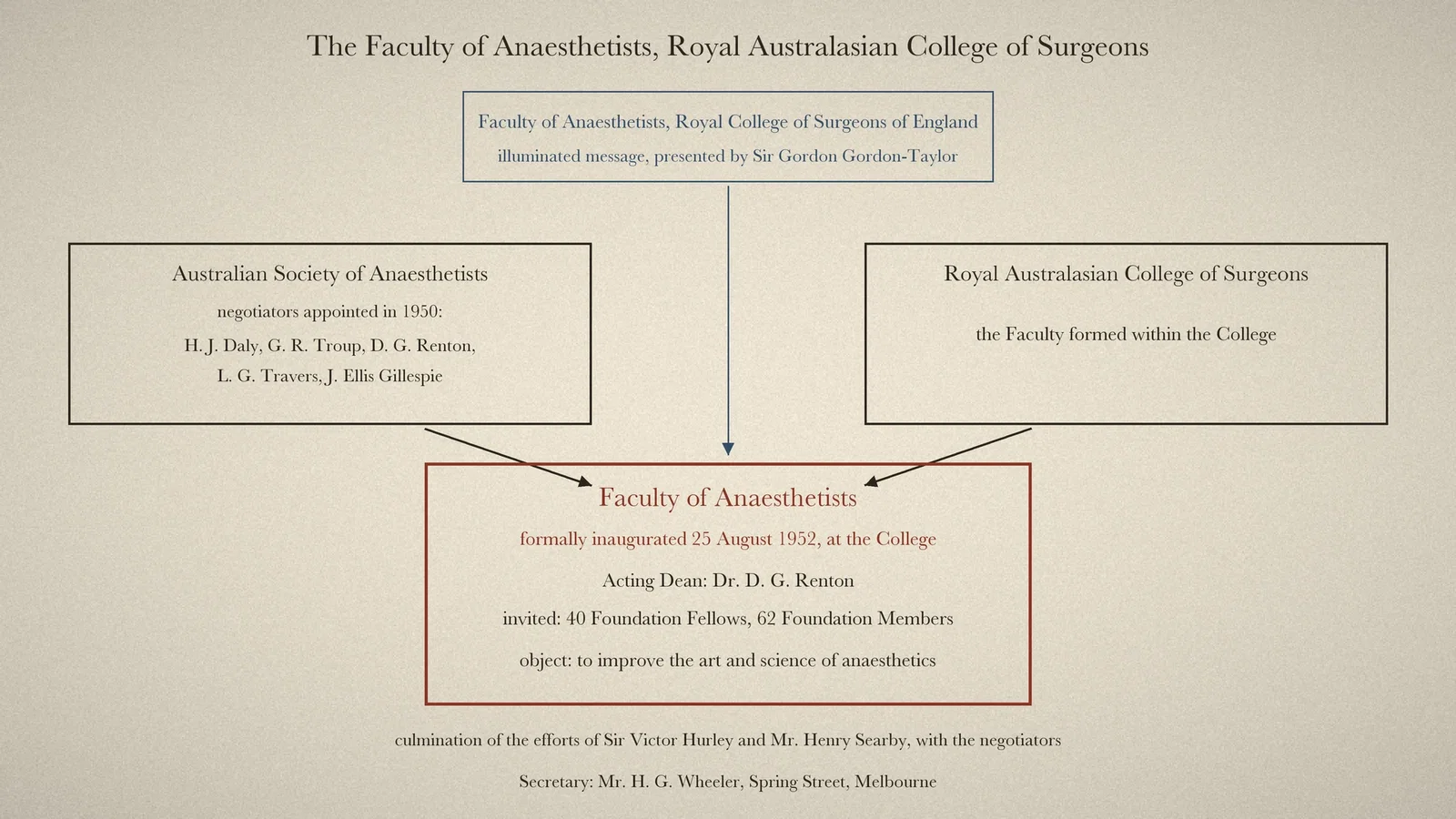
Australian anaesthetists already had a society in 1952, the Australian Society of Anaesthetists. What they did not have was an academic body inside a college, with fellowships and examinations, of the kind English anaesthetists had gained a few years earlier. In August 1952 one was set up within the Royal Australasian College of Surgeons. This article follows its founding through two notices printed in Britain at the time, a British editorial, and two later society histories that do not agree on every detail.
The announcement
The fullest contemporary account appeared in the British Journal of Anaesthesia in January 1953. "A Faculty of Anaesthetists within the Royal Australasian College of Surgeons was formally inaugurated on 25th August, 1952, at the College." At that meeting Sir Gordon Gordon-Taylor presented to the Faculty an illuminated message from the Faculty of Anaesthetists of the Royal College of Surgeons of England. The Faculty's object was "to improve, by all means possible, the art and science of Anaesthetics", and in this object "the College is most anxious to help". [1, p. 87]
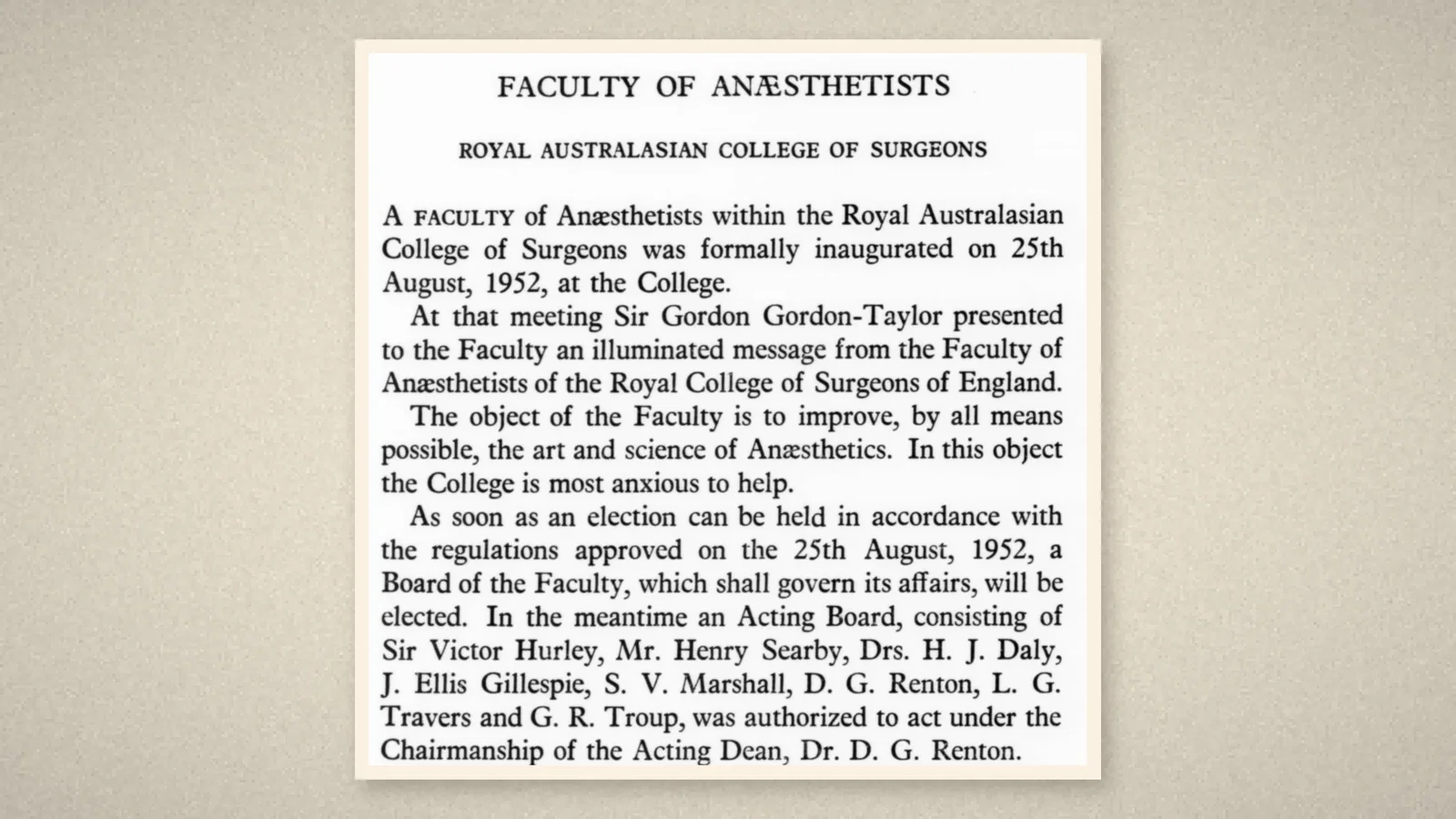
The regulations had been approved on the same day. Until a Board could be elected under them, an Acting Board ran the Faculty: Sir Victor Hurley, Henry Searby, and Drs H. J. Daly, J. Ellis Gillespie, S. V. Marshall, D. G. Renton, L. G. Travers and G. R. Troup, under the chairmanship of the Acting Dean, D. G. Renton. [1, p. 87]
The announcement explained how this had come about. The Faculty was "the happy culmination of the efforts of Sir Victor Hurley and Mr. Henry Searby", together with Drs Daly, Troup, Renton, Travers and Gillespie, "who were appointed by the Australian Society of Anaesthetists in 1950 to conduct the necessary negotiations with the College". With the Society's general approval, forty Foundation Fellows and sixty-two Foundation Members had been invited to join. [1, p. 87] Later members would apply, and the Board would recommend them to the College Council; the Board could also put forward a limited number of names each year for election to the Fellowship. The secretary was H. G. Wheeler, at the College in Spring Street, Melbourne. [1, p. 88]
The notice ended on the relation between the new body and the old one. The Australian Society was congratulated on wishing to establish a scientific body that it believed was "a natural development of that Association"; the Faculty's functions would be "essentially educational and academic", and would not in any way lessen the importance of the Society or its work. [1, p. 88]
In the British journals
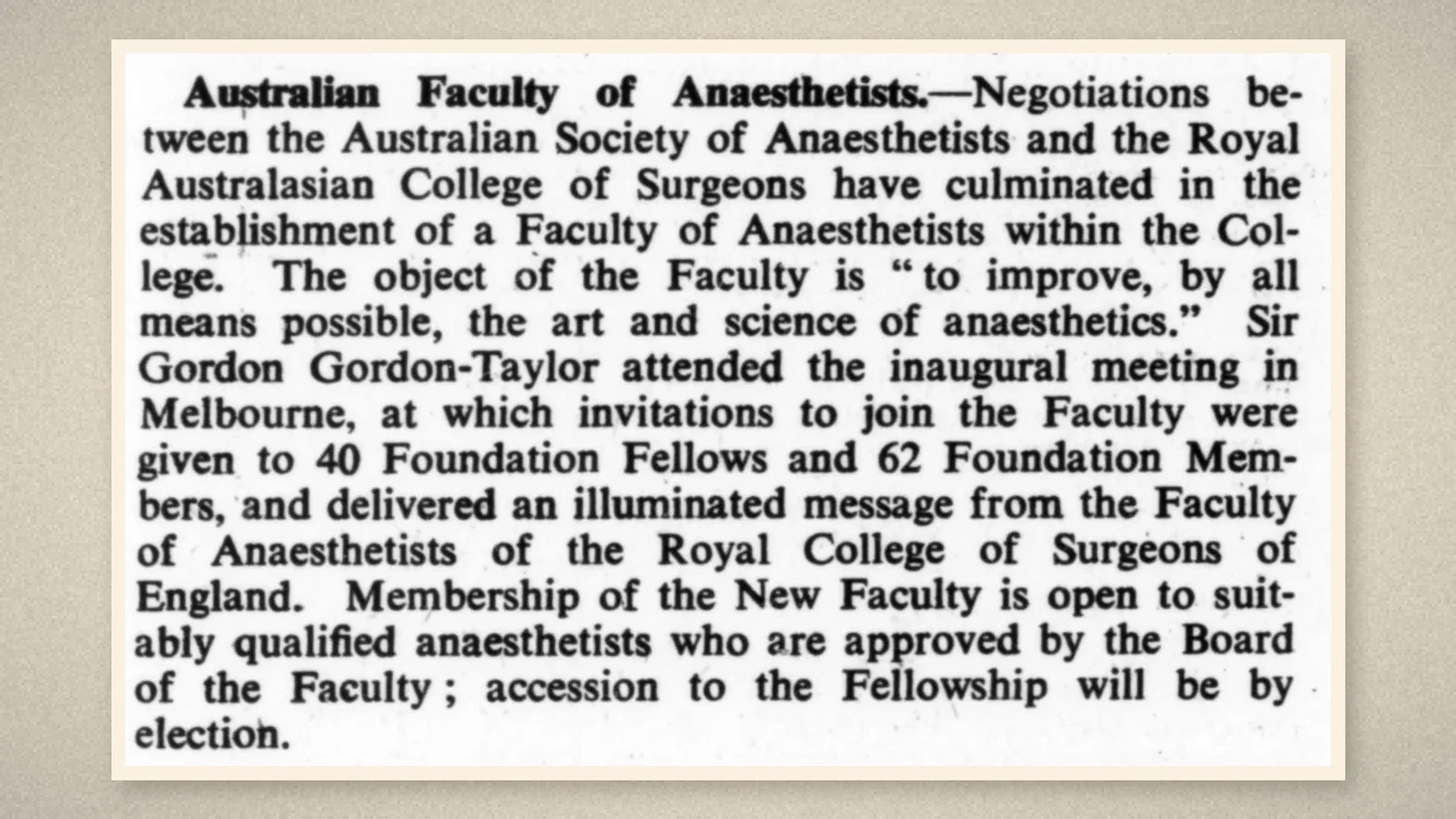
The British Medical Journal had already reported the news in its Medical News column on 15 November 1952. Negotiations between the Australian Society of Anaesthetists and the Royal Australasian College of Surgeons, it said, had culminated in a Faculty of Anaesthetists within the College. Gordon-Taylor had attended "the inaugural meeting in Melbourne", at which invitations were given to 40 Foundation Fellows and 62 Foundation Members, and had delivered the illuminated message from the English Faculty. Membership was open to suitably qualified anaesthetists approved by the Board; the Fellowship would be by election. [2, p. 1111]
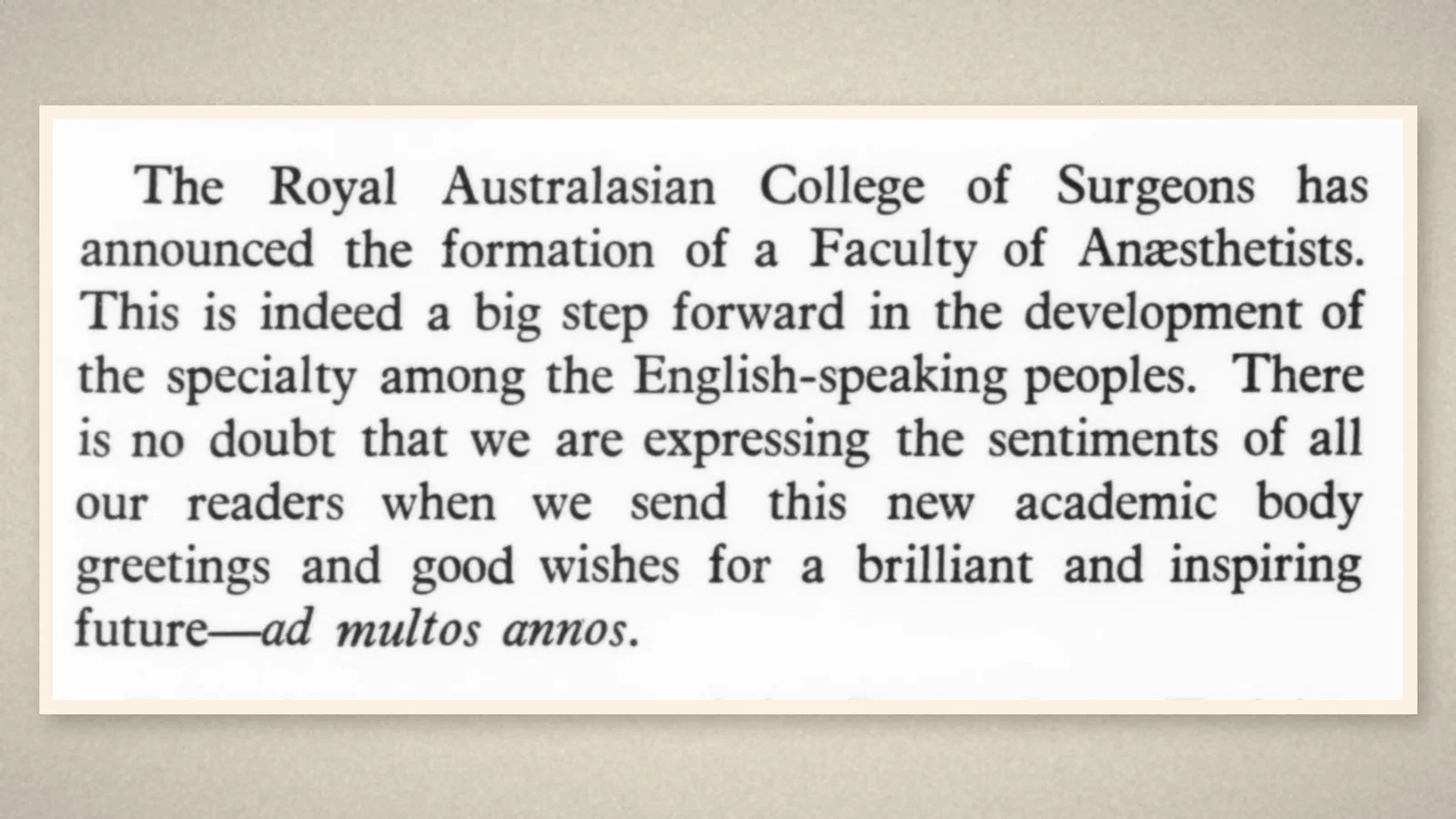
A month earlier, in October 1952, the British Journal of Anaesthesia had greeted the news in an editorial. The College's announcement was "indeed a big step forward in the development of the specialty among the English-speaking peoples", and the editors sent "this new academic body greetings and good wishes for a brilliant and inspiring future". [3, p. 231]
Across the Tasman
New Zealand anaesthetists had been watching. According to the New Zealand Society of Anaesthetists' history, at the Society's annual general meeting on 17 February 1950 "the question of more intimate contact with the Colleges of Surgeons was raised", since the English Faculty already existed and the Royal Australasian College of Surgeons "was already in discussions" with the Australian Society about a local Faculty. [4, p. 29] The August 1952 issue of the New Zealand Society's Newsletter printed the regulations of the new Faculty and its lists of Foundation Fellows and Members, "which included thirteen New Zealanders". [4, p. 69]
Where the sources disagree
The later accounts do not match the notices on three points. The New Zealand history says that "in December" 1952 the Faculty was formed, whereas the BJA gives a formal inauguration on 25 August. [4, p. 30] [1, p. 87] The Australian Society's timeline gives "69 founding members"; the BJA and BMJ say that 40 Foundation Fellows and 62 Foundation Members were invited, without saying how many accepted. [5, PDF p. 59] [2, p. 1111] And the New Zealand history dates the English Faculty to 1947, while the Australian timeline dates it to 1948. [4, p. 29] [5, PDF p. 56] The same timeline records that the Faculty's first Final examinations were held in Melbourne in 1956 with seven candidates, and the first Primary examinations in 1957 with five. [5, PDF p. 59]
What the record shows
The Faculty was made by agreement between an existing society and a surgical college, and was announced as an academic and educational body that would leave the society's work alone. Its first acting officers came from both sides, and an English Faculty only a few years old sent its greetings.
Sources and reading limits
Read: the BJA announcement of January 1953 (pp. 87-88), the BMJ news item of 15 November 1952 (p. 1111) and the BJA editorial of October 1952 (p. 231); the New Zealand Society's history Safety Through Knowledge (1998), pp. 29-30 and 69; the Australian Society of Anaesthetists' history timeline (2024).
Not covered: no Australian report of 1952 (such as the Medical Journal of Australia), no College council minutes, no copy of the regulations or of the lists of Foundation Fellows and Members, and not the illuminated message itself. The college's own history is not covered. The notices do not say what posts Hurley and Searby held, and none is assigned here. The BMJ calls the meeting at which invitations were given the inaugural meeting in Melbourne but gives no date. The disagreements listed above are reported as found and are not resolved.
One illustration is a diagram drawn from the BJA and BMJ notices; three are crops of the journal pages.
- Faculty of Anaesthetists, Royal Australasian College of Surgeons. Br J Anaesth. 1953;25(1):87-8. Internet Archive
- Australian Faculty of Anaesthetists [Medical News]. Br Med J. 1952;2(4793):1111. Internet Archive
- Editorial. Br J Anaesth. 1952;24(4):231. Internet Archive
- Hutchinson BR, Gibbs JM, Newson AJ. Safety Through Knowledge: A Fifty Year History of the New Zealand Society of Anaesthetists. Auckland: New Zealand Society of Anaesthetists; 1998. pp. 29-30, 69. NZSA
- Australian Society of Anaesthetists. Anaesthesia History Timeline. 2024. PDF
Continue exploring
Related reading connects shared questions and contexts; it does not by itself establish historical influence.
Anesthesia Epochs · The Source Room · About & Editorial Method
Published November 2, 2026. Sources and reading limits are stated above. Illustrations are labelled as original source images or AI-made. Historical accounts are educational; they are not current treatment instructions.