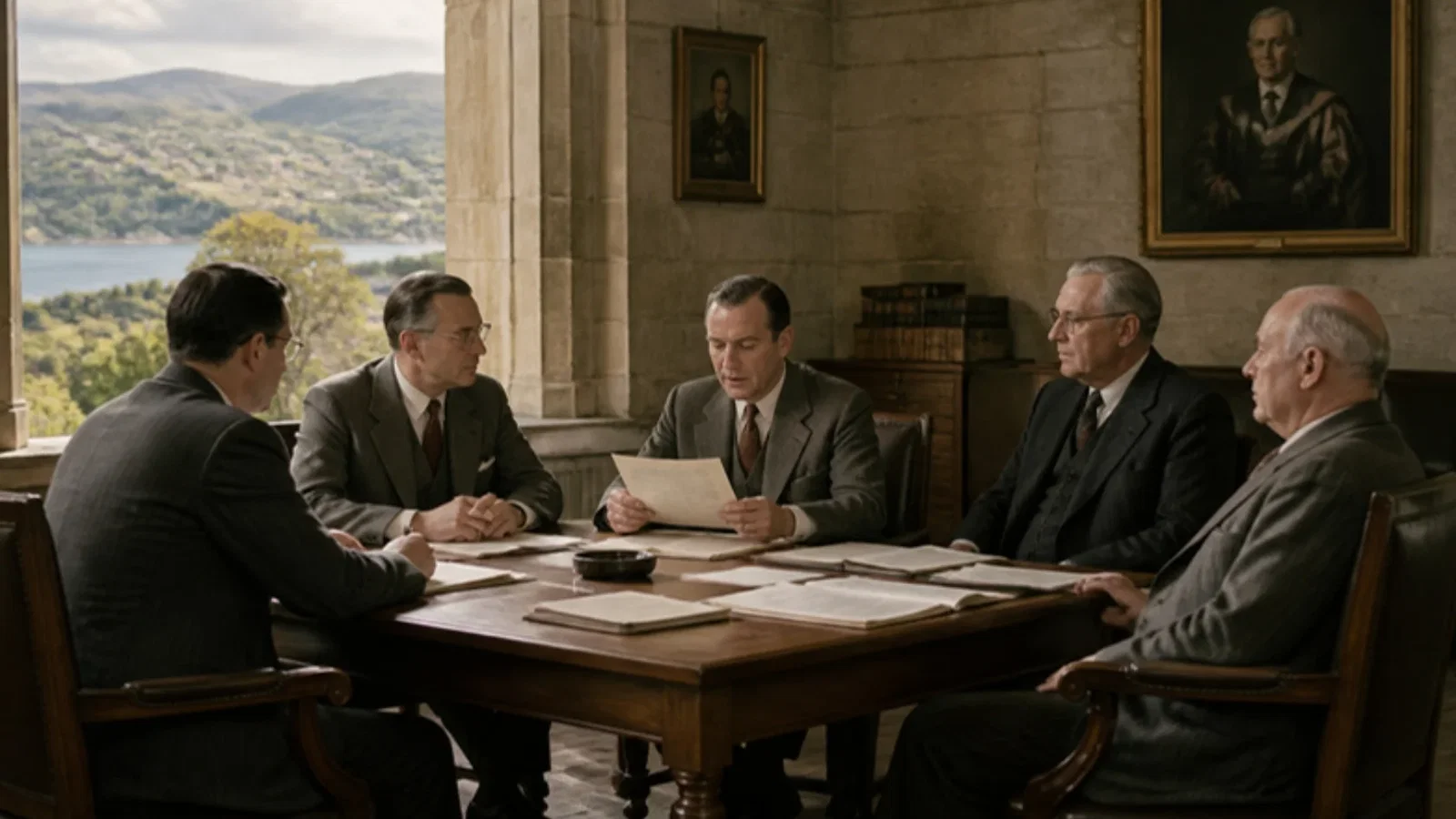
From a letter of 1939 to a meeting on 5 February 1948: the minutes, the medical journal notice and the first newsletter, as reproduced in the Society's fifty-year history.
Reading Library · Anesthesia Epochs · 中文版
Watch the education video (for clinicians)
1948: The New Zealand Society of Anaesthetists — Formed in Dunedin · Anesthesia Epochs Education Series
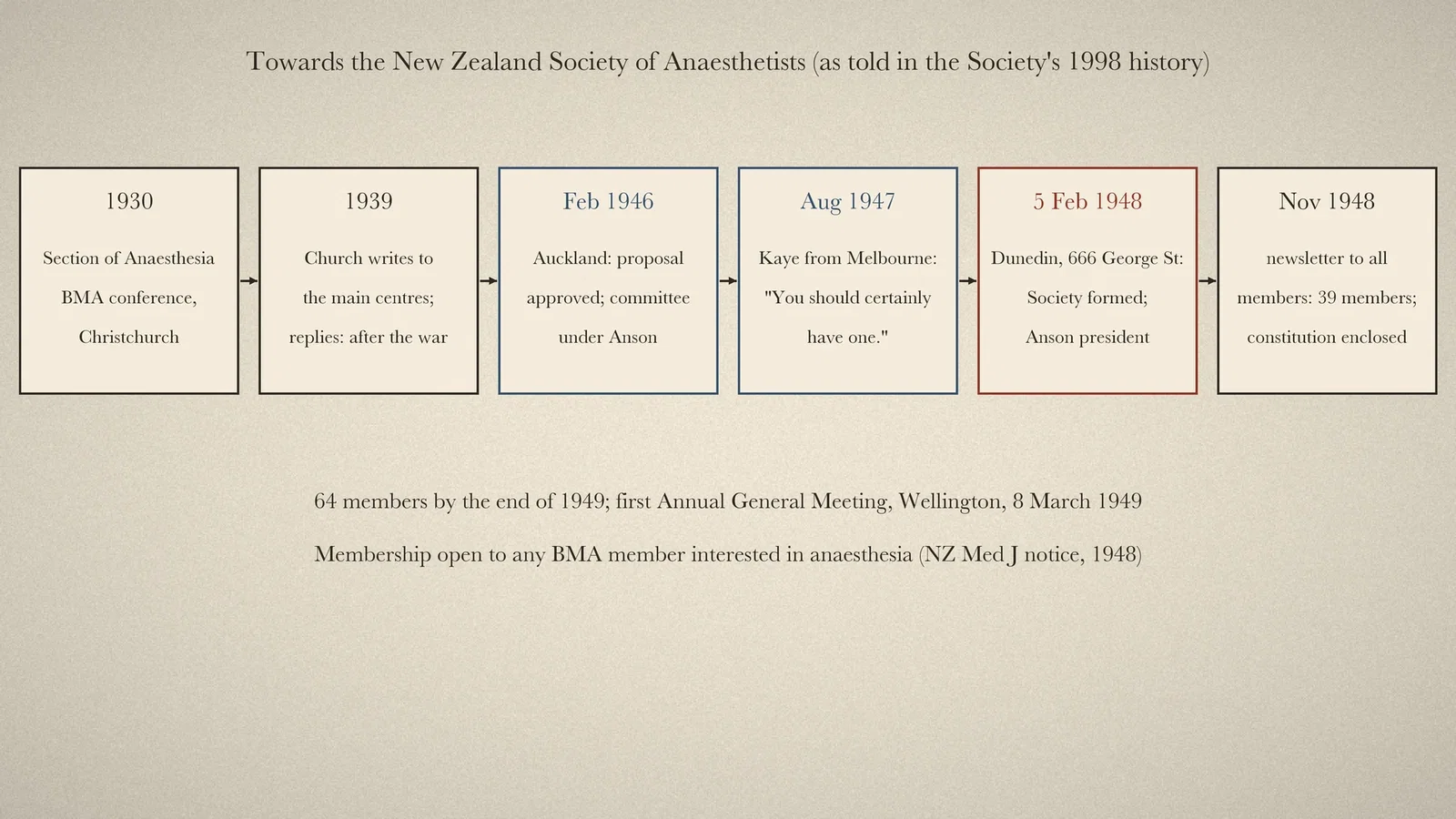
The New Zealand Society of Anaesthetists (NZSA) dates its founding to a meeting in Dunedin on 5 February 1948. The Society's own fifty-year history, Safety Through Knowledge (1998), called this "late by world standards". [1, p. 23] Contemporary records of the founding could not be read in their original form for this article. The 1998 history, however, reproduces three of them: the first page of the minutes, the notice printed in the New Zealand Medical Journal, and the first newsletter sent to members. This article is built on those reproductions and on the history's narrative, and it reads them as what they are: documents chosen and presented by the Society itself.
A letter in 1939
According to the history, a Section of Anaesthesia was formed at the BMA (New Zealand Branch) conference in Christchurch on 21 February 1930. [1, p. 24] F. W. Fullerton later recalled that, after an early meeting had elected officers and collected five shillings from each member, "that was the last we ever heard of the Society". [1, p. 25]
In 1939 James S. Church, an anaesthetist in New Plymouth, wrote to leading anaesthetists in the main centres suggesting a New Zealand society. Church's original letter has not been preserved, the history says, but three replies survive, from Marion Whyte, senior anaesthetist at Dunedin Hospital, from Eric Anson and from Fullerton. All suggested that "until the war was over, it would be difficult to achieve anything". [1, p. 23]
From Auckland to Dunedin
At the BMA conference in Auckland on 15 February 1946, anaesthetists proposed a New Zealand society within the Branch, "modelled on the already formed Australian Society", and elected a committee under the chairmanship of G. F. V. (Eric) Anson. [1, p. 25] Throughout 1947 the committee worked on it, and Anson sought advice from Geoffrey Kaye in Melbourne. Kaye's reply of 13 August 1947, quoted in the history, began: "You should certainly have one." Kaye warned against "an exclusive mutual-admiration society of DA's" and urged the widest possible membership. [1, p. 25–26] During 1947 local societies were formed in Wellington and Christchurch. [1, p. 26]
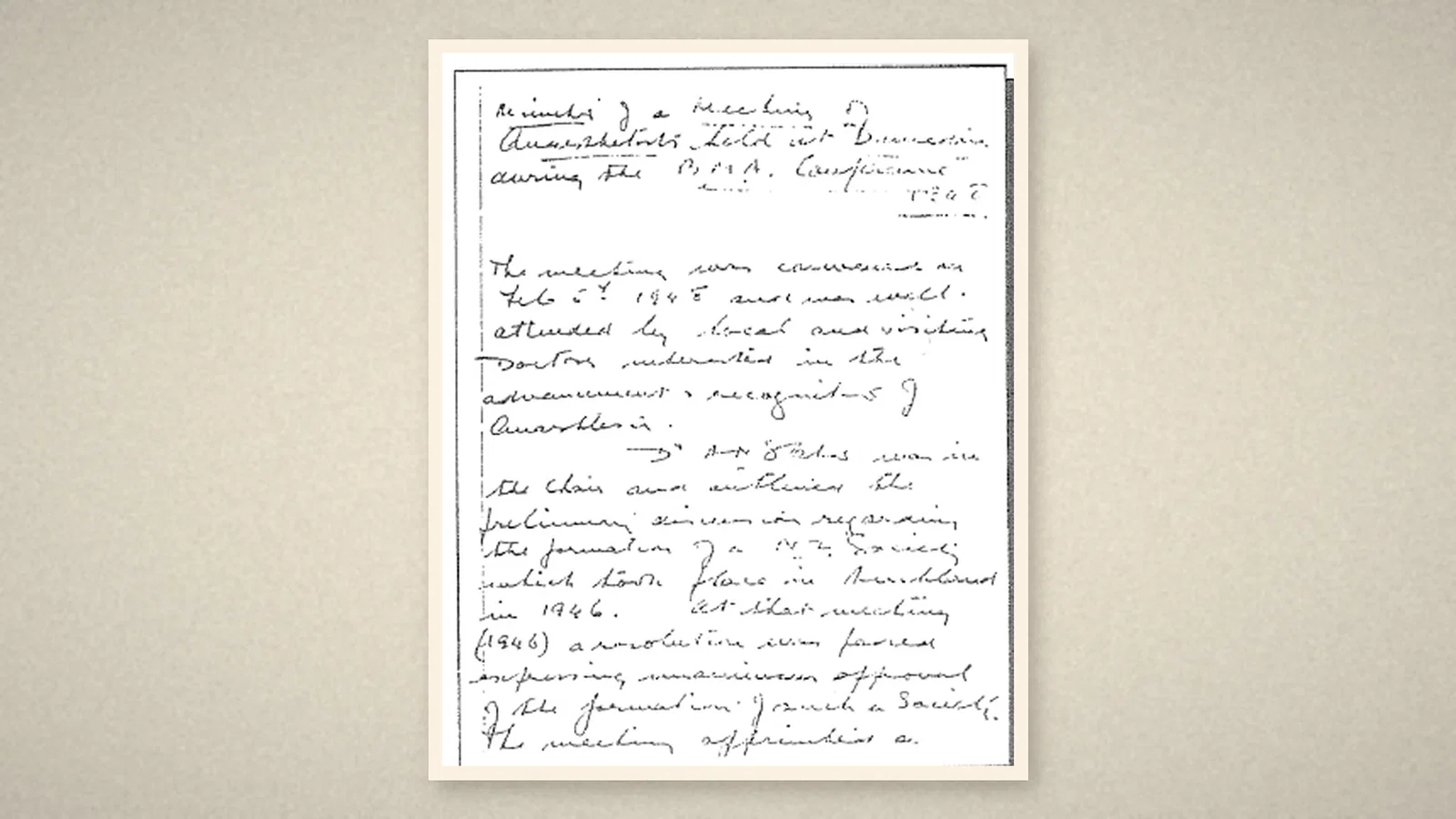
At the Biennial Conference in Dunedin in February 1948, the history records, a meeting was held at John Ritchie's house, 666 George Street, where it was unanimously agreed to form the Society within the BMA and to seek the Branch's sanction; R. H. Orton of Melbourne, guest speaker at the Section, had been invited to attend. [1, p. 26–27] The first page of the handwritten minutes, reproduced in the book, records that the meeting was convened on 5 February 1948, that it was well attended by local and visiting doctors interested in the advancement and recognition of anaesthesia, and that A. N. Slater, in the chair, recalled the 1946 resolution approving such a society. [1, p. 27] The officers elected were G. F. V. Anson of Auckland, president; A. A. Tennent of Wellington, vice-president; and A. N. Slater of Wellington, secretary-treasurer. [1, p. 27]
What the Society said about itself
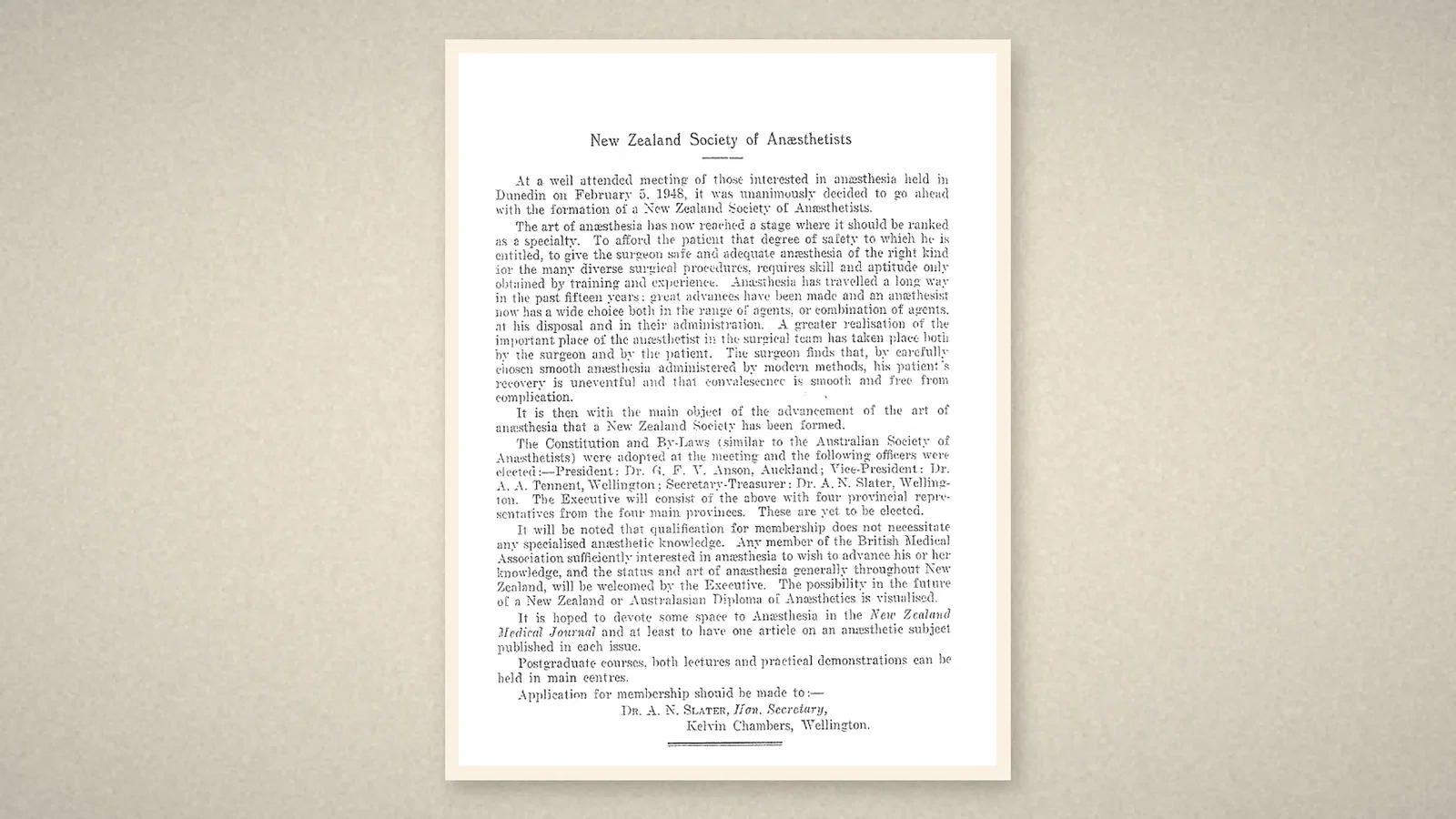
The notice published in the New Zealand Medical Journal, reproduced in the history, gave the Society's reasons in its own words. The art of anaesthesia had "reached a stage where it should be ranked as a specialty"; safe anaesthesia for the many kinds of surgery required skill and aptitude obtained only by training and experience. A constitution similar to the Australian Society's had been adopted. Membership did not require any specialised knowledge: any member of the BMA sufficiently interested in anaesthesia would be welcome. The notice looked forward to a New Zealand or Australasian Diploma of Anaesthetics, to an anaesthetic article in every issue of the journal, and to postgraduate courses in the main centres. [1, p. 28]
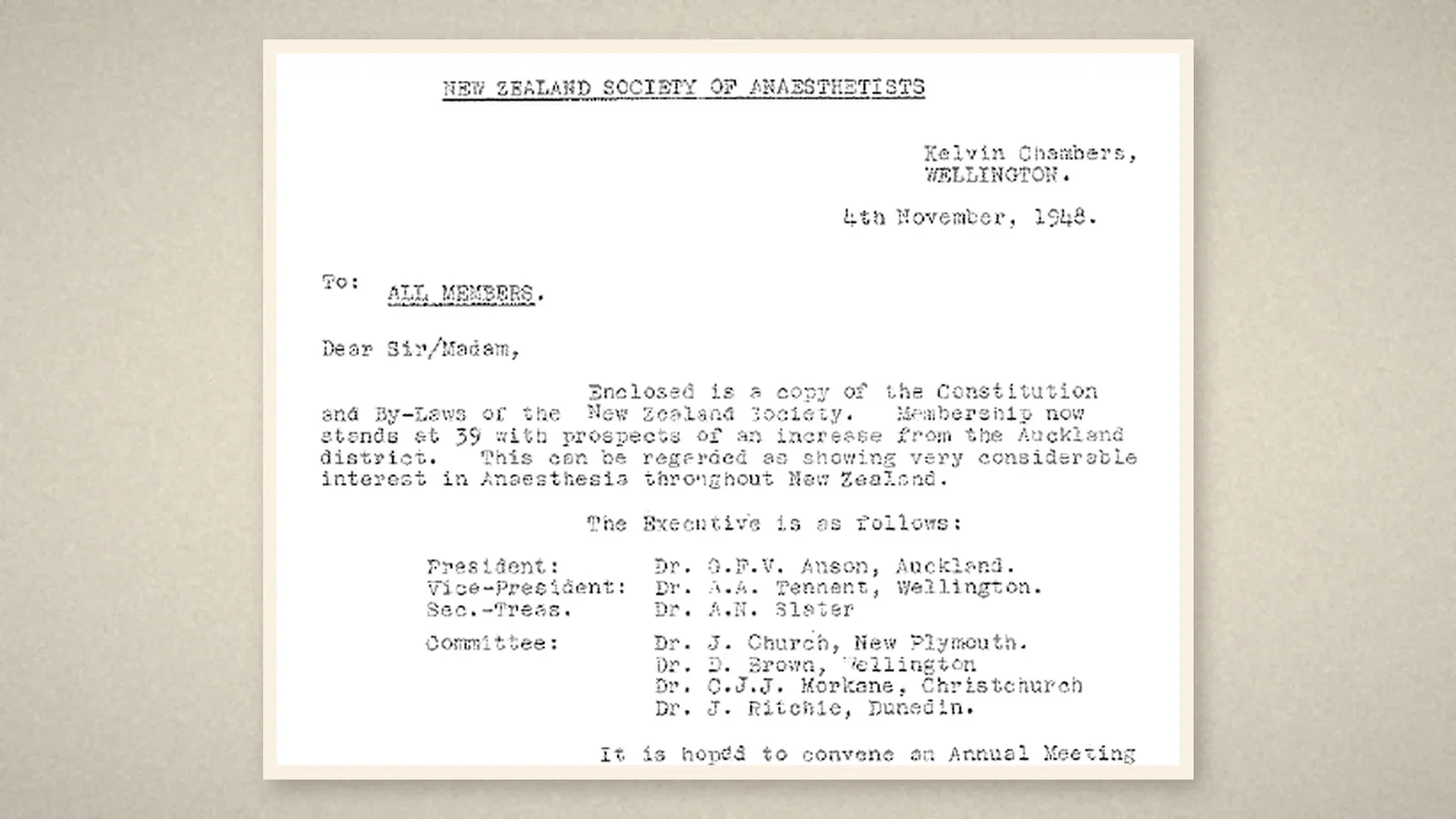
The first newsletter sent to all members, dated 4 November 1948 from Kelvin Chambers, Wellington, enclosed the constitution and reported that membership "now stands at 39", with an increase expected from Auckland. It listed the executive and a committee of four, among them James Church, and noted the Royal Australasian College of Surgeons' growing interest in anaesthetic societies. [1, p. 68] By the end of 1949 there were 64 members, and the first Annual General Meeting was held in Wellington on 8 March 1949. [1, p. 28] On the Society's website the subscription is given as one guinea a year, and the first constitution's aims as improving the status of anaesthesia, promoting education, exchanging ideas, encouraging research and encouraging publication. [2]
What the record shows
A society proposed in a letter of 1939 waited out the war, was approved in principle in 1946, took advice from Australia, and was formed in a private house in Dunedin in 1948. Its first public statement was that anaesthesia should be ranked as a specialty, and in the same breath it opened membership to any interested doctor. The Society became an incorporated body only in 1961. [2]
Sources and reading limits
Read: Safety Through Knowledge, chapter 2 (pp. 23–29) and the opening of chapter 4 (pp. 68–69), including the reproductions of the first page of the minutes of 5 February 1948, the New Zealand Medical Journal notice and the newsletter of 4 November 1948, read from the page images; the NZSA website's History page. The book's PDF, no longer at its address on the Society's website, was retrieved from the Wayback Machine.
Not covered: the original New Zealand Medical Journal of 1948 (cited in the book as vol. 47, p. 160) could not be found online, so the notice is known only from the book's reproduction. The rest of the minutes, the newsletter of 16 March 1948 and the replies to Church are known only from the book. Papers Past, the New Zealand newspaper archive, showed a human-verification check and was not searched. The book is the Society's official history, written by members; where it is the only source, its statements are attributed to it.
One illustration is drawn from the book; three are crops of the documents it reproduces.
- Hutchinson BR, Gibbs JM, Newson AJ. Safety Through Knowledge: A Fifty Year History of the New Zealand Society of Anaesthetists. Auckland: New Zealand Society of Anaesthetists; 1998. Wayback Machine
- New Zealand Society of Anaesthetists. History [Internet]. Wellington: NZSA; [cited 2026 Nov 1]. anaesthesia.nz
Continue exploring
Related reading connects shared questions and contexts; it does not by itself establish historical influence.
- 1945: Sydney Opens a Diploma Course in Anaesthesia
- 1935: Geoffrey Kaye Counts the Patients Who Died Under Anaesthesia
- 1932: The Association of Anaesthetists of Great Britain and Ireland Forms
Anesthesia Epochs · The Source Room · About & Editorial Method
Published November 2, 2026. Sources and reading limits are stated above. Illustrations are labelled as original source images or AI-made. Historical accounts are educational; they are not current treatment instructions.