
From the coroner's archives and the hospital's operation registers, an anaesthetist finds preventable deaths and writes six recommendations.
Reading Library · Anesthesia Epochs · 中文版
Watch the education video (for clinicians)
1935: Geoffrey Kaye Counts the Deaths Under Anaesthesia · Anesthesia Epochs Education Series
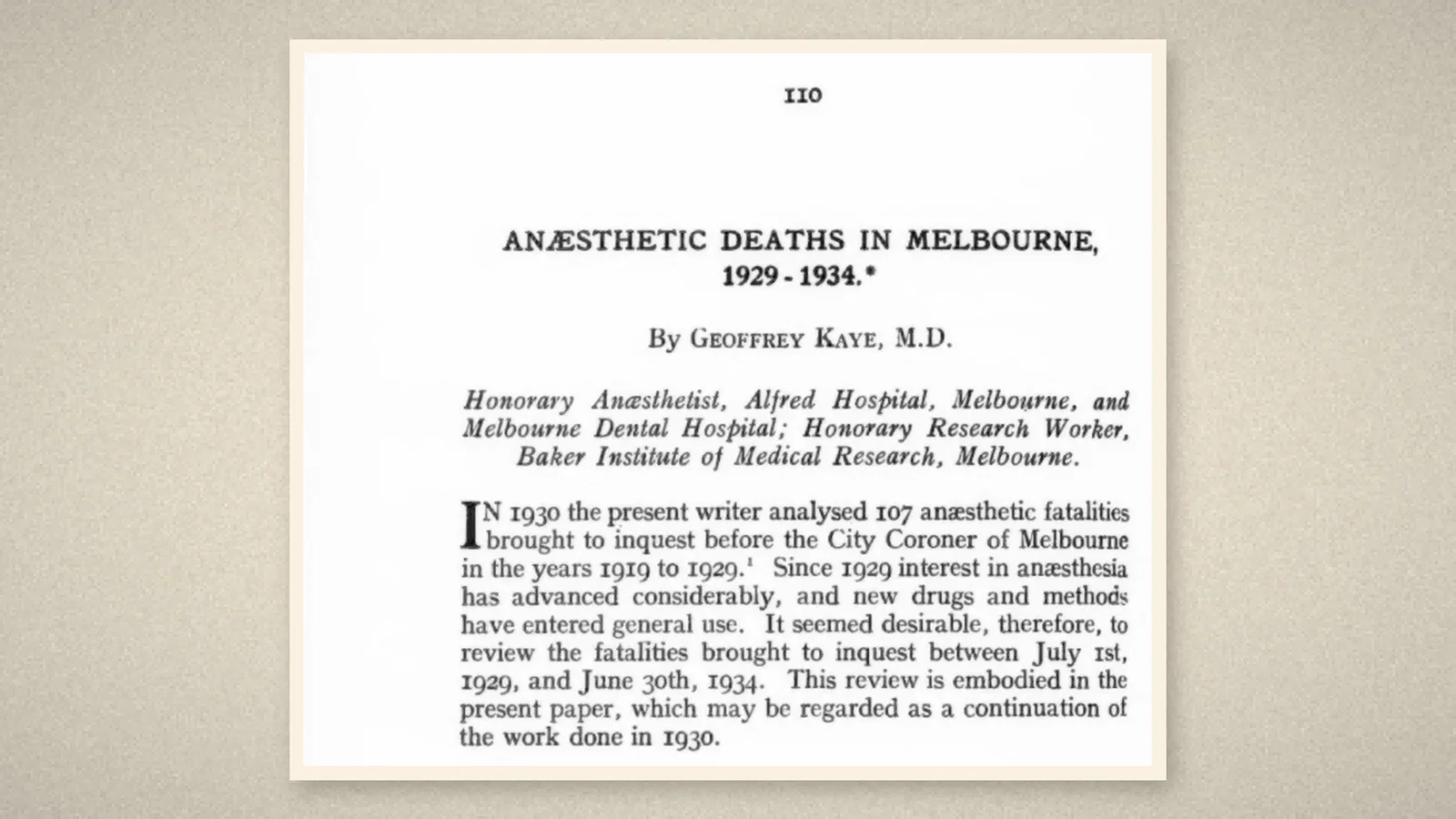
Departments now review every death and serious complication after anaesthesia. In the 1930s Geoffrey Kaye of Melbourne tried to do this for a whole city. On 17 September 1935 Kaye presented to the Australian Society of Anaesthetists a review of anaesthetic deaths, published in the British Journal of Anaesthesia in April 1936. [1, p. 110] Kaye signed it as Honorary Anaesthetist to the Alfred Hospital and the Melbourne Dental Hospital, and Honorary Research Worker at the Baker Institute of Medical Research. [1, p. 110]
Five years of inquests
"In 1930 the present writer analysed 107 anaesthetic fatalities brought to inquest before the City Coroner of Melbourne in the years 1919 to 1929." Since then new drugs and methods had come into use, so Kaye reviewed the deaths brought to inquest from July 1929 to June 1934. [1, p. 110] Of the 25 cases, 16 deaths occurred in public hospitals and six in private ones; in three, the drug had apparently been taken with suicidal intent. [1, p. 110]
Kaye was careful about what the numbers meant. The yearly average of inquests had fallen from 10.7 to 5.0, but "not every anaesthetic death comes to inquest". [1, p. 111] The City Coroner told Kaye that the coroner now held no inquest when the pathologist's findings and the doctors' statements showed that the anaesthetic was proper and only a minor factor: "I have been moved by motives of economy". [1, p. 111] The inquest series was therefore a selected one, weighted toward cases where the coroner was not satisfied.
For a truer rate Kaye went to the operation registers of Kaye's own hospital. In 1919–1929, 13,400 in-patient operations had a death rate "on the table" of 1.8 per 1,000; in 1929–1934, among 17,757 operations, it was 1.3 per 1,000. That meant "eight fewer fatalities than would have occurred at the 1929 death-rate". [1, p. 111–112] Gas anaesthesia showed the highest rate, 6 per 1,000 in 2,255 cases, because it was "selected for the worst anaesthetic risks". [1, p. 112]
Preventable deaths
Then Kaye went through the inquests case by case. Chloroform had caused three deaths, all during induction; in one, chloroform was chosen so that diathermy could be used, "a choice by no means obligatory in a metropolitan hospital in the year 1933". [1, p. 113–114] Other deaths followed ether sequences, gas, spinal anaesthesia and local anaesthetics.
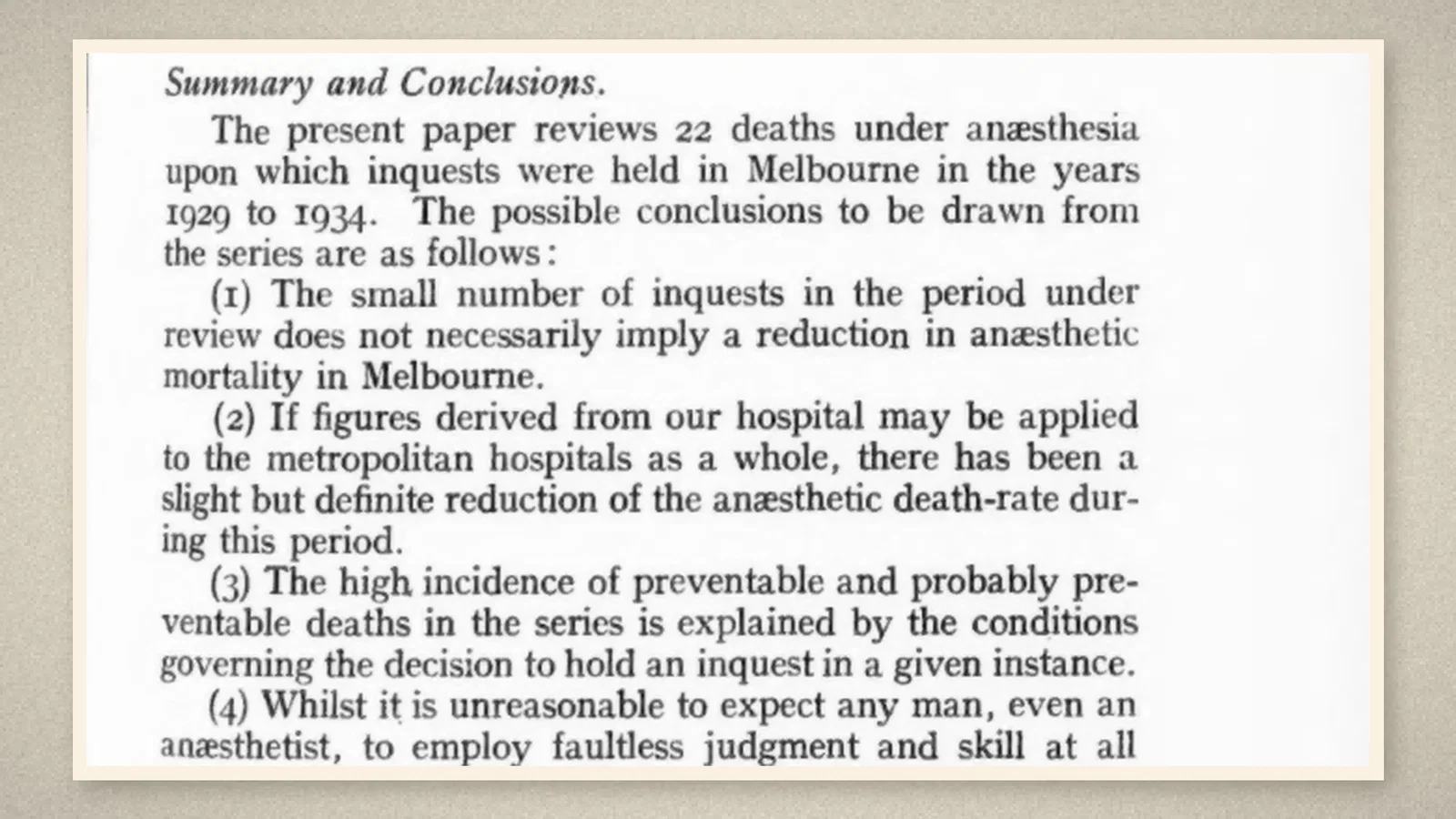
The summary was plain. The paper reviewed "22 deaths under anaesthesia" upon which inquests were held. The fall in inquests did not prove that mortality had fallen, but if the hospital's figures applied to the metropolitan hospitals generally, there had been "a slight but definite reduction" in the death rate. And "several lives were lost during 1929 and 1934 because of gross errors in anaesthetic technique", such as suffocation by inhaled blood during recovery or an overdose of carbon dioxide. [1, p. 125–126]
Six recommendations
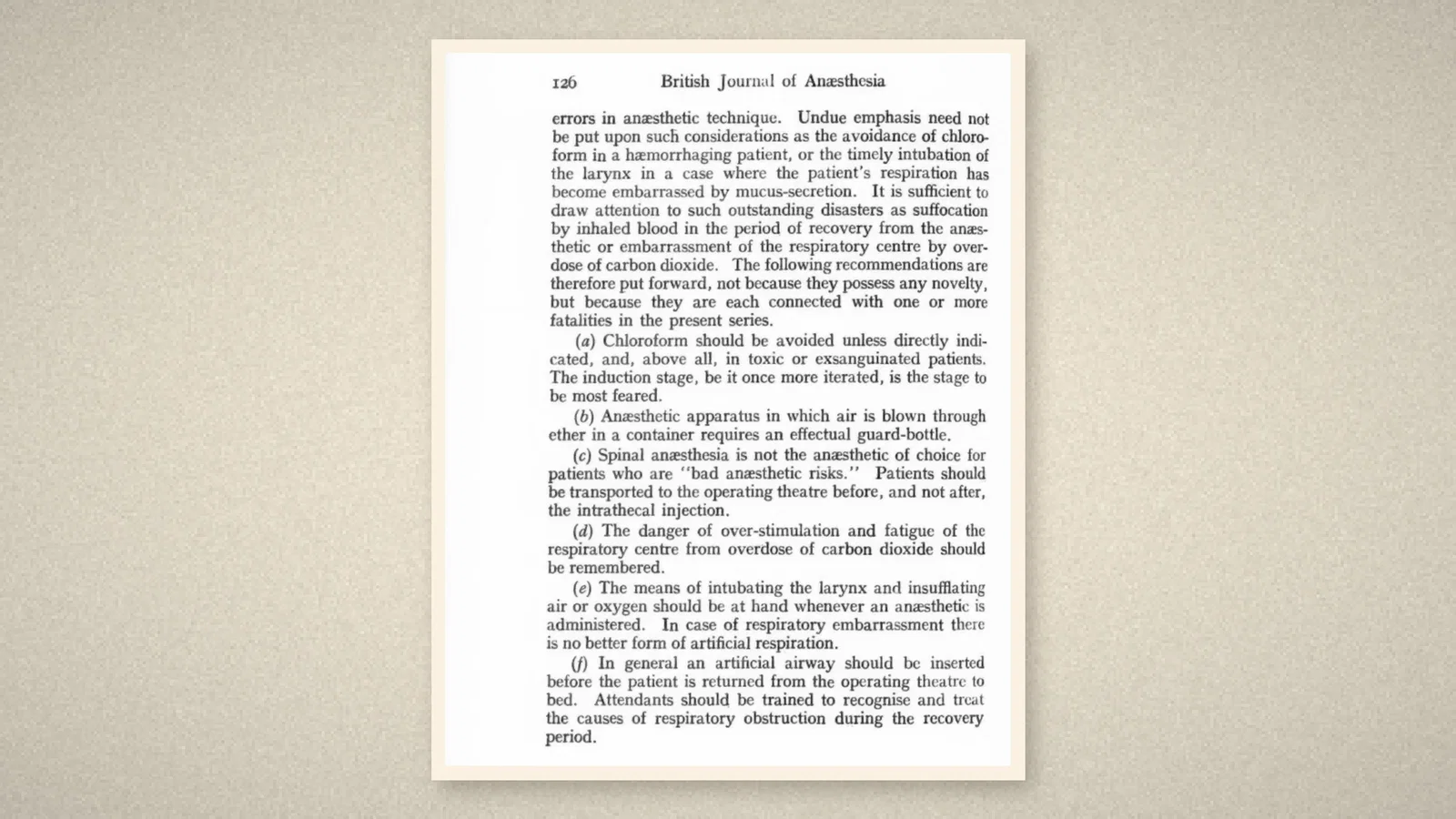
Kaye offered the recommendations "not because they possess any novelty, but because they are each connected with one or more fatalities". Chloroform "should be avoided unless directly indicated", above all in toxic or exsanguinated patients; "the induction stage, be it once more iterated, is the stage to be most feared". Apparatus that blew air through ether needed an effectual guard-bottle. Spinal anaesthesia "is not the anaesthetic of choice" for bad risks. The danger of carbon dioxide overdose should be remembered. "The means of intubating the larynx and insufflating air or oxygen should be at hand whenever an anaesthetic is administered." And an artificial airway "should be inserted before the patient is returned from the operating theatre to bed", with attendants trained to recognise obstruction in recovery. [1, p. 126] Kaye thanked the City Coroner and the Registrar-General for access to the official archives. [1, p. 126]
Ten years later: the Society's secretary
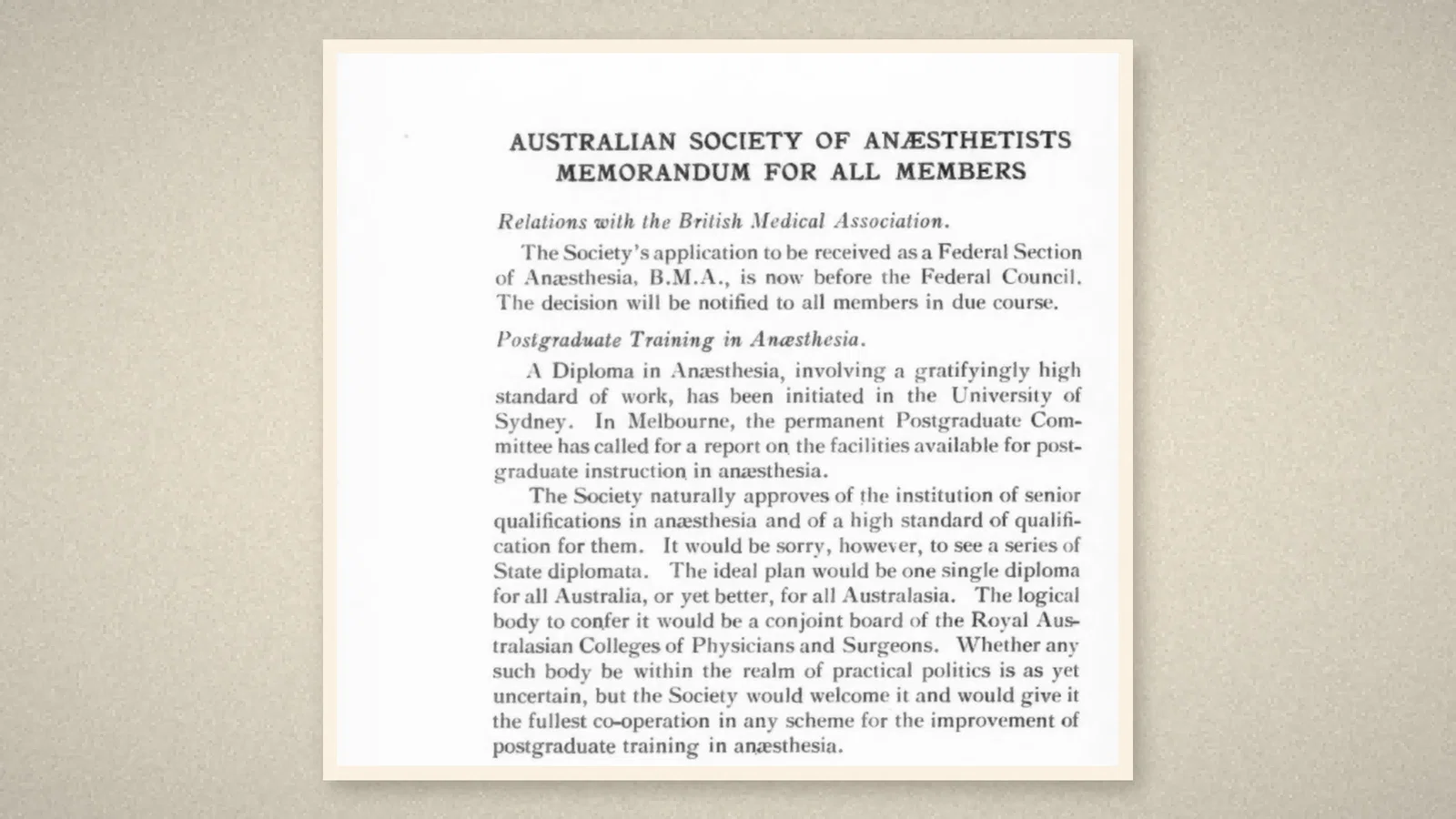
In 1946 Kaye signed a memorandum to all members as Honorary Secretary of the Australian Society of Anaesthetists, from 14 Collins Street, Melbourne. [2, p. 78] The Society had applied to become a Federal Section of the British Medical Association. A Diploma in Anaesthesia had begun at the University of Sydney. The Society approved of senior qualifications but "would be sorry, however, to see a series of State diplomata": "the ideal plan would be one single diploma for all Australia, or yet better, for all Australasia", conferred by a conjoint board of the Royal Australasian Colleges of Physicians and Surgeons. [2, p. 76] The memorandum also thanked Laurette McMechan for back numbers of Anesthesia and Analgesia, asked members to search their shelves for old books "to complete the Society's historical collection", and reported a showing of Magill's teaching films in July 1945. [2, p. 76–77]
What the record shows
An honorary hospital anaesthetist went to the coroner's archives and the hospital's own registers, separated what the numbers could and could not show, and turned each preventable death into a rule: avoid chloroform, fear the induction, keep intubation equipment ready, secure the airway before the patient leaves the theatre. Ten years later the same anaesthetist was arguing for one standard of training across Australasia.
Sources and reading limits
Read: Kaye, BJA 1936, pp. 110–127, in full; Kaye's ASA memorandum, BJA 1946, pp. 76–78.
Not covered: Practical Anaesthesia (1932), Wilson's history of the Society (1984), Westhorpe and Ball (2003), the RCoA biography and the ASA timeline are not covered. Kaye's 1928–1930 study tour is reported in Kaye's travel papers of 1931 and 1932, which were found but not read. The sources read do not document a 1927 appointment as a full-time specialist, the tour with Magill and Waters, the first Australian textbook, cylinder standards, organizing the Society's founding or the museum in Kaye's home. The paper gives 25 cases (including three suicides) and, in its summary, 22 deaths under anaesthesia; both are as printed.
All four illustrations are crops of the 1936 and 1946 journal pages.
- Kaye G. Anaesthetic deaths in Melbourne, 1929-1934. Br J Anaesth. 1936;13(3):110-27. Internet Archive
- Kaye G. Australian Society of Anaesthetists: memorandum for all members. Br J Anaesth. 1946;20(2):76-8. Internet Archive
Continue exploring
Related reading connects shared questions and contexts; it does not by itself establish historical influence.
- 1913: Hornabrook's Album, an Anaesthetist as Subject
- 1906: A Melbourne Certificate for Six Anaesthetics
- 1927: Ralph Waters Joins Wisconsin with a Three-Year Residency
Anesthesia Epochs · The Source Room · About & Editorial Method
Published November 2, 2026. Sources and reading limits are stated above. Illustrations are labelled as original source images or AI-made. Historical accounts are educational; they are not current treatment instructions.