The NSW Post-Graduate Committee's course for a Diploma in Anaesthesia opens in March 1945; Geoffrey Kaye's Embley Memorial Lecture the same year sets out how little anaesthesia was taught in Australia.
Reading Library · Anesthesia Epochs · 中文版
Watch the education video (for clinicians)
1945: Sydney's Diploma — Kaye's 'Cinderella of the Specialities' · Anesthesia Epochs Education Series
Anaesthetists in Australia and New Zealand now pass through years of organised specialist training and examinations. In 1945 almost none of it existed. This article rests on two items in the Medical Journal of Australia: a notice in February 1945 of a diploma course in anaesthesia in Sydney, and the Melbourne anaesthetist Geoffrey Kaye's assessment, in the E. H. Embley Memorial Lecture of the same year, of how anaesthesia was organised and taught in Australia.
A notice
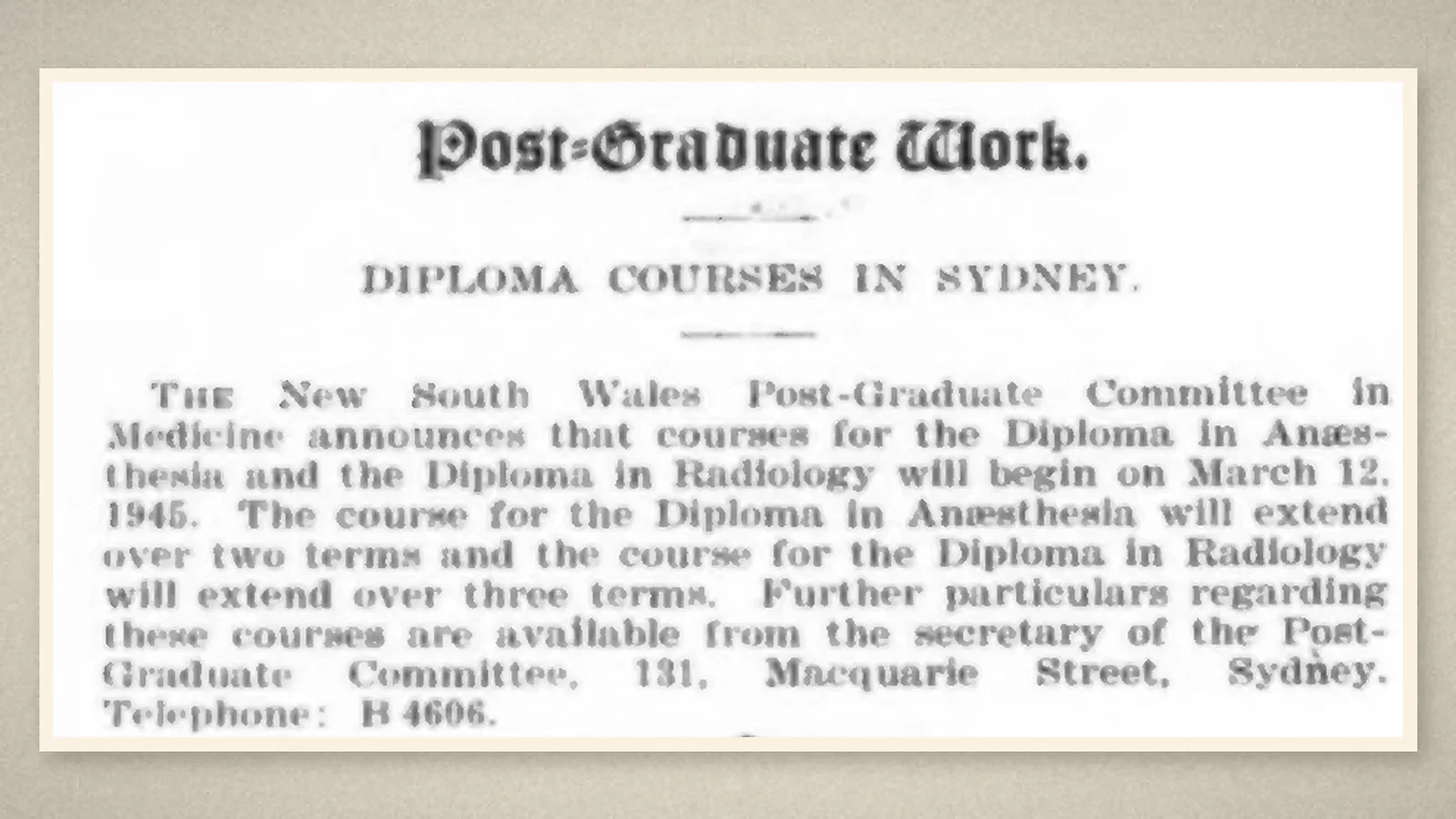
On 17 February 1945, under "Post-Graduate Work", the journal printed "Diploma courses in Sydney". The New South Wales Post-Graduate Committee in Medicine announced that courses for the Diploma in Anaesthesia and the Diploma in Radiology "will begin on March 12", 1945; the anaesthesia course "will extend over two terms", the radiology course over three; particulars were available from the Committee's secretary at "131, Macquarie Street, Sydney". [1, p. 188]
Until then an Australian who wanted a diploma in anaesthesia went to England for it. In January 1944 Lorna Bray of Melbourne wrote on intravenous anaesthesia in the same journal as "D.A. (R.C.P. and S.) (England)", the diploma of the English Royal Colleges, and as "Honorary Anaesthetist, Saint Vincent's Hospital" and the Royal Melbourne Hospital. [3, p. 46] Kaye's own byline carried the same English diploma. [2, p. 197]
"If Embley were to return"
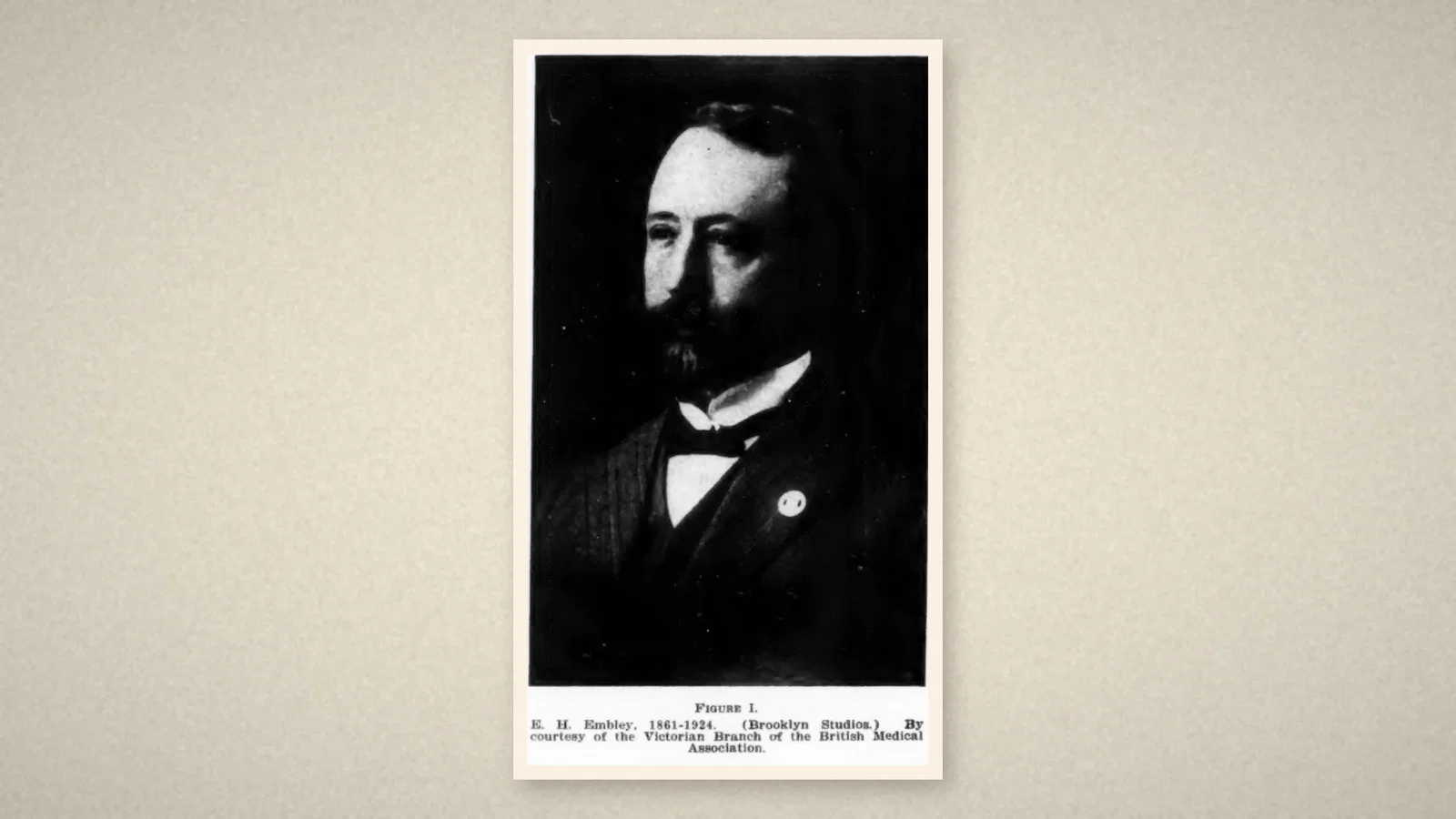
On 4 April 1945 Kaye gave the E. H. Embley Memorial Lecture to the Victorian Branch of the British Medical Association; it was printed on 18 August. Embley, a Melbourne anaesthetist, had died in 1924. Embley had missed recognition at home in life, Kaye said, though "his name is still honoured in America", and Embley was perhaps the only Australian anaesthetist with an international reputation. [2, p. 197]
Kaye gave the reason. The easy discoveries had been made; research now needed chemist, physiologist, pharmacologist and clinical anaesthetist working together, and it had centred in great university hospitals, "Oxford, Madison, New York and elsewhere", with trained men, equipment and endowments. In the Commonwealth the Nuffield Department at Oxford was a fine beginning, "but in Australia there exists only a vision for the future". [2, p. 197–198]
The Cinderella
The sections on organisation and teaching were blunt. The Australian Society of Anaesthetists "was founded in 1934, ten years after" Embley's death, yet of its members "perhaps one in five confines his work solely" to anaesthesia, and "the reason for this is economic". Australia also lacked "that class of salaried teachers" who in America supported organised anaesthesia. [2, p. 198]
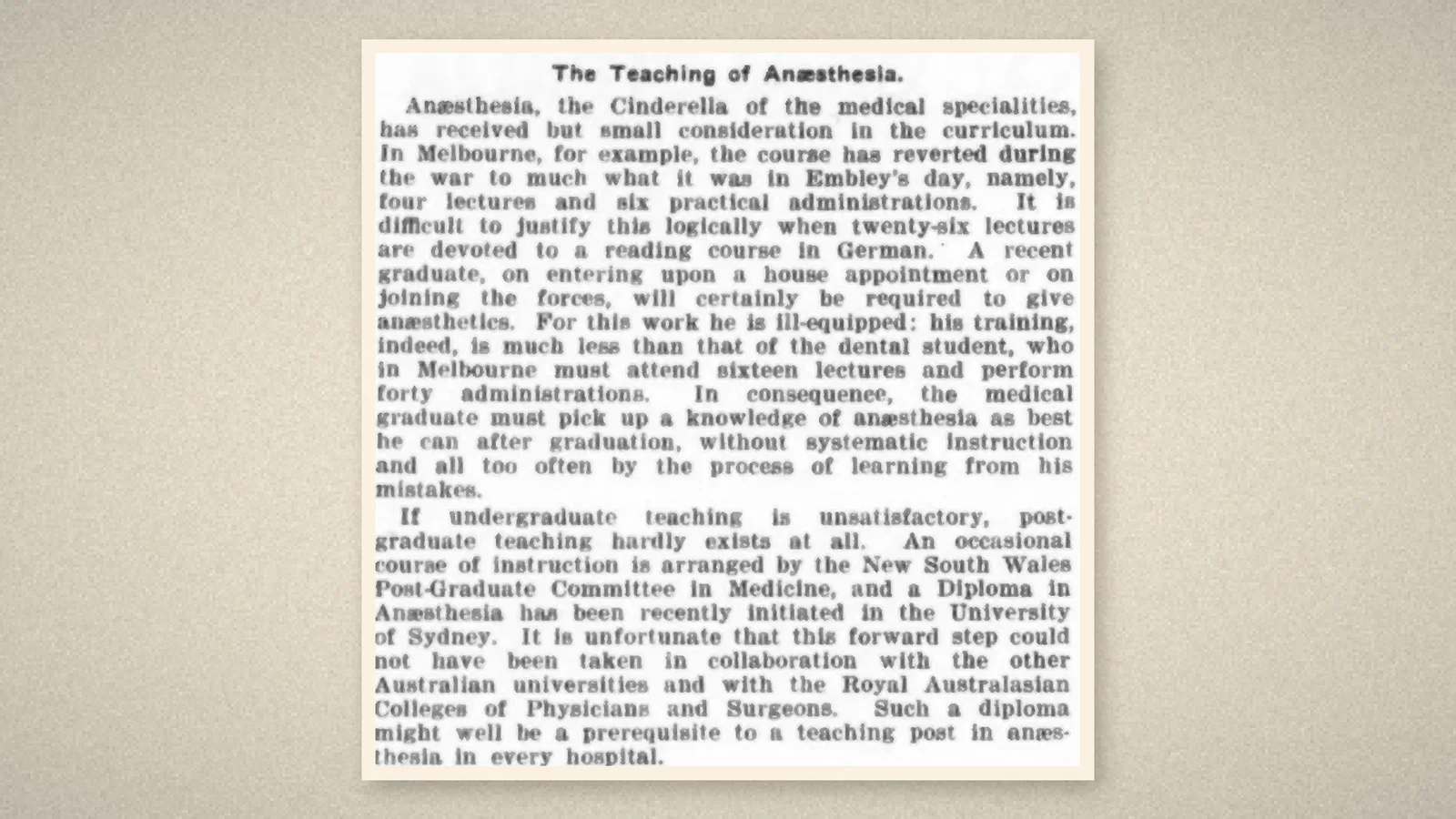
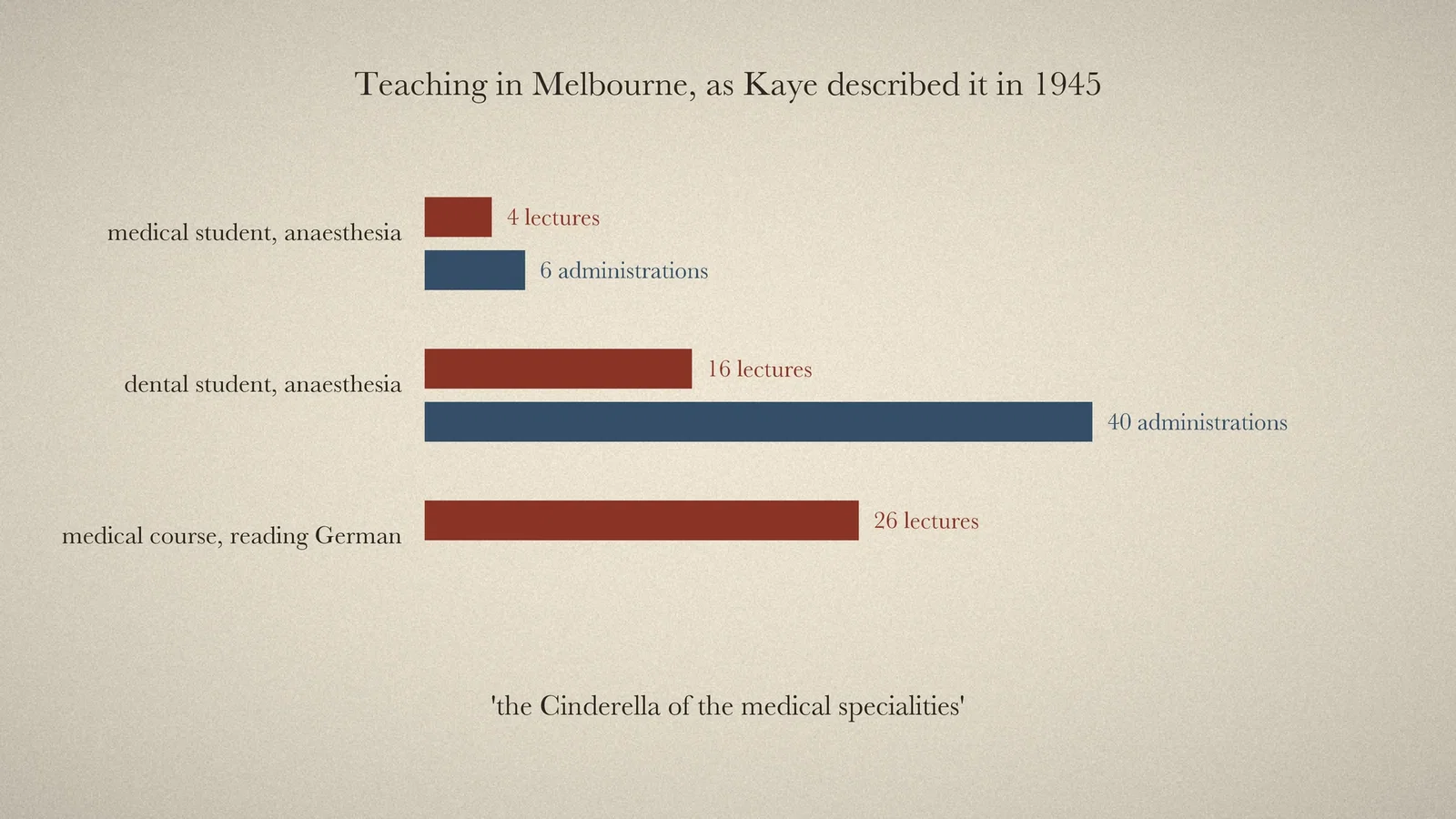
Anaesthesia, Kaye said, was "the Cinderella of the medical specialities". In Melbourne the wartime course had reverted to what it had been in Embley's day, "four lectures and six practical administrations", while twenty-six lectures went to a reading course in German. A new graduate would certainly have to give anaesthetics as a house officer or in the forces, yet was trained less than a dental student, who in Melbourne "must attend sixteen lectures and perform" forty administrations. The medical graduate learned afterwards, without system, "all too often by the process of learning from his mistakes". [2, p. 198]
Postgraduate teaching "hardly exists at all". The New South Wales Post-Graduate Committee arranged an occasional course, and a Diploma in Anaesthesia "has been recently initiated in the University" of Sydney. Kaye regretted that this step had not been taken "in collaboration with the other" Australian universities and the Royal Australasian Colleges of Physicians and Surgeons; such a diploma "might well be a prerequisite to a teaching post" in anaesthesia in every hospital. [2, p. 198]
Security and salaried posts
Kaye turned to recruitment. The specialty had become wide and strenuous and needed constant recruits, who would come only if it were made attractive: "Security is essential", whether from surgeons' steady support or from salaried appointments. Because the anaesthetist depended on surgical colleagues, private practice competed with hospital work; public hospitals got too little specialist help, residents carried more, and teaching suffered. The time was approaching when public hospitals might have "to consider the appointment of salaried" anaesthetists, as in the United States, and the need for systematic postgraduate instruction was urgent in nearly every capital city. [2, p. 198] In conclusion Kaye expected that "in the future training of anaesthetists" physiology and pharmacology would predominate. [2, p. 204]
What the record shows
In 1945 Sydney opened Australia's own course for a Diploma in Anaesthesia, and in the same year Kaye used Embley's name to take stock: one member in five working only in anaesthesia, four lectures and six administrations for a medical student, postgraduate teaching close to nil. Kaye's remedies (a diploma agreed nationally, the diploma as a condition for teaching posts, salaried hospital anaesthetists, systematic postgraduate teaching) were the prescription Kaye offered for Australian anaesthesia teaching in 1945.
Sources and reading limits
Read: MJA 17 February 1945, p. 188, the course notice; MJA 18 August 1945, pp. 197–205, Kaye's Embley Memorial Lecture in full (the organisation and teaching sections on pp. 197–198 and the conclusion on p. 204 are used); MJA 15 January 1944, p. 46, Bray's byline. The 1944–45 issues were also searched; no further notice of the diploma was found.
Not covered: the records of the University of Sydney and the Post-Graduate Committee, the date and names of the first diplomates, and the other dated events in Australian and New Zealand training were not found in primary form and are not described. The article is dated by the February 1945 course notice and Kaye's April 1945 lecture, which calls the diploma "recently initiated".
Three illustrations are crops of journal pages (one is the portrait of Embley printed with the lecture); one is a chart drawn from the lecture's figures.
- Diploma courses in Sydney. Med J Aust. 1945;1(7):188. Internet Archive
- Kaye G. E. H. Embley Memorial Lecture: If Embley were to return. Med J Aust. 1945;2(7):197-205. Internet Archive
- Bray L. Intravenous anaesthesia. Med J Aust. 1944;1(3):46. Internet Archive
Continue exploring
Related reading connects shared questions and contexts; it does not by itself establish historical influence.
- 1935: London Holds the Diploma in Anaesthetics Examination
- 1937: Oxford Creates the Nuffield Chair of Anaesthetics
Anesthesia Epochs · The Source Room · About & Editorial Method
Published November 2, 2026. Sources and reading limits are stated above. Illustrations are labelled as original source images or AI-made. Historical accounts are educational; they are not current treatment instructions.