In 2008, a one-minute preoperative screen separated risk stratification from the sleep study that still defined disease.
Reading Library · Anesthesia Epochs · 中文版
Watch the companion film
2008: Frances Chung — STOP-Bang Sleep Apnea Screening · Watch on YouTube
Historical anchor: 2008. Date details and source qualifications are explained below.
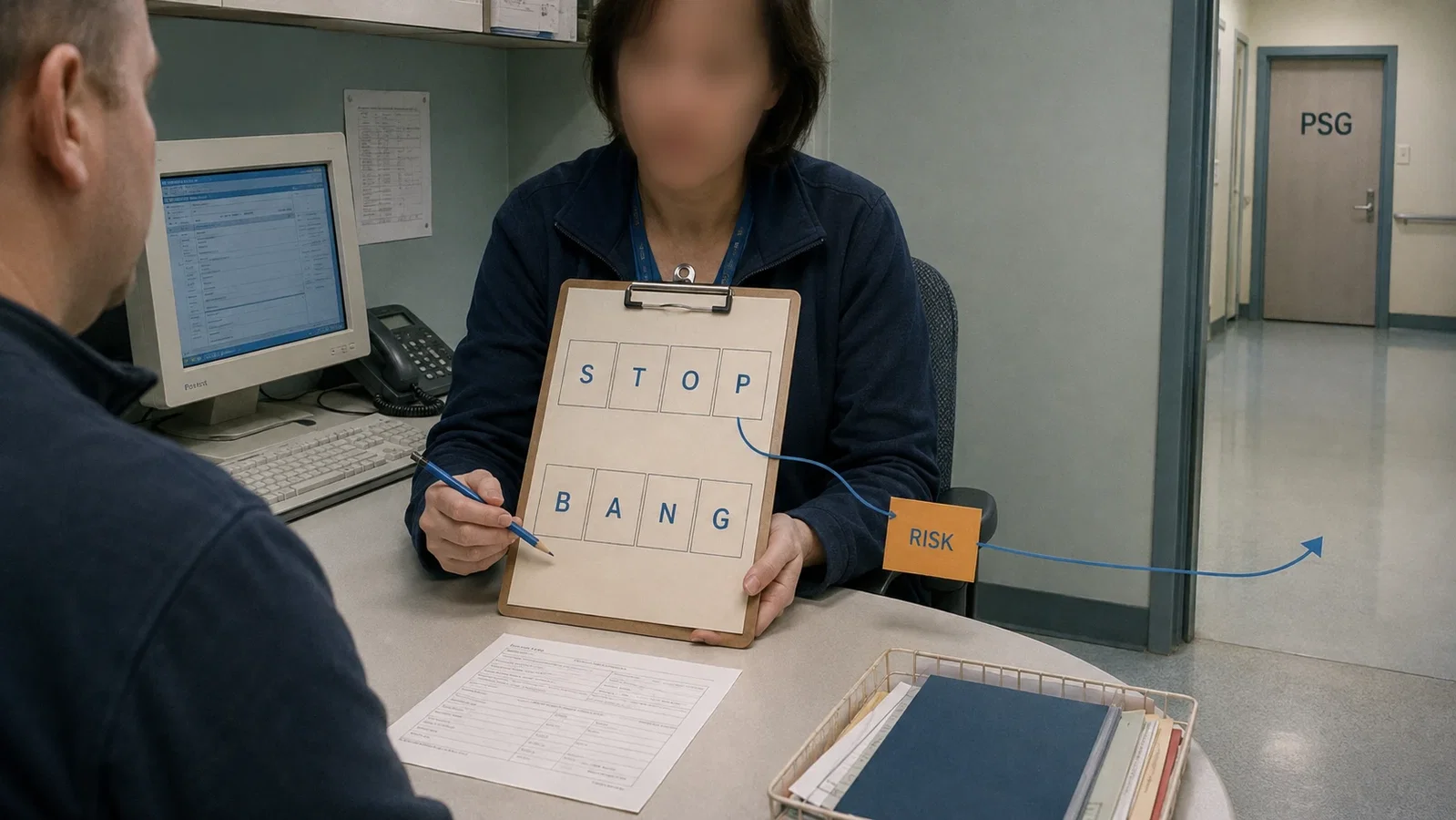
The most visible object in this story is a sheet of paper.
It did not record a sleep study, make a diagnosis, or predict what would happen after surgery. It asked a few questions that could be answered while a patient was already moving through a busy clinic. That modest role mattered because the accepted diagnostic test for obstructive sleep apnoea, overnight polysomnography, demanded time, laboratory capacity, technical staff, and another commitment from a patient whose operation was approaching.
In May 2008, Frances Chung and colleagues published a study from the preoperative clinics of Toronto Western Hospital and Mount Sinai Hospital. Their aim was practical: build a short screen for surgical patients, then test it against the apnoea-hypopnoea index measured during monitored laboratory polysomnography. The paper ultimately supplied the name STOP-Bang, but its formal title was STOP Questionnaire: A Tool to Screen Patients for Obstructive Sleep Apnea. That distinction reveals how the instrument was actually assembled.
1. The paper began with STOP, not eight equal items
The investigators started with previous work, a literature review, and discussion among anaesthesiologists and sleep specialists. They assembled 14 candidate questions and gave the list to 278 patients. Complete responses from 254 patients entered factor analysis.
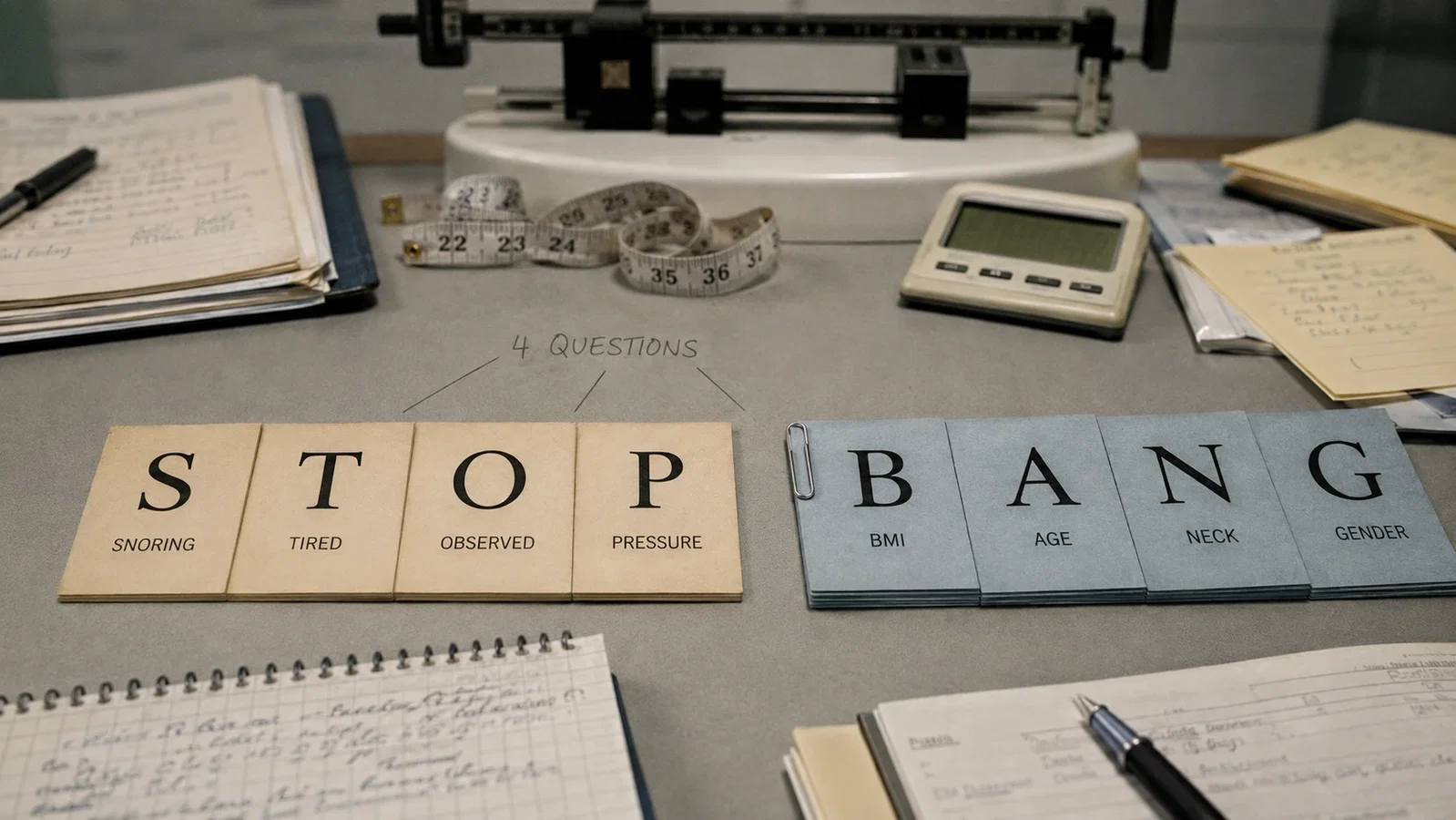
Four yes-or-no prompts were selected to represent four domains: loud snoring, daytime tiredness, observed pauses in breathing during sleep, and high blood pressure. Their initials produced STOP. The wording was set at a fifth-grade English reading level, and the paper-and-pencil scale took about one minute to complete. A patient with two or more positive answers was classed as high risk.
This simplicity was engineered. Longer questionnaires and more complicated scoring systems might work in research settings yet falter at a crowded clinic desk. The authors treated completion time and reading demand as part of the clinical problem, not as matters of presentation.
They also asked 55 patients to complete STOP twice, at intervals ranging from 1 to 27 days, with a median of 8 days. Fifty-three received the same score on retesting, producing 96.4% agreement and a kappa of 0.923. That result belongs to the four-question STOP instrument in this small reliability sample. It should not be enlarged into a separate reliability study of all eight STOP-Bang items.
2. The denominator narrowed long before validation
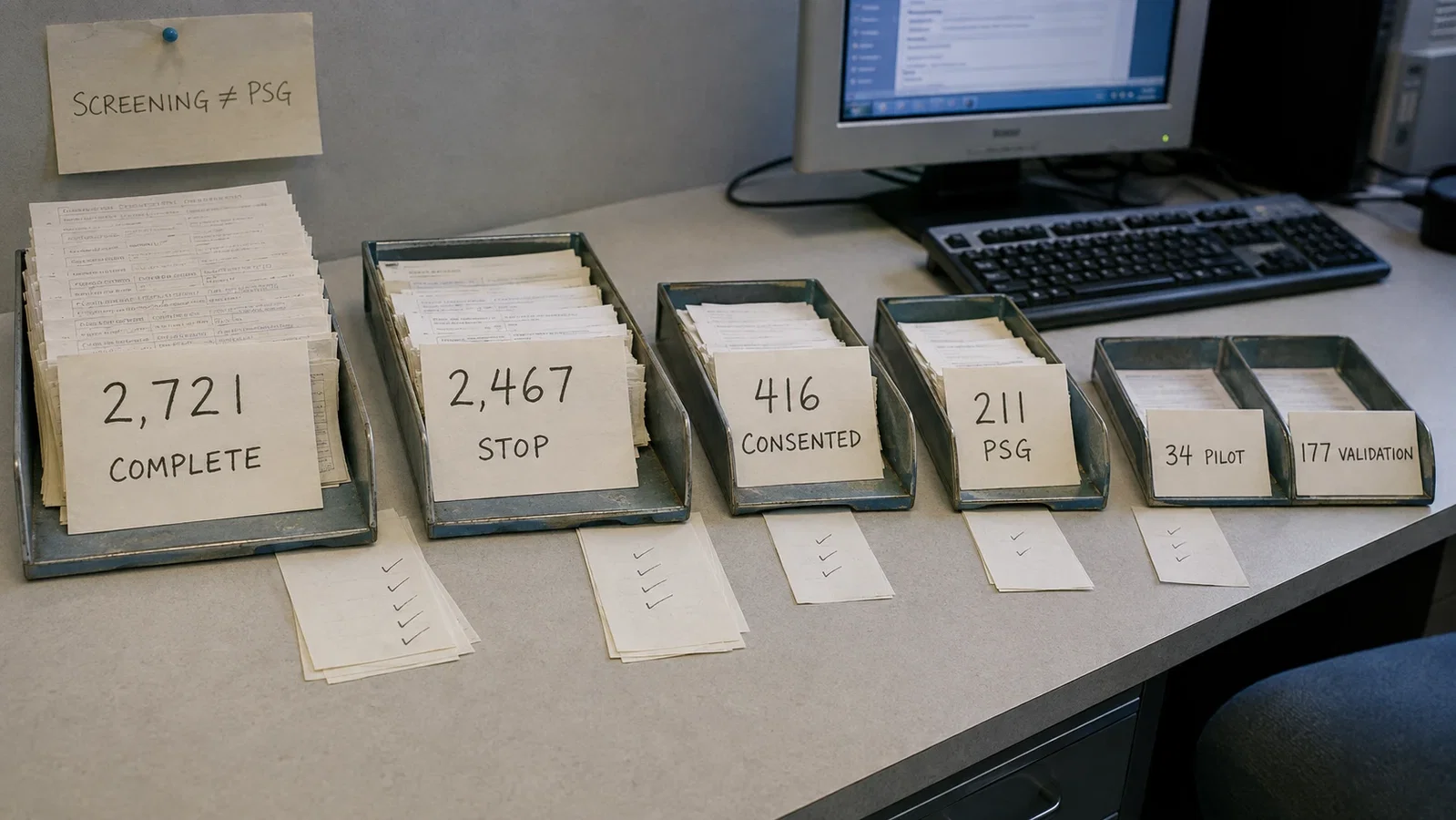
The study's patient flow is as instructive as the mnemonic. During 16 months, 2,974 patients were willing to complete the questionnaire. Complete questionnaire and demographic data were available for 2,721. Of those records, 254 were used for factor analysis. Once STOP had been developed, it was administered to another 2,467 patients: 592 in the pilot phase and 1,875 in the subsequent validation phase.
All 2,467 patients who answered STOP were invited to undergo overnight polysomnography regardless of the score. Only 416 consented, or 17%. Then 205 of those who had consented did not arrive at the laboratory. In the end, 211 patients completed polysomnography. The first 34 formed the pilot group; the remaining 177 formed the validation group.
Those numbers prevent an easy but serious mistake. The study did not validate the questionnaire with 2,467 sleep studies. It screened 2,467 people with STOP and estimated diagnostic performance in 177 who completed the validation pathway.
STOP classified 679 of the 2,467 screened patients, 27.5%, as high risk. That was a questionnaire result, not the prevalence of obstructive sleep apnoea. Prevalence required a reference assessment and remained inseparable from who agreed to undergo it.
3. Bang was an added layer
After developing STOP, the researchers examined four characteristics that were readily available in a preoperative clinic: body mass index, age, neck circumference, and gender. The thresholds used in the 2008 model were BMI above 35 kg/m², age above 50 years, neck circumference above 40 cm, and male gender. Their initials added B, A, N, and G to STOP.
The resulting eight-item alternative scoring model was called STOP-Bang. In Appendix 2 of the original paper, three or more positive items indicated high risk. Later risk categories and combination rules belong to later versions of the tool; they are not evidence about what the 2008 investigators tested.
Bang therefore did not emerge as four more symptom questions chosen by the same factor analysis. It added measured and demographic information to a symptom-and-history screen. The mnemonic made the two layers feel seamless, but the construction history remained two-stage: four selected questions, then four added characteristics.
4. Sensitivity came with a visible price
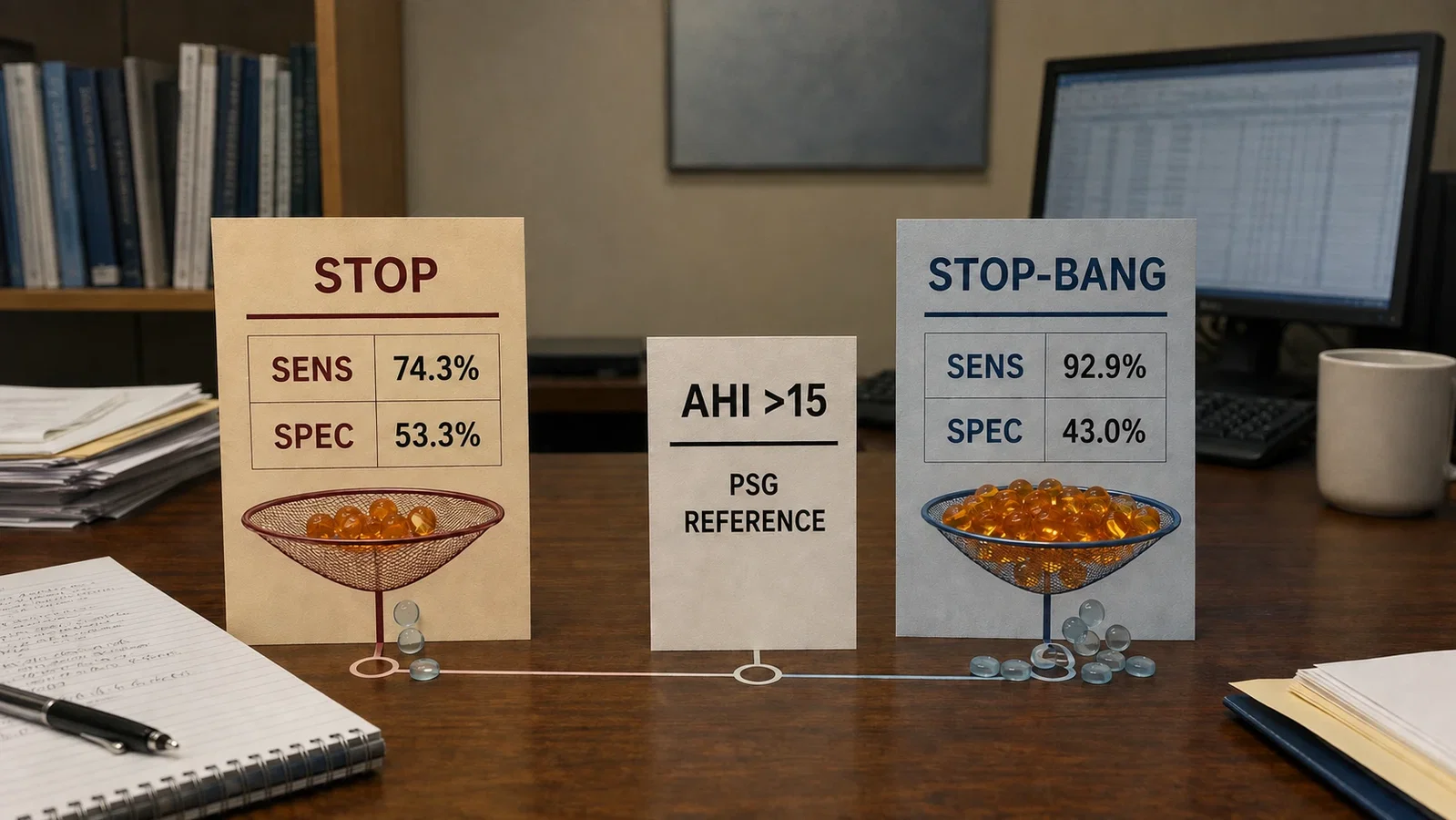
The 177-person validation sample allowed the team to compare STOP and STOP-Bang against several AHI thresholds. At AHI greater than 15, STOP had a sensitivity of 74.3% and a specificity of 53.3%. STOP-Bang raised sensitivity to 92.9% while specificity fell to 43.0%.
At AHI greater than 30, STOP-Bang reached 100% sensitivity in this sample, with specificity of 37.0%. The severe group contained 39 patients, and the 95% confidence interval for sensitivity ran from 91.0% to 100%. The estimate deserves attention, but it cannot promise that every future patient with severe disease will be detected.
This trade-off is the logic of a screen. A sensitive threshold sends more people with possible disease onward for assessment. It also sends more people who do not meet the reference threshold. In a preoperative clinic, the gain is fewer missed high-risk patients; the cost is additional evaluation, planning, and use of limited resources. A percentage without its paired specificity hides that clinical choice.
The original 2008 table reported the STOP-Bang sensitivity and specificity at AHI greater than 5 as 83.6% and 56.4%. A later 2016 guideline table printed 56.3%, a small rounding or transcription difference. For this historical article, the primary 2008 table controls the value.
5. The sleep laboratory stayed on a separate path
The reference procedure was a one-night, technician-supervised polysomnogram performed before surgery at the Toronto Western Hospital Sleep Laboratory. The main technologist scoring the recordings did not know the patient's STOP risk classification or clinical information. Ten randomly selected studies were rescored by another experienced technologist, with a correlation of 0.984. This was a useful safeguard in PSG scoring. It did not make every part of the study double blind.
Selection into the sleep laboratory remained the larger limitation. Among the 177 validation participants, 122 had an AHI greater than 5, a prevalence of 68.9%. Patients who completed polysomnography had a higher BMI than patients who did not consent. The authors also noted that people with sleep symptoms may have been more willing to volunteer. The low consent rate and the 49% no-show rate among consenters made self-selection difficult to dismiss.
The validation group was therefore not a miniature copy of every preoperative clinic. The study included adults with ASA physical status I to IV who were scheduled for specified elective surgical specialties. Patients with previously diagnosed OSA or another sleep-breathing disorder were excluded, as were patients who could not provide consent and some patients expected to have abnormal electroencephalographic findings. The authors stated that the tool had so far been tested only in surgical, noncancer patients and required validation elsewhere.
Nor was this a management trial. The investigators compared a screen with AHI. They did not randomise patients to care with or without STOP-Bang, and they did not show that using the questionnaire reduced complications, deaths, admissions, or costs. The paper made risk easier to flag. Diagnosis and decisions about care still required a separate clinical pathway.
6. What survived was a division of labour
Later institutional accounts from University Health Network describe STOP-Bang moving beyond the two original preoperative clinics into wider clinical use. By 2016, the Society of Anesthesia and Sleep Medicine guideline listed STOP-Bang among the tools that could be used to identify surgical patients with suspected OSA. Its recommendation was graded as strong, based on moderate evidence.
The same guideline resisted turning a successful screen into a universal diagnostic claim. Performance and predictive values depend on the population being tested. In settings with lower prevalence, the meaning of a positive result changes. Evidence that screening itself reduced perioperative complications was still limited.
Those cautions leave a clear account of the 2008 contribution. STOP-Bang divided the work sensibly: a one-minute paper screen could raise a risk flag; polysomnography and clinical assessment could answer a different question. The questionnaire did not shrink a sleep laboratory into eight boxes. It gave a busy preoperative team a way to decide whose risk should no longer remain invisible.
Here, the durable advance was a practical way to decide who should move to the next step, without pretending that step was no longer needed.
Sources and reading limits
Sources: Chung F, Yegneswaran B, Liao P, et al. Anesthesiology. 2008;108(5):812–821. DOI 10.1097/ALN.0b013e31816d83e4; Chung F, Memtsoudis SG, Ramachandran SK, et al. Anesth Analg. 2016;123(2):452–473. DOI 10.1213/ANE.0000000000001416; University Health Network institutional histories, 2011 and 2023. The complete 2008 article was text-read and visually inspected page by page; the sections of the 2016 guideline cited here were read.
Visual interpretations
These illustrations explore the setting and ideas. Depicted people, actions, instruments and documents are reconstructions, not evidence of their exact historical appearance.
Continue exploring
Related reading connects shared questions and contexts; it does not by itself establish historical influence.
- 2024: GPT-4 Turbo Classifies Preoperative Text but Struggles to Predict Duration
- 2024: Nine Organizations Turn Preoperative Cardiac Clearance into a Continuous Pathway
The Source Room · About & Editorial Method
Sources and reading limits are stated above. Illustrations are labelled as original source images or AI-made. Historical accounts are educational; they are not current treatment instructions.