An Amsterdam startup decision and a Stockholm-based registration built a durable organization around perioperative research, education, audit, and implementation.
Reading Library · Anesthesia Epochs · 中文版
Watch the companion film
2010: The ERAS Society — From Pathway to System · Watch on YouTube
Historical anchor: 2010. Date details and source qualifications are explained below.
The important document in 2010 was not another perioperative checklist.
By then, the Enhanced Recovery After Surgery Study Group had already produced and revised evidence-based recommendations. It had also encountered a harder problem: knowing what clinicians should do did not ensure that a hospital would do it consistently. A pathway could be printed while the work at the bedside remained divided among specialties, locations, and shifts.
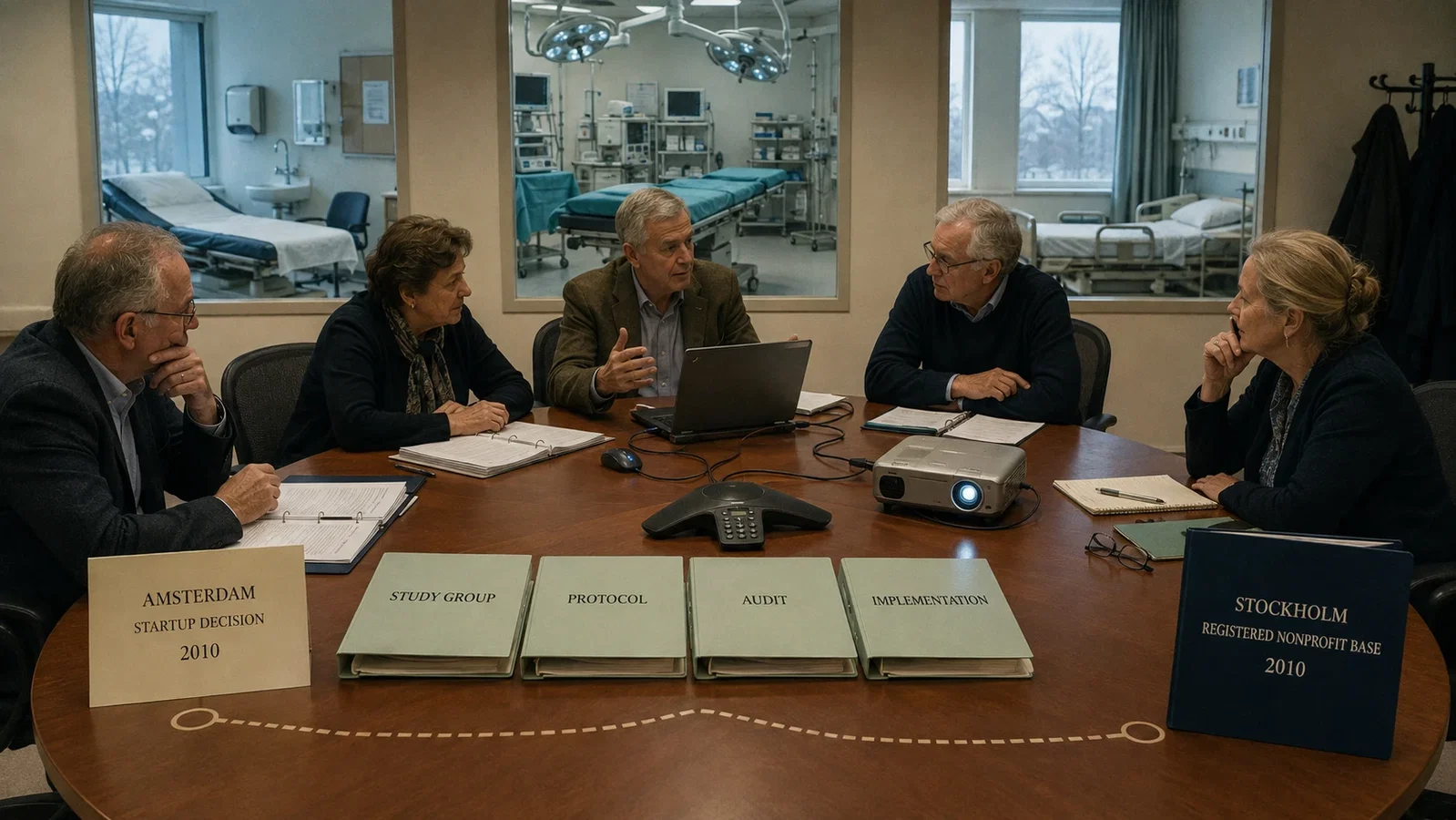
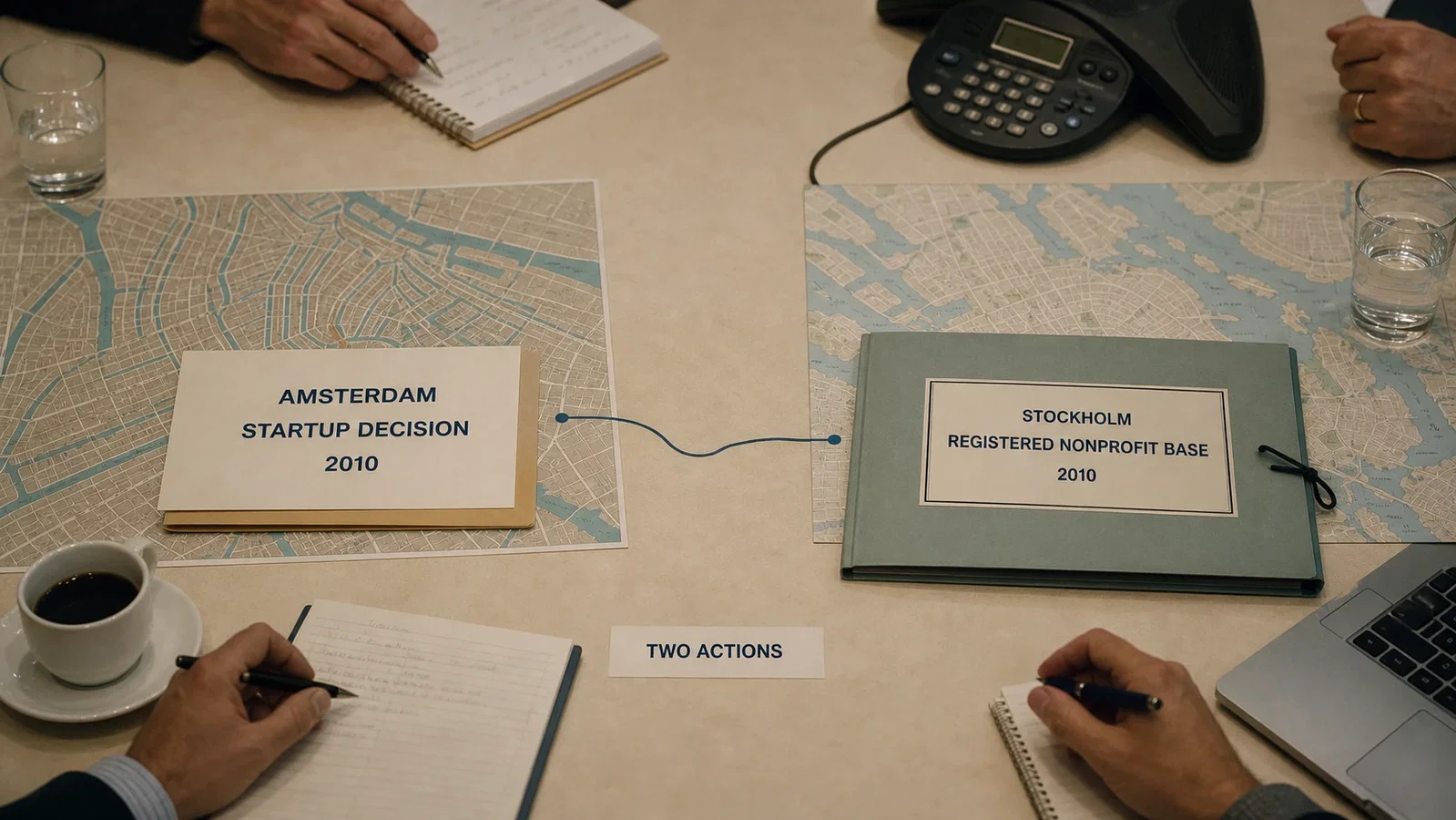
The response was institutional. At a meeting in Amsterdam in January 2010, members decided to start the ERAS Society. In the same year, the organization was officially registered as a nonprofit medical society based in Stockholm, Sweden. Those are two related actions in two cities, not one precisely dated founding ceremony.
The Society did not invent enhanced recovery in 2010. It gave an existing international collaboration a durable structure for research, education, audit, and implementation.
Two cities, two steps
A 2015 chapter by two of the founders, Olle Ljungqvist and Kenneth Fearon, says the Society "was formed in January of 2010 in Amsterdam" and was formally registered a few months later that year. Formation and legal registration were therefore two steps, not one founding act in Amsterdam.
The Society's official history identifies Amsterdam as the place where a meeting made the startup decision. It then records that the Society was officially registered in 2010 as a nonprofit medical society based in Stockholm. The page provides no month, day, venue, registration number, or legal instrument. Two later peer-reviewed reviews independently place the Society's creation or development in 2010 and its registration or base in Sweden, but neither supplies the missing precision.
This article therefore dates the Amsterdam formation to January 2010 on the founders' own account, and the Stockholm registration only to 2010, since no source read gives its month. Amsterdam represents deliberation and decision; Stockholm represents the registered organizational base. Compressing both into “founded in Amsterdam” would turn a convenient map pin into a false legal history.
The pathway existed before the Society
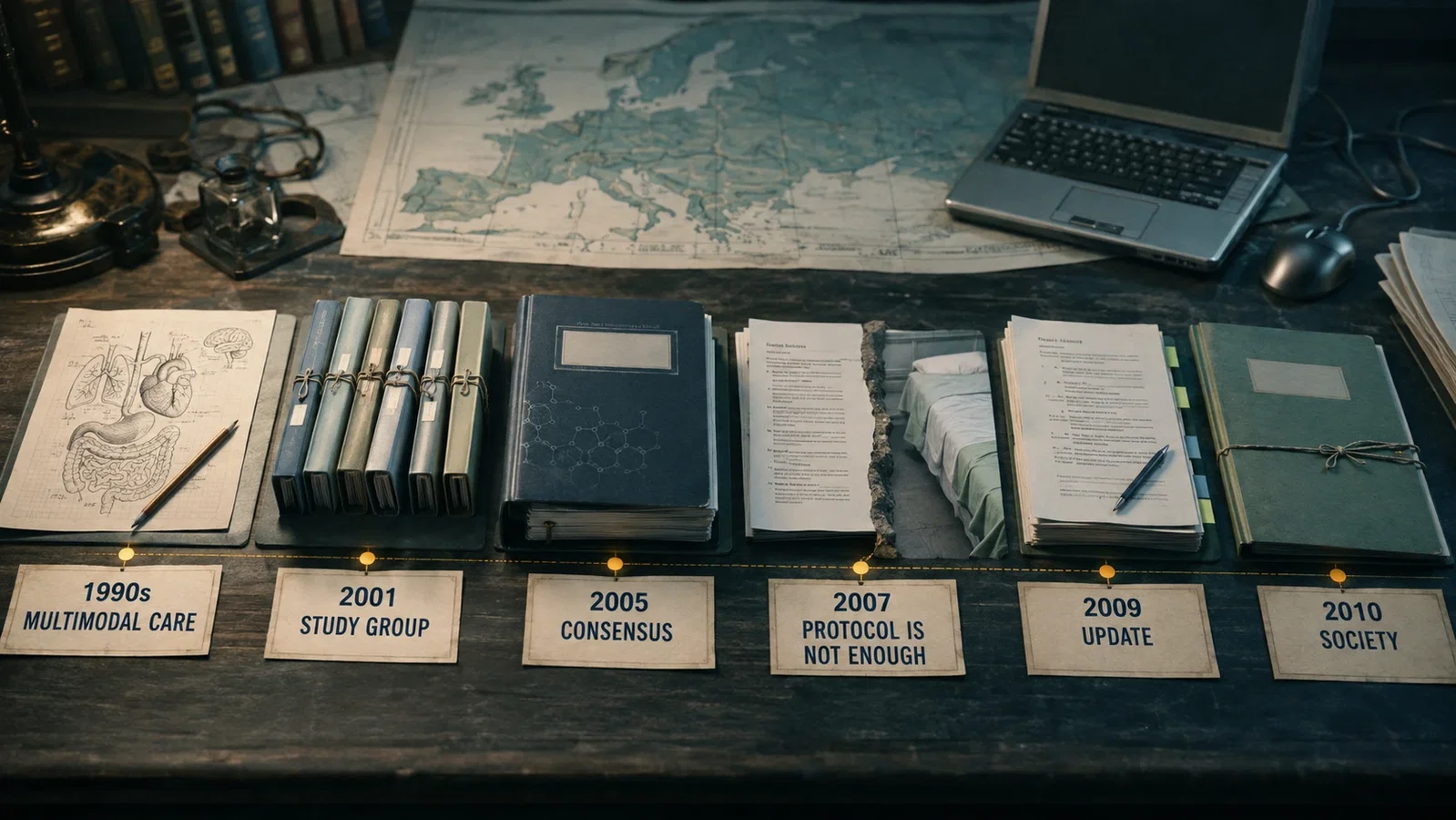
The official history traces the intellectual ancestry to Henrik Kehlet's work on multimodal surgical care in the 1990s. The premise was that postoperative recovery could not be reduced to one drug, one operation, or one monitor. Surgical stress, pain, nutrition, mobility, organ function, and the timing of routine care had to be considered together.
In 2001, Kenneth Fearon and Olle Ljungqvist assembled the ERAS Study Group. The official account names Arthur Revhaug, Maarten von Meyenfeldt, and Cornelis de Jong among the original members. A 2019 full-text history of the ERAS Interactive Audit System describes the same beginning from a data perspective: five surgical research groups working on surgical stress physiology met to review the literature, define an optimal pathway for elective colonic resection, and compare consecutive cases through a common database.
The collaboration soon found substantial variation between units. Traditions differed, and recorded practice did not always match what the literature suggested. The first ERAS symposium was held at Ersta Hospital in Stockholm in 2003. In 2005, the Study Group published an evidence-and-consensus protocol for colonic surgery after reviewing clinical studies and trials.
That 2005 abstract was appropriately cautious. It described growing evidence for an integrated multimodal approach, but stated that effects on major morbidity and mortality remained to be determined. The protocol was a framework to test and refine, not a declaration that every element or outcome question had been settled.
In 2009, the group published an updated, comprehensive evidence-based consensus review for colorectal surgery. The unresolved question was how to make the pathway live in ordinary clinical work.
A two-day gap exposed the organizational problem
A five-centre observational study published in 2007 made that problem measurable. It included 425 consecutive patients undergoing elective open colorectal resection between January 2001 and January 2004. One centre had developed multimodal perioperative care for ten years; the other four had previously used traditional care.
Compliance with protocol elements was high before and during surgery, then fell in the immediate postoperative phase. Patients met predetermined functional-recovery criteria at a median of three days after surgery, but were actually discharged at a median of five days. Previous fast-track experience was associated with a shorter stay.
The investigators did not conclude that the protocol was useless. They concluded that a protocol alone was insufficient to discharge patients when functional recovery had been achieved. More experience and better organization of care might be required.
The two-day gap is useful because it shows where a written standard ends. A surgeon cannot single-handedly deliver intraoperative anaesthesia, postoperative analgesia, nutrition, mobilization, line removal, ward routines, and discharge coordination. An anaesthetist cannot carry those tasks across the entire admission either. Even sound recommendations can fragment when responsibility passes from clinic to operating room, recovery area, and ward.
The 2007 study was not a trial of forming a Society, and its findings cannot prove why the Society appeared three years later. It does, however, document the implementation problem that the later organization was designed to address.
The institutional turn joined four kinds of work
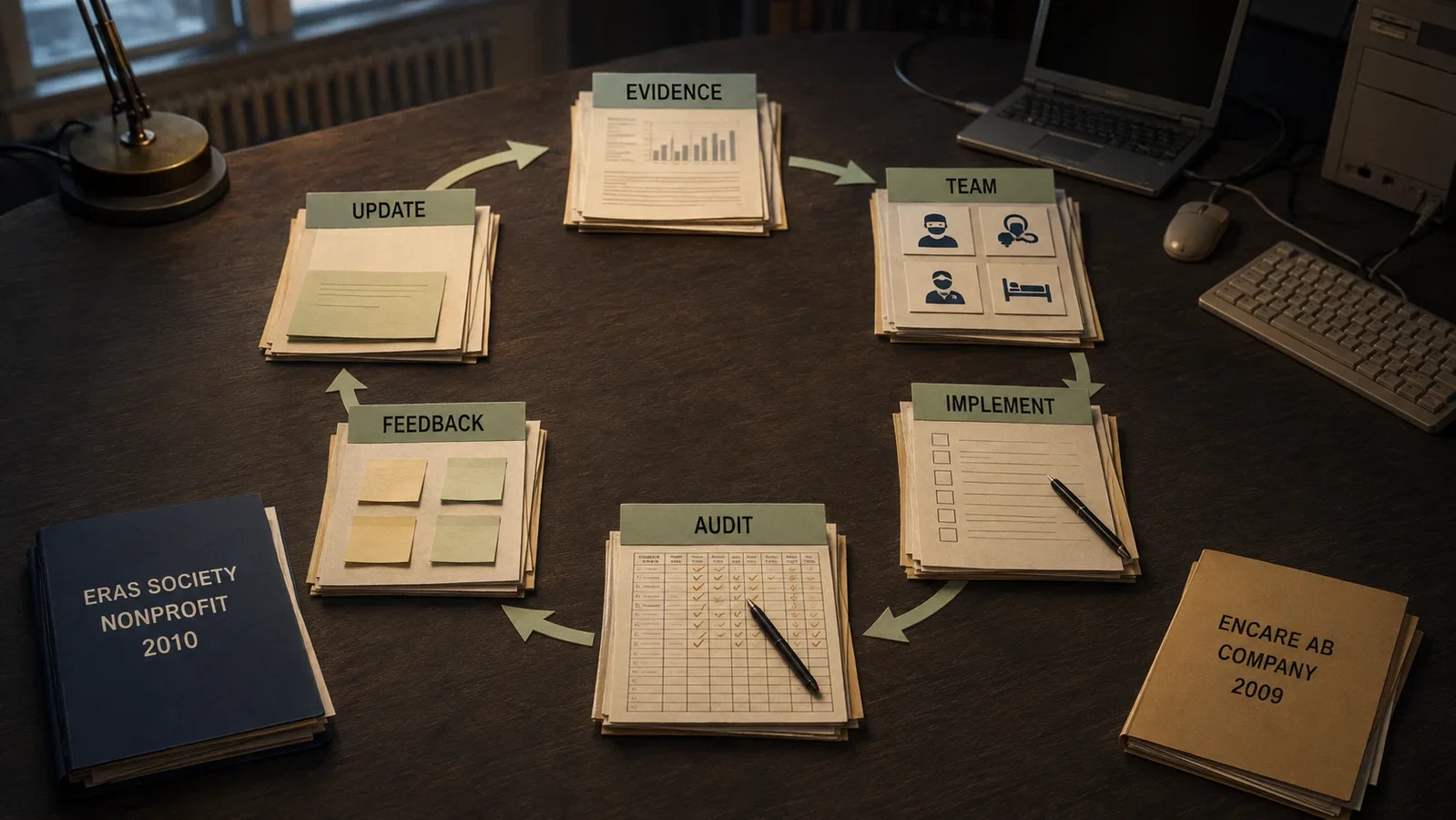
The official mission places research, education, audit, and implementation together. Each function answers a different failure mode.
Research keeps the pathway open to new evidence instead of freezing a consensus document in time. Education gives different professional groups a shared account of the patient's perioperative journey. Implementation translates general recommendations into tasks that a local unit can carry out. Audit compares intended care with recorded care, making gaps visible and returning them to the next cycle of change.
The multidisciplinary boundary matters. The complete abstract of a 2017 JAMA Surgery review describes local implementation teams that include surgeons, anesthetists, an ERAS coordinator, and staff from units caring for surgical patients. A 2018 open full-text review similarly places surgeons, anaesthetists, nurses, and allied health professionals in the implementation process.
Anaesthesiology is central to many pathway elements, including analgesia, fluid management, temperature, and the response to surgical stress. It is not the sole owner of ERAS. Surgery is equally unable to deliver the pathway alone. The organizational unit is the team and the care transition, not a single specialty defending its section of a checklist.
The database became institutional memory
The audit system also began before the Society. According to the 2019 full text, the five groups agreed in 2001 to submit consecutive cases to a common database maintained by the Stockholm team. Early data had to be sent in portions, reformatted, and merged manually. The records revealed that overall compliance was lower than expected and that units did not always comply where they believed they did.
In 2006, the database moved to a more robust architecture with a web-based interface. Participating units could enter data directly and compare their own practice with the wider group.
The organizational chronology needs careful handling. The 2019 article's abstract retrospectively says that the “ERAS Society” developed EIAS in 2006. Its body, however, describes the 2006 database change and then states that the nonprofit ERAS Society developed from this work in 2010. The official history and the separate 2018 review also place Society formation in 2010.
The coherent reading assigns the 2006 action to the Study Group and its database work, not to a Society that had not yet formed. The conflict shows why the body matters in institutional chronology: abstracts sometimes apply a later organizational name to earlier work. Repeating the shortest sentence would move the Society four years backward.
A related distinction separates Encare AB from the Society. The same full text reports that Encare AB, a commercial company in Stockholm, was launched in 2009 to develop and operate EIAS and provide training. The ERAS Society was the nonprofit organization that emerged in 2010. They were connected within the implementation infrastructure, but they were not the same organizational or legal entity.
Founders, antecedents, and the danger of the lone hero
The official history names Fearon, Ljungqvist, Revhaug, von Meyenfeldt, and de Jong as the Society's founding group. Where the webpage varies in spelling, this account uses the forms found in the PubMed records.
Kehlet occupies a different, equally important place. His multimodal-care work is the stated intellectual antecedent, but the official page does not add him to its five-person Society founder list. Calling every major contributor a founder may sound generous, yet it erases the difference between developing an idea, assembling a study collaboration, and forming a registered organization.
Registration was not a clinical intervention
Later ERAS studies and reviews discuss protocol compliance, recovery, complications, hospital stay, and cost. Those questions belong to specific interventions, cohorts, and implementation programs. They cannot be reassigned to the act of registering a Society.
No patient was randomized to a world with or without the 2010 organization. The Amsterdam decision and Stockholm registration have no independent effect size. Claims about current membership, geographic reach, specialty coverage, or contemporary officers would also describe a changing organization, not the bounded 2010 event.
The defensible historical conclusion is narrower. By 2010, an international study collaboration had learned that evidence and protocols were necessary but insufficient. It needed a structure that could repeatedly connect recommendation, team training, local execution, measurement, and revision. The Society gave that work a continuing home.
ERAS history therefore concerns more than deciding what good perioperative care should contain. It concerns how people in different roles keep producing that care, notice when practice departs from intention, and learn together. The 2010 institutional turn moved the story from an ideal pathway toward a care system capable of examining itself.
Sources and reading limits
Sources: ERAS Society official History page; Taurchini M, Del Naja C, Tancredi A. J Vis Surg. 2018;4:40. PMID 29552522; Currie A, Soop M, Demartines N, et al. Clin Colon Rectal Surg. 2019;32(1):75–81. PMID 30647549; Fearon KCH, Ljungqvist O, von Meyenfeldt M, et al. Clin Nutr. 2005;24(3):466–477. PMID 15896435; Maessen J, Dejong CHC, Hausel J, et al. Br J Surg. 2007;94(2):224–231. PMID 17205493; Lassen K, Soop M, Nygren J, et al. Arch Surg. 2009;144(10):961–969. PMID 19841366; Ljungqvist O, Scott M, Fearon KC. JAMA Surg. 2017;152(3):292–298. PMID 28097305; Ljungqvist O, Fearon KCH. The ERAS® Society. In: Feldman LS, Delaney CP, Ljungqvist O, Carli F, eds. The SAGES/ERAS® Society Manual of Enhanced Recovery Programs for Gastrointestinal Surgery. Springer; 2015:345–355. doi:10.1007/978-3-319-20364-5_28 (read in excerpt only). The official history and both open peer-reviewed PDFs were read. The 2005, 2007, 2009, and JAMA 2017 records are used only at official-abstract level.
Visual interpretations
These illustrations explore the setting and ideas. Depicted people, actions, instruments and documents are reconstructions, not evidence of their exact historical appearance.
Continue exploring
Related reading connects shared questions and contexts; it does not by itself establish historical influence.
The Source Room · About & Editorial Method
Sources and reading limits are stated above. Illustrations are labelled as original source images or AI-made. Historical accounts are educational; they are not current treatment instructions.