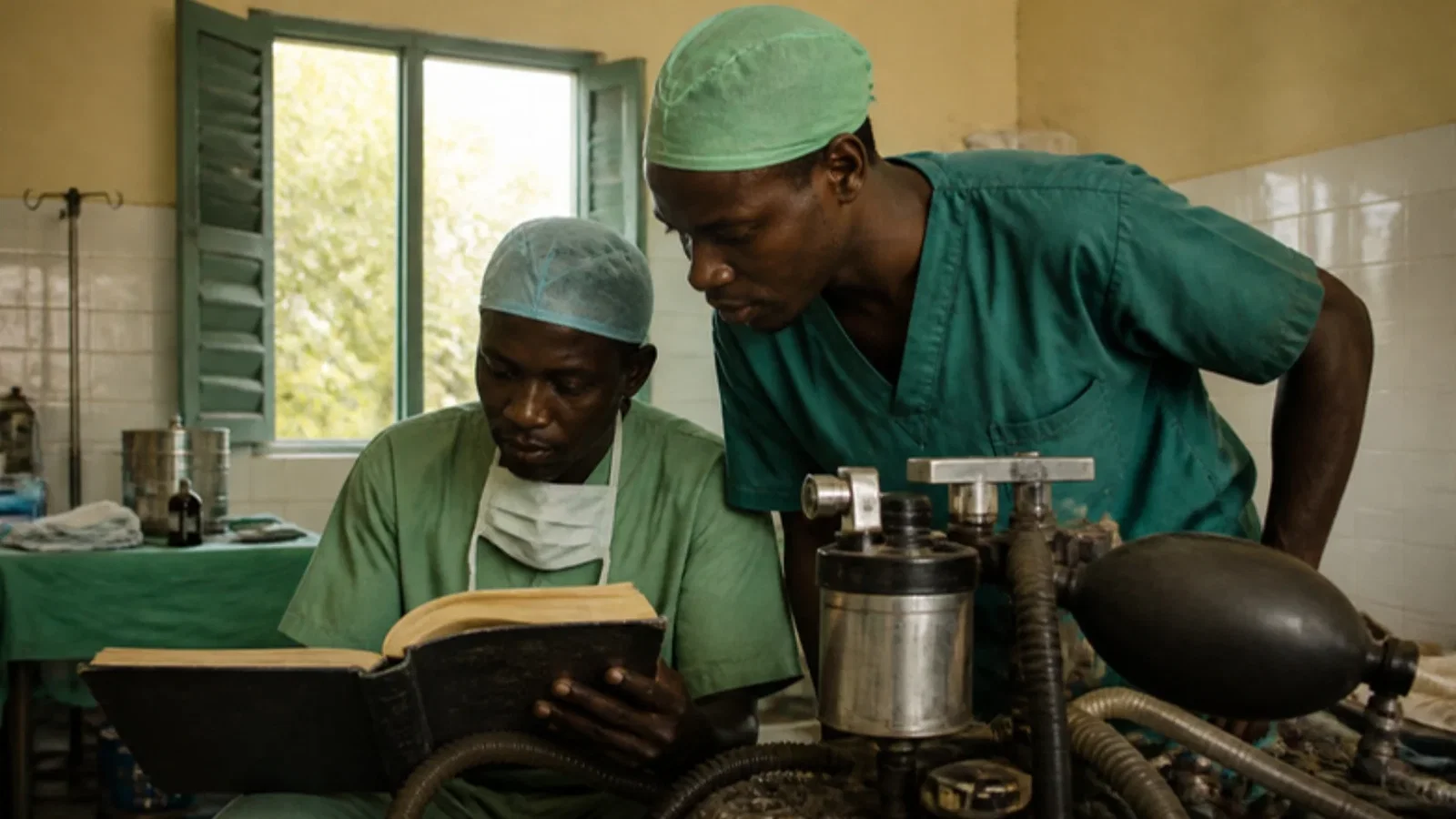
Asked in 1983 for a paragraph on how to give an anaesthetic, the WFSA instead commissioned a whole manual for 30-100-bed hospitals; Michael Dobson's Anaesthesia at the District Hospital appeared from WHO in 1988 and was later translated into many languages.
Reading Library · Anesthesia Epochs · 中文版
Watch the education video (for clinicians)
1973–1988: Anaesthesia at the District Hospital — The WHO Manual · Anesthesia Epochs Education Series
In 1988 the World Health Organization (WHO) published Anaesthesia at the District Hospital by Michael B. Dobson. [1, p. 8; 2, p. v] It was written for doctors in small hospitals who had to give anaesthetics without a specialist. This article tells how the book came about, mostly in Dobson's own words, written in December 2024 for a history issue of the World Federation of Societies of Anaesthesiologists' journal Update in Anaesthesia. [1] It also draws on the prefaces of the book as reprinted in WHO's second edition of 2000. [2]
A request for a paragraph
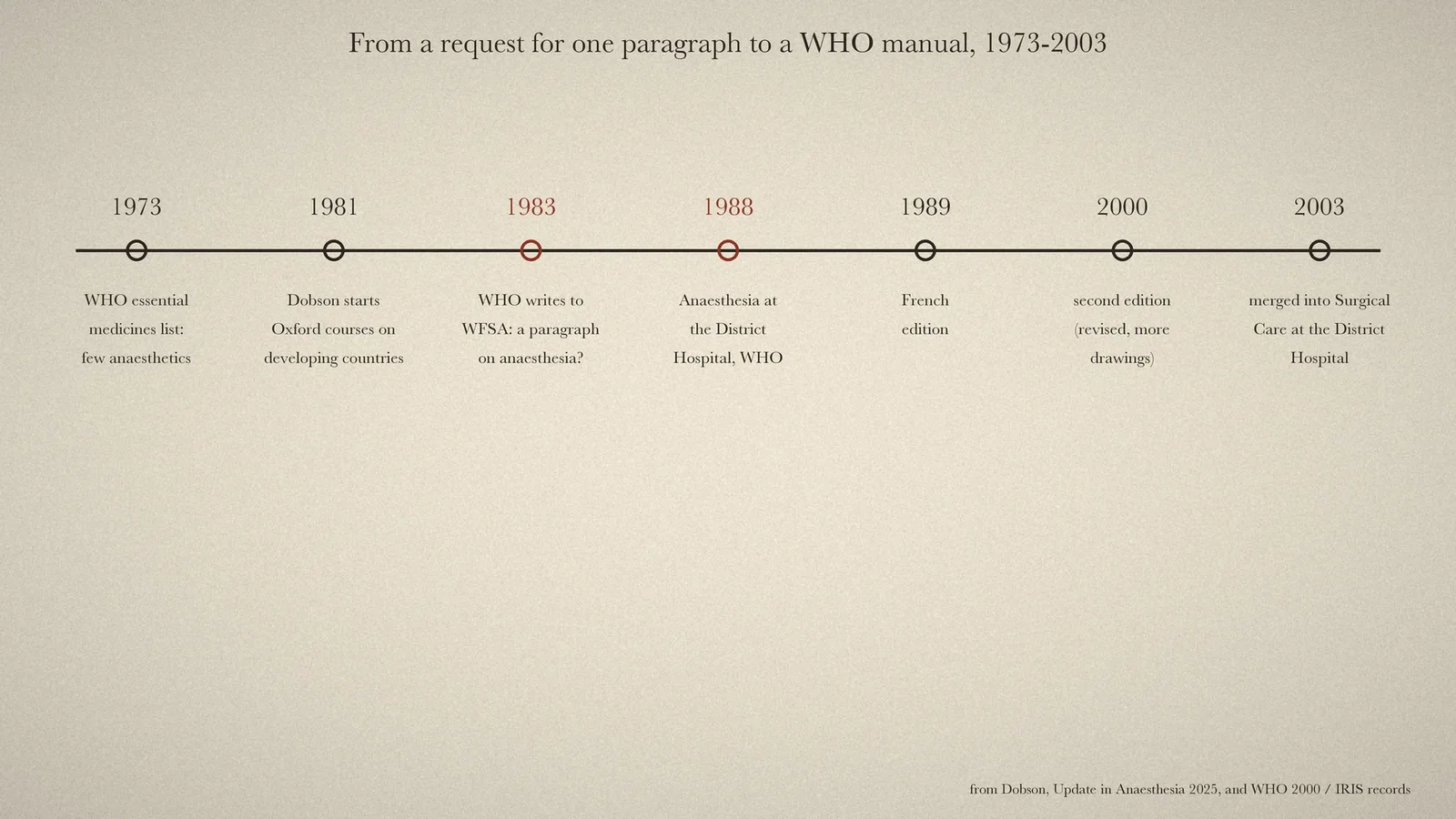
Dobson begins with WHO's list of essential medicines, started "Back in 1973". Only a few anaesthetic drugs were on it: "halothane, ether, suxamethonium, ketamine, and atropine". WHO recognised that these drugs could not be listed without advice on how to use them. An instruction to "swallow a tablet twice daily" works for most medicines, but, as Dobson puts it, "An anaesthetic is a compound event, including drugs, people, and equipment." [1, p. 7]
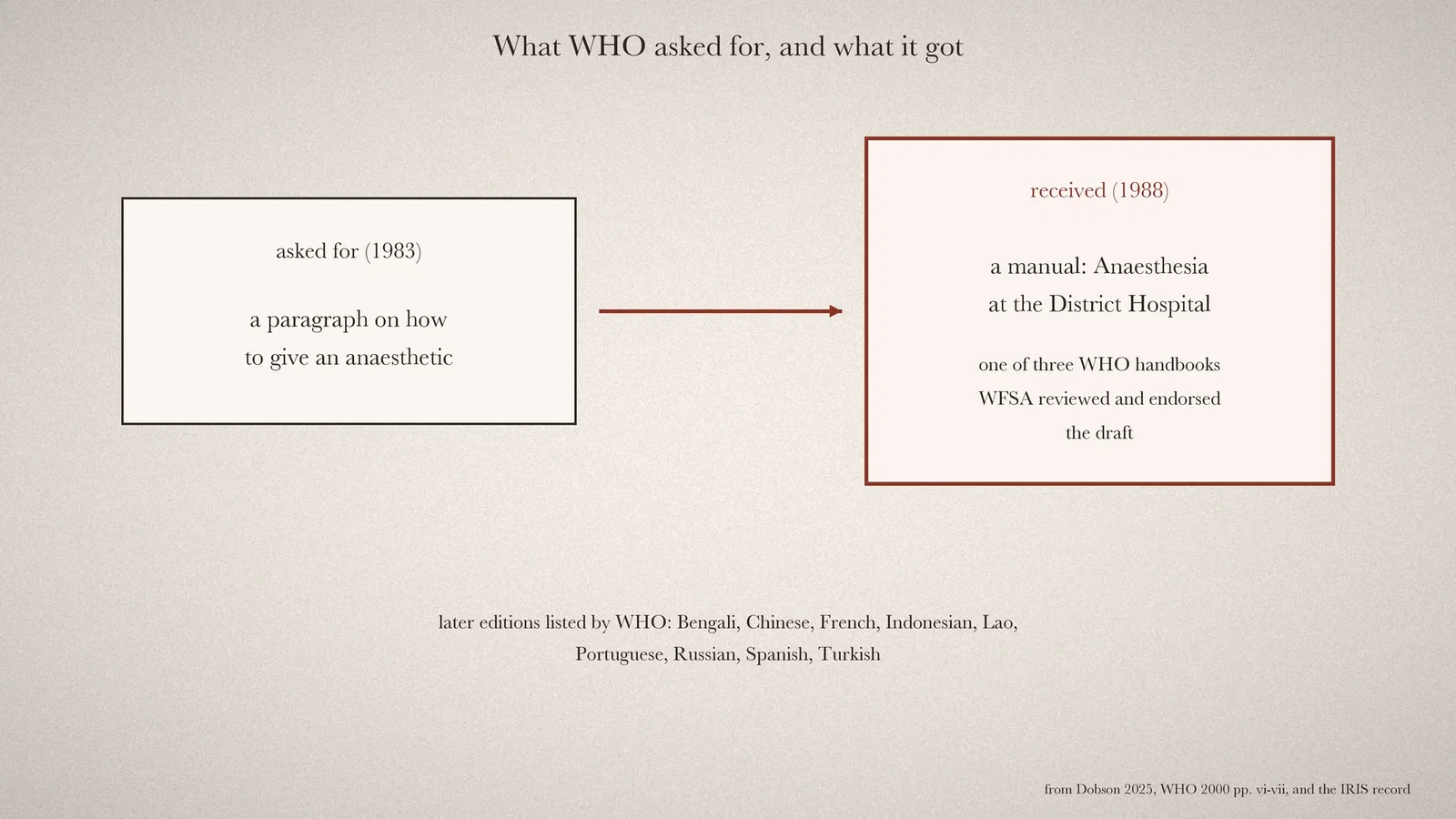
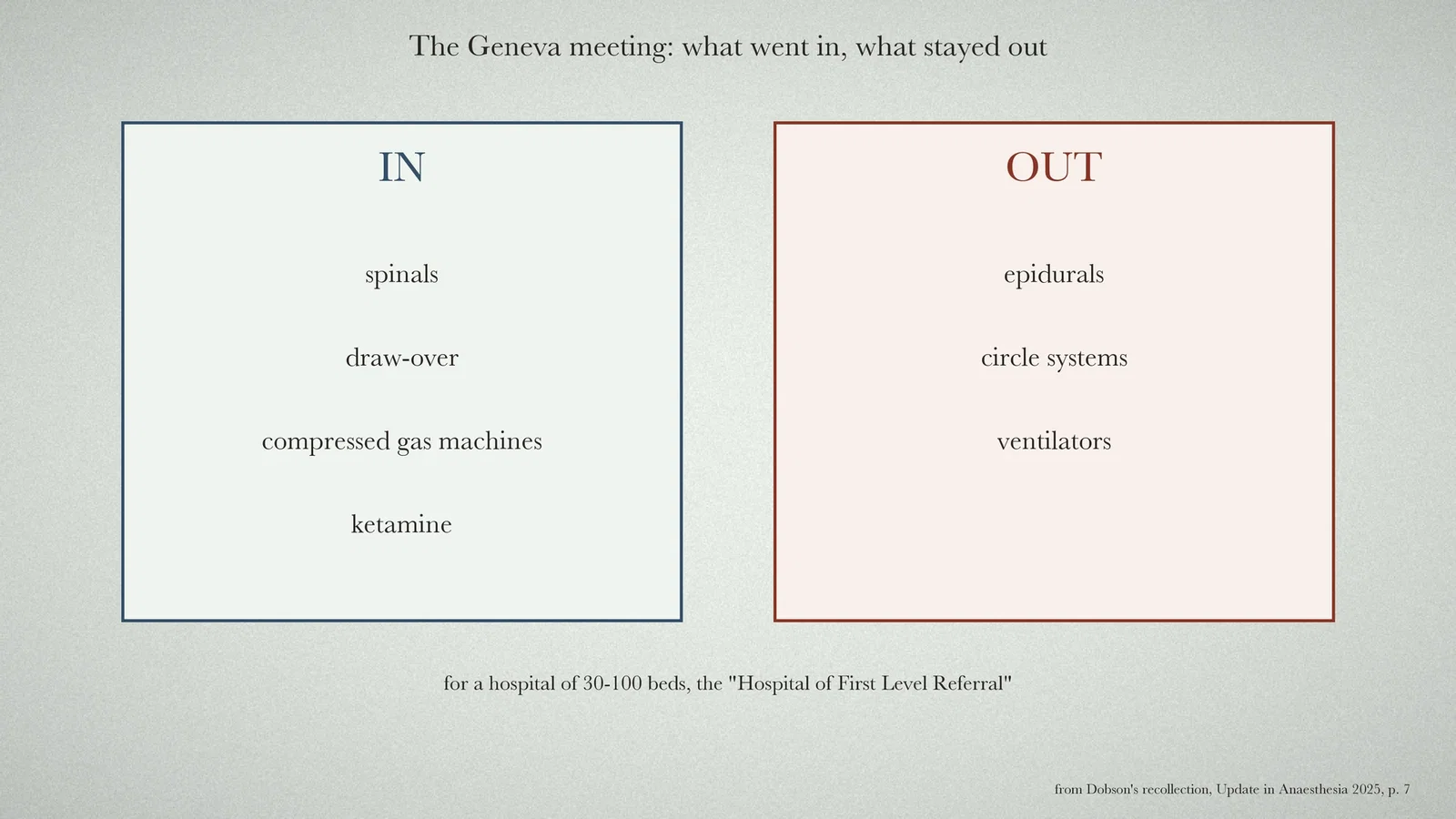
"So in 1983, WHO wrote to the World Federation of Societies of Anaesthesiologists (WFSA)" to ask whether someone could write a paragraph on how to give an anaesthetic. The letter went to John Zorab, then the WFSA's honorary secretary and later its president. Zorab decided to give WHO what it needed, which "was not at all what they had asked for". Zorab wanted a manual of anaesthetic practice for the cases likely to present "in a hospital of 30–100 beds", which WHO called the "Hospital of First Level Referral", in what were then called developing countries. [1, p. 7]
Writing the book
Zorab asked Dobson to write it. Zorab had been Dobson's mentor at Frenchay after Dobson came back from a spell in Nepal, and Dobson had been running courses in Oxford on "Anaesthesia for Developing Countries" since 1981. [1, p. 7] Zorab also persuaded WHO to hold a week-long meeting in Geneva to take advice from regional experts, among them Patricia Coyle (Africa), SayWan Lim (Asia) and Howard Zauder (USA). After "a week of intense discussions", spinal anaesthesia, draw-over apparatus, compressed gas machines and ketamine were in. Epidurals, circle systems and ventilators were out. [1, p. 7]
While the book was in production, WHO decided to publish parallel books on general surgery and on trauma and orthopaedics. The anaesthesia book "was published in 1988", Dobson writes, and it "astonishingly is still for sale on Amazon, 36 years later". It "was produced only by anaesthetists". [1, p. 8]
What the book said it was for
The preface to the first edition, reprinted in 2000, describes the handbook as one of three that WHO would publish "for the guidance of doctors providing surgical and anaesthetic services in small district hospitals (hospitals of first referral) with limited access to specialist services". Its advice was deliberately limited to procedures "that may need to be carried out by a young doctor with limited experience". It warned that the handbooks were "no substitute for practical experience", and that young doctors and their supervisors needed to understand the limits of practice at the district hospital. [2, p. vi] The three handbooks were prepared with ten organisations, including the WFSA, the International Council of Nurses and the League of Red Cross and Red Crescent Societies. [2, p. vi] The acknowledgements record that the WFSA "reviewed and endorsed the draft manuscript and illustrations", and thank John Zorab. [2, p. vii]
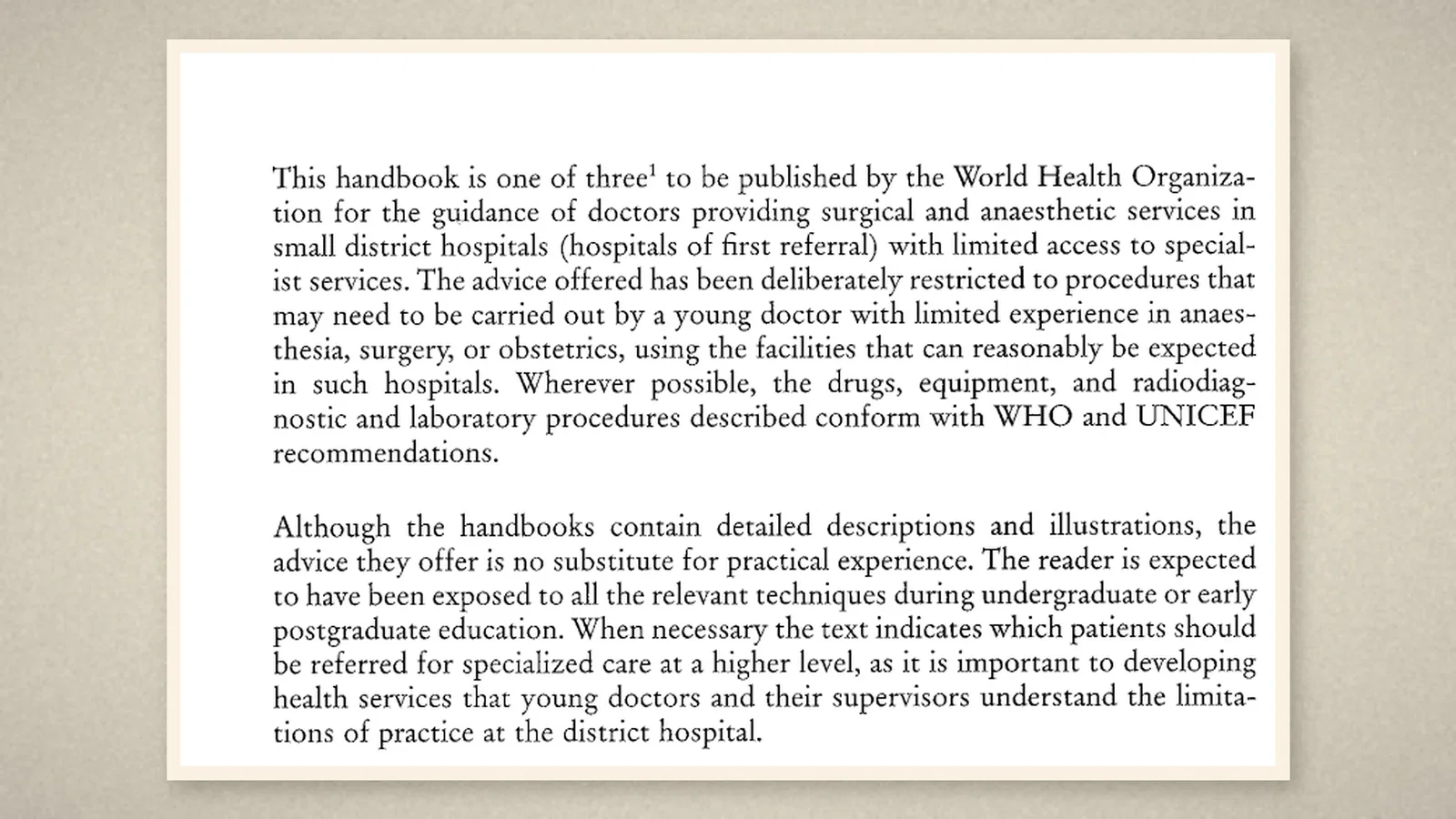
Later editions
A French edition, L'anesthésie à l'hôpital de district, appeared from WHO in 1989, "Published in collaboration with the World Federation of Societies of Anaesthesiologists". The same catalogue record notes a Spanish version issued by the Pan American Health Organization. [4] In the preface to the second edition of 2000, Dobson wrote that the response to the 1988 edition had been "extremely good". Changes in equipment, drugs and clinical practice made a new edition necessary, especially since the book was aimed at "non-specialist anaesthetists who may not have access to other means of keeping up to date". [2, p. v] WHO's catalogue lists editions in Bengali, Chinese, French, Indonesian, Lao, Portuguese, Russian, Spanish and Turkish. [3] Dobson adds that the anaesthesia and surgery books were later rewritten into a single volume, Surgical Care at the District Hospital, published by WHO in 2003. [1, p. 8]
What the record shows
WHO asked anaesthetists for a paragraph and got a book. Its authors chose what a lone doctor in a 30- to 100-bed hospital could do safely with the equipment likely to be there, and they wrote down what to leave out as carefully as what to put in. Dobson closes the chapter with the aim behind the collaboration: "the safest caesarean sections", rather than the latest machine. [1, p. 8]
Sources and reading limits
Read: Dobson's chapter in Update in Anaesthesia 2025;40, pp. 7-8 (text and page image); the WHO second edition of 2000, pp. v-vii (prefaces and acknowledgements) by page image, since the scan has no text layer; the WHO catalogue records of the 2000 edition and the 1989 French edition.
Not covered: a copy of the 1988 English first edition; the 1983 WHO-WFSA correspondence and the records of the Geneva meeting; contemporary reviews. The 1988 preface and acknowledgements are quoted as reprinted in 2000. The year of the Geneva meeting and the year Dobson became the WFSA's liaison officer to WHO are not given here, because the sources read do not give the first, and they disagree on the second. The book's clinical content is not summarised, and no doses or techniques are given.
One illustration is a crop of the 2000 edition; three are drawn from the sources. No patients or equipment are depicted.
- Dobson M. WFSA and WHO liaison - the first 20 years. Update in Anaesthesia. 2025;40:7-8. PDF
- Dobson MB. Anaesthesia at the district hospital. 2nd ed. Geneva: World Health Organization; 2000. WHO IRIS
- World Health Organization. IRIS catalogue record: Anaesthesia at the district hospital, 2nd ed. Record
- Dobson MB. L'anesthésie à l'hôpital de district. Genève: Organisation mondiale de la Santé; 1989. WHO IRIS
Continue exploring
Related reading connects shared questions and contexts; it does not by itself establish historical influence.
Anesthesia Epochs · The Source Room · About & Editorial Method
Published November 2, 2026. Sources and reading limits are stated above. Illustrations are labelled as original source images or AI-made. Historical accounts are educational; they are not current treatment instructions.