
Timed for the COP26 climate conference, a WFSA working group of 45 anaesthesia providers from every inhabited continent agreed seven principles that any anaesthetist anywhere could follow.
Reading Library · Anesthesia Epochs · 中文版
Watch the education video (for clinicians)
2021: Environmentally Sustainable Anaesthesia — Global Principles · Anesthesia Epochs Education Series
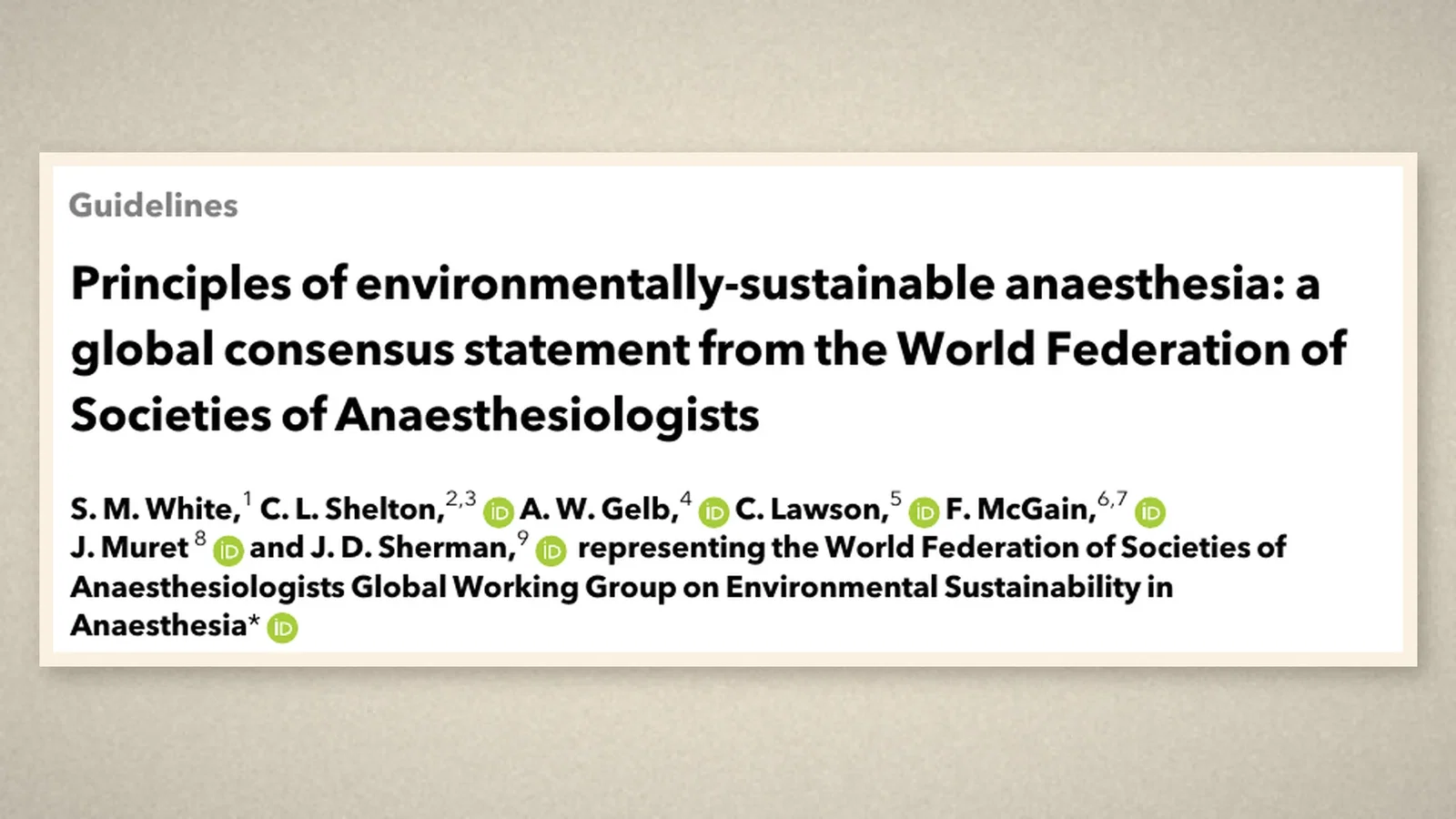
The World Federation of Societies of Anaesthesiologists (WFSA) timeline for 2021 records that "Principles of environmentally-sustainable anaesthesia: a global consensus statement" was published. [3] The paper appeared online in Anaesthesia on 1 November 2021, and its authors explain the date: the method "was implemented deliberately to deliver this statement by the start of" the 26th UN Climate Change Conference, COP26, in Glasgow. [1,4] The statement was not written in Glasgow; it was written for it. This article reads what anaesthetists from around the world agreed to tell each other about their share of climate change.
Why a global statement
The paper begins with the climate: the Earth's mean surface temperature is already about 1.1 °C above pre-industrial levels, and healthcare accounts for nearly 5% of global greenhouse gas emissions. Inhalational anaesthetics alone were estimated at nearly 3% of the National Health Service's emissions in England. [1] Earlier professional guidance on reducing anaesthesia's environmental impact contained useful recommendations, the authors wrote, but had been developed "primarily by, and for, anaesthesia professionals in high-income countries". The new statement was meant to test which recommendations were desirable and achievable everywhere. [1]
Forty-five voices
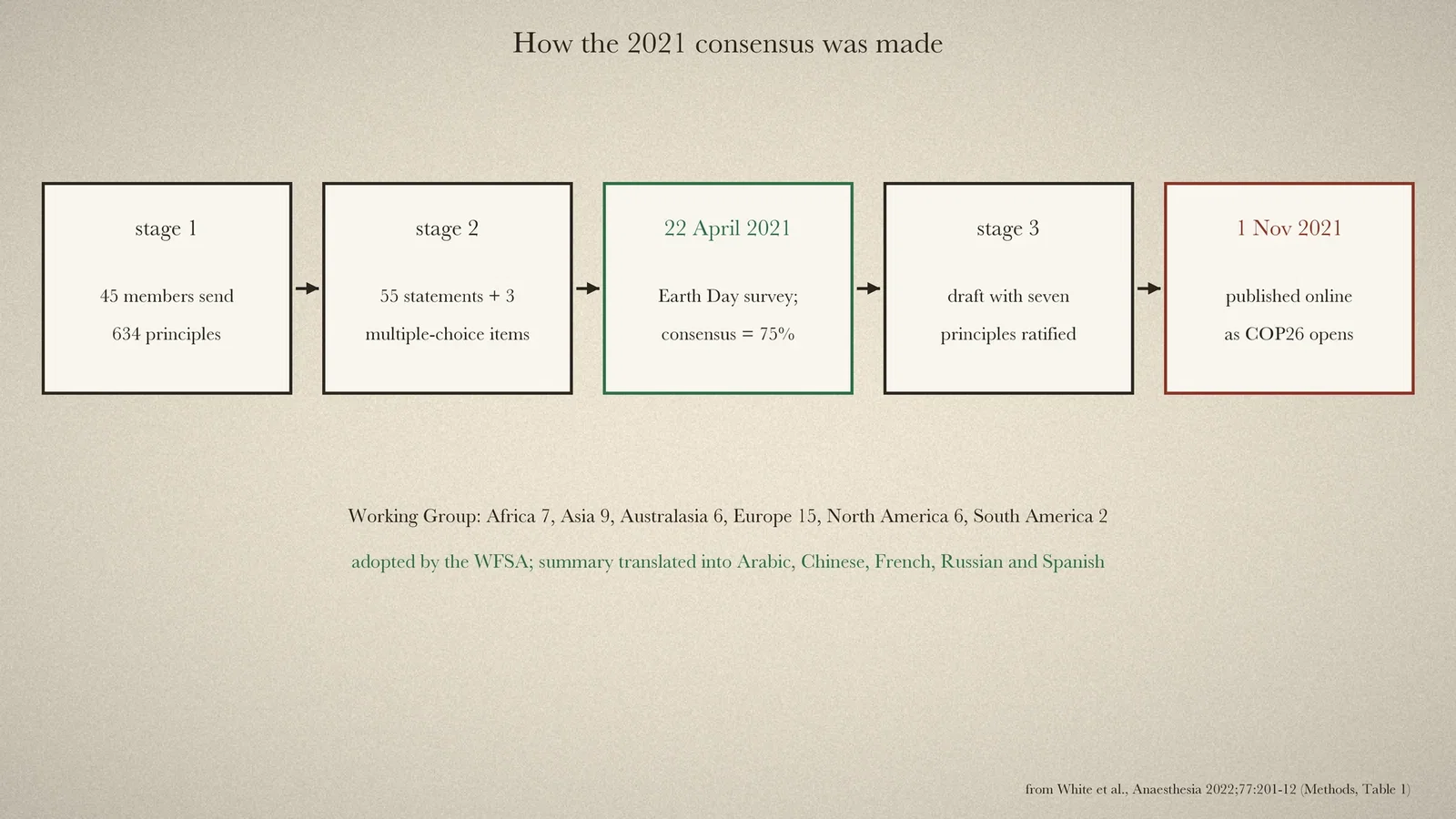
The project grew out of discussions among a seven-member steering committee about the effects of the COVID-19 pandemic on sustainability. It recruited a working group of 45 anaesthesia providers with an interest in sustainability, from every continent except Antarctica: 7 from Africa, 9 from Asia, 6 from Australasia, 15 from Europe, 6 from North America and 2 from South America. Two-thirds of the group came from high-income countries; for 27 of the 45, English was a second language. [1]
The method was a three-stage modified Delphi process. In the first stage members submitted 634 principles. In the second, the steering committee merged them into 55 statements, plus three multiple-choice questions on desflurane, nitrous oxide and the duties of health systems; the group voted anonymously on Earth Day, 22 April 2021, and consensus required agreement from more than 33 members, or 75%. In the third stage the group ratified a draft built on seven themes. [1]
What they agreed
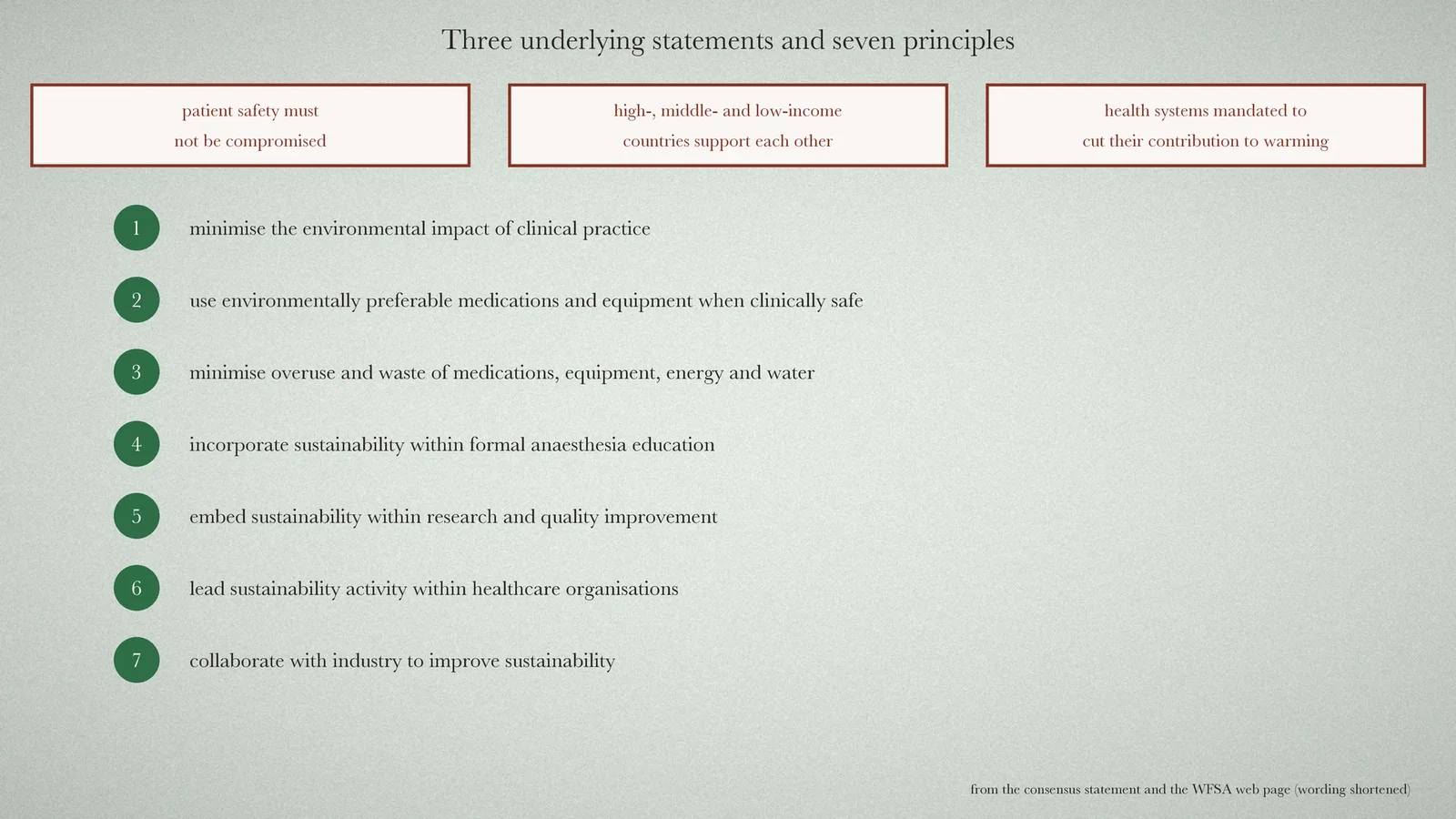
Three statements underlie the rest: patient safety should not be compromised by sustainable practice; high-, middle- and low-income countries should support each other in delivering sustainable healthcare; and health systems should be required to reduce their contribution to global warming. [1] Seven principles follow. Anaesthesia providers should minimise the environmental impact of their clinical practice; use environmentally preferable medications and equipment when clinically safe; minimise overuse and waste of medications, equipment, energy and water; bring sustainability into anaesthesia education; embed it in research and quality improvement; lead sustainability work in their organisations; and collaborate with industry. [1,2]
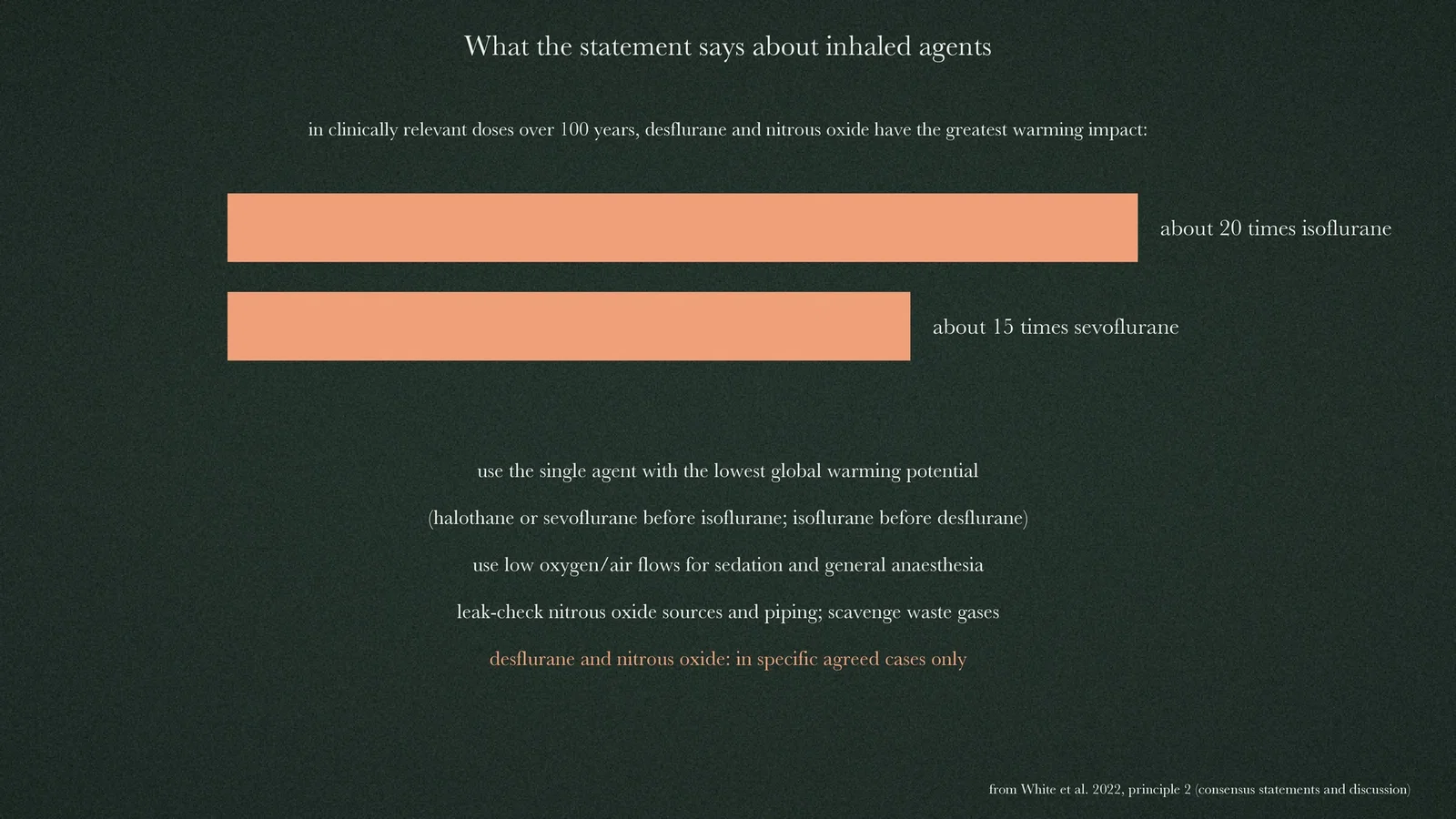
The most specific statements concern inhaled agents. The paper states that, in clinically relevant doses over 100 years, desflurane and nitrous oxide have the greatest warming impact of the inhaled agents, about 20 times that of isoflurane and 15 times that of sevoflurane. The working group agreed that anaesthetists should choose the single agent with the lowest global warming potential, use low gas flows, leak-check nitrous oxide supplies and scavenge waste gases, and use desflurane and nitrous oxide only "in specific agreed cases", rather than banning them or leaving them freely available. [1]
Adoption
The WFSA designated the participants as its Global Working Group on Environmental Sustainability in Anaesthesia, reviewed the principles and adopted them as a global consensus statement. It had the summary translated from English into the other five official UN languages, Arabic, Chinese, French, Russian and Spanish, and still offers those versions on its website. [1,2] The authors added that the changes were achievable with minimal financial investment and should be re-evaluated as better evidence appears. [1]
What the record shows
This statement asked anaesthetists to weigh something beyond the patient on the table: the gases and waste that leave the operating theatre. By building the statement with members from low- and middle-income countries, and by refusing to put patient safety second, the WFSA tried to make green anaesthesia a standard for everyone rather than a luxury for some.
Sources and reading limits
Read: the full text of White et al. (open-access PDF and Europe PMC XML; first page also as an image); the PubMed record; the WFSA web page on environmentally sustainable anaesthesia; the WFSA history timeline.
Not covered: the supporting appendices beyond their description; the translated summaries (the WFSA resource site requires an account for downloads); the Delphi survey data; any study of whether anaesthetic practice or emissions changed afterwards. The date of the WFSA's formal adoption is not given in the sources read. The percentage figures on healthcare emissions are those cited in the paper, not independently checked.
One illustration is a crop of the article's first page; three are drawn from the sources.
- White SM, Shelton CL, Gelb AW, Lawson C, McGain F, Muret J, Sherman JD; WFSA Global Working Group on Environmental Sustainability in Anaesthesia. Principles of environmentally-sustainable anaesthesia: a global consensus statement from the World Federation of Societies of Anaesthesiologists. Anaesthesia. 2022;77(2):201-12. DOI
- World Federation of Societies of Anaesthesiologists. Environmentally-sustainable anaesthesia. Website
- World Federation of Societies of Anaesthesiologists. WFSA history timeline. Website
- White SM, et al. Principles of environmentally-sustainable anaesthesia (PubMed record; published online 1 November 2021). PubMed
Continue exploring
Related reading connects shared questions and contexts; it does not by itself establish historical influence.
Anesthesia Epochs · The Source Room · About & Editorial Method
Published November 2, 2026. Sources and reading limits are stated above. Illustrations are labelled as original source images or AI-made. Historical accounts are educational; they are not current treatment instructions.