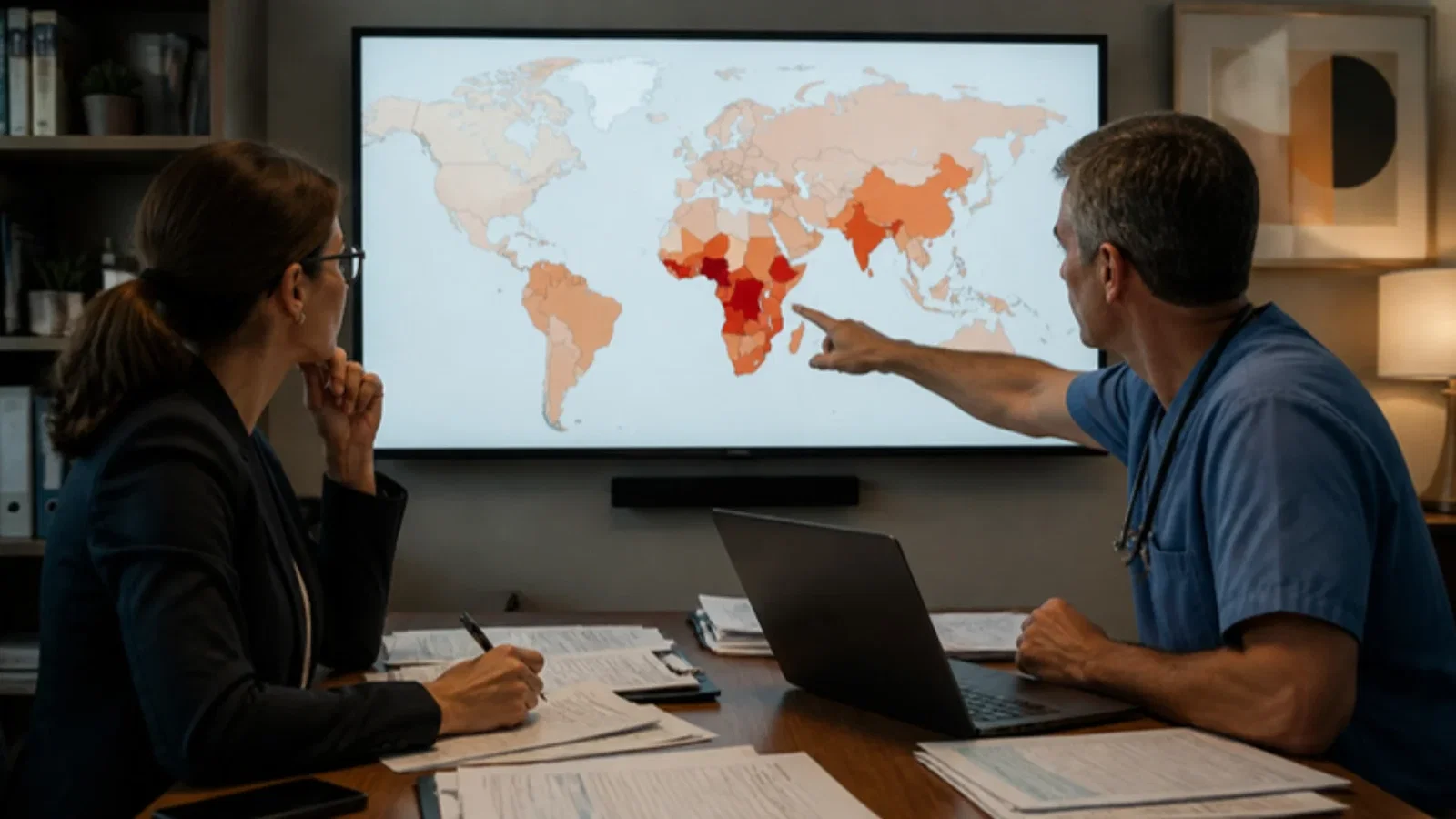
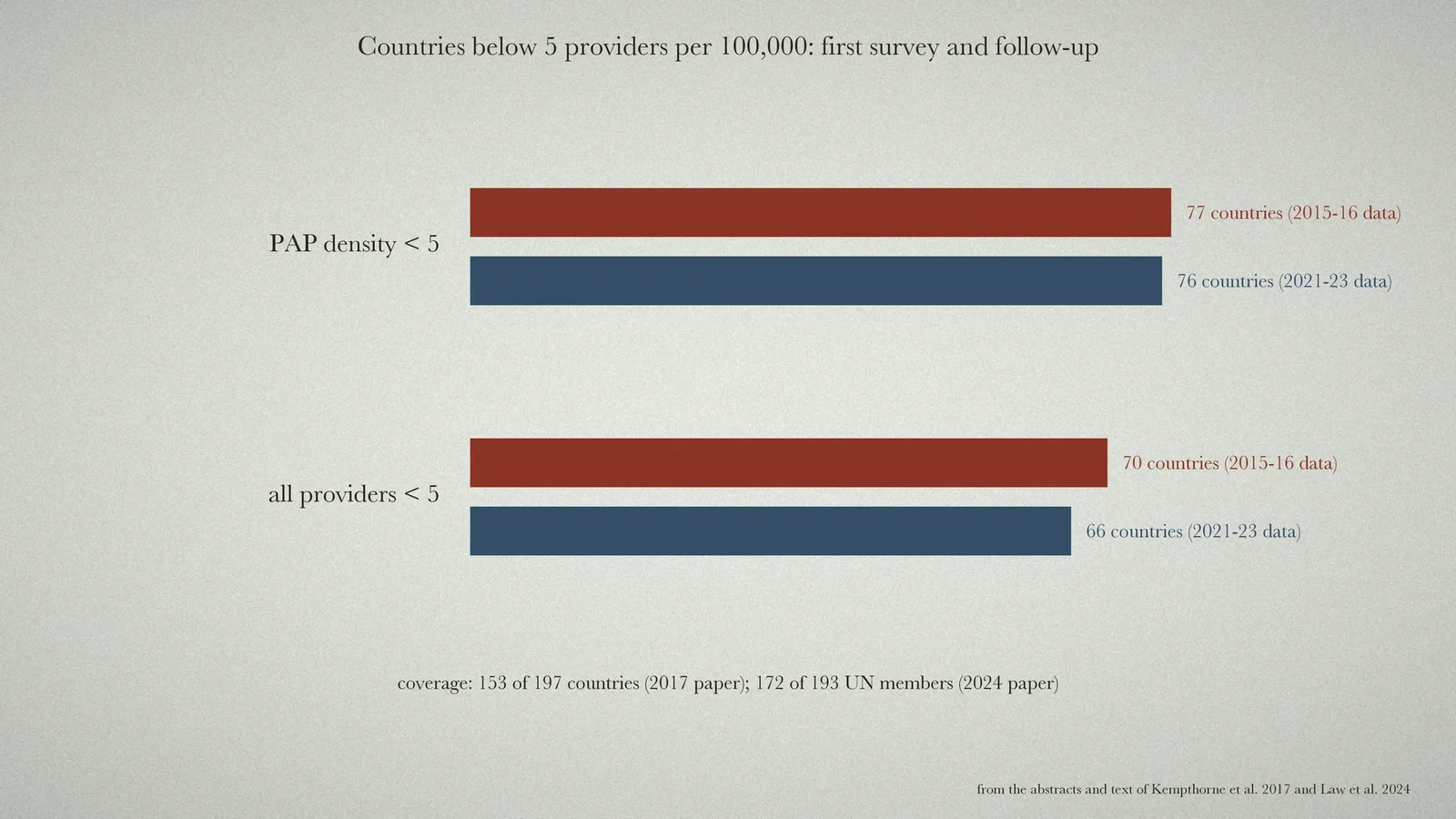
The first global anaesthesia workforce survey gathered data for 153 countries and found that 77 of them had fewer than five physician anaesthesia providers per 100,000 people.
Reading Library · Anesthesia Epochs · 中文版
Watch the education video (for clinicians)
2017: The Global Anaesthesia Workforce Survey — Counting Providers · Anesthesia Epochs Education Series
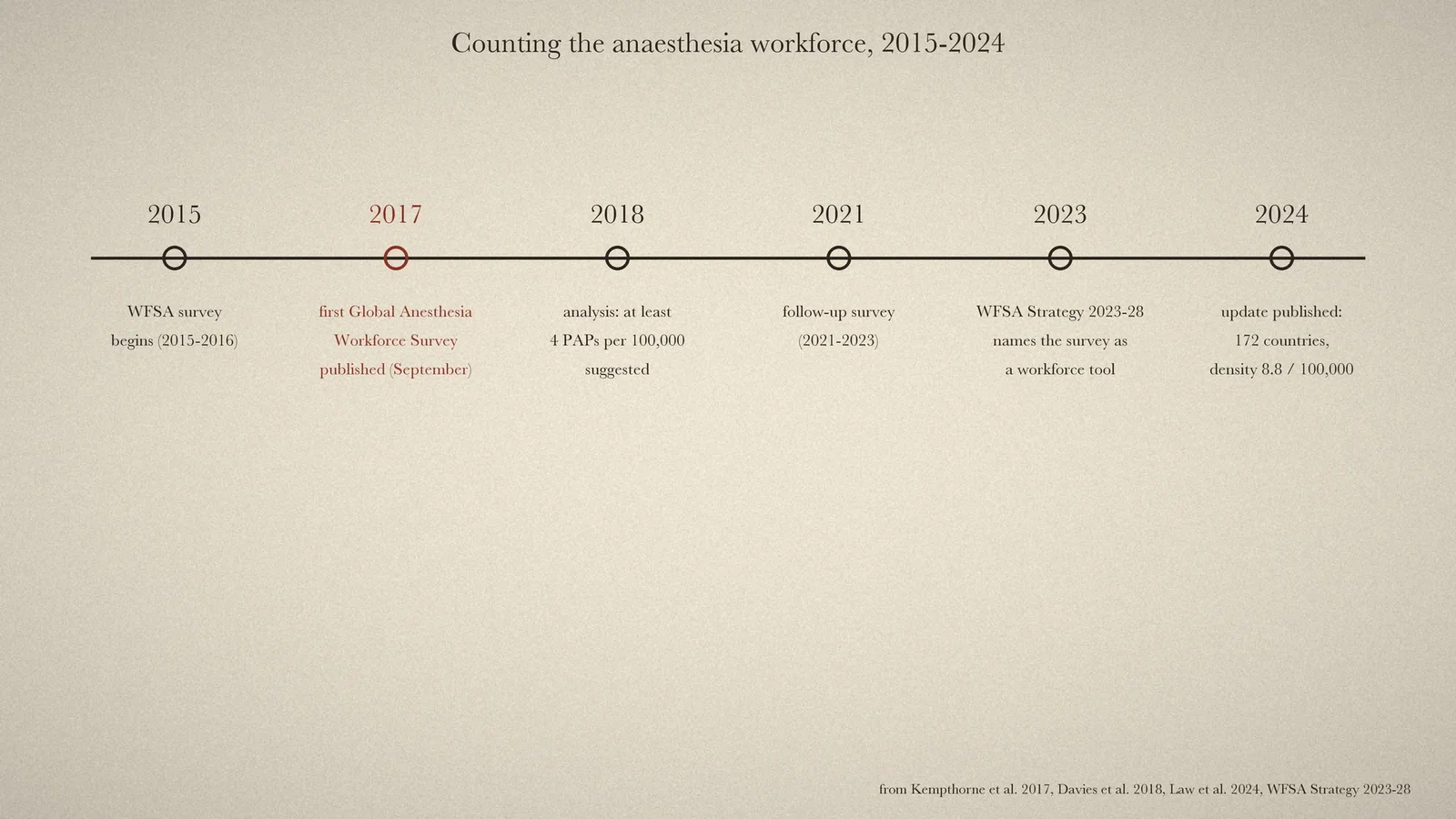
Among its entries for 2017, the World Federation of Societies of Anaesthesiologists (WFSA) history timeline lists the "Publication of first Global Anaesthesia Workforce Survey". [6] The report appeared in Anesthesia & Analgesia that September, written by P. Kempthorne, W. W. Morriss, J. Mellin-Olsen and J. Gore-Booth. [1] Its aim was simple to state and hard to carry out: to count, country by country, the people who give anaesthesia.
Why count
The survey begins from a figure used in global surgery: safe anaesthesia and surgical care are not available when needed for 5 billion of the world's 7 billion people. The authors noted major shortages in the specialist surgical workforce, while "specific data on the anesthesia workforce" were lacking. [1] A 2024 paper later explained why: global databases of health indicators do not record the health workforce down to medical specialty. [2]
What was counted
The WFSA ran the survey in 2015 and 2016. It sought the number, distribution and training of physician anaesthesia providers (PAPs) and non-physician anaesthesia providers (NPAPs), grouped by World Health Organization region and World Bank income group. Information came back for 153 of 197 countries, covering 97.5% of the world's population. [1]
What was found
Density ranged from zero to more than 20 PAPs per 100,000 population. Seventy-seven countries reported fewer than 5 PAPs per 100,000, with particularly low densities in the African and South-East Asia regions. NPAPs made up a large share of the workforce where resources were limited, yet even counting them, 70 countries had fewer than 5 anaesthesia providers of any kind per 100,000. On current population data, more than 136,000 additional PAPs would be needed immediately to give every country 5 per 100,000. [1]
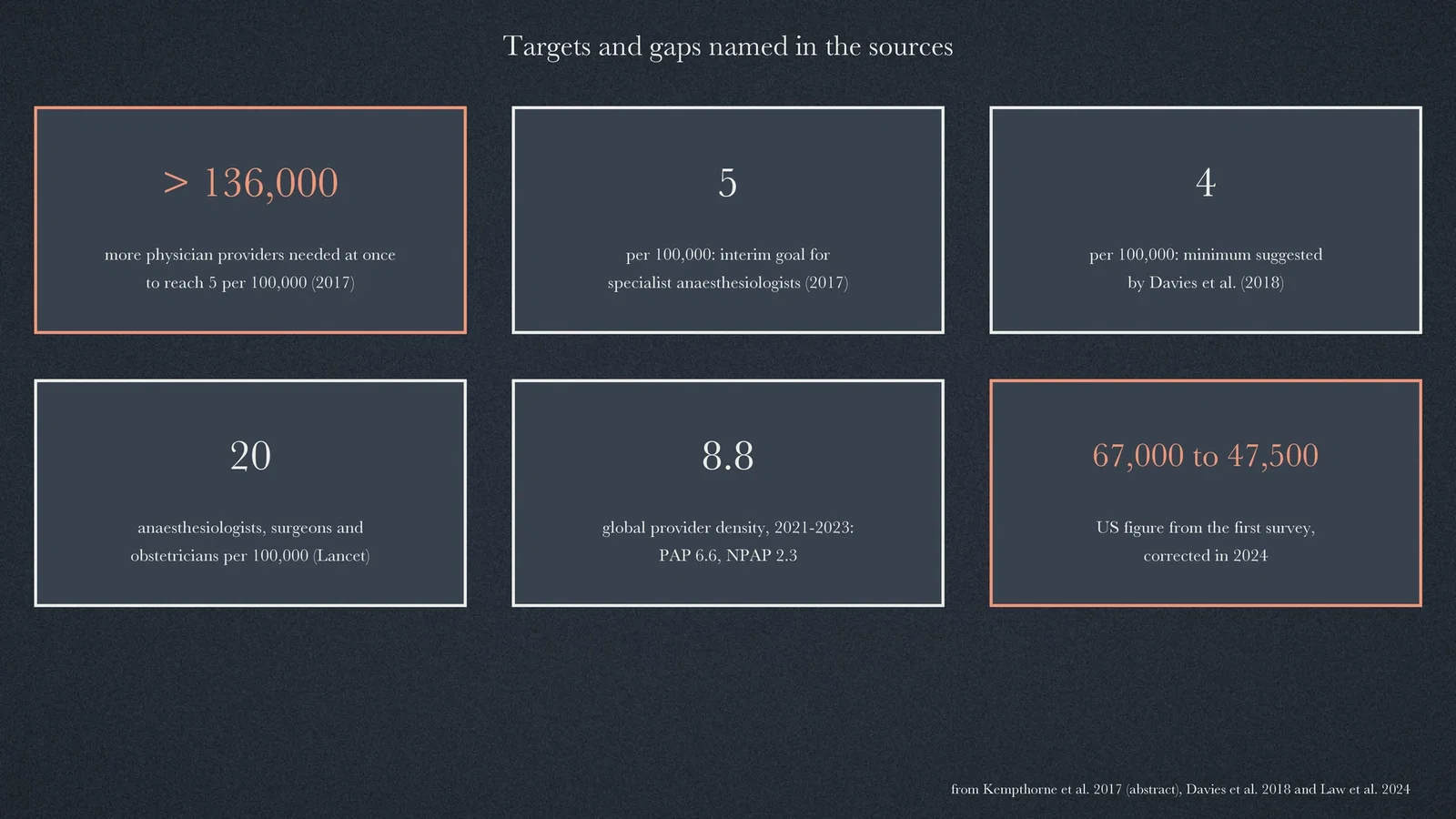
The authors called the survey the most comprehensive study of the global anaesthesia workforce to date and the first step in continuing data collection. They proposed an interim goal of at least 5 specialist anaesthesiologists per 100,000 and warned that training would have to rise sharply "if we are to have any hope of achieving safe anesthesia for all by 2030". [1]
What counts as enough
The numbers quickly fed into argument about targets. In 2018 J. I. Davies, E. Vreede, B. Onajin-Obembe and Morriss related specialist density to maternal mortality and concluded that countries should aim for "at least four PAPs per 100 000 population"; on the data then available, 80 countries had fewer. [3] The 2024 paper cites the Lancet Commission's recommendation of at least 20 surgeons, anaesthesiologists and obstetricians per 100,000 as the broader indicator. [2]
The second count
The WFSA repeated the survey between 2021 and 2023, sending questionnaires to national societies of physician anaesthetists, nurse anaesthetists and other providers. T. J. Law and colleagues, reporting in 2024, obtained responses for 172 of 193 United Nations member states. Global provider density was 8.8 per 100,000 (6.6 PAPs and 2.3 NPAPs). Seventy-six countries still had a PAP density below 5, and 66 a total provider density below 5. PAP density had risen everywhere except in high- and low-income countries and the African region. [2]
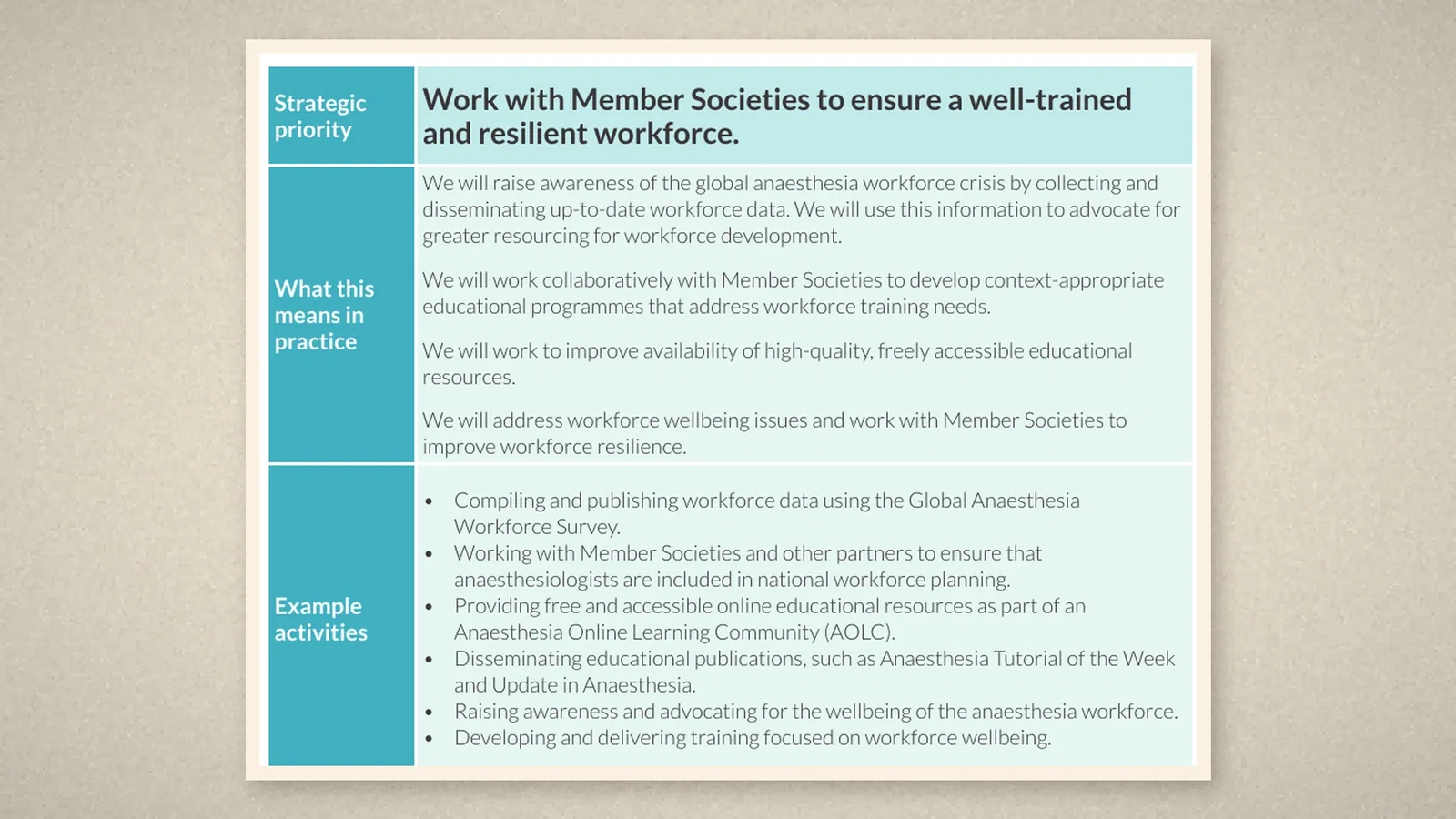
The follow-up is also a check on the first survey. It credits the 2016 count with having "enumerated for the first time" the anaesthesia workforce shortage globally and nationally. It also reports that the 2016 figure for the United States had been wrong: the comparison number was adjusted from 67,000 to 47,500, because the error had skewed results for the United States, the Americas and high-income countries. [2] The WFSA now publishes the data as an online workforce map, and its strategy for 2023-28 lists compiling and publishing workforce data through the survey among its priorities. [4,5]
What the record shows
By its successors' account, this survey was the first to put a number on the global shortage of anaesthesia providers, country by country. The WFSA then chose to keep counting. The correction in 2024 is part of the same story: a count that is repeated can be checked.
Sources and reading limits
Read: the abstract of Kempthorne et al. 2017; the full text of Law et al. 2024 and of Davies et al. 2018; the WFSA Strategy 2023-28 (p. 7 also as an image); the WFSA workforce map page; the WFSA history timeline.
Not covered: the full text, tables and country data of Kempthorne et al. 2017 (one journal link tried returned a different article, which was not used); the survey questionnaire; the letters published in response. The first survey is described from its abstract and from its successor's account. The sources date the first survey's data collection to 2015-2016 (2017 abstract) and to 2016 (2024 paper); both are reported.
One illustration is a crop of the WFSA Strategy 2023-28; three are drawn from the sources.
- Kempthorne P, Morriss WW, Mellin-Olsen J, Gore-Booth J. The WFSA Global Anesthesia Workforce Survey. Anesth Analg. 2017;125(3):981-90. PubMed
- Law TJ, Lipnick MS, Morriss W, Gelb AW, et al. The Global Anesthesia Workforce Survey: updates and trends in the anesthesia workforce. Anesth Analg. 2024;139(1):15-24. Full text
- Davies JI, Vreede E, Onajin-Obembe B, Morriss WW. What is the minimum number of specialist anaesthetists needed in low-income and middle-income countries? BMJ Glob Health. 2018;3(6):e001005. DOI
- World Federation of Societies of Anaesthesiologists. WFSA Strategy 2023-28. PDF
- World Federation of Societies of Anaesthesiologists. World Anaesthesiology Workforce Map. Website
- World Federation of Societies of Anaesthesiologists. WFSA history timeline. Website
Continue exploring
Related reading connects shared questions and contexts; it does not by itself establish historical influence.
- 2015: The World Health Assembly Puts Surgery and Anaesthesia on Its Agenda
- 2000: A Planning Model Counts Canada's Anaesthesiologists
Anesthesia Epochs · The Source Room · About & Editorial Method
Published November 2, 2026. Sources and reading limits are stated above. Illustrations are labelled as original source images or AI-made. Historical accounts are educational; they are not current treatment instructions.