
Resolution WHA68.15 called emergency and essential surgical care and anaesthesia neglected but cost-effective, and asked every Member State to build them into universal health coverage.
Reading Library · Anesthesia Epochs · 中文版
Watch the education video (for clinicians)
2015: WHA68.15 — What the Health Ministers Asked For · Anesthesia Epochs Education Series
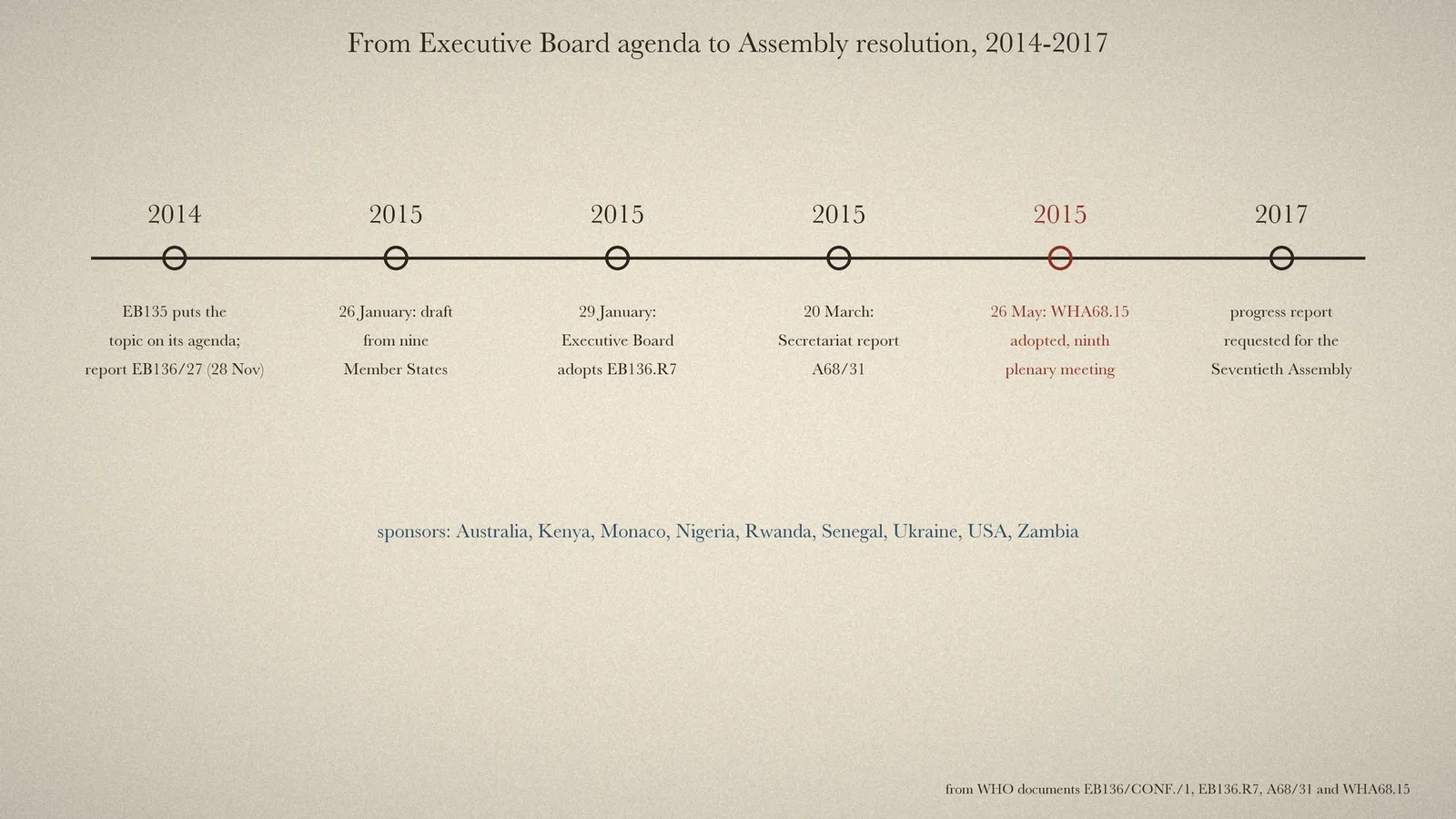
At its ninth plenary meeting on 26 May 2015, the Sixty-eighth World Health Assembly adopted resolution WHA68.15, Strengthening emergency and essential surgical care and anaesthesia as a component of universal health coverage. [1] The World Federation of Societies of Anaesthesiologists (WFSA) lists two events for 2015 in its history timeline: the launch of the Lancet Commission on Global Surgery and the "Passing of WHO's Resolution 68.15". [5,6] This article reads the resolution itself: how it reached the Assembly, what case it made and what it asked governments to do.
The route through WHO
The documents show a short path. According to the Secretariat, the Executive Board at its 135th session agreed to put the subject on the agenda of its next session, and a revised report, EB136/27, was dated 28 November 2014. [2] On 26 January 2015 a draft resolution was tabled by Australia, Kenya, Monaco, Nigeria, Rwanda, Senegal, Ukraine, the United States of America and Zambia. [4] Three days later the Board adopted resolution EB136.R7, recommending the text to the Assembly; the Secretariat's report A68/31 of 20 March 2015 invited the Assembly to adopt it. [2,3]
The case in numbers
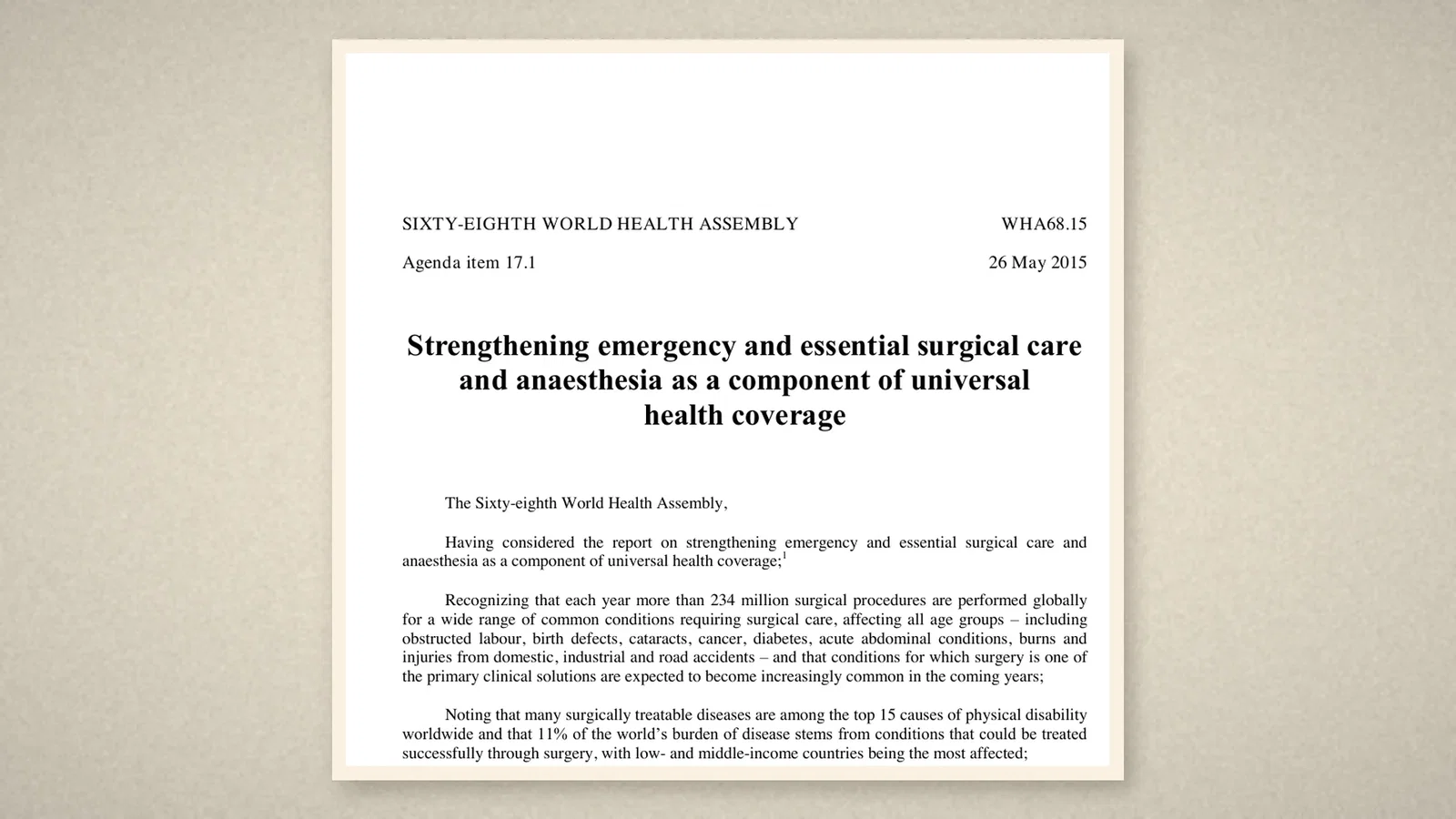
The preamble reads like an argument. It recognises that more than 234 million surgical procedures are performed each year, that surgically treatable diseases are among the top 15 causes of physical disability, and that 11% of the world's burden of disease comes from conditions that surgery could treat, with low- and middle-income countries most affected. It notes that more than 289 000 women die in childbirth each year and that about a quarter of maternal deaths could be avoided "if safe surgery and anaesthesia were universally available". [1]
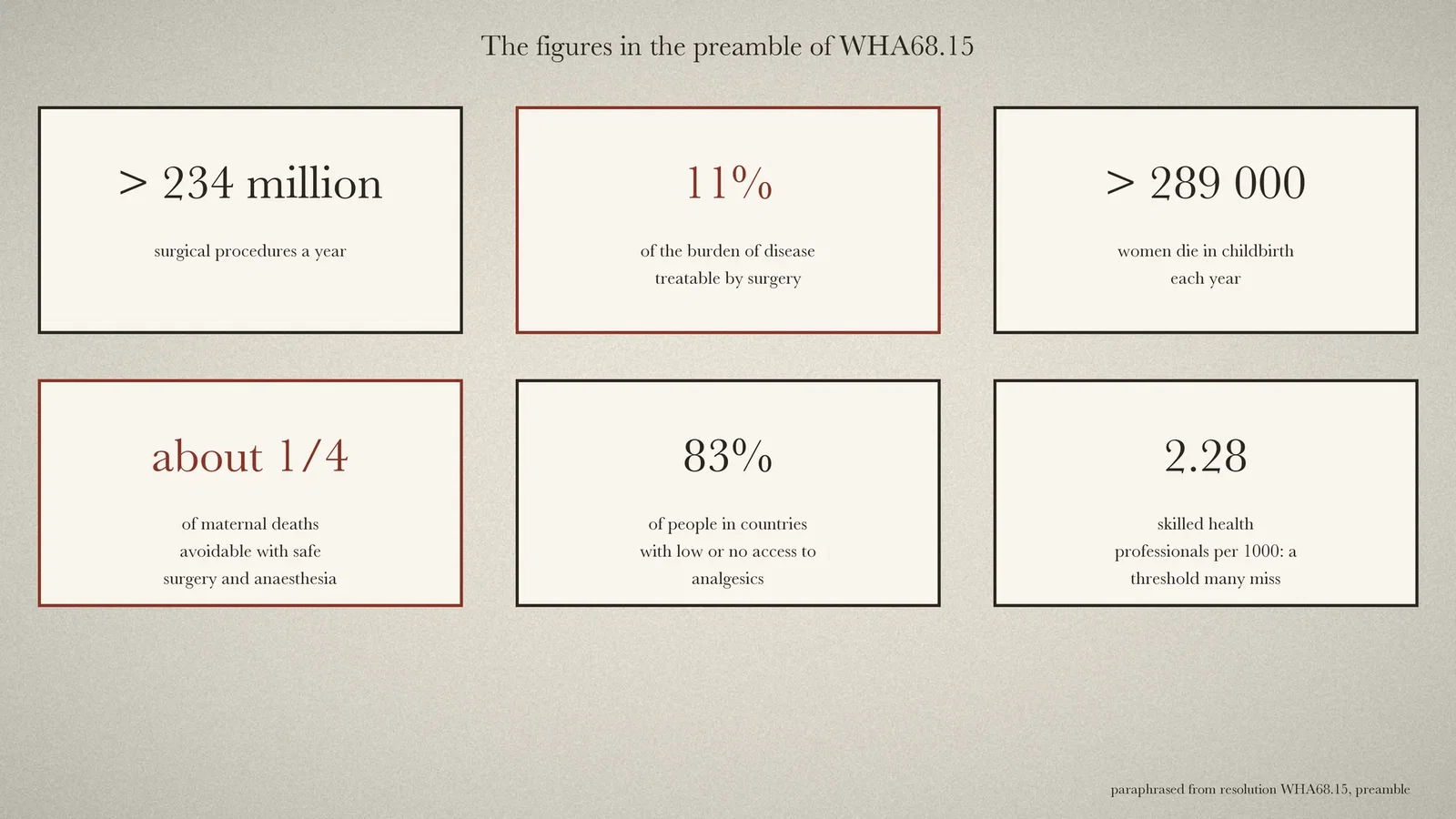
Pain relief has its own paragraph. The resolution states that 5500 million people, 83% of the world's population, live in countries with low or no access to analgesics, and it asks that efforts to prevent the diversion of controlled drugs should not create "inappropriate regulatory barriers to medical access". It also acknowledges that many countries cannot meet the threshold of 2.28 skilled health professionals per 1000 people, and that some procedures can be carried out by other trained workers through task-sharing. [1] Its central judgement is that emergency and essential surgery and anaesthesia are "neglected but efficacious and cost-effective" additions to basic health services, especially at first-referral hospitals. [1]
What governments were asked to do
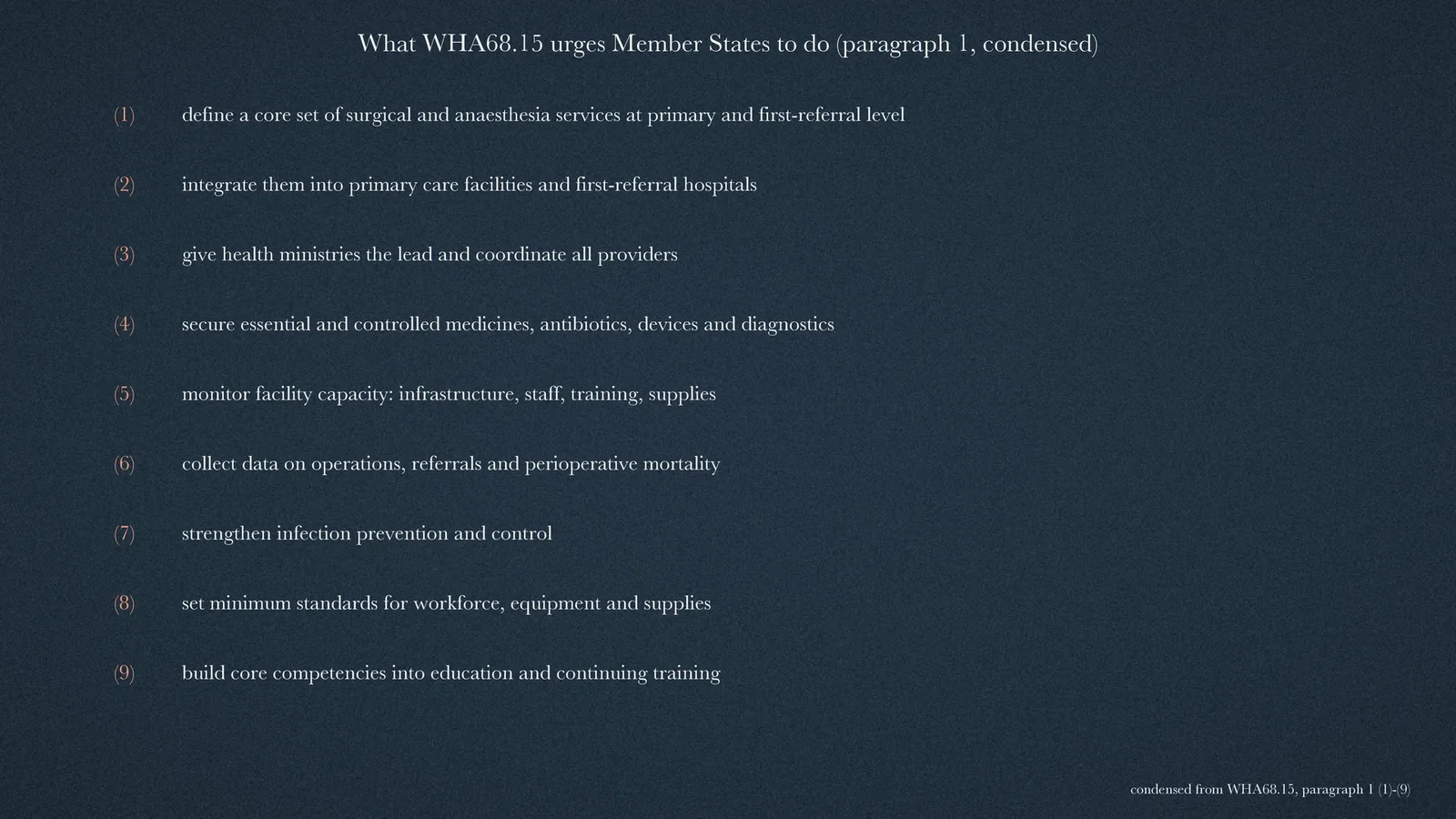
The resolution urges Member States to identify a core set of emergency and essential surgery and anaesthesia services at primary care and first-referral hospital level and to make them affordable for all who need them; to give health ministries the lead; to secure essential and controlled medicines, antibiotics, devices and diagnostics; to monitor the capacity of facilities; to collect data on the number and type of operations, referrals and perioperative mortality; to strengthen infection control; to set minimum standards for workforce, equipment and supplies; and to build core competencies into the training of doctors, nurses, midwives and other providers. [1]
It asks the Director-General, among other things, to devise reliable measures of access to and safety of surgery and anaesthesia, including a risk-adjusted perioperative mortality rate; to work with the International Narcotics Control Board and the UN Office on Drugs and Crime on access to controlled medicines; and to report on progress to the Seventieth World Health Assembly in 2017. [1]
Anaesthesia in the title
WHO's earlier district-hospital work, described in an earlier article of this series, already treated anaesthesia as part of surgical care. In 2015 the word appeared in the title of an Assembly resolution, beside surgery and tied to universal health coverage. The Lancet Commission's report, Global Surgery 2030, appeared in the same year. [6]
What the record shows
WHA68.15 is a statement of intent by the world's health ministers, not a programme with money attached. It gave anaesthesiologists' societies, including the WFSA, a document they could cite to governments: surgery and anaesthesia are part of basic health care, and the drugs, staff and data needed for them are the responsibility of the state.
Sources and reading limits
Read: resolution WHA68.15 in full (the first page also as an image); the Secretariat report A68/31 with the attached Executive Board report EB136/27; Executive Board resolution EB136.R7; the draft EB136/CONF./1 and its sponsors; the WFSA history timeline; the PubMed record of the Lancet Commission report.
Not covered: the records of the Board and Assembly debates and the statements of delegations; any account of the WFSA's own part in the process; the text of the Lancet Commission report; WHO's 2017 progress report and later implementation data. The reference to earlier WHO manuals rests on an earlier article in this series, not on the sources read here. Whether the resolution changed services in any country is not assessed.
One illustration is a crop of the resolution's first page; three are drawn from the sources.
- World Health Assembly. Resolution WHA68.15: Strengthening emergency and essential surgical care and anaesthesia as a component of universal health coverage. Geneva: WHO; 26 May 2015. PDF
- World Health Organization. Strengthening emergency and essential surgical care and anaesthesia as a component of universal health coverage: report by the Secretariat. A68/31. 20 March 2015. PDF
- WHO Executive Board. Resolution EB136.R7. 29 January 2015. PDF
- WHO Executive Board. Draft resolution proposed by Australia, Kenya, Monaco, Nigeria, Rwanda, Senegal, Ukraine, United States of America and Zambia. EB136/CONF./1. 26 January 2015. PDF
- World Federation of Societies of Anaesthesiologists. WFSA history timeline. Website
- Meara JG, Leather AJ, Hagander L, et al. Global Surgery 2030: evidence and solutions for achieving health, welfare, and economic development. Lancet. 2015;386(9993):569-624. PubMed
Continue exploring
Related reading connects shared questions and contexts; it does not by itself establish historical influence.
- 1988: A WHO Manual of Anaesthesia for the District Hospital
- 2011: An International Standard for Anaesthesia Without Reliable Power or Gas
Anesthesia Epochs · The Source Room · About & Editorial Method
Published November 2, 2026. Sources and reading limits are stated above. Illustrations are labelled as original source images or AI-made. Historical accounts are educational; they are not current treatment instructions.