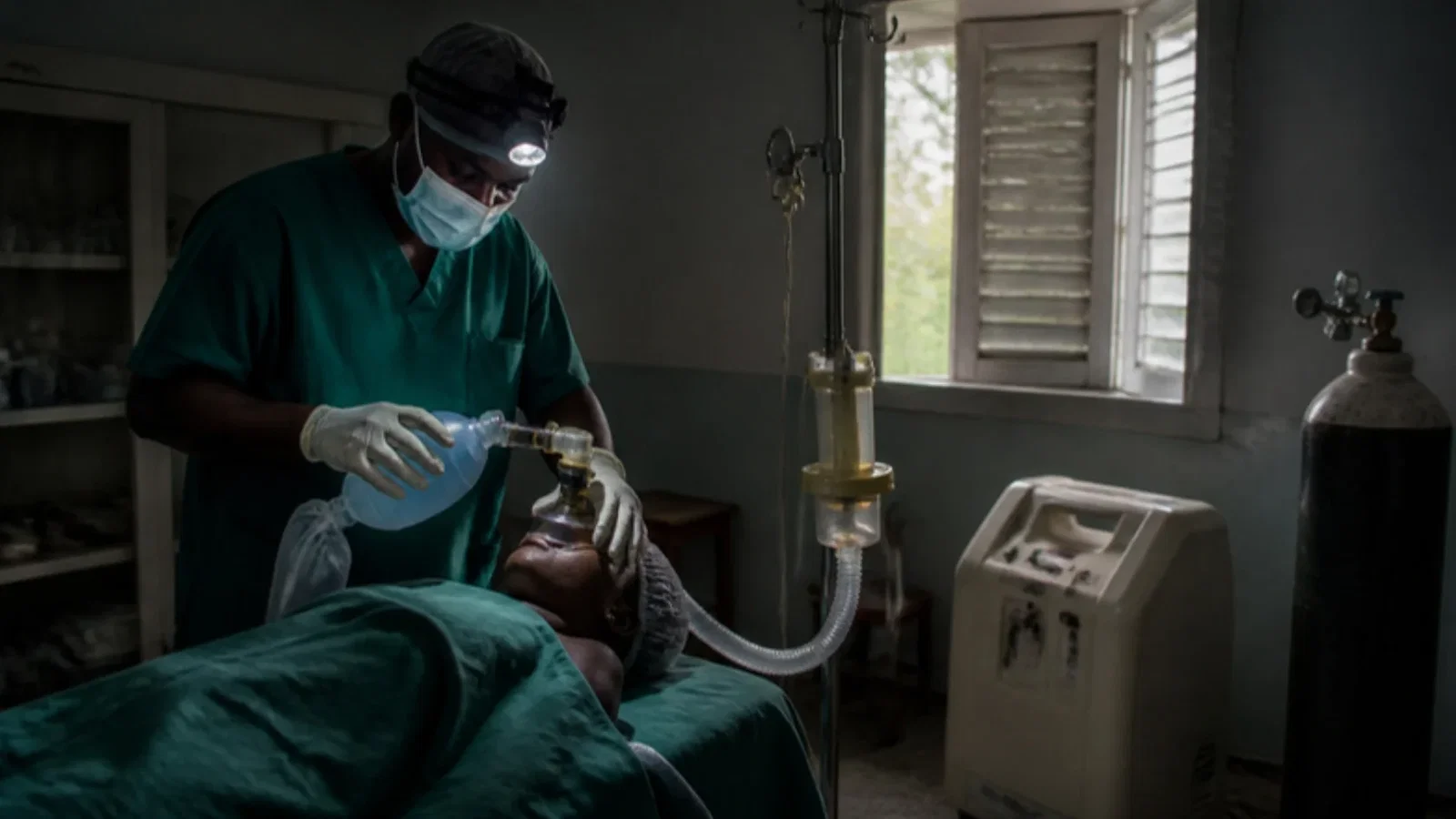
ISO 8835-7 wrote down what an anaesthetic system must do when the electricity fails, the oxygen cylinders run out and the nearest engineer is far away, in a standard the WFSA helped to develop.
Reading Library · Anesthesia Epochs · 中文版
Watch the education video (for clinicians)
2011: ISO 8835-7 — Anaesthesia Without Reliable Power or Gas · Anesthesia Epochs Education Series
Among its 2011 entries, the World Federation of Societies of Anaesthesiologists (WFSA) history timeline notes that the federation was "involved in developing" a new ISO standard, 8835-7:2011, for anaesthetic systems in areas with "limited logistical supplies of electricity and anesthetic gases". [3] This article looks at what that standard says, so far as its public preview shows, and at the problem it was written to address.
The problem in the standard's own words
ISO 8835-7 belongs to the series Inhalational anaesthesia systems and was prepared by ISO technical committee 121, Anaesthetic and respiratory equipment, subcommittee 1. [1] Its introduction begins with a concern shared by the World Health Organization (WHO) and the WFSA: safe anaesthesia in the many countries where cost or infrastructure means complex technology is unlikely to work well, and may introduce hazards of its own. The introduction counts 152 such countries. [1]
Clinicians had described the same problem in print. In 2008 R. M. Beringer and R. J. Eltringham wrote that sophisticated machines built for modern hospitals depend on skilled engineers and on uninterrupted electricity and compressed gas, which many hospitals in poorer countries lack. [4] In 2015 Eltringham and R. C. Neighbour added that such machines were still being delivered in large numbers and often could not function at all. [6]
Four minimum criteria
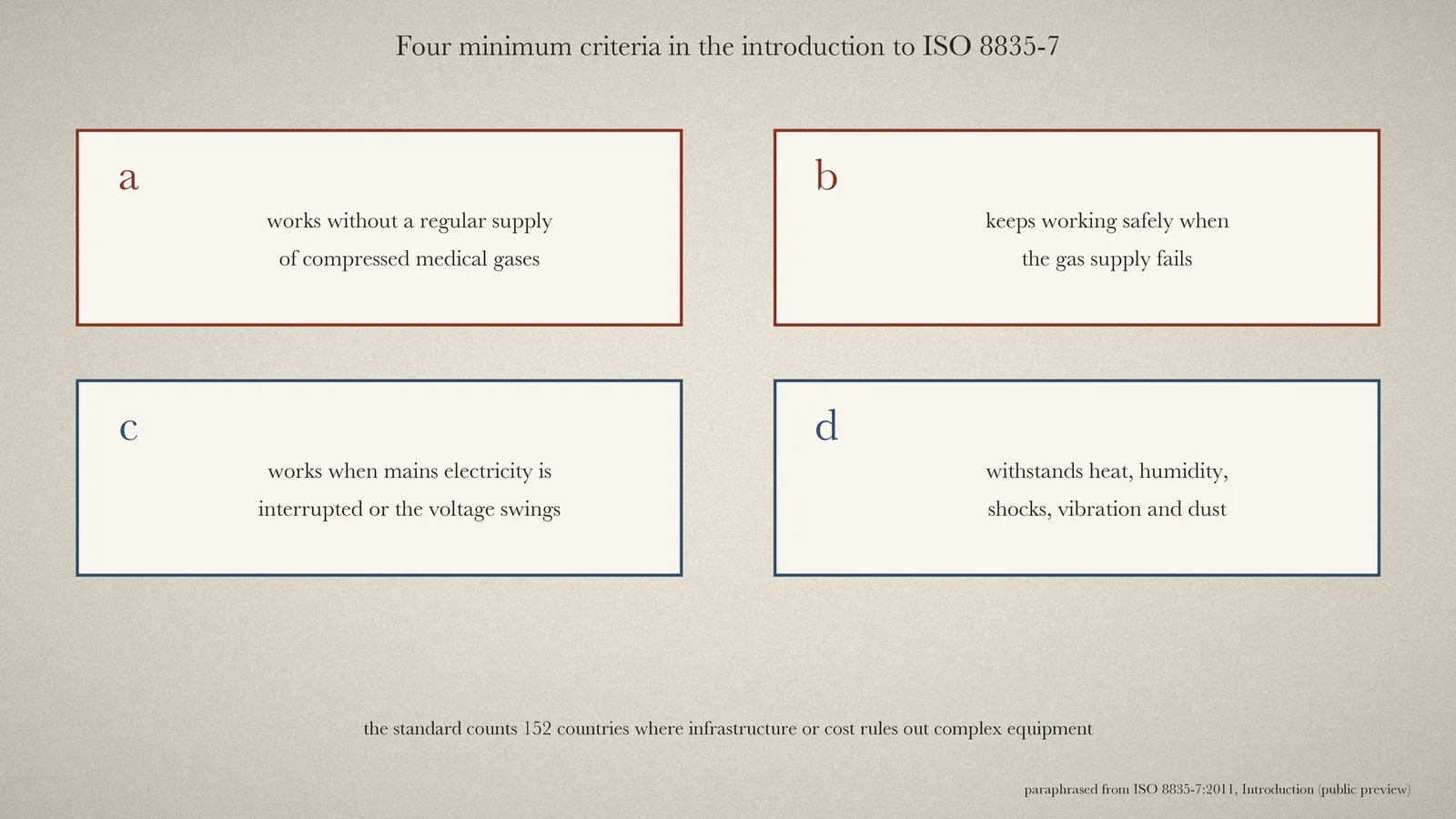
The introduction sets out four minimum criteria for equipment for these countries. It should work without a regular supply of compressed medical gases; keep working safely when the gas supply fails; keep working when mains electricity is interrupted or the voltage rises and falls unpredictably; and cope with high temperatures, humidity, shocks, vibration and dust. [1] The scope adds two more aims: the equipment should allow local servicing and maintenance, and may be suitable for flammable anaesthetic agents. [1,2]
What a system must contain
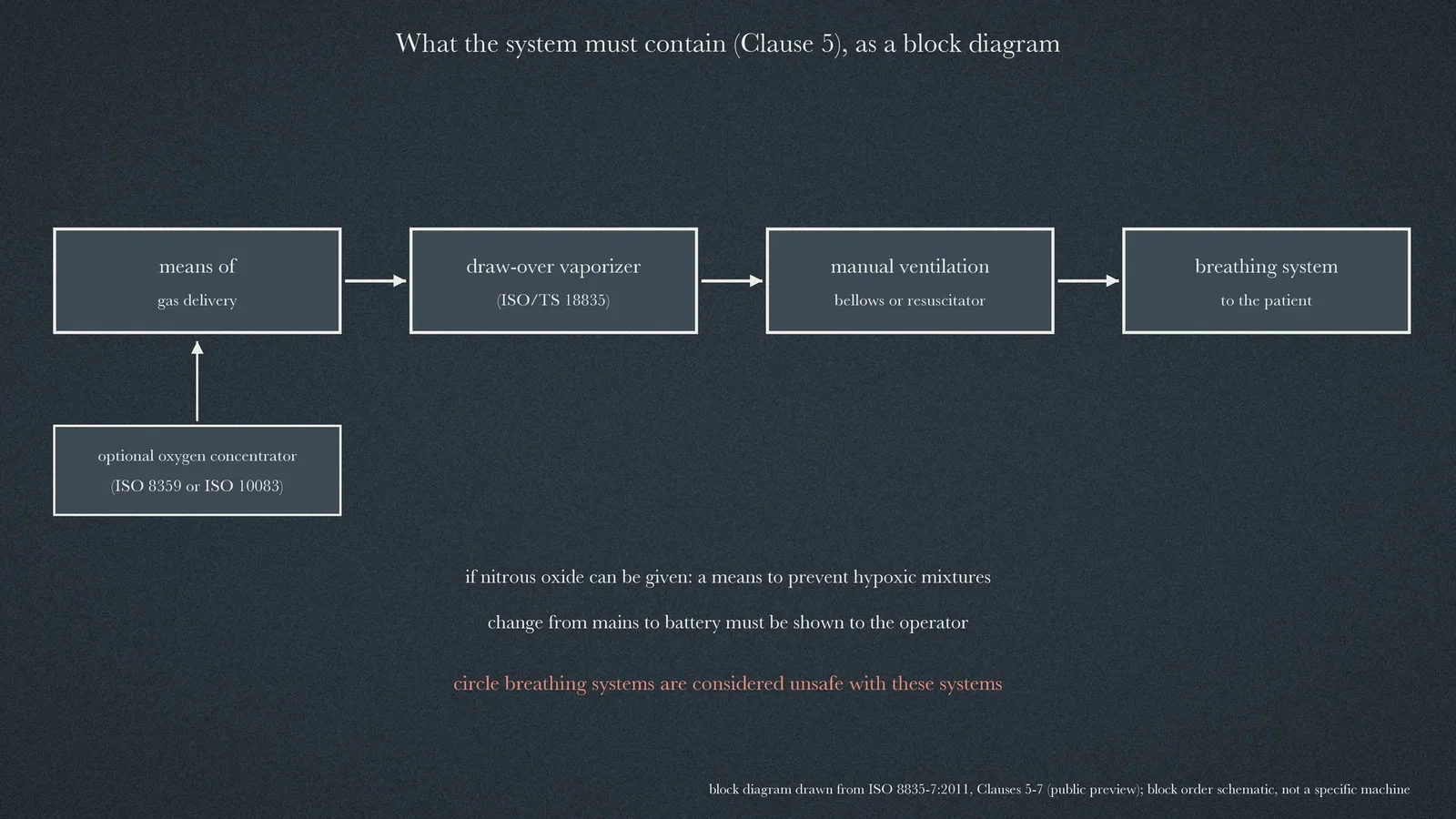
The preview shows the essential functions in Clause 5. An anaesthetic system meeting the standard must have a means of gas delivery; a draw-over vaporizer conforming to ISO/TS 18835; a means of manual ventilation, such as an inflating bellows or an operator-powered resuscitator; a breathing system, either continuous-flow or draw-over; and, if it can deliver nitrous oxide, a means of preventing hypoxic mixtures. A note states that circle breathing systems are considered unsafe with these systems. [1]
Later clauses bring in the other realities. An oxygen concentrator, if used to enrich the gas mixture, must meet the oxygen-concentrator standards. The system must keep delivering anaesthetic if mains power fails or the voltage changes, must show the operator when it switches to battery, and must be protected against surges. Where gas is available it must provide at least 6 L/min of fresh gas, and it must keep working if gas pressure fails. A system intended for flammable agents such as diethyl ether must meet the electrical standard's requirements for them. Servicing must take account of the communication, supply and technical skills available where the machine is used. [1]
Machines that came first
The standard did not invent this kind of machine. The Glostavent, which combines a draw-over system with an oxygen concentrator and a gas-driven ventilator, was described in 2008 as already modified after years of use in developing countries, and a portable version weighing under 10 kg was reported in 2010. [4-6] A later workstation, the Universal Anaesthesia Machine, was assessed in 2017 as built for settings with an unreliable supply of electricity and gases. [7] None of the abstracts read states that these machines were certified to ISO 8835-7; they show only that the need the standard describes was already being met by designers.
A standard in time
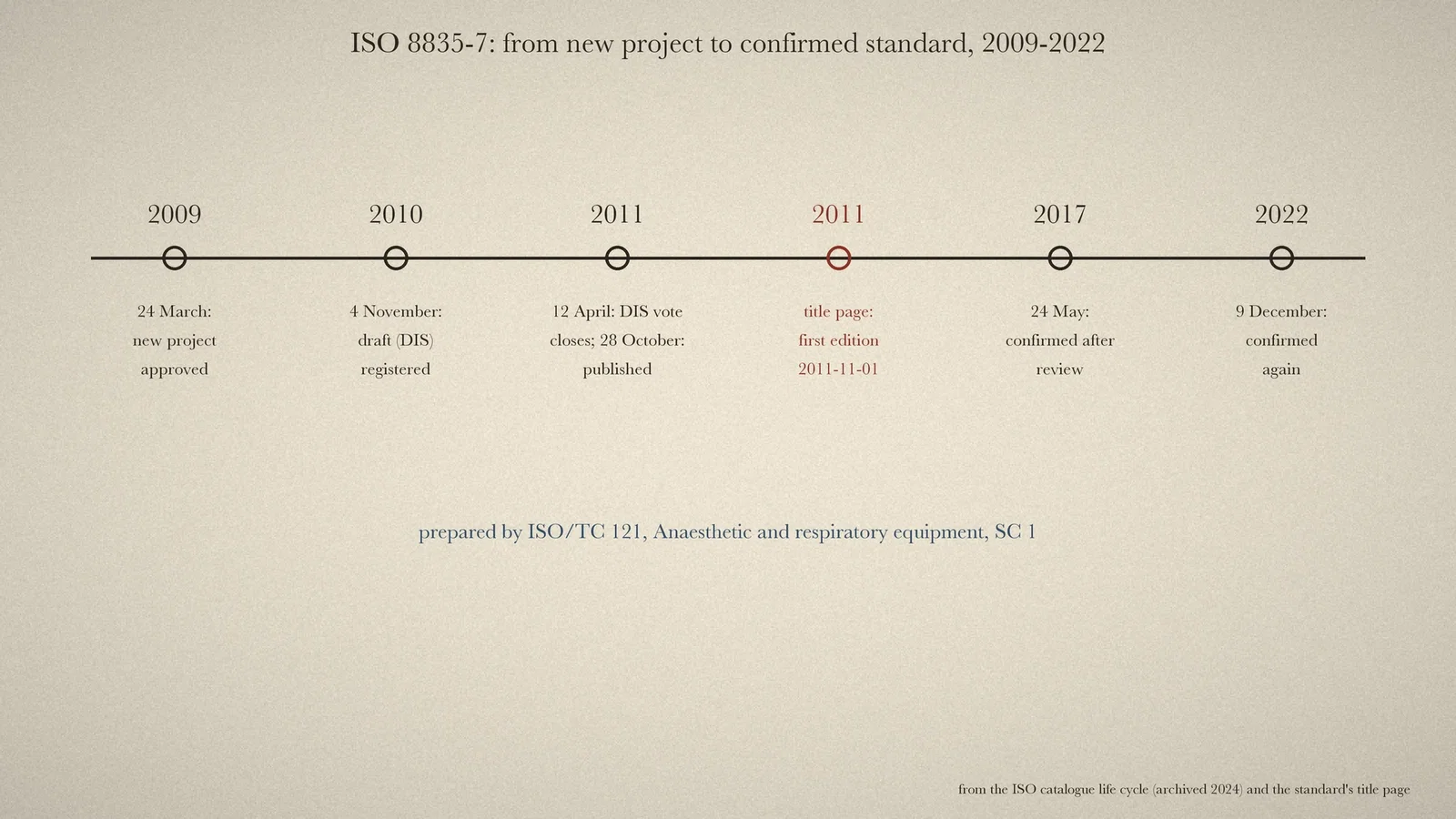
The ISO catalogue records the project's path: approved on 24 March 2009, draft international standard registered in November 2010, voting closed in April 2011, published on 28 October 2011. The title page is dated 1 November 2011. ISO reviewed and confirmed the standard in 2017 and again in 2022, and in 2024 listed it as current and under review. [2] The foreword notes that other parts of ISO 8835 had been withdrawn and replaced by the anaesthetic workstation standard, ISO 80601-2-13, and that draw-over vaporizers are covered by ISO/TS 18835. [1]
What the record shows
ISO 8835-7 starts from places where neither mains power nor compressed gas can be taken for granted. With the WFSA among its developers, it turned a long-standing clinical complaint into requirements that manufacturers, donors and buyers could check.
Sources and reading limits
Read: the public preview of ISO 8835-7:2011 (title page, contents, foreword, introduction and clauses 1 to 9 as far as the preview runs); an archived 2024 copy of the ISO catalogue page; the WFSA history timeline; the PubMed abstracts of four papers on machines designed for low-resource settings.
Not covered: the full standard, which ISO sells and which was not bought; so the rest of Clause 9, Clauses 10 and 11 and the Annex A rationale were not read. The current ISO page and the ANSI preview could not be accessed. The committee's records, the names of its experts and the exact nature of the WFSA's part are not in the sources read; the timeline says only that the WFSA was "involved". The machines described are context, not evidence of compliance. The standard is described as of its 2011 edition and its 2024 catalogue status; later revisions are not projected back.
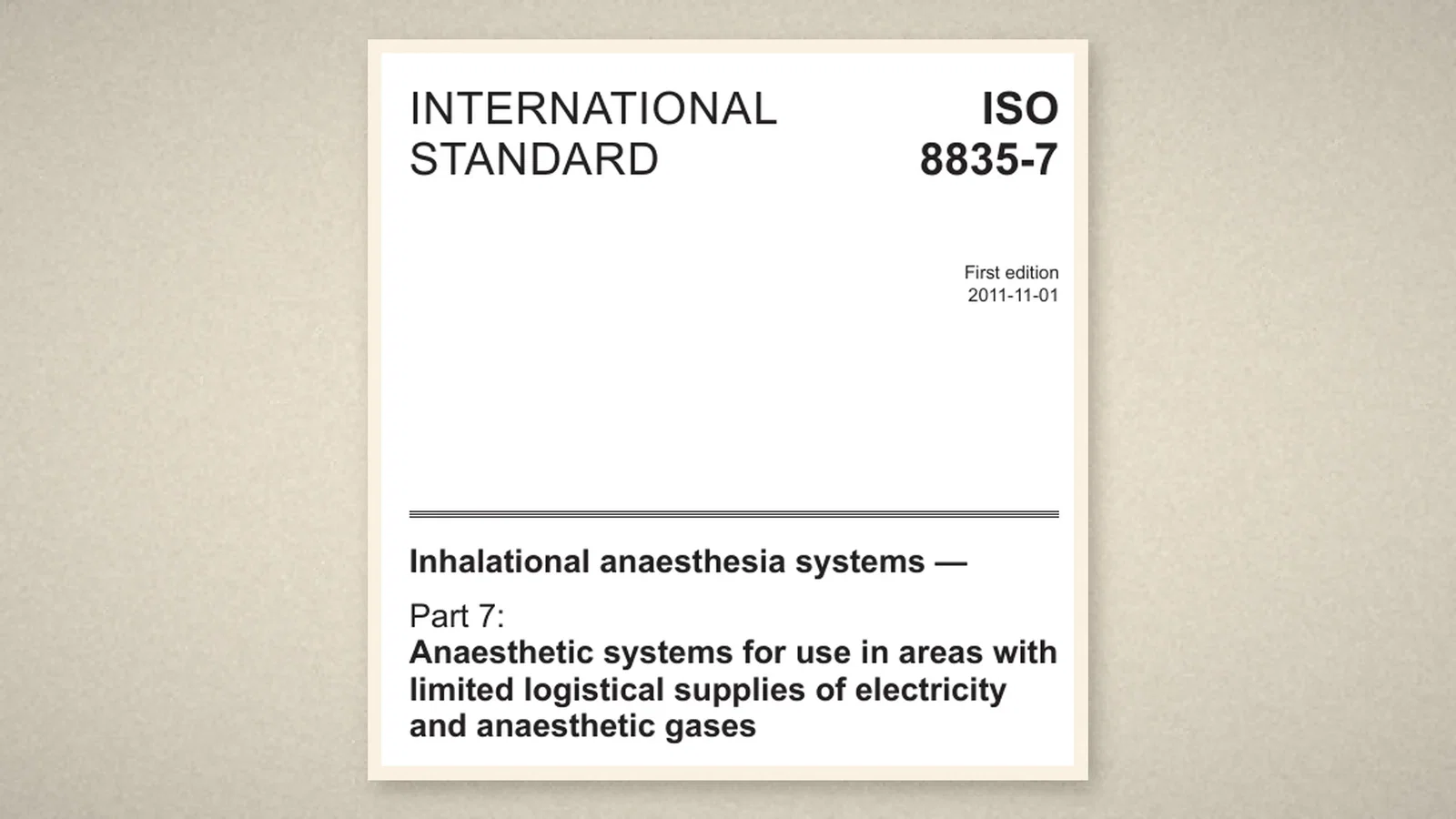
One illustration is a crop of the title page of the public preview; three are drawn from the sources.
- International Organization for Standardization. ISO 8835-7:2011. Inhalational anaesthesia systems - Part 7: Anaesthetic systems for use in areas with limited logistical supplies of electricity and anaesthetic gases. 1st ed. Geneva: ISO; 2011. Public preview
- International Organization for Standardization. ISO 8835-7:2011, catalogue entry. Archived 14 April 2024. Archived copy
- World Federation of Societies of Anaesthesiologists. WFSA history timeline. Website
- Beringer RM, Eltringham RJ. The Glostavent: evolution of an anaesthetic machine for developing countries. Anaesth Intensive Care. 2008;36(3):442-8. PubMed
- Tully R, Eltringham R, Walker IA, Bartlett AJ. The portable Glostavent: a new anaesthetic machine for use in difficult situations. Anaesth Intensive Care. 2010;38(6):1085-9. PubMed
- Eltringham RJ, Neighbour RC. The environmental impact of the Glostavent anesthetic machine. Anesth Analg. 2015;120(6):1264-70. PubMed
- de Beer DA, Nesbitt FD, Bell GT, Rapuleng A. The Universal Anaesthesia Machine (UAM): assessment of a new anaesthesia workstation built with global health in mind. Anaesthesia. 2017;72(4):444-51. PubMed
Continue exploring
Related reading connects shared questions and contexts; it does not by itself establish historical influence.
Anesthesia Epochs · The Source Room · About & Editorial Method
Published November 2, 2026. Sources and reading limits are stated above. Illustrations are labelled as original source images or AI-made. Historical accounts are educational; they are not current treatment instructions.