Chief of anaesthesia at the State University of Iowa from 1938, Stuart Cullen reported curare in 131 operations in 1943 and xenon anaesthesia with Erwin Gross in 1951, then left in 1958 to chair a new independent department in San Francisco.
Reading Library · Anesthesia Epochs · 中文版
Watch the education video (for clinicians)
1938: Stuart Cullen at Iowa — Relaxation Is Not Recovery · Anesthesia Epochs Education Series
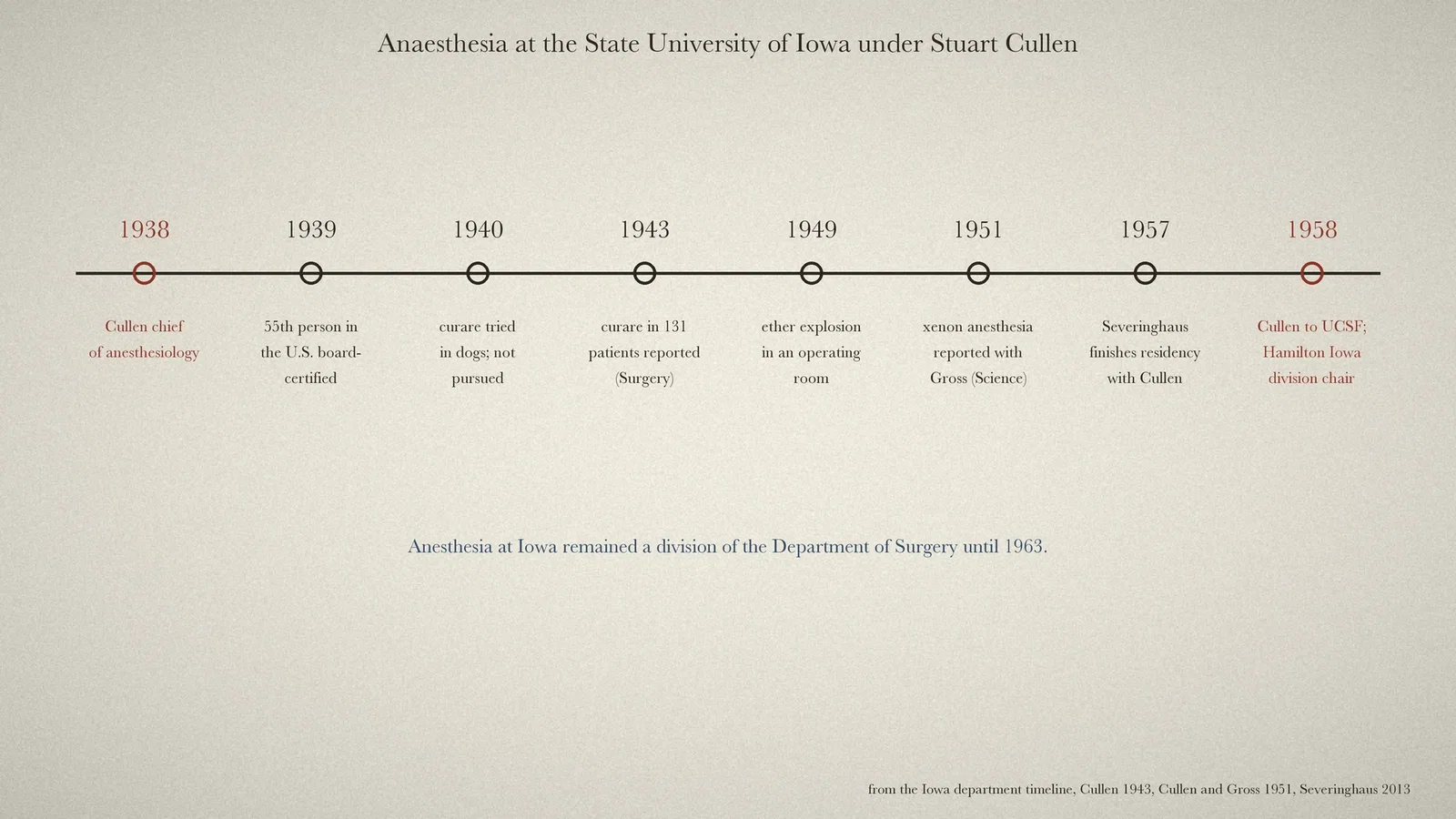
The University of Iowa's department of anesthesia traces its history back to the nineteenth century, through a resident physician anaesthetist hired in 1910, Mary Ross's residency in 1923 and Dorothy Dimond's leadership of the division from 1927. [1] In this line, the department's timeline gives 1938 as the year "Stuart Cullen, MD, becomes chief of anesthesiology", and adds that in 1939 Cullen became "the 55th person in the U.S. to be board-certified in anesthesia". [1] This article follows the twenty years that Cullen led anaesthesia in Iowa City, through two pieces of published work: curare in the early 1940s and xenon in 1951. It ends with the move to San Francisco in 1958.
A division inside surgery
Cullen's papers from Iowa City were signed from the "Division of Anesthesiology, Department of Surgery" of the State University of Iowa College of Medicine. [2,3,4] The department's own timeline records that anaesthesia separated from surgery to become an independent department only in 1963. [1] Cullen's clinical research therefore came from a unit that was, administratively, part of the surgical service it worked for.
Curare, 1943
In 1943 the journal Surgery printed two Iowa papers on curare. The first, by Cullen and C. S. Quinn, reported a patient with tetanus admitted in November 1942. Tribromethanol (Avertin) had controlled the spasms only with marked general depression, and pneumonia developed; Intocostrin (an extract of curare) was then given, and the authors describe the jaw relaxing and the opisthotonos disappearing within seconds of an intravenous dose. [2] A note added in proof reported three further patients with tetanus treated with curare, all of whom died, and stressed that the method required trained staff devoted entirely to the patient. [2]
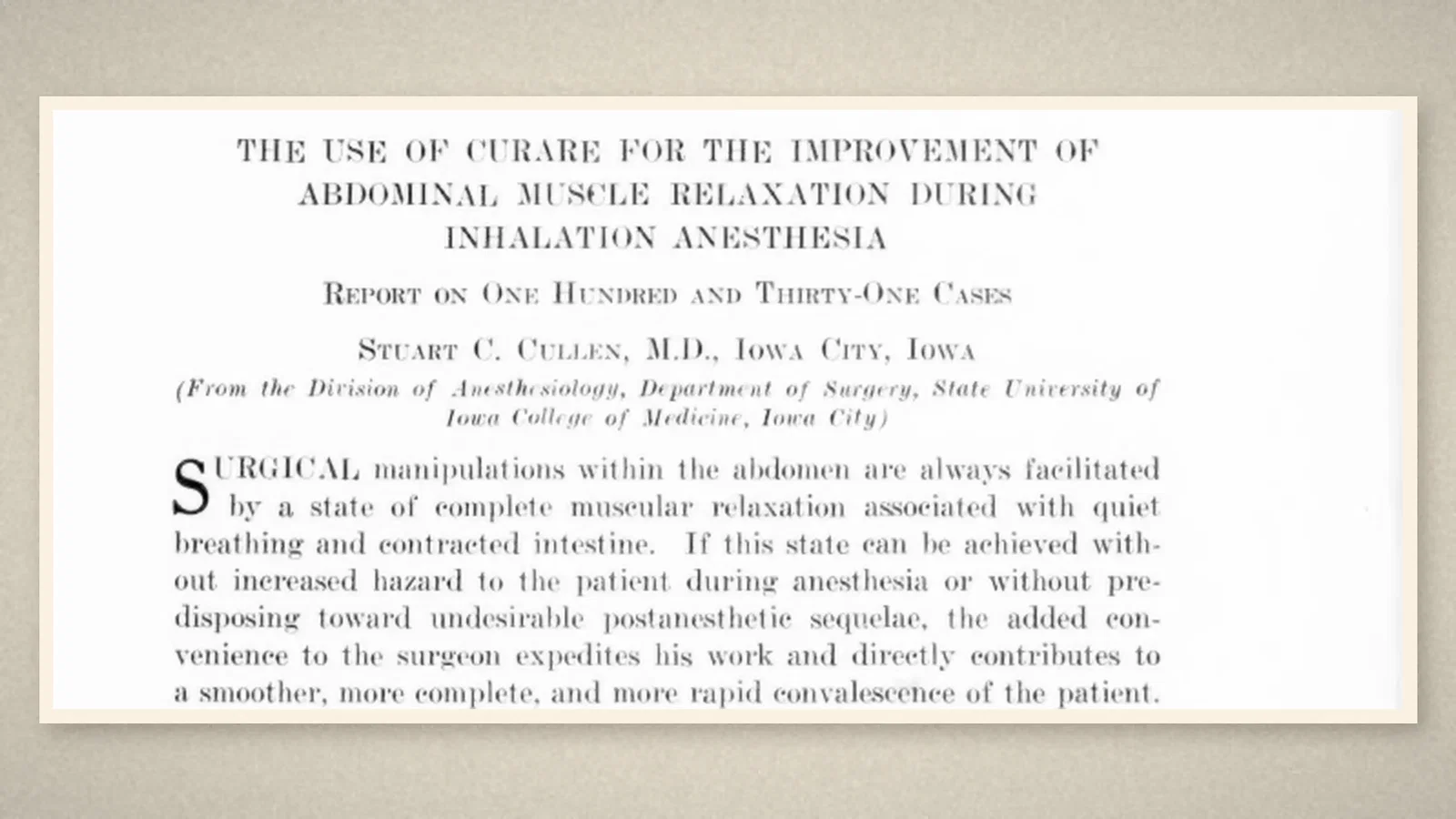
The second paper was Cullen's own report on 131 operations. [3] Cullen explained that published work on curare in spastic disorders and in convulsive shock therapy had prompted a trial in 1940, but dogs given relaxing doses "salivated profusely, had extreme respiratory depression and asphyxial convulsive movements", which deterred clinical use. [3] Interest returned with Griffith and Johnson's 1942 report of curare in 25 patients under cyclopropane, and Cullen then gave Intocostrin to 131 patients to improve abdominal muscle relaxation during inhalation anaesthesia. [3] Four of the patients received ether; two of those had pronounced and prolonged respiratory depression, so that, Cullen wrote, curare was no longer used with ether. [3] The remaining 122 received cyclopropane, a combination Cullen found particularly effective because relaxation no longer required high concentrations of the agent. [3] By the time of publication curare had been given in 370 further cases. [3]
Xenon, 1951
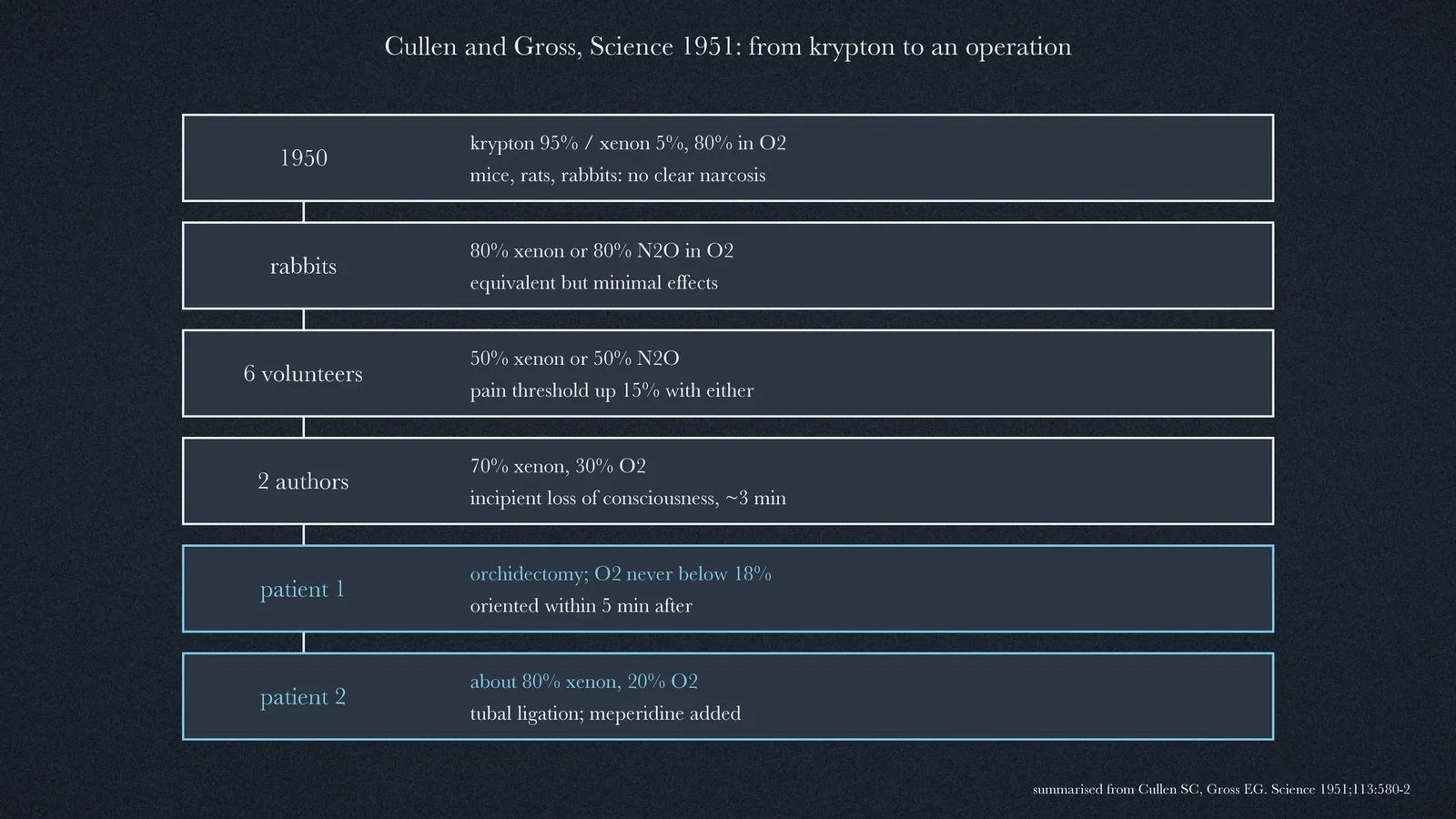
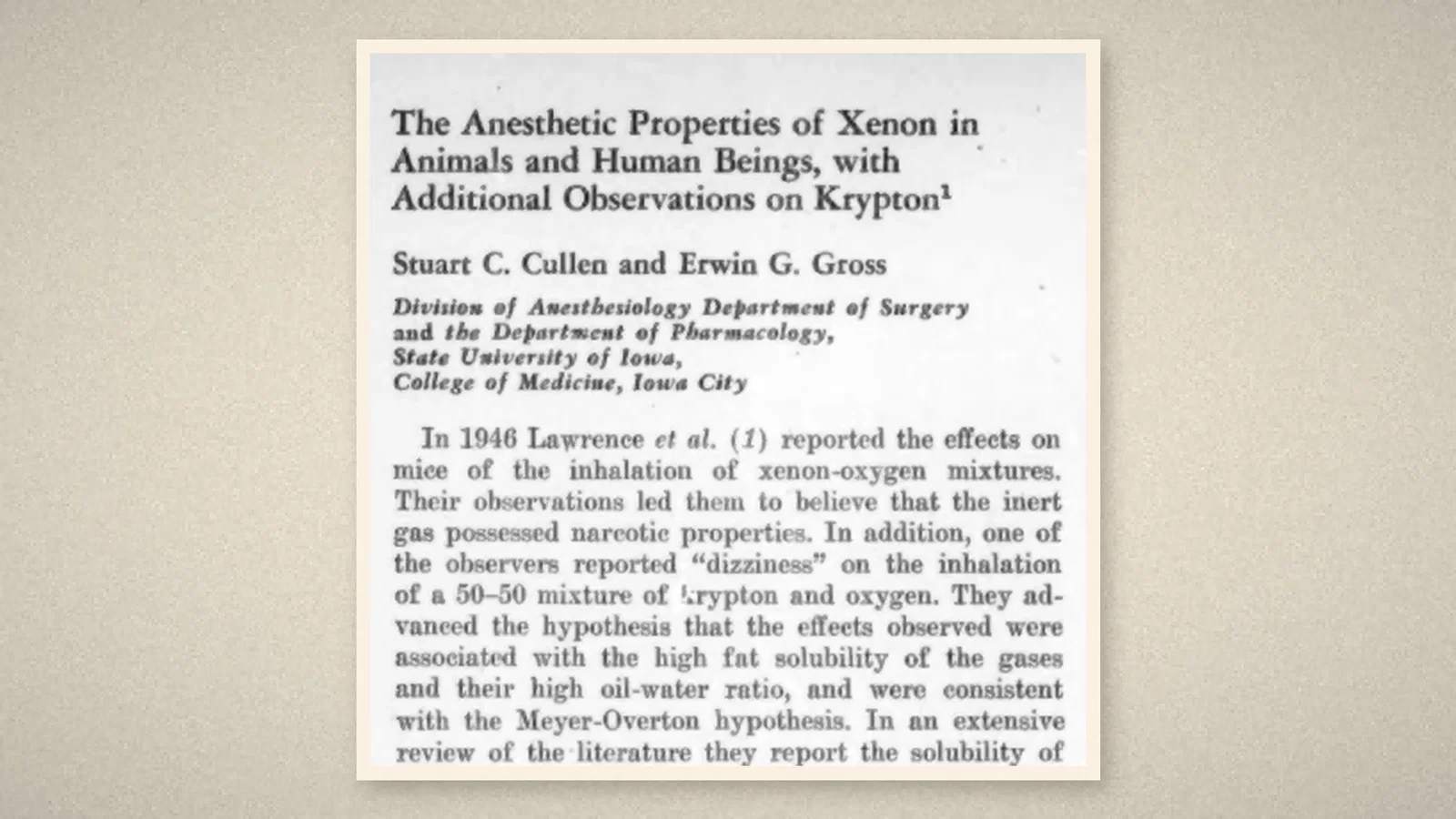
The department's timeline records that in 1949 an ether explosion in an Iowa operating room, set off by wool trousers, injured the anaesthetist and the patient and "motivates Stuart Cullen, MD, to begin researching inert gases (xenon) as anesthetizing agents". [1] The published work was a joint project with the pharmacologist Erwin G. Gross. [4] Starting from Lawrence's 1946 observations in mice, Cullen and Gross obtained krypton and xenon from the Linde Air Products Company early in 1950. [4] An 80% krypton-rich mixture produced no unequivocal narcosis in mice, rats or rabbits. Pure xenon at 80% in rabbits produced effects equivalent to the same concentration of nitrous oxide. Six volunteers breathing 50% xenon or 50% nitrous oxide showed a 15% rise in pain threshold with either, and the two authors themselves breathed 70% xenon and reported incipient loss of consciousness after about three minutes. [4]
The authors then gave xenon in oxygen to two surgical patients. The first, aged 81, had an orchidectomy under xenon with inspired oxygen never below 18%, without reaction to pain, and recovered within two minutes of the end of the anaesthetic to the point of self-identification. [4] The second, aged 38, had a tubal ligation induced with about 80% xenon, with meperidine added during the operation. [4] Cullen and Gross wrote that this was "the first time, to our knowledge" that xenon had been used as an anaesthetic for an operation, judged its effects at least equivalent to ethylene, and suggested that cost might keep it from commercial use even though it might help solve a theoretical problem of anaesthesia. [4]
Leaving Iowa
John W. Severinghaus later wrote that Severinghaus finished anaesthesia residency "at the University of Iowa with Stuart Cullen in 1957", on leave from the National Institutes of Health. [5] That autumn, during a physiology meeting in Iowa City, Julius Comroe, newly appointed to lead a cardiovascular research institute at the University of California San Francisco, persuaded the UCSF chief of surgery by telephone to offer Cullen the chair of anaesthesia "in a new independent (of surgery) department". [5] Severinghaus recalled that the two arrived in mid-1958. [5] In Iowa, William Hamilton was appointed division chair in 1958. [1]
What the record shows
Cullen's Iowa years show a university anaesthesia service doing its own clinical research while still a division of surgery: testing a new relaxant in more than a hundred operations, reporting its failures with ether and in tetanus, and taking an inert gas from rabbits to the operating table. The move of 1958 took Cullen to a department that was independent from the start. Iowa's own division became independent five years later.
Sources and reading limits
Read: the University of Iowa Department of Anesthesia history timeline; Cullen and Quinn's 1943 tetanus report and Cullen's 1943 report on 131 cases, in full from the Internet Archive scan of Surgery; Cullen and Gross's 1951 paper in full from the Internet Archive scan of Science; Severinghaus's 2013 career perspective.
Not covered: the 1980 obituary of Cullen by Hamilton and Larson in Anesthesiology (publisher paywall); the California Society of Anesthesiologists history article on Cullen and the UCSF department (site could not be accessed); Cullen's textbook Anesthesia in General Practice and a 1970 UCSF bulletin on Cullen's deanship (Internet Archive lending or stream-only copies, not opened); the Iowa department's xenon news story and a 2013 department newsletter (no longer reachable); a Wood Library-Museum video on this subject. Cullen's work at UCSF is outside this article. The Iowa timeline credits Severinghaus, as Cullen's resident, with the PCO2 electrode in 1957, while Severinghaus's own account places that work at the NIH; the article follows Severinghaus. The 1949 explosion is known here only from the department's timeline, and the claim of first use of xenon is the authors' own "to our knowledge".
Two illustrations are crops of the 1943 and 1951 papers; two are drawn from the sources.
- University of Iowa Carver College of Medicine, Department of Anesthesia. Our history. Website
- Cullen SC, Quinn CS. The use of curare in the treatment of tetanus: case report. Surgery. 1943;14(2):256-60. Internet Archive
- Cullen SC. The use of curare for the improvement of abdominal muscle relaxation during inhalation anesthesia: report on one hundred and thirty-one cases. Surgery. 1943;14(2):261-6. Internet Archive
- Cullen SC, Gross EG. The anesthetic properties of xenon in animals and human beings, with additional observations on krypton. Science. 1951;113(2942):580-2. DOI · Internet Archive
- Severinghaus JW. Career perspective: John W. Severinghaus. Extrem Physiol Med. 2013;2:29. DOI
Continue exploring
Related reading connects shared questions and contexts; it does not by itself establish historical influence.
- 1986: The Society for Pediatric Anesthesia Admits Members by Interest
- 1985: Ambulatory Anaesthesia Gets Its Own Society
Anesthesia Epochs · The Source Room · About & Editorial Method
Published November 2, 2026. Sources and reading limits are stated above. Illustrations are labelled as original source images or AI-made. Historical accounts are educational; they are not current treatment instructions.