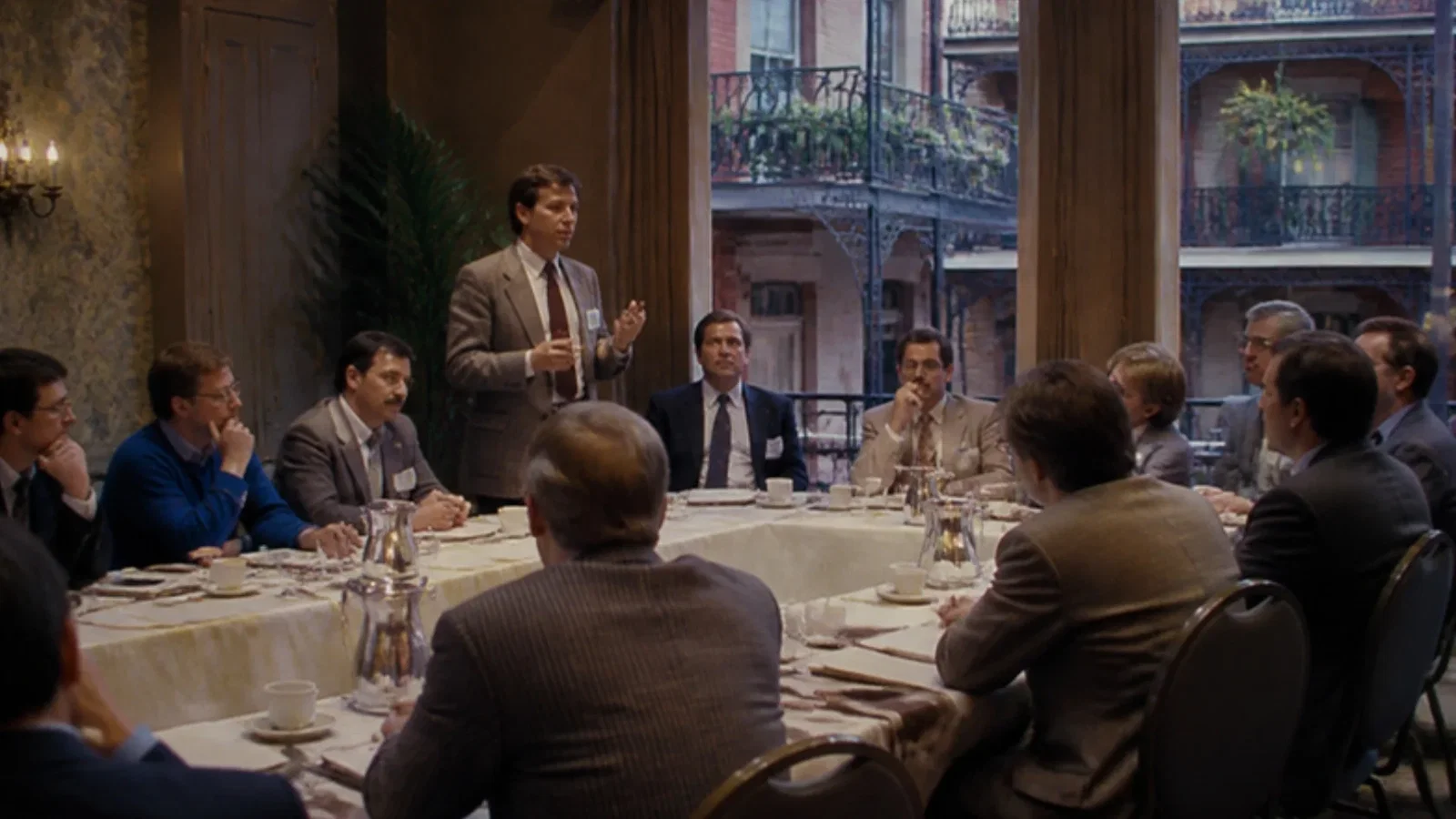
Twenty anaesthesiologists met in New Orleans in 1984; six months later the group named the Society for Ambulatory Anesthesia, which grew past 2000 members as day surgery became the majority of American operations.
Reading Library · Anesthesia Epochs · 中文版
Watch the education video (for clinicians)
1985: The Society for Ambulatory Anesthesia — Williamsburg · Anesthesia Epochs Education Series
In 1993 Beverly K. Philip, of the Day Surgery Unit at Brigham and Women's Hospital in Boston and then immediate past president of the Society for Ambulatory Anesthesia (SAMBA), wrote the society's history for the new journal Ambulatory Surgery. [1] Philip had been one of SAMBA's first officers. SAMBA still reproduces the account on its website. [2] This article follows that account from a question asked in 1984 to a society of more than 2000 members.
A question and a list
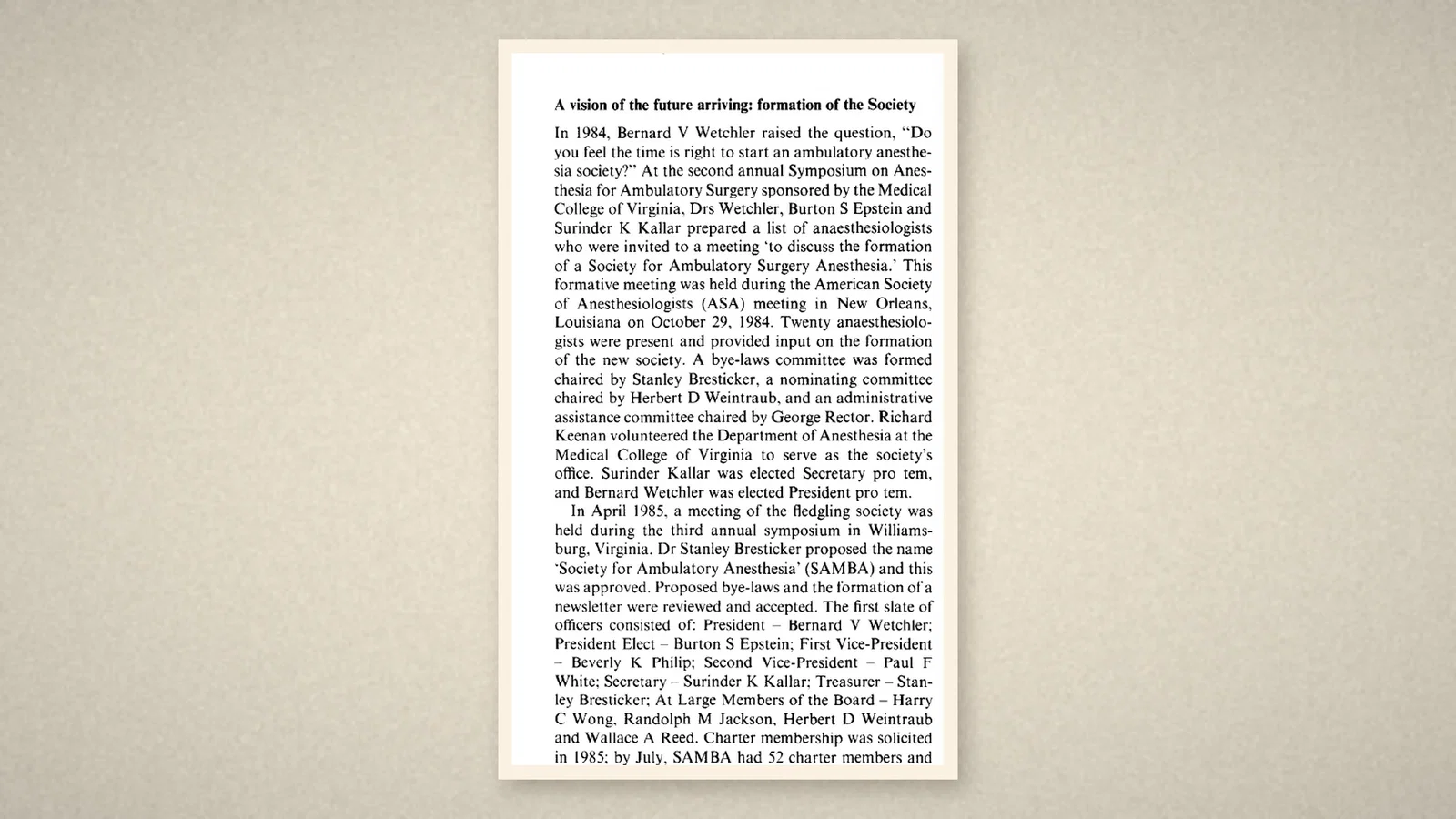
The story begins with Bernard V. Wetchler asking: "Do you feel the time is right to start an ambulatory anesthesia society?" At the second annual Symposium on Anesthesia for Ambulatory Surgery, sponsored by the Medical College of Virginia, Wetchler, Burton S. Epstein and Surinder K. Kallar drew up a list of anaesthesiologists to invite to a meeting "to discuss the formation of a Society for Ambulatory Surgery Anesthesia". [1]
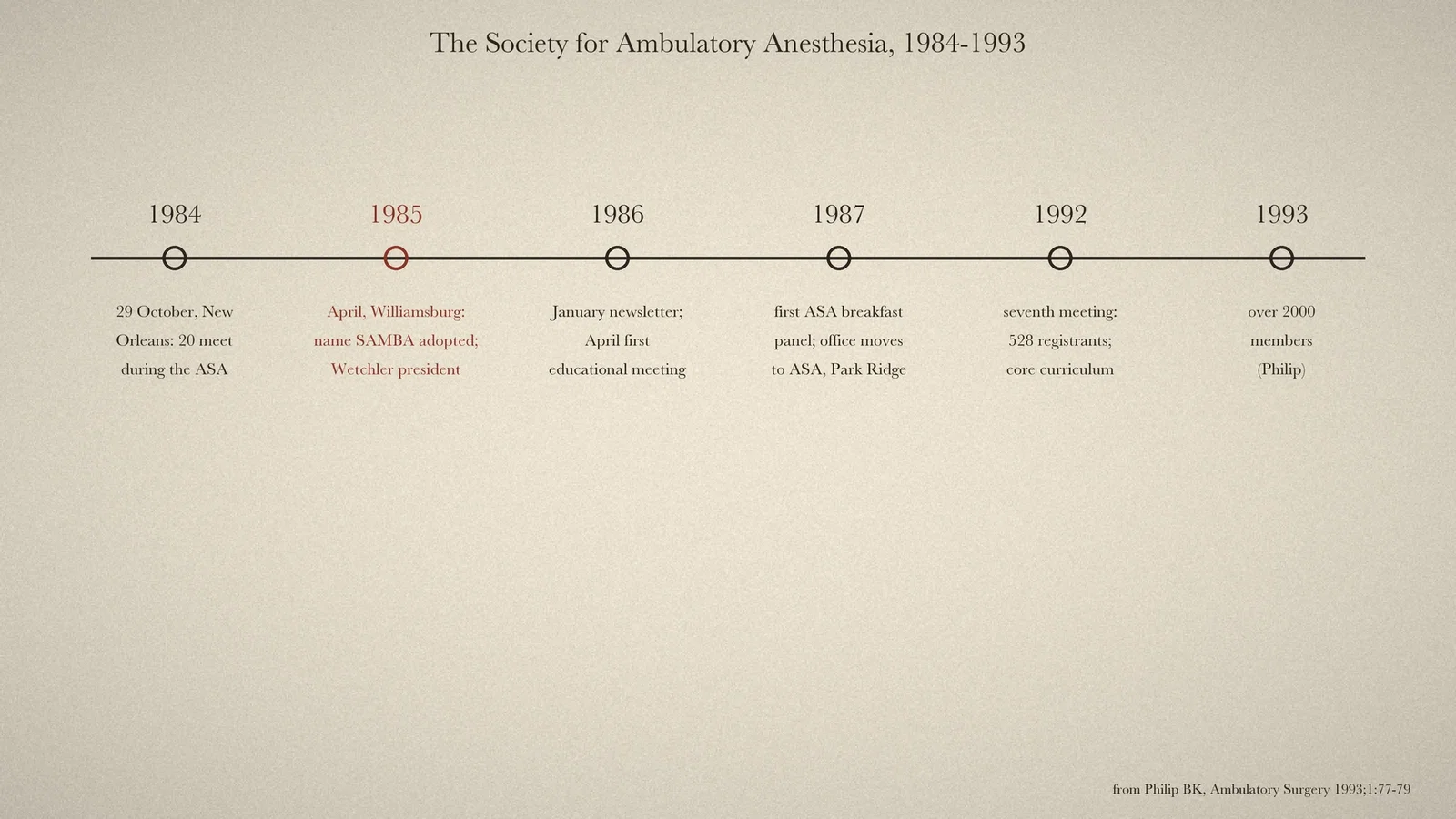
That meeting took place during the American Society of Anesthesiologists (ASA) meeting in New Orleans on 29 October 1984. Twenty anaesthesiologists attended. They formed committees for bylaws, chaired by Stanley Bresticker, for nominations, chaired by Herbert D. Weintraub, and for administration, chaired by George Rector. Richard Keenan offered the anaesthesia department of the Medical College of Virginia as the society's office. Kallar was elected secretary pro tem and Wetchler president pro tem. [1]
A name in Williamsburg
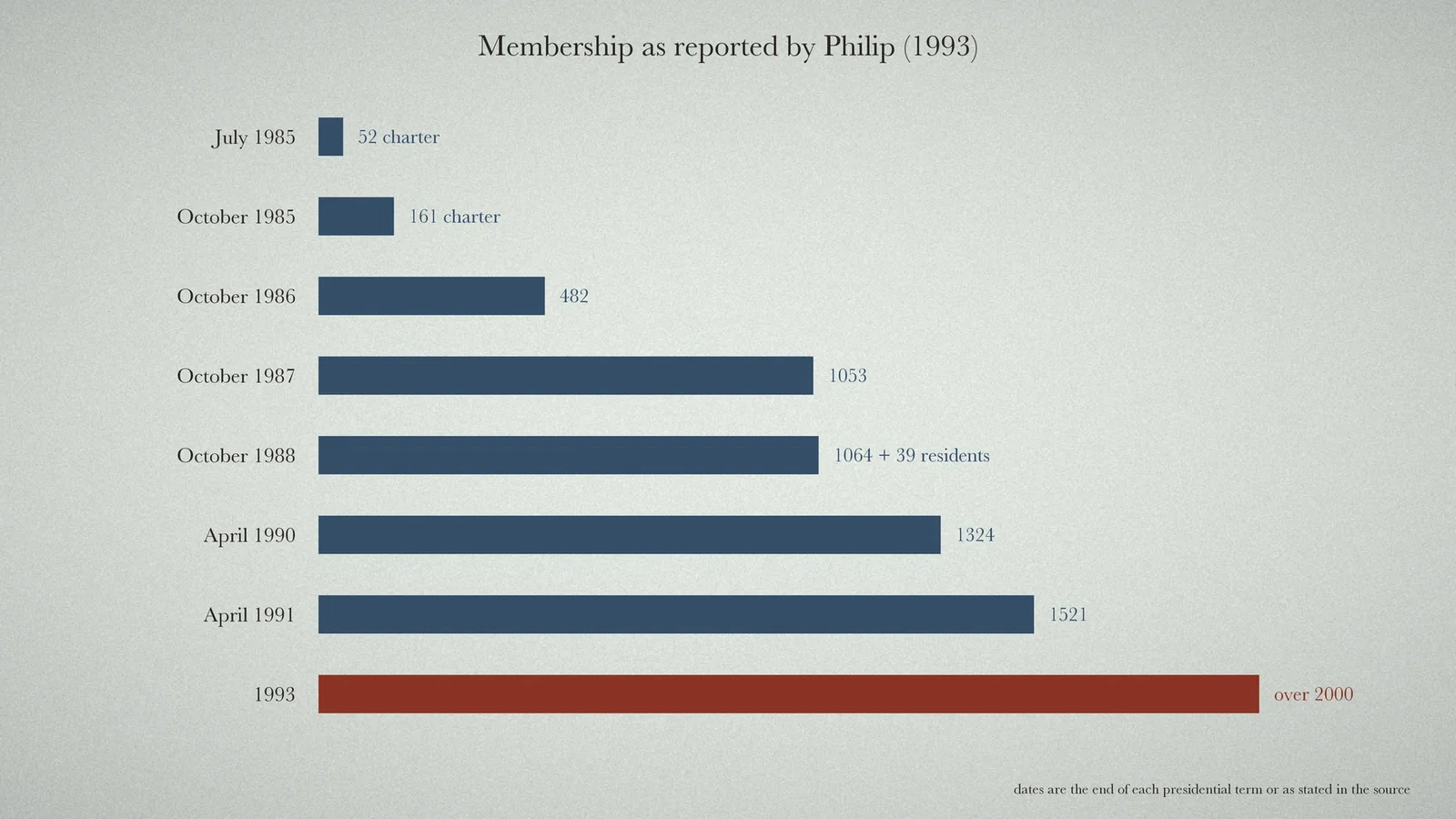
In April 1985 the fledgling society met again at the third symposium, in Williamsburg, Virginia. Bresticker proposed the name "Society for Ambulatory Anesthesia" (SAMBA), which was approved, together with draft bylaws and plans for a newsletter. The first officers were Wetchler as president, Epstein as president-elect, Philip and Paul F. White as vice-presidents, Kallar as secretary and Bresticker as treasurer. Charter membership opened that year: 52 members by July, 161 by October. [1] The first issue of the newsletter, Ambulatory Anesthesia, edited by White, appeared in January 1986, and the first educational meeting was held with the Medical College of Virginia programme in April 1986. By October 1986 SAMBA had 482 members and four commercial benefactors. [1]
What the society set out to do
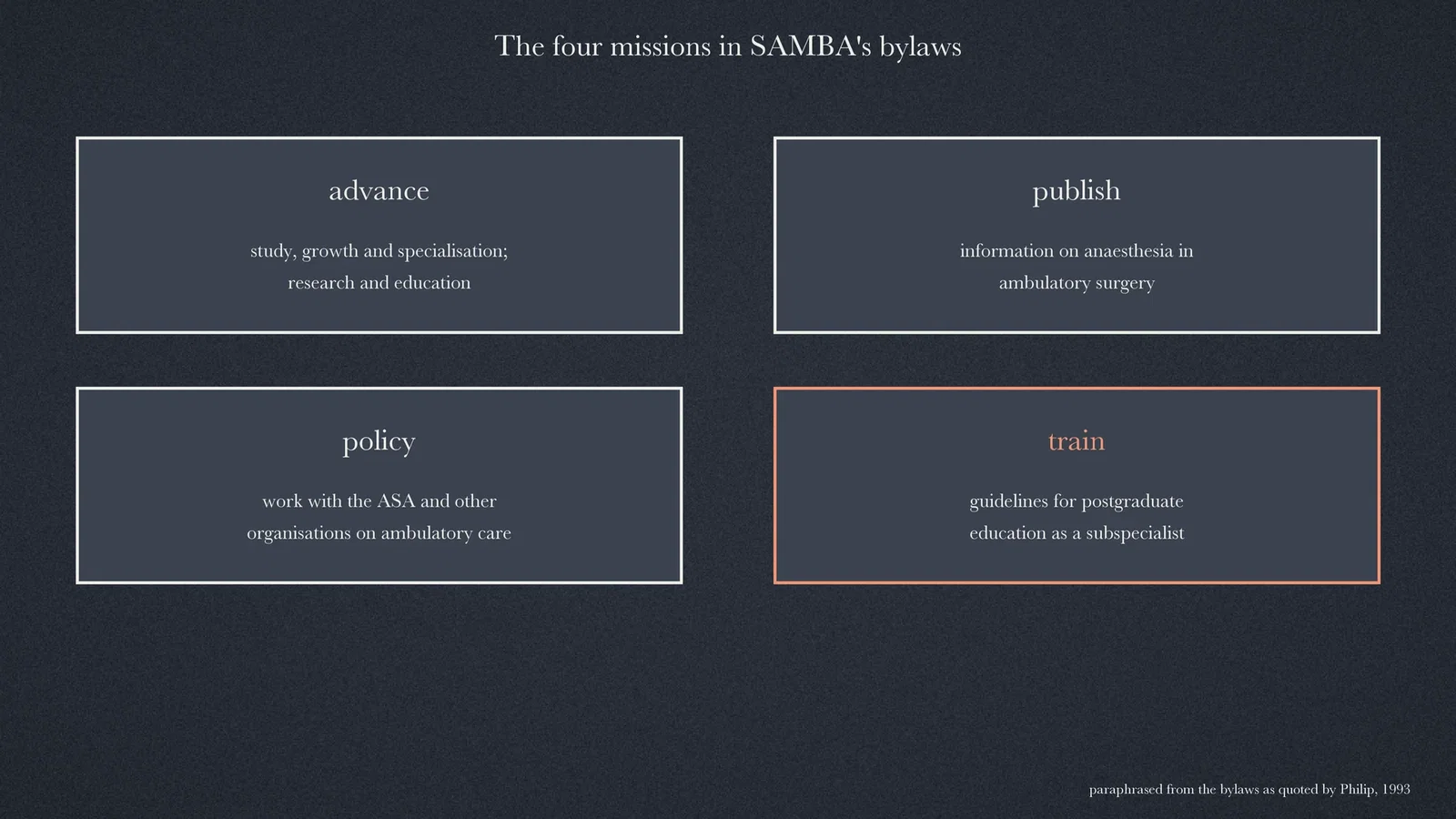
Philip quotes four missions from SAMBA's bylaws: to advance the study of ambulatory anaesthesia and encourage specialisation, research and education; to publish information on anaesthesia in ambulatory surgery; to take part in ASA and other organisations' policies on ambulatory anaesthesia; and to help develop guidelines for postgraduate training "as a subspecialist in ambulatory anaesthesia". [1]
Growing inside the ASA
The society grew quickly and stayed close to the ASA. By the end of Wetchler's term in October 1987 it had 1053 members; it held its first breakfast panel at the ASA meeting on 14 October 1987 and moved its offices to ASA headquarters in Park Ridge, Illinois. Under later presidents SAMBA gained representation in the ASA House of Delegates as an anaesthesia subspecialty organisation, created a membership category for international physicians, and pressed for separate research sessions on ambulatory anaesthesia at ASA meetings, the first held in October 1990. [1]
By 1992 SAMBA's seventh annual meeting drew 528 registrants. That year the society produced educational guidelines for residents and fellows: a "core curriculum for ambulatory anaesthesia" for the first three postgraduate years and an advanced curriculum for fellowship training. It also began representing ambulatory anaesthesia on an advisory committee of the Joint Commission's ambulatory accreditation programme. [1]
What the record shows
Philip closed with two claims: that SAMBA had grown to over 2000 members, and that ambulatory surgery had become "the majority of procedures being done in the USA". Through the society's efforts, Philip wrote, ambulatory anaesthesia had "gained acceptance as a recognized subspecialty". [1] Day surgery changed where anaesthesia was given; SAMBA was the profession's way of organising around that change.
Sources and reading limits
Read: Philip's 1993 history in full (PDF hosted by SAMBA, with the first page as an image); SAMBA's History of SAMBA web page.
Not covered: SAMBA's minutes, bylaws and early newsletters; the Medical College of Virginia symposium programmes; any independent account of the founding; a 2006 textbook chapter on the history of ambulatory anaesthesia (available only as a lending copy and not accessed); developments after 1993; a Wood Library-Museum video on this subject. The account comes from a founding officer writing as immediate past president, and its claims about national practice are reported as that author's. The article is dated to April 1985, when the name was adopted; the society's first meeting was in October 1984.
One illustration is a crop of Philip's article; three are drawn from the sources.
- Philip BK. A history of the Society for Ambulatory Anesthesia. Ambulatory Surgery. 1993;1:77-9. PDF
- Society for Ambulatory Anesthesia. History of SAMBA. Website
Continue exploring
Related reading connects shared questions and contexts; it does not by itself establish historical influence.
- 2012: Anaesthesiologists Propose a Perioperative Surgical Home
- 1988: The Society for Technology in Anesthesia Is Born at 6 a.m.
Anesthesia Epochs · The Source Room · About & Editorial Method
Published November 2, 2026. Sources and reading limits are stated above. Illustrations are labelled as original source images or AI-made. Historical accounts are educational; they are not current treatment instructions.