
The American Society of Anesthetists launches its journal: Henry S. Ruth edits, Howard Haggard's opening paper argues for the anesthetist's public standing, and the editorial sets the journal after the society's reorganization and the specialty board.
Reading Library · Anesthesia Epochs · 中文版
Watch the education video (for clinicians)
1940: Anesthesiology's First Issue — Progress and Education · Anesthesia Epochs Education Series
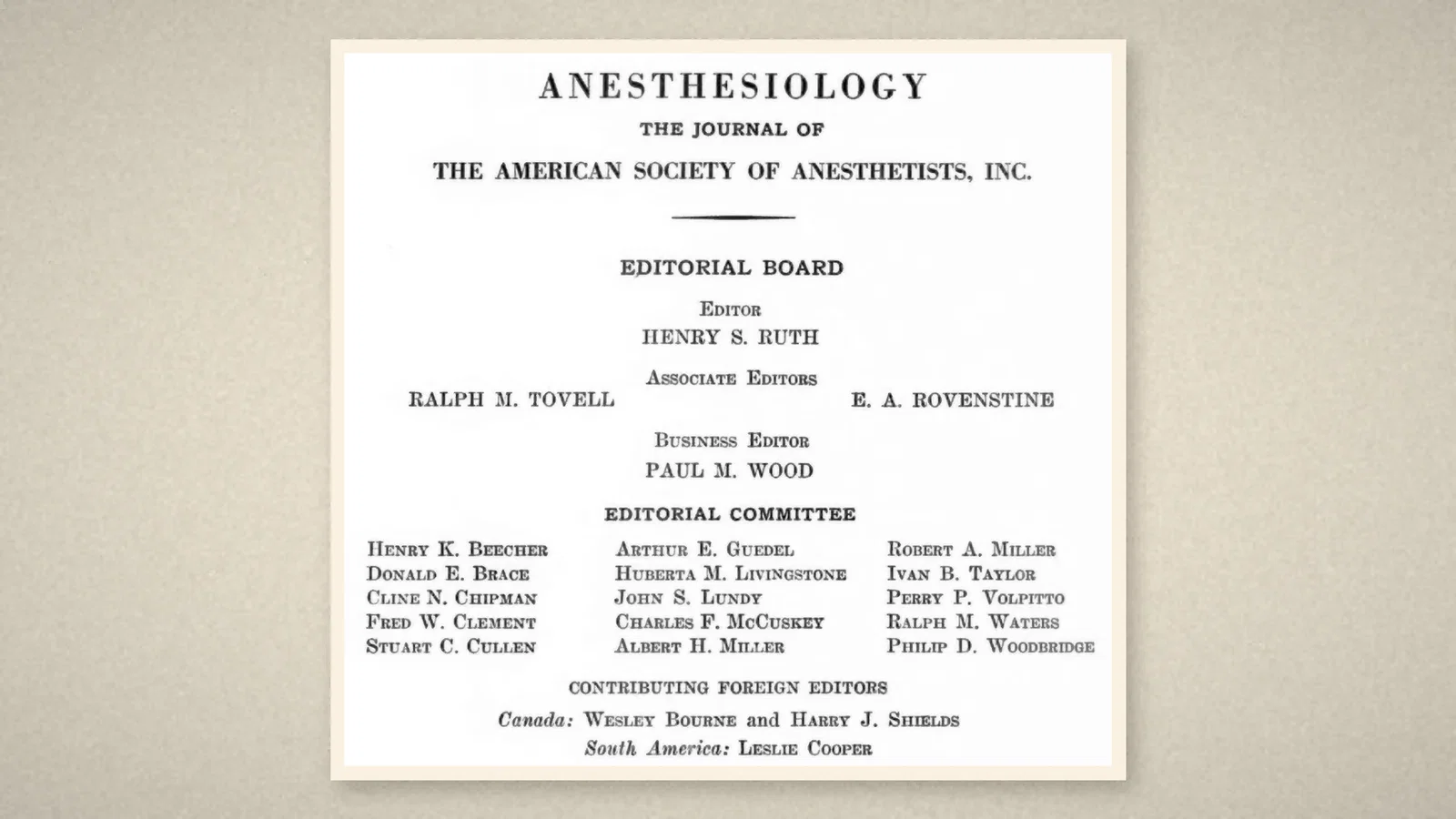
Anesthesiology is today the journal of the American Society of Anesthesiologists. Its first number appeared in July 1940. This article rests on that number alone (its masthead, opening paper, editorial and contents) to see how the journal introduced itself.
The masthead
The masthead reads Anesthesiology, "The Journal of The American Society of Anesthetists, Inc." The editor was Henry S. Ruth; the associate editors Ralph M. Tovell and E. A. Rovenstine; the business editor Paul M. Wood. An editorial committee of fifteen included Beecher, Guedel, Lundy and Waters; the contributing foreign editors were Wesley Bourne and Harry J. Shields for Canada and Leslie Cooper for South America; consulting editors covered physiology, surgery, pharmacology, obstetrics, public health, and the Army and Navy. The journal was "published bi-monthly" at Lancaster, Pennsylvania, at "Domestic, $6.00; Canadian, $6.50" a year. [1, masthead]
The opening paper: the anesthetist's place
The first paper was not clinical research but an address by Howard W. Haggard, "Director, Laboratory of Applied Physiology, Yale University", on "the place of the anesthetist in American medicine", read to the Society at the "New York World's Fair, New York City, October 12, 1939". [1, p. 1] Haggard would not praise anesthetists; the subject was the public regard in which their work was held, because that regard determined their place. Good anesthesia for a fortunate few was not enough; for all anesthesia to be the best that knowledge allowed, the public must recognise "that the administration of an anesthetic is a major therapeutic operation", and the anesthetist must give good anesthesia and "must also shape public opinion". [1, p. 1–2]
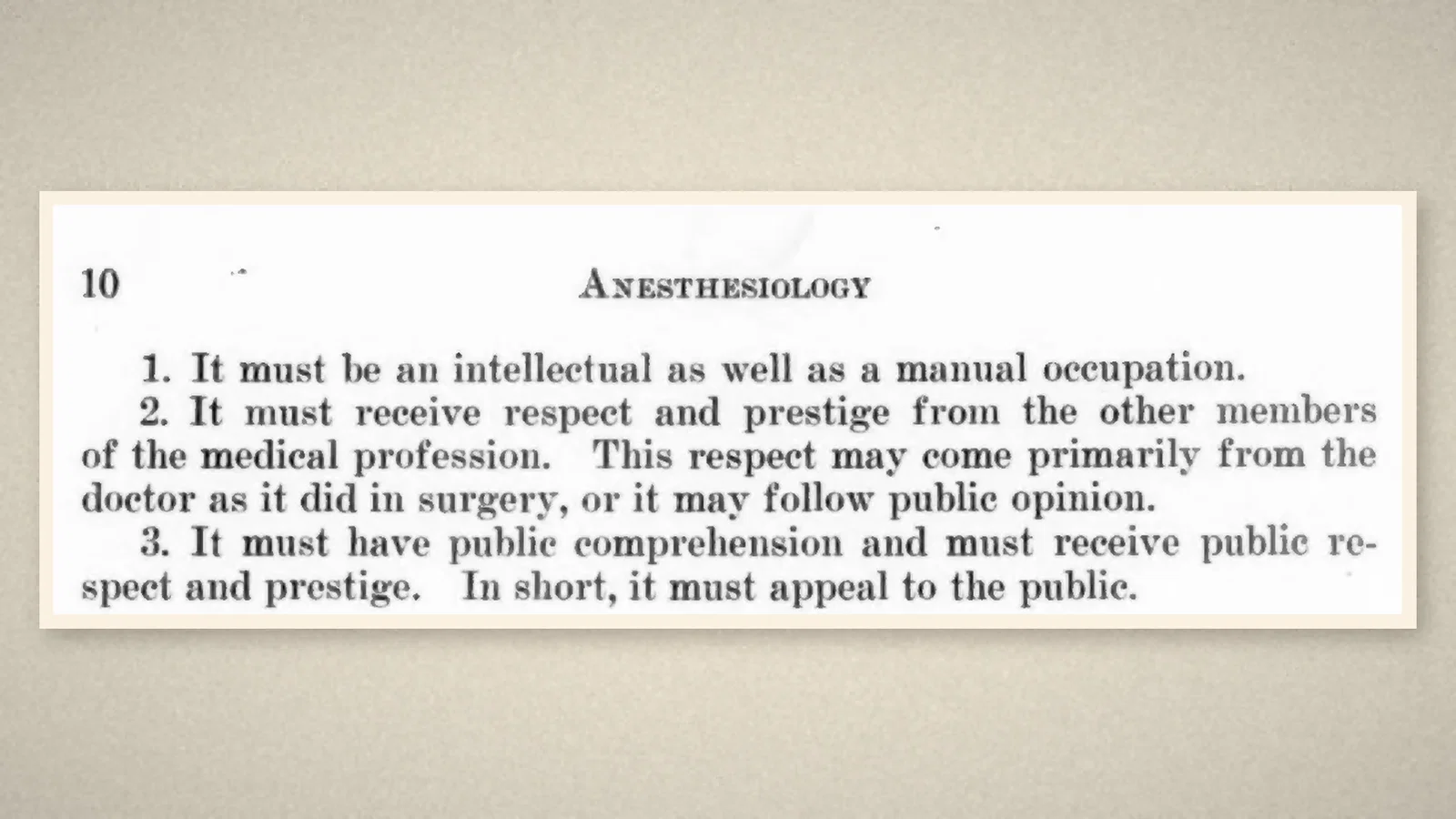
A specialty, Haggard argued, rested on three points: "It must be an intellectual as well as a manual occupation"; it must win the respect of the rest of the profession; and "it must have public comprehension" and respect. [1, p. 10] Anesthesia had started badly, without scholarly basis, a rule-of-thumb procedure given by nurse, intern or, in emergency, a layman. Haggard was an example: "During my internship I was trained by a nurse. I was given a cone, a can of ether" and a few empirical tricks. [1, p. 10]
The contents
The rest of the number was mostly clinical and laboratory work: Arthur E. Guedel on cyclopropane anesthesia; regional anesthesia combined with cyclopropane for abdominal relaxation; a preliminary report on cyclopropane-air-oxygen anesthesia; a Mayo Clinic review of the liver and kidneys from the anesthetist's standpoint; an experimental analysis of convulsions during anesthesia; the local anesthetic properties of ephedrine; postoperative pulmonary complications and suction bronchoscopy; blood-flow velocity during spinal anesthesia; early postoperative fall in prothrombin; and the treatment of aphonia with intravenous Pentothal. Book reviews and a section of abstracts followed. [1, pp. 13–124]
The editorial: why a journal
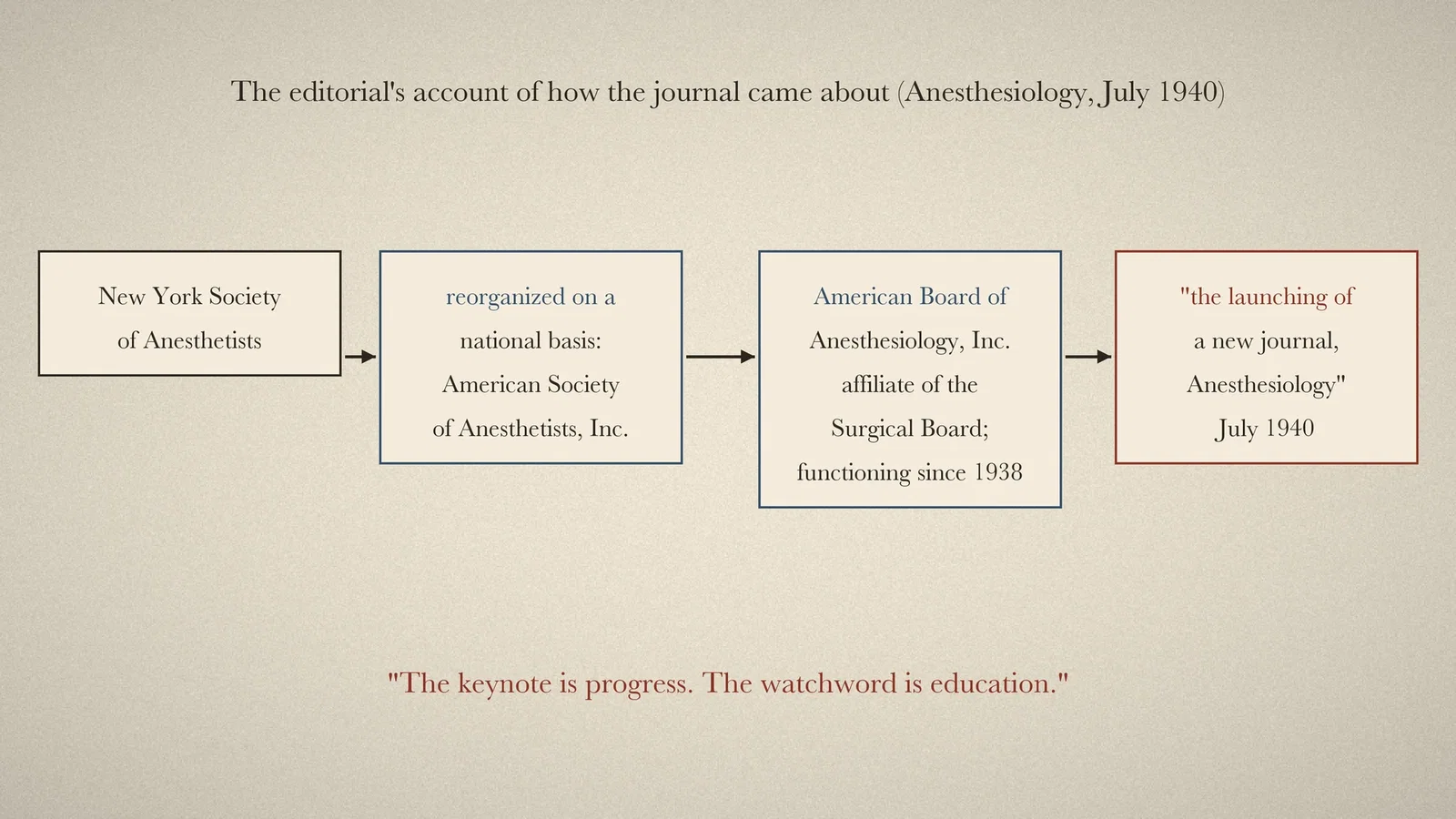
The unsigned editorial on pp. 95–96 said anesthesiology had adopted its new conception not on its own initiative but to keep pace with surgery; the anesthetist was now expected to be "the pharmacological and biochemical consultant of the" surgical team, with interests including transfusion, intravenous and oxygen therapy, "therapeutic nerve blocking and resuscitation". [1, p. 95] It listed the steps: "the reorganization of the New York Society of Anesthetists on a national rather than a local basis", named the American Society of Anesthetists; the Society's sponsorship, with the American Medical Association's surgical section and the American Society of Regional Anesthesia, of the American Board of Anesthesiology, an affiliate of the surgical board, which "has functioned since 1938"; and, as the latest project, "the launching of a new journal". "The keynote is progress. The watchword is education." [1, p. 95–96]
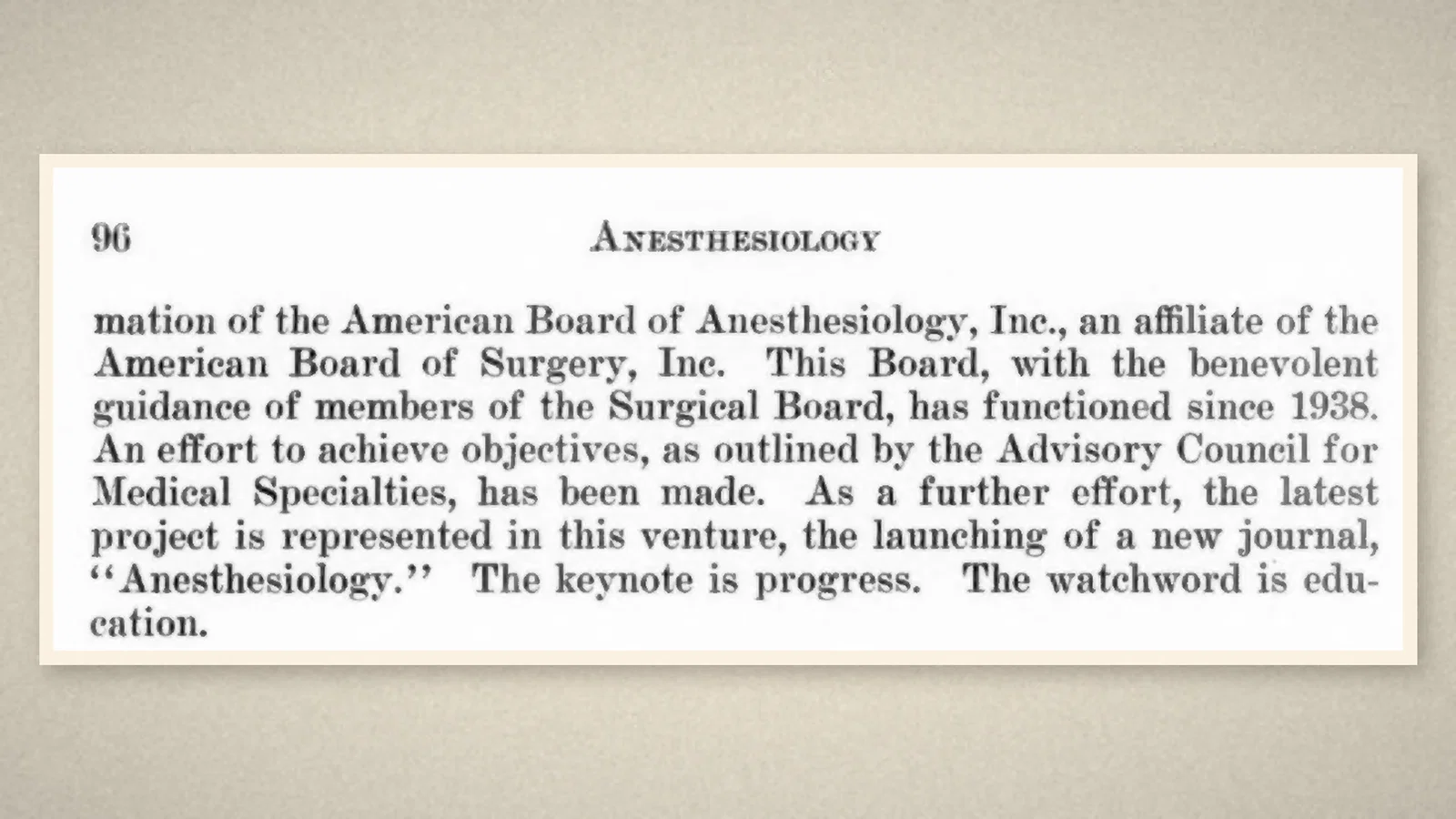
The editorial then turned to restraint. Medical literature was enormous; "there is considerable agitation from many sources to curtail the" output, and much of the argument was sound. Articles should be chosen on merit, original work, merited reviews and valuable experience only, and "there should be an insistence upon brevity". The Society believed the specialty needed Anesthesiology, and accepted its responsibility "to avoid further burdening the medical literature" with articles that did not merit publication. [1, p. 96]
What the record shows
The first number of 1940 put three things side by side: a table of contents full of clinical research, an address urging anesthetists to earn the regard of colleagues and public, and an editorial that set the journal after the Society's reorganization and the specialty board. In announcing the journal, the editorial also promised restraint in what it would publish.
Sources and reading limits
Read: Anesthesiology vol. 1 no. 1 (July 1940), all 124 scanned pages: the masthead and editorial board, Haggard's opening paper in full, the editorial on pp. 95–96 in full, and the titles and authors of the other papers, reviews and abstracts.
Not covered: the Society's minutes and correspondence on founding the journal, and later histories of it, are not covered; the editorial is unsigned and its author is not guessed. Circulation, the Society's later change of name and the journal's later standing are not in this number and are not discussed.
Three illustrations are crops of pages from this number; one is a sequence drawn from the editorial.
- Haggard HW. The place of the anesthetist in American medicine. Anesthesiology. 1940;1(1):1-12; Editorial. Anesthesiology. 1940;1(1):95-6; masthead and contents of vol. 1 no. 1 (July 1940). Internet Archive
Continue exploring
Related reading connects shared questions and contexts; it does not by itself establish historical influence.
- 1941: The American Board of Anesthesiology Becomes a Separate Board
- 1922: McMechan Founds a Research Society and a Journal
- 1923: The First Number of the British Journal of Anaesthesia
Anesthesia Epochs · The Source Room · About & Editorial Method
Published November 2, 2026. Sources and reading limits are stated above. Illustrations are labelled as original source images or AI-made. Historical accounts are educational; they are not current treatment instructions.