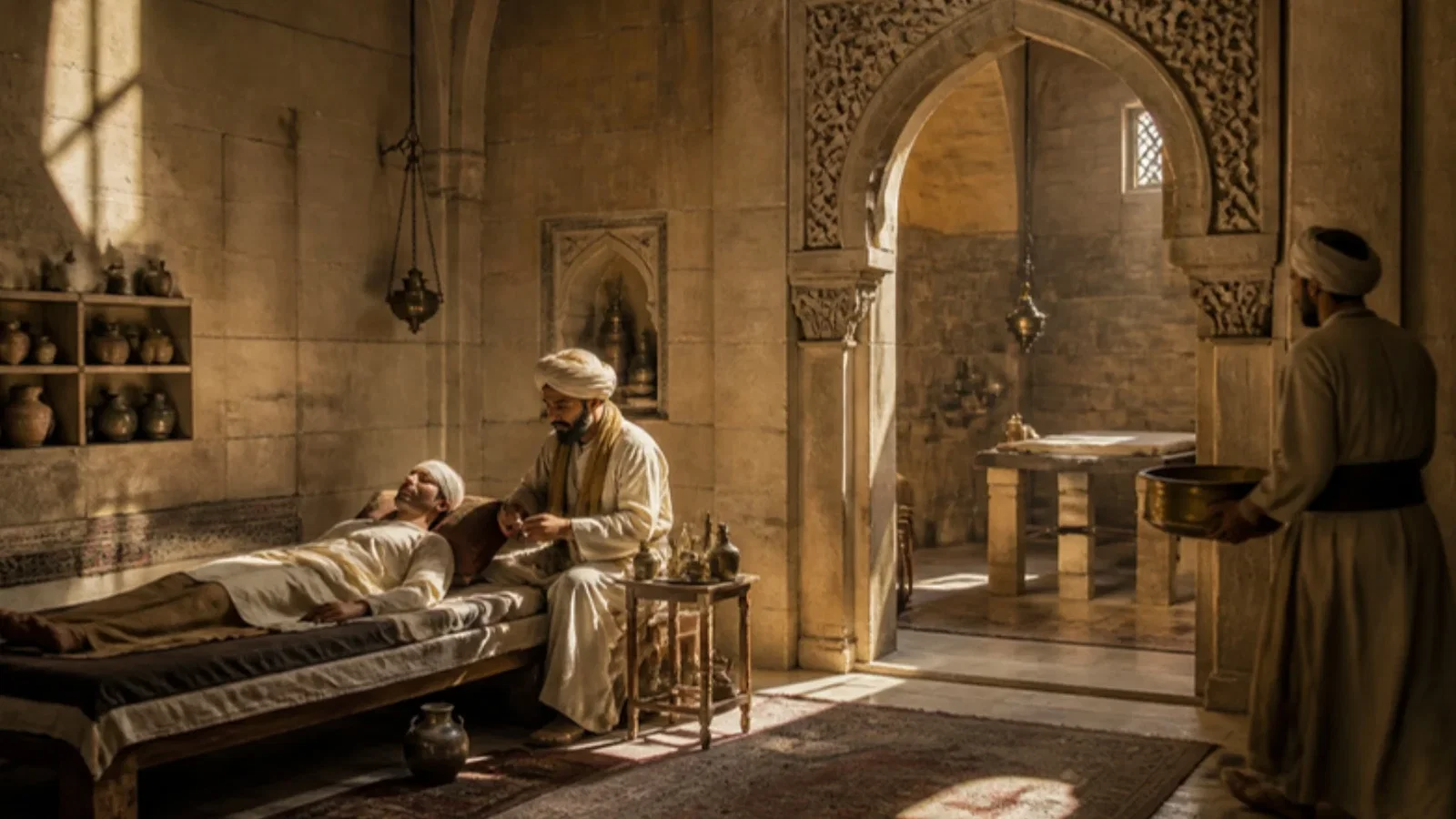
In a 2006 article, two anaesthesiologists pointed to a room labelled the induction room beside the operating room of a hospital built in Kayseri in 1206, and used it to argue for block rooms in modern practice.
Reading Library · Anesthesia Epochs · 中文版
Watch the education video (for clinicians)
1206: The Gevher Nesibe Hospital — A Room Before the Operating Room · Anesthesia Epochs Education Series
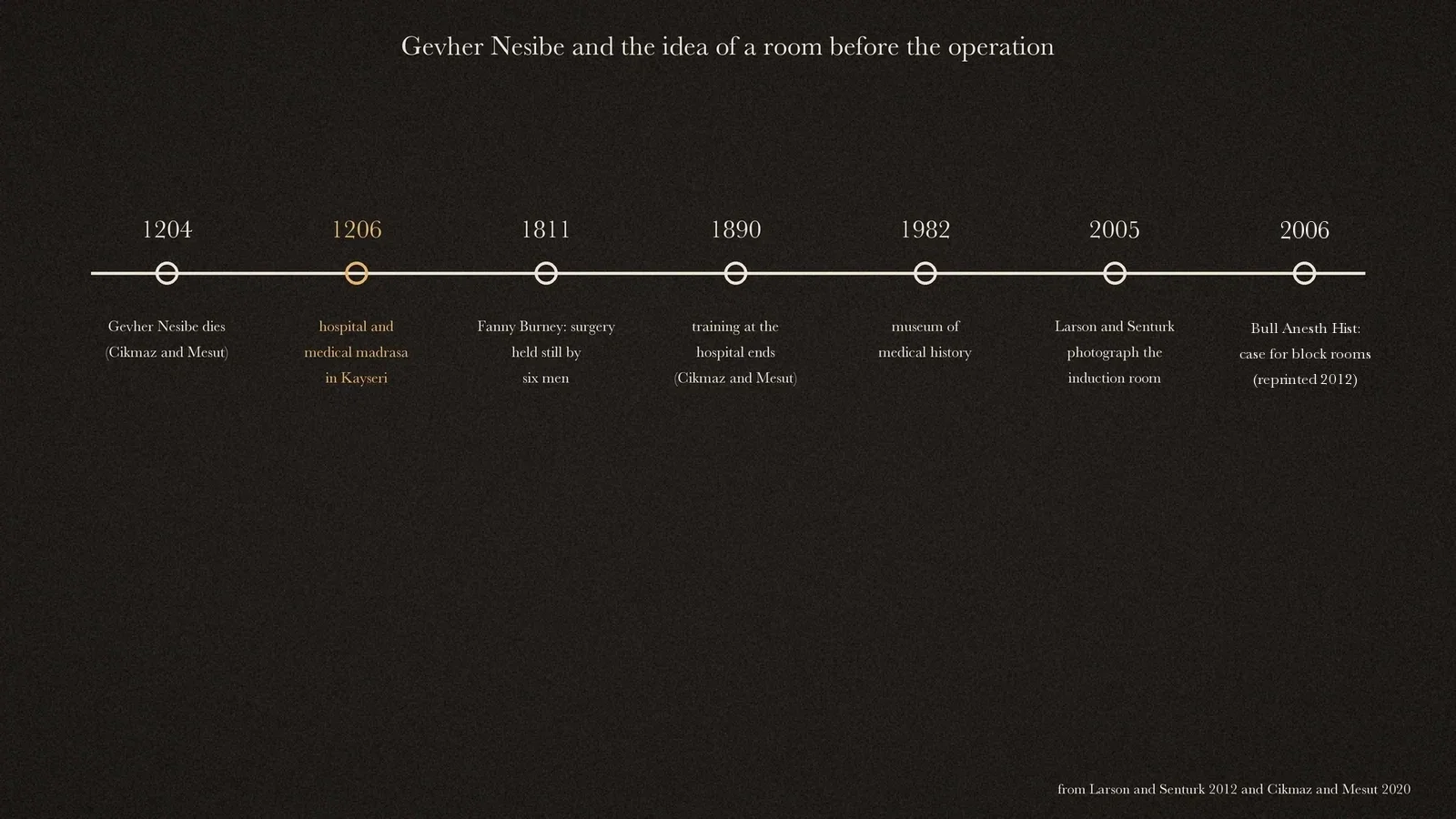
In 2006 the anaesthesiologists Merlin Larson and Mert Senturk complained that American practice suffered from "a conspicuous failure": the lack of induction or block rooms beside the operating rooms, where nerve blocks and neuraxial catheters could be placed without the pressure to "get the case started". [1] Such rooms were routine in some countries but uncommon in the United States. To make the point they went back eight centuries, to a hospital in central Turkey that one of them had toured and photographed in 2005. The article was reprinted in the CSA Bulletin in 2012. [1] This article reads that article alongside a 2020 review of Islamic medical schools in Turkey. [2]
The hospital
Kayseri, the Roman Caesarea, sits on the old Silk Road in Cappadocia. [1] Its medical centre, Larson and Senturk write, was built in 1206 and is regarded by many historians as one of the first institutions dedicated to teaching and research; it survives today as the History of Gevher Nesibe Medical Museum. [1] Selman Cikmaz and Recep Mesut give more detail: in 1206 Sultan Giyaseddin Keyhusrev built the Gevher Nesibe hospital and medical madrasa in the name of a sister, Gevher Nesibe, who had died of tuberculosis in Kayseri in 1204, with the Giyasiyye madrasa adjoining it. [2] Physicians were trained there until 1890; S. Ünver called it "Turkey's first medical school"; and it has been a museum of the history of medicine since 1982. [2] Larson and Senturk give a different tradition: that the princess conceived the institution and willed it on a deathbed. [1] They also describe a secular arrangement in which Jewish, Christian and Muslim physicians worked together. [1]
Room 12
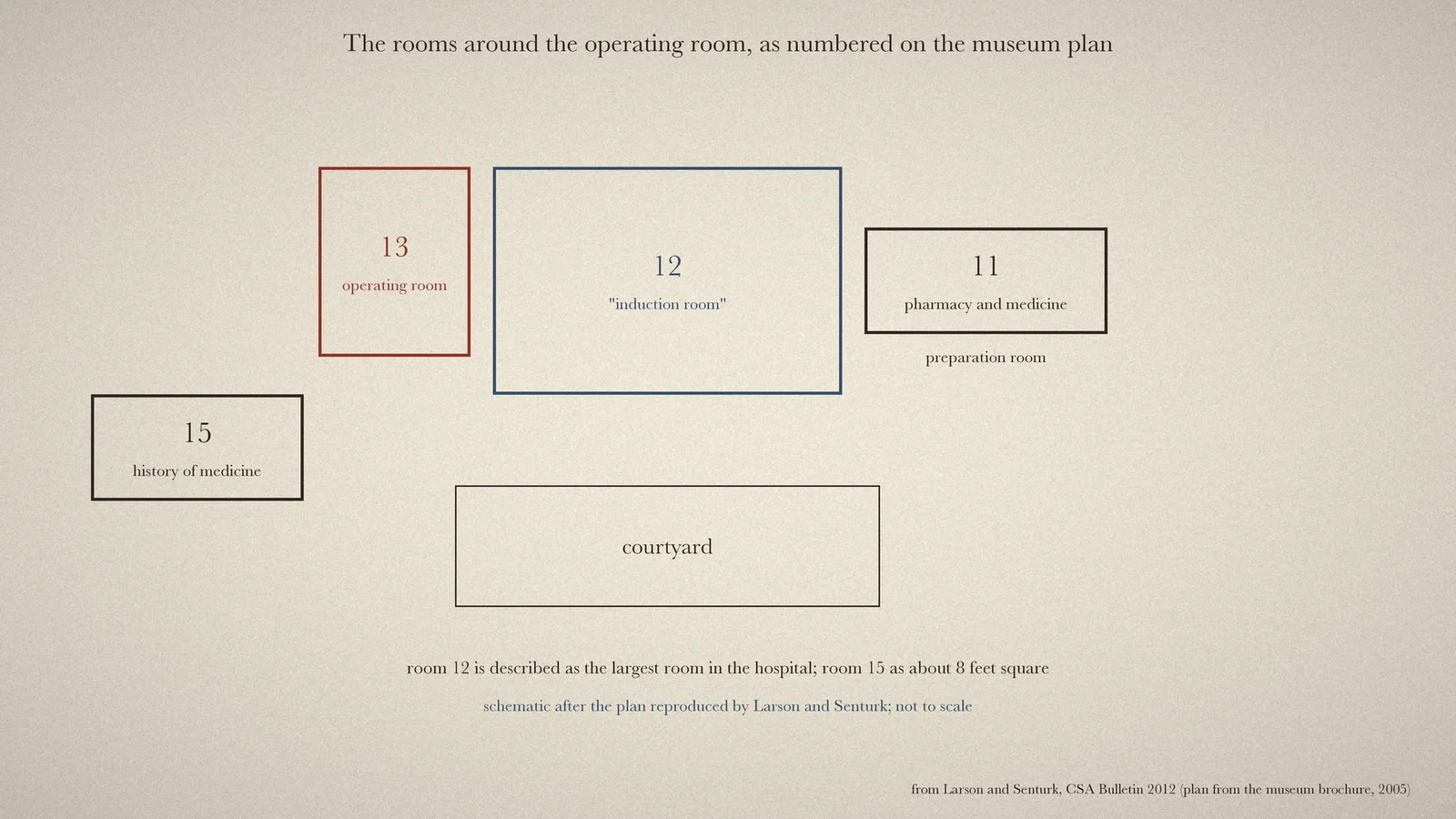
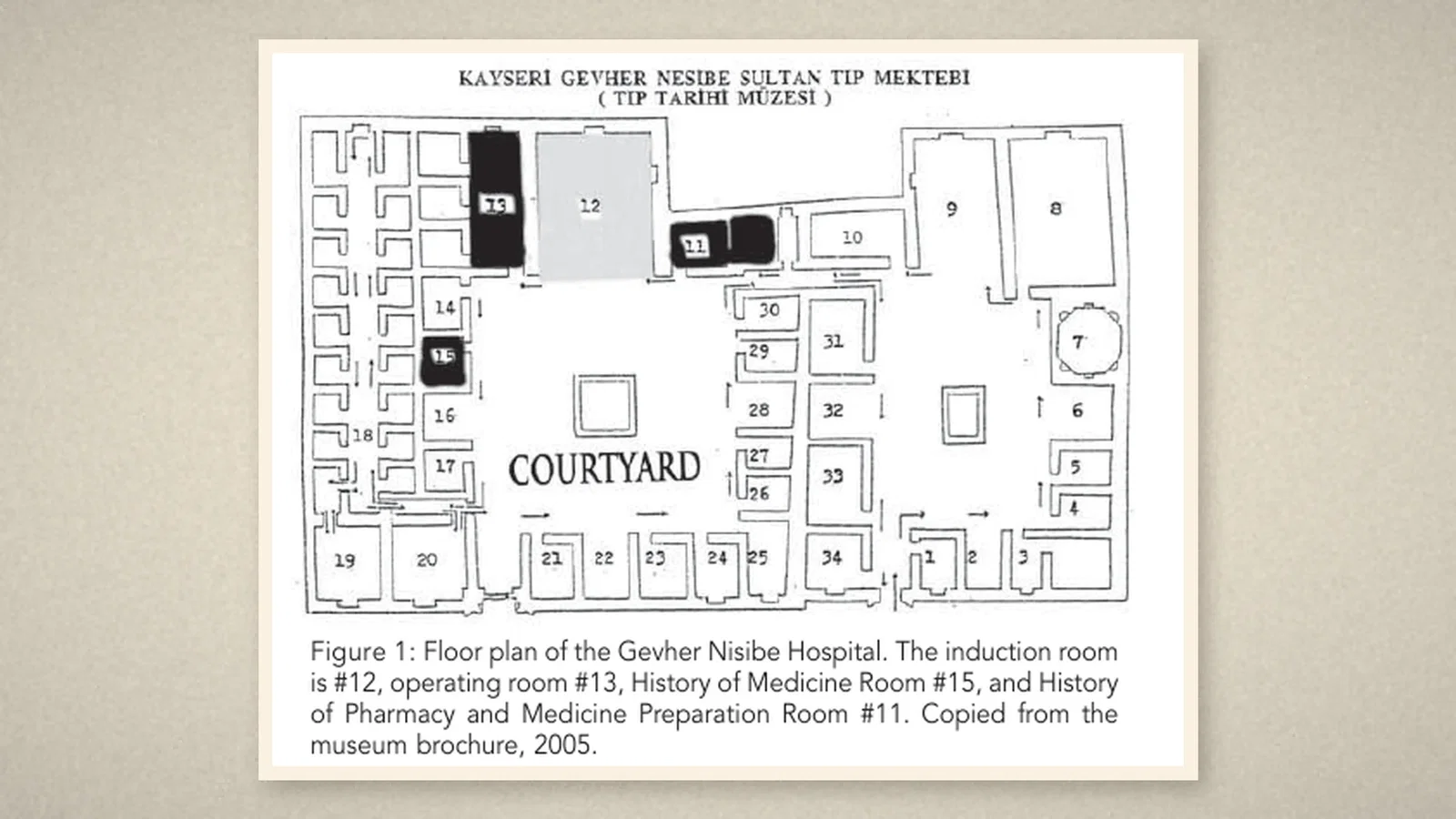
The museum brochure's floor plan, which Larson and Senturk reproduced, numbers the operating room 13 and the room beside it 12: "The induction room is #12". [1] Room 12 is, in their caption, "the largest room in the hospital"; a room for the history of pharmacy and the preparation of medicines (number 11) adjoins it, and a small room for the study of the history of medicine (number 15) lies nearby. [1] The operating room was lit by a hole in the ceiling, so that most operations were done at midday. [1]
Why would a medieval hospital need such a room? The authors point to the drugs. The soporific described by Dioscorides in the first century was mandrake in wine; by the 13th century the mixture included opium, mandrake, henbane and other ingredients, and was given by mouth, by inhalation or through the skin. [1] Such slow-acting preparations, the authors suggest, needed time and space before the operation began, and "given properly" they might have produced a tranquil patient who would remember little. [1] They are careful about the label: the physicians "presumably did not use the term 'anesthesia induction' but rather something like 'soporific induction'". [1]
The lost room
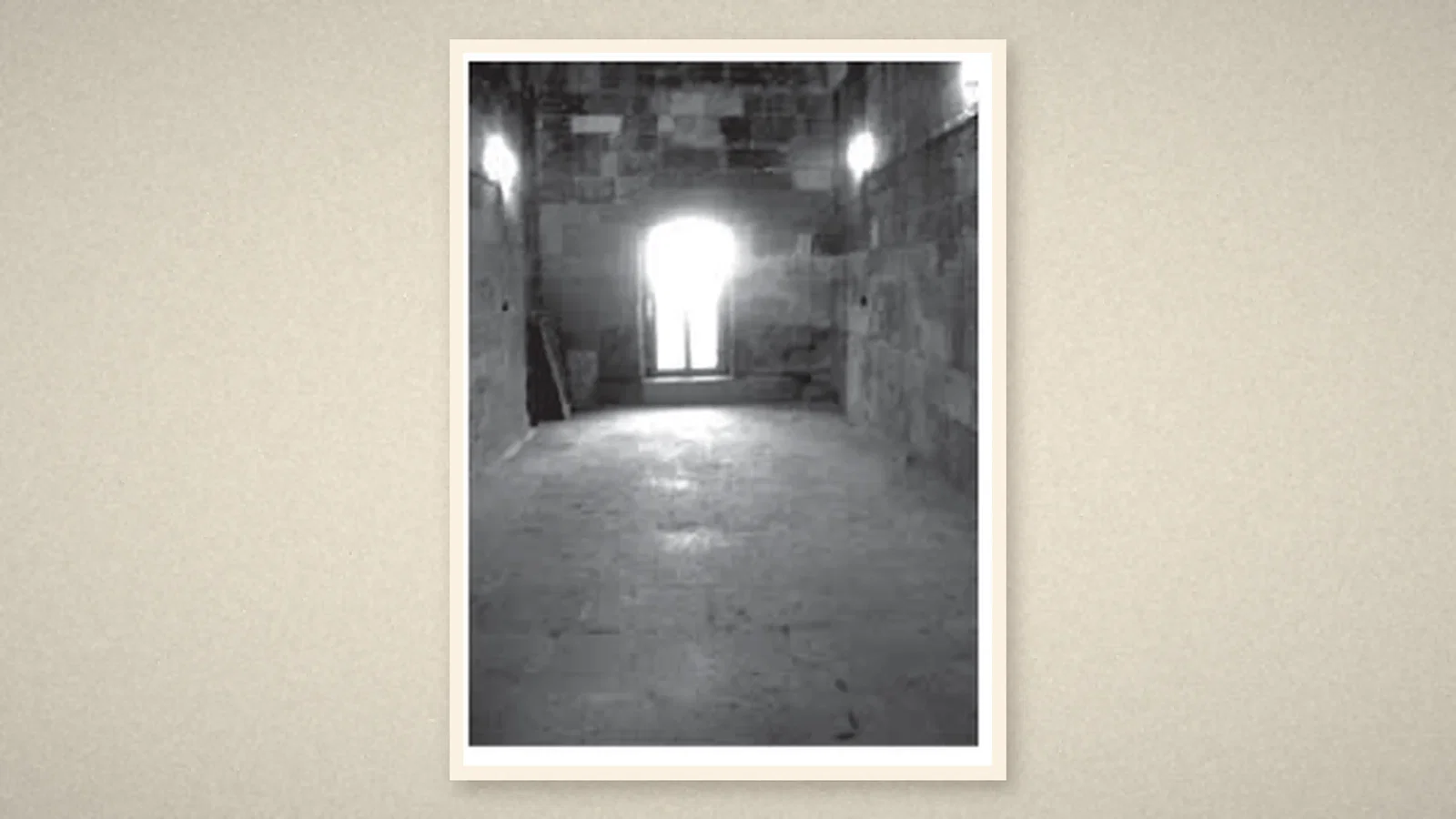
Larson and Senturk contrast this with Europe, where between the 16th and 18th centuries there was almost no effective attempt to control surgical pain, and with Fanny Burney's account of a mastectomy in 1811 performed while six men held the patient still. [1] When American physicians introduced inhalation vapours, the induction room "remained in the dustbin of history", and even the rise of regional anaesthesia in the early 20th century did not bring back what the authors call "this 800-year-old idea". [1]
What the record shows
The Kayseri plan does not prove how a room was used eight hundred years ago; it shows how a museum labels it today and how two anaesthesiologists read it. What it supports is a simpler point: a hospital built around slow drugs gave the time before surgery a room of its own. Modern block rooms make the same argument for regional anaesthesia.
Sources and reading limits
Read: Larson and Senturk's four-page article, reprinted in the CSA Bulletin in 2012 (archived from the California Society of Anesthesiologists website); Cikmaz and Mesut's open-access 2020 review.
Not covered: the museum brochure itself; the hospital's foundation deed, which Cikmaz and Mesut report has not been found; any medieval text describing the use of room 12; the unreferenced "recent assessment" of the medieval mixture that Larson and Senturk mention; the original 2006 printing in the Bulletin of Anesthesia History. The identification of room 12 as an induction room is the museum's and the authors' interpretation. The two sources differ on how the hospital was founded; both accounts are given. Doses of the medieval mixture are not given in the sources and none are implied.
Two illustrations are crops of Larson and Senturk's article; two are drawn from the sources.
- Larson M, Senturk M. Induction rooms. CSA Bull. 2012 Spring:51-4. Reprinted from Bull Anesth Hist. 2006 Apr. Internet Archive PDF
- Cikmaz S, Mesut R. History of Islamic medical schools in Turkey's territory. Balkan Med J. 2020;37(6):361-70. PMC
Continue exploring
Related reading connects shared questions and contexts; it does not by itself establish historical influence.
Anesthesia Epochs · The Source Room · About & Editorial Method
Published November 2, 2026. Sources and reading limits are stated above. Illustrations are labelled as original source images or AI-made. Historical accounts are educational; they are not current treatment instructions.