Two histories by Pakistani anaesthesiologists: from assistant anaesthetists trained by ENT surgeons after 1947 to a chair at King Edward Medical College in 1959, a Diploma in 1962, the first MCPS examination in 1964 and the first FCPS in 1968.
Reading Library · Anesthesia Epochs · 中文版
Watch the education video (for clinicians)
1959: Lahore's Chair of Anaesthesia — Pakistan · Anesthesia Epochs Education Series
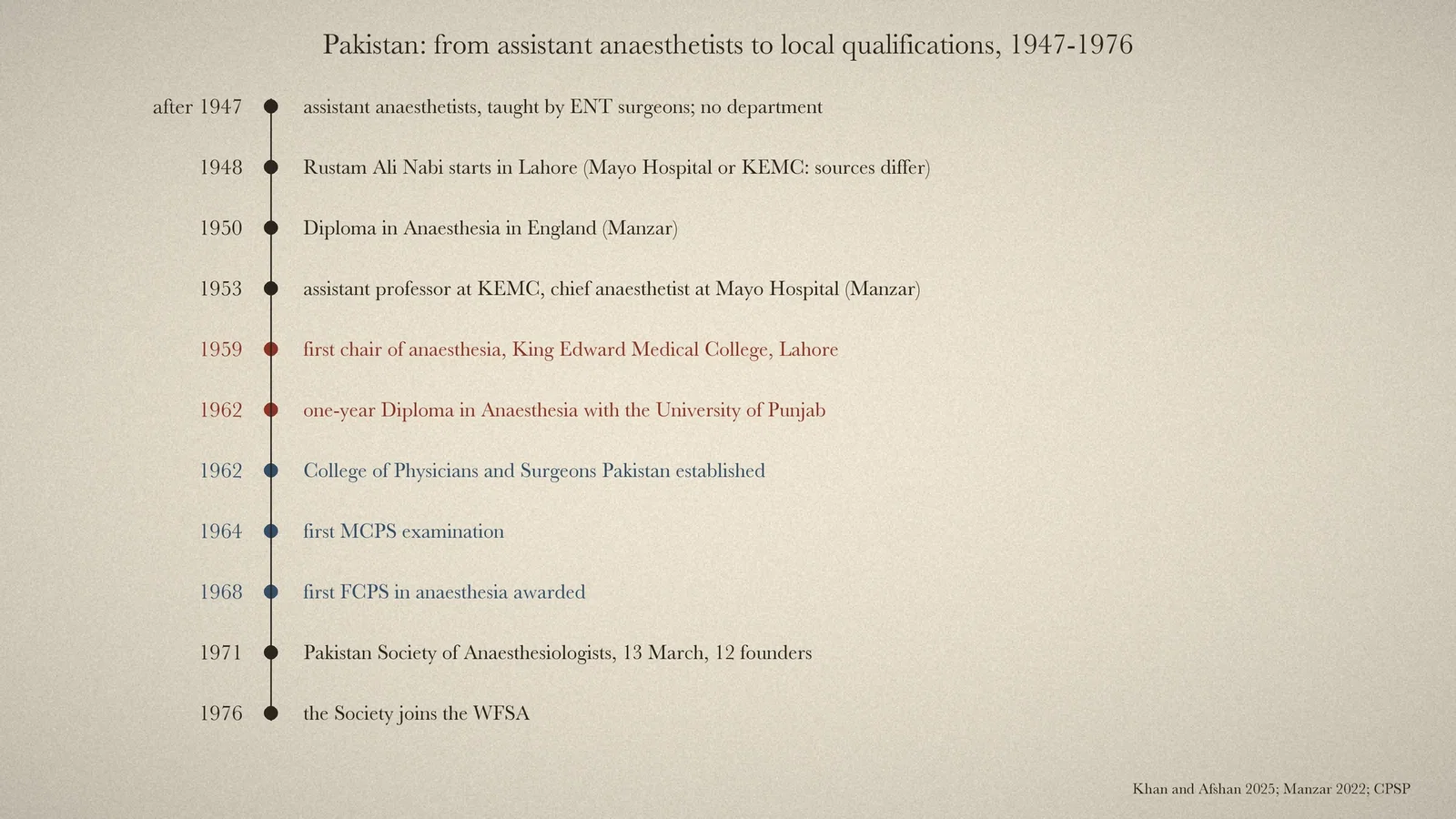
For its first dozen years, Pakistan trained no anaesthetists of its own. Some went abroad, and the rest learned on the job. That began to change in Lahore in 1959, when King Edward Medical College created the country's first chair of anaesthesia. Within ten years Pakistan had a local diploma, a national college and its first fellow in anaesthesia. This article tells that story from two recent histories by Pakistani anaesthesiologists: a 2025 review in the World Federation's Update in Anaesthesia and a 2022 biographical article in the Pakistani journal Anaesthesia, Pain & Intensive Care.
Assistant anaesthetists
Fauzia Khan and Gauhar Afshan, of the Aga Khan University in Karachi, describe "the post-1947 era in Pakistan" as "the era of assistant anaesthetists", hired by major hospitals on salary. They were trained in basic airway management and some basic physiology "by the ear, nose, and throat (ENT) surgeons of that time". No department of anaesthesiology existed in the country. [1, p. 53] Some assistant anaesthetists went to the UK or Denmark on scholarships. "Until 1960, no local formal anaesthesia training programme was available", and it was commonly believed that minimal training was enough to practise. [1, p. 54] The authors add that documented information on the history of postgraduate training in Pakistan "is lacking". [1, p. 54]
A doctor from the army
Tahoor Manzar's article tells the life of Professor Rustam Ali Nabi, born on 29 September 1916 in Rahon, District Jalandhar. Nabi was schooled in London, qualified at St Bartholomew's in 1941, and was conscripted into the Royal Army Medical Corps in 1942. Nabi trained in anaesthesia at Poona and served as an anaesthetist in Burma, Malaya and Java until December 1947. [2, p. 425] After Partition, Manzar writes, Nabi went straight to King Edward Medical College (KEMC), Lahore, as an assistant anaesthetist "in February 1948". In September 1948 Nabi left for postgraduate training in England and qualified for the Diploma in Anaesthesia, then "the highest qualification in anesthesia at that time in 1950". [2, p. 425]
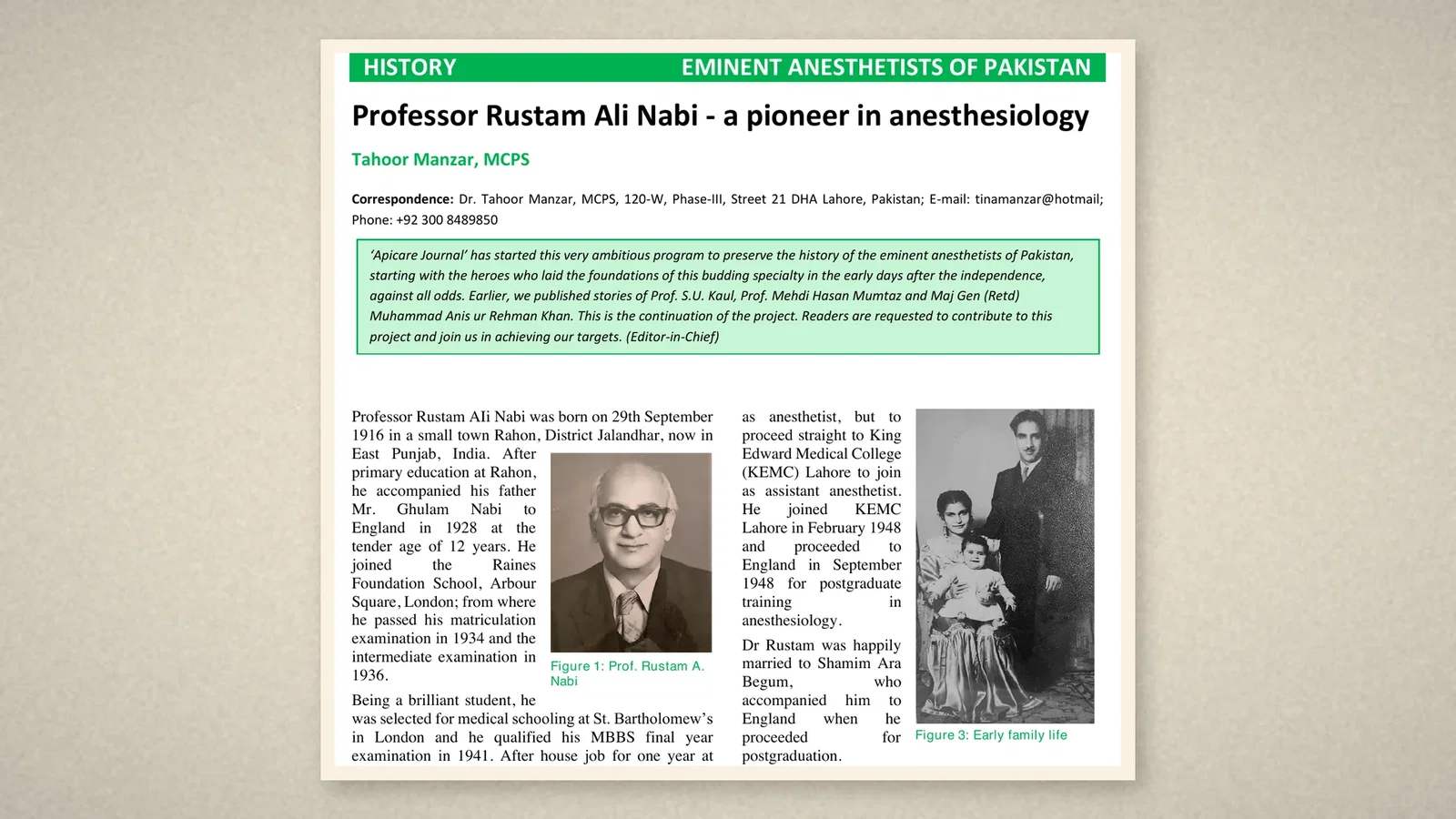
Khan and Afshan give the same figure a different name and a different first hospital. In their account "Professor Rustum Nabi Noor" joined "Mayo Hospital, Lahore, as Assistant Anaesthetist in 1948". Noor trained in the UK, returned as Assistant Professor, and established the first Department of Anaesthesia at King Edward Medical College. [1, p. 53] Both names are given here, as are both hospitals.
The chair
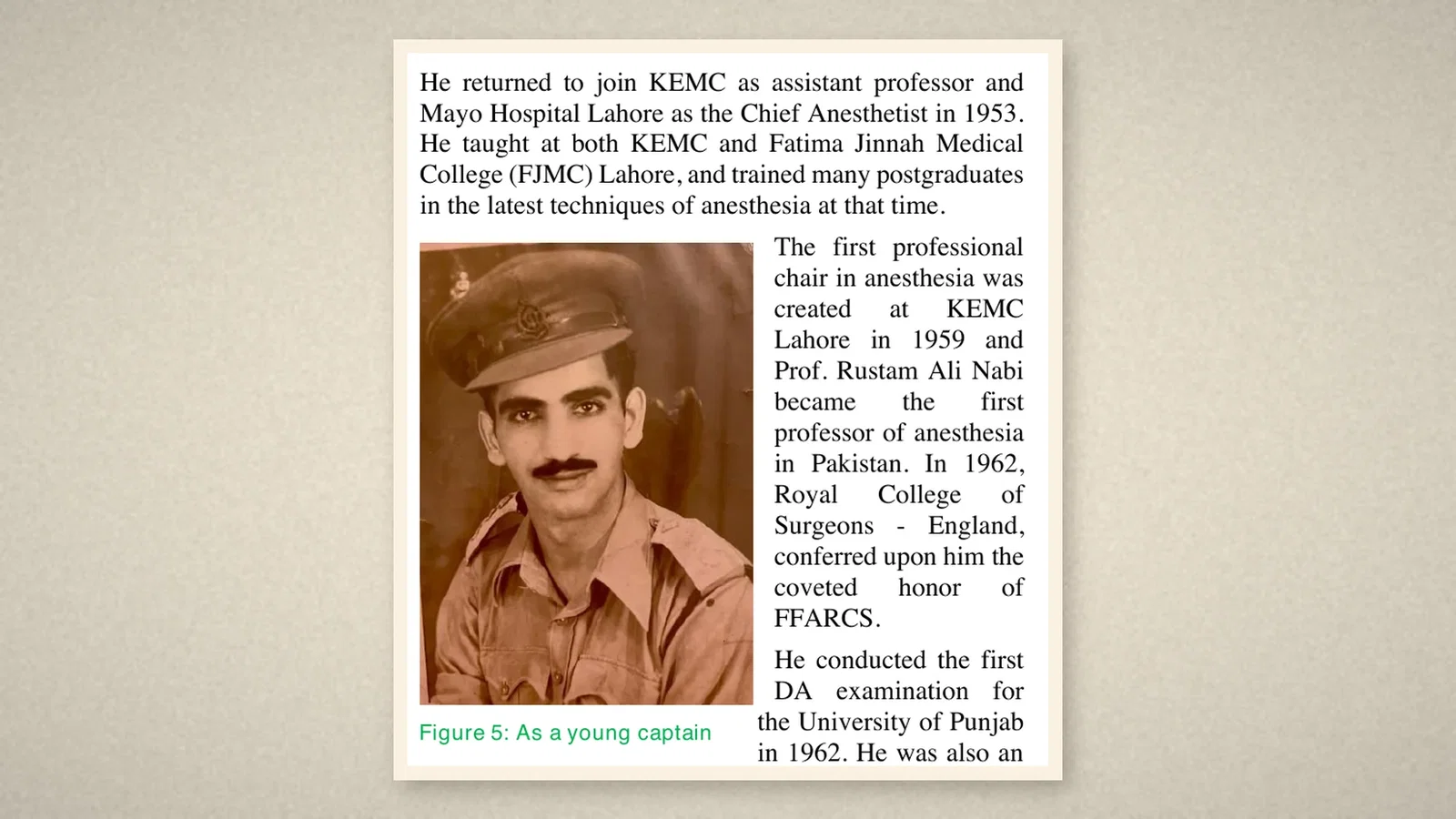
Back in Lahore, Nabi became assistant professor at KEMC and "Chief Anesthetist" at Mayo Hospital in 1953. [2, p. 426] "The first professional chair in anesthesia was created at KEMC Lahore in 1959," Manzar writes, and Nabi "became the first professor of anesthesia in Pakistan". [2, p. 426] Khan and Afshan agree: Nabi was appointed the first Professor of Anaesthesia at the same institution "in 1959". [1, p. 53] In Karachi, another pioneer, Professor Hussain, had joined the Civil Hospital in 1949 and also trained in Britain. [1, p. 53]
Qualifications at home
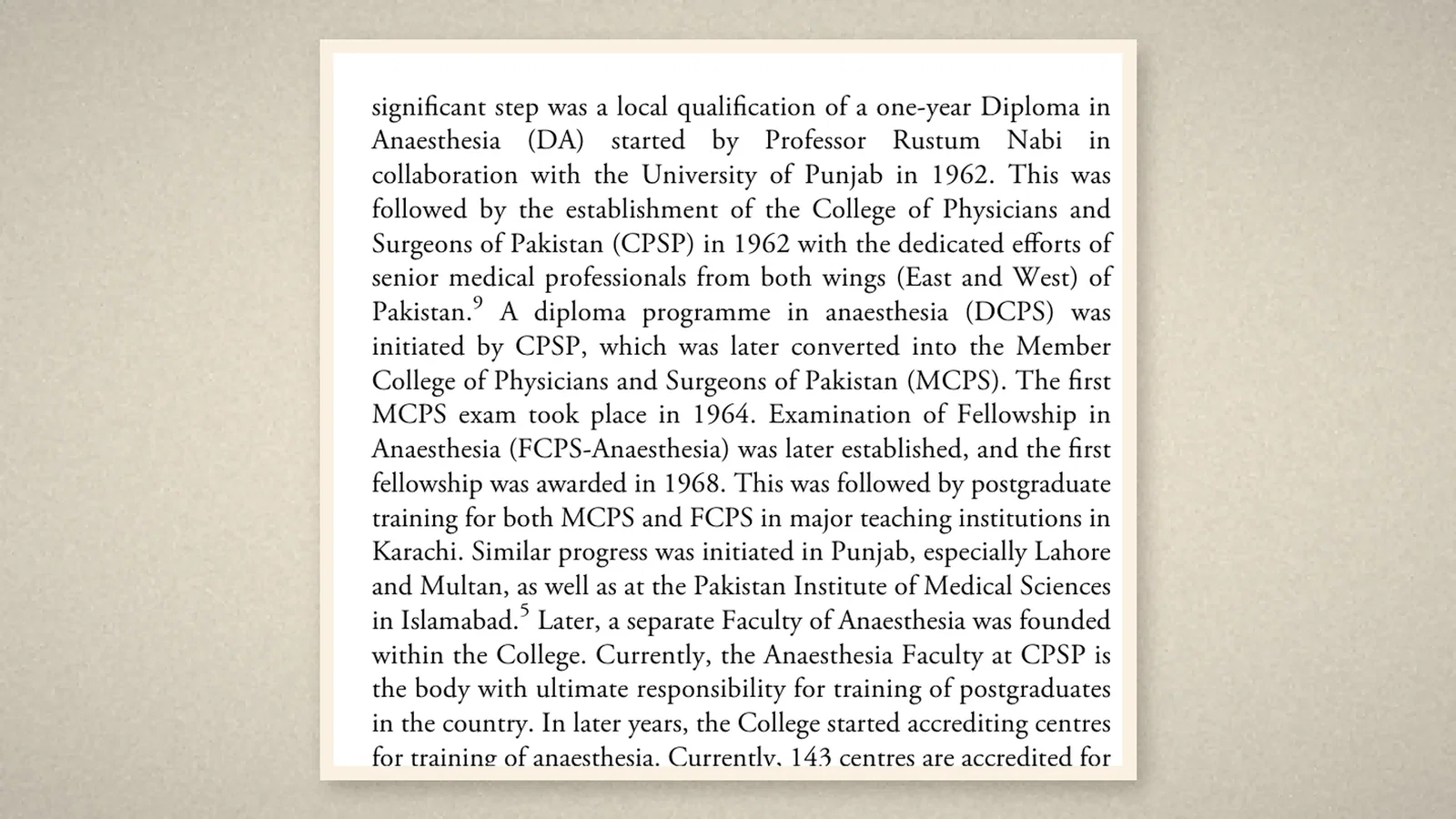
The first local qualification came three years after the chair. Khan and Afshan call it "the first significant step". Professor Nabi started a one-year Diploma in Anaesthesia (DA) "in collaboration with the University of Punjab in 1962". [1, p. 54] Manzar adds that Nabi conducted the first DA examination for the university that year. [2, p. 426] Also in 1962, the College of Physicians and Surgeons of Pakistan (CPSP) was established. [1, p. 54] Its own website says the College was founded "through an act of parliament" by 50 physicians from both wings of the country. Its charter focused on "promotion of specialist medical practice through organization of postgraduate medical education". [3] The College's anaesthesia diploma became the MCPS, whose first examination was held in 1964, and the first fellowship in anaesthesia (FCPS) was awarded in 1968. [1, p. 54] Today, according to Khan and Afshan, the College's Anaesthesia Faculty accredits 143 training centres with 313 supervisors. [1, p. 54]
The specialty's society came later. The Pakistan Society of Anaesthesiologists was founded on 13 March 1971 "by a group of 12 Pakistani anaesthesiologists". [1, p. 56] Its Lahore chapter followed in 1976 with Nabi among the four founders, and the Society joined the World Federation the same year. [2, p. 426] [1, p. 56] Nabi retired from government service in 1974, at the age of 58. [2, p. 426]
What the record shows
Pakistan's anaesthesia education began with a single chair in Lahore. A diploma followed three years later, then a national college with its own examinations. The two histories agree on the dates of the chair and the diploma. They disagree on a name and a hospital, and one of them says plainly how little of the early record survives.
Sources and reading limits
Read: Khan and Afshan, Update in Anaesthesia 40 (2025), pp. 53-57, full text and page images; Manzar, Anaesthesia, Pain & Intensive Care 2022;26:425-426, full text and page images (open access, CC BY-NC 4.0); the CPSP's About page.
Not covered: no document from 1948-1968 was obtained. That includes the college and university records of the 1959 chair and the 1962 Diploma, the CPSP ordinance, and the records of the first MCPS and FCPS examinations. The 2022 book chapter by Afshan and Sultan that Khan and Afshan cite is not covered. Both sources read are secondary. The name (Rustam Ali Nabi or Rustum Nabi Noor) and the hospital of 1948 (King Edward Medical College or Mayo Hospital) differ between them and are given as each states them. Manzar's statement that the Royal College of Surgeons of England "conferred" the FFARCS on Nabi in 1962 is left in Manzar's wording.
One illustration is a timeline drawn from the sources; three are crops of the two articles.
- Khan F, Afshan G. A historical overview of anaesthesia in Pakistan: 1947-2025. Update in Anaesthesia. 2025;40:53-7. PDF
- Manzar T. Professor Rustam Ali Nabi - a pioneer in anesthesiology. Anaesth Pain Intensive Care. 2022;26(3):425-6. doi:10.35975/apic.v26i3.1917
- College of Physicians and Surgeons Pakistan. About CPSP. Website
Continue exploring
Related reading connects shared questions and contexts; it does not by itself establish historical influence.
Anesthesia Epochs · The Source Room · About & Editorial Method
Published November 2, 2026. Sources and reading limits are stated above. Illustrations are labelled as original source images or AI-made. Historical accounts are educational; they are not current treatment instructions.