A Korean scholar's review of 2025 and some cross-checks: a specialist system of 1953 that left anaesthesia out, a society founded at Severance Hospital on 10 November 1956, membership of the World Federation in 1958, recognition in 1962 and the first board examination in 1963.
Reading Library · Anesthesia Epochs · 中文版
Watch the education video (for clinicians)
1956: The Korean Society of Anaesthesiology — Before Certification · Anesthesia Epochs Education Series
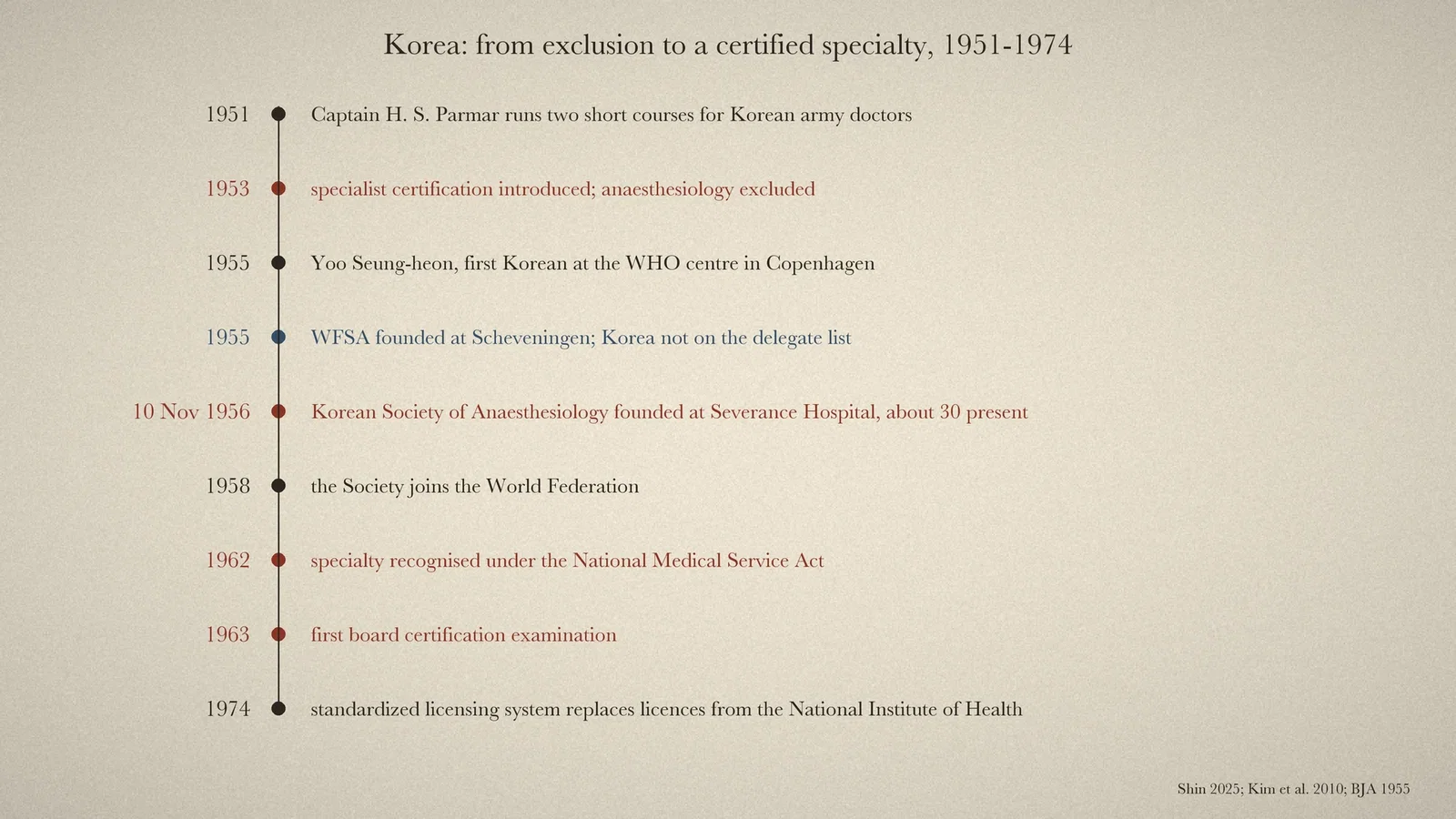
Most national societies in this series formed around a specialty that already existed. In Korea the order was different. A specialist system was created in 1953 without anaesthesia in it, and three years later the doctors it had left out founded a society. The specialty they asked for was recognised six years after that. This article follows that sequence, mainly through a review published in 2025 by a Korean anaesthesiologist in the World Federation's journal Update in Anaesthesia. Its key dates are checked where other sources allow.
War and first contact
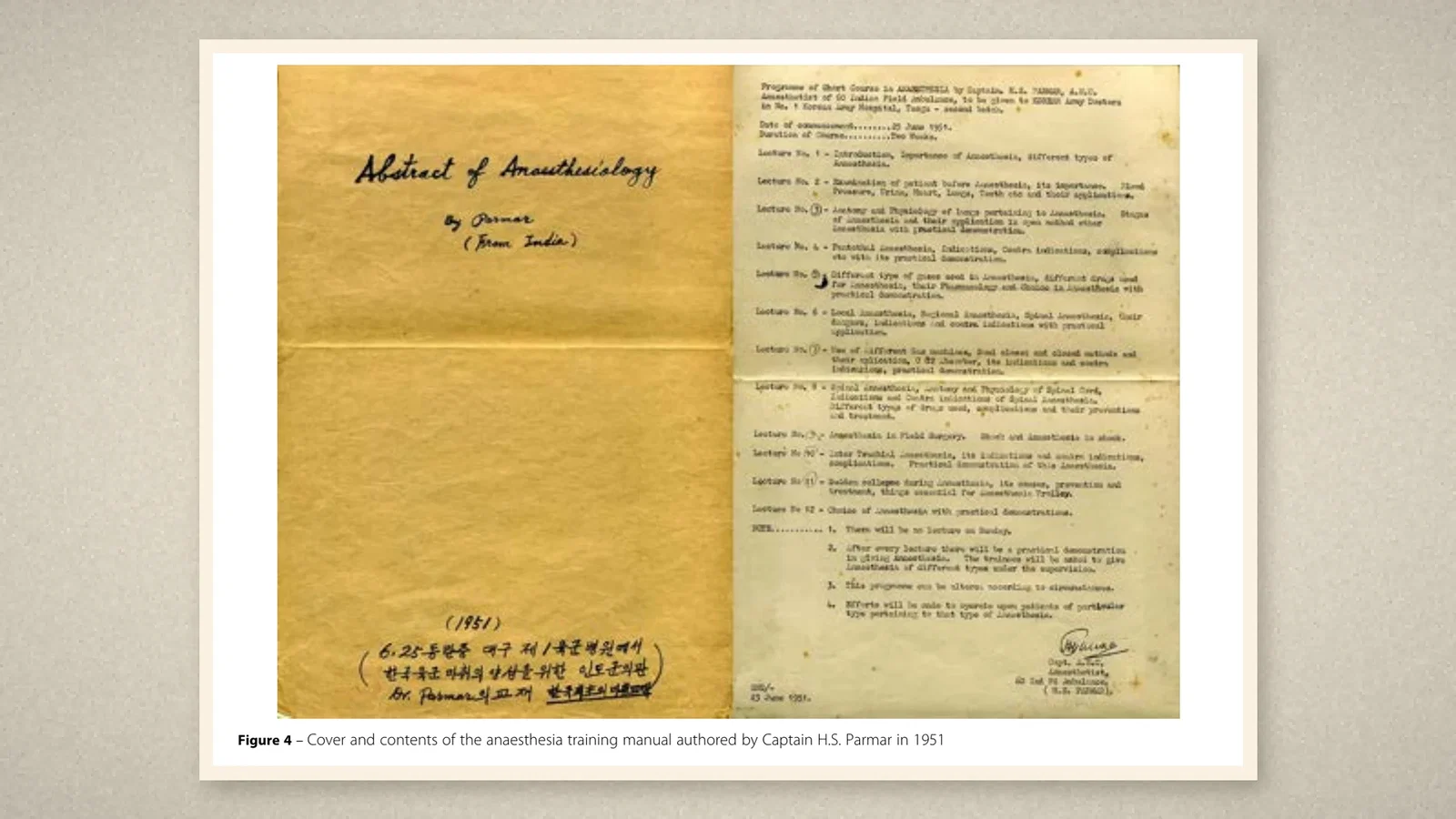
Seokyung Shin, of Severance Hospital and Yonsei University College of Medicine, describes anaesthesia in Korea after 1945 as basic: spinal or open-drop ether, often without "proper monitoring or oxygen supplementation". [1, p. 35] The Korean War changed that. United Nations teams arrived, and "hospital ships from various countries docked in Busan". Korean military and civilian doctors met "trained anaesthesiologists for the first time aboard the Danish hospital ship and at the Norwegian mobile hospital in Pocheon". [1, p. 35] In 1951 Captain H. S. Parmar, "an Indian anaesthesiologist with the British Army", ran two short anaesthesia courses for Korean army doctors. [1, p. 36] The review reproduces the cover and typed contents of Parmar's training manual. [1, p. 37]
The World Health Organization's anaesthesia centre in Copenhagen trained "160 physicians from 45 countries" between 1950 and 1961. According to Shin, Yoo Seung-heon was "the first Korean to attend this program in 1955". [1, p. 36]
Left out
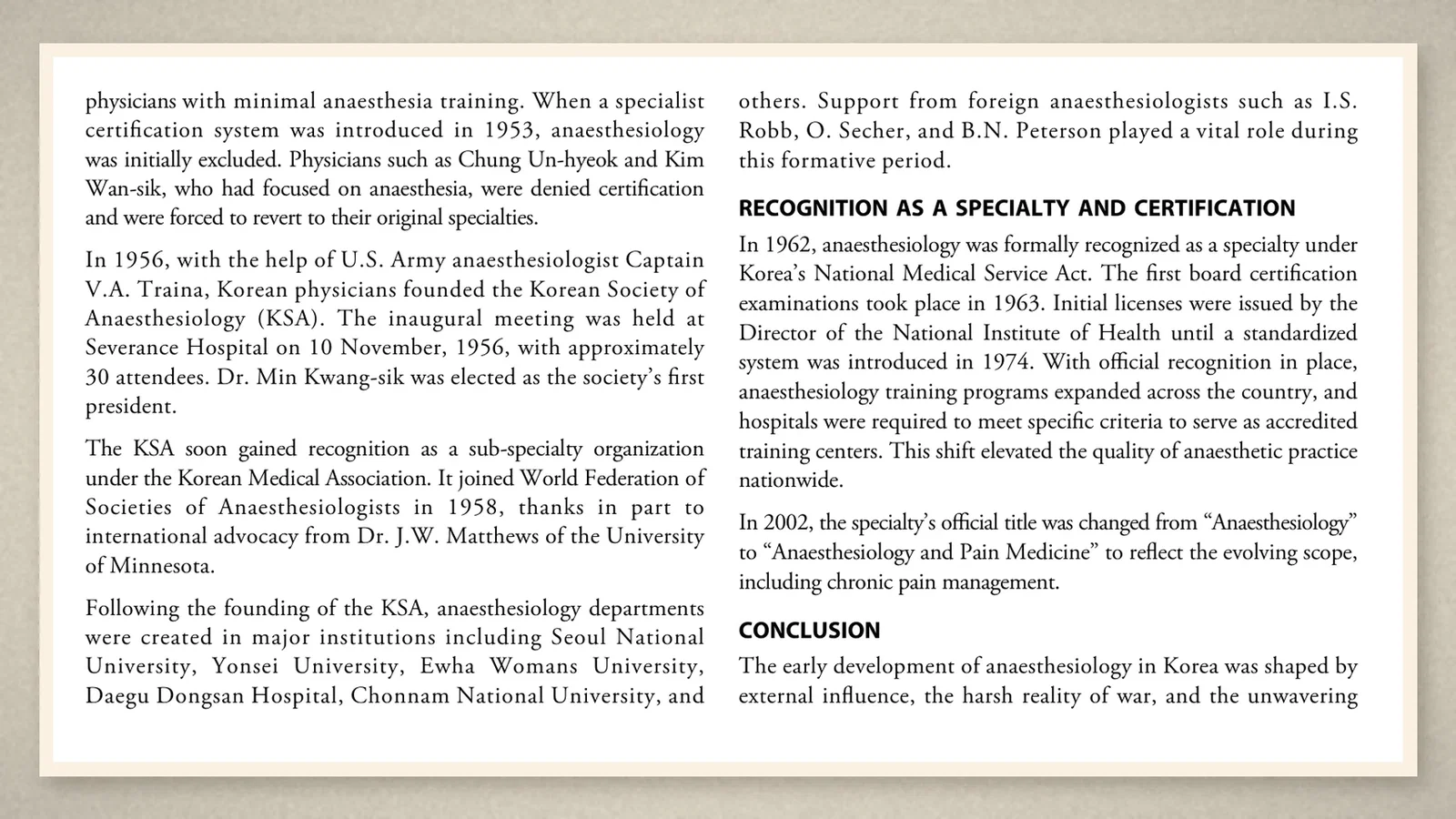
"Before 1953, anaesthesiology was not recognized as a medical specialty" in Korea. When a specialist certification system came in that year, anaesthesiology "was initially excluded". Chung Un-hyeok and Kim Wan-sik, who had concentrated on anaesthesia, "were denied certification and were forced to revert to their original specialties". [1, p. 36-37]
A society first
In 1956, "with the help of U.S. Army anaesthesiologist Captain V.A. Traina", Korean physicians founded the Korean Society of Anaesthesiology. Its inaugural meeting was held at Severance Hospital on 10 November 1956, with about 30 present, and Min Kwang-sik was elected its first president. [1, p. 37] The Society was soon recognised as a sub-specialty organisation under the Korean Medical Association. It joined the World Federation of Societies of Anaesthesiologists in 1958, helped by advocacy from J. W. Matthews of the University of Minnesota. [1, p. 37] Departments followed at Seoul National University, Yonsei, Ewha Womans University, Daegu Dongsan Hospital, Chonnam National University and elsewhere, with help from foreign anaesthetists including I. S. Robb, O. Secher and B. N. Peterson. [1, p. 37]
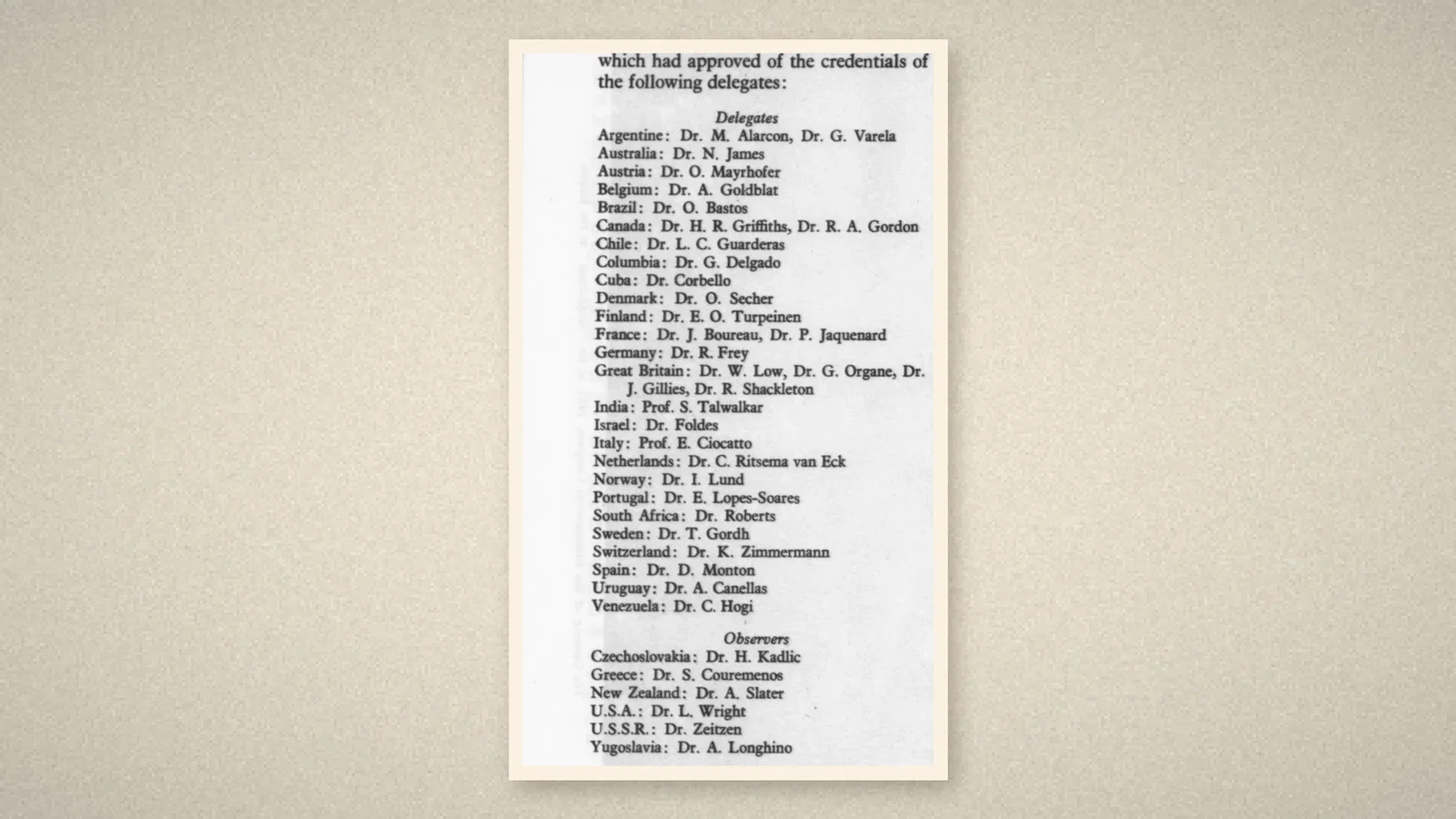
One cross-check is possible. When the World Federation was founded at Scheveningen in September 1955, the British Journal of Anaesthesia printed the list of countries whose delegates and observers took part. Korea is not on it. [3, p. 506] That fits a later entry, though it does not prove the date of 1958. The Federation's own timeline lists Korea among the members of its new Asian-Australasian Regional Section in 1970. [4]
Then the specialty
"In 1962, anaesthesiology was formally recognized as a specialty under Korea's National Medical Service Act." The first board certification examinations took place in 1963. Licences were initially issued by the Director of the National Institute of Health, until a standardised system came in 1974. [1, p. 37] The date of the first examination is confirmed by Kim, Higa and Higa, writing in Japanese in Masui in 2010: "The national examination began in 1963". They counted 3,050 board-certified anaesthesiologists in 2006 and noted that the government adopted nurse anaesthetists in 1973. [2] In 2002 the specialty's name became "Anaesthesiology and Pain Medicine". [1, p. 37]
What the record shows
In Korea the society came before the specialty. A group of doctors refused certification founded it with help from a foreign army doctor. It joined the world body within two years, and it took another four years to win the recognition that had been withheld in 1953.
Sources and reading limits
Read: Shin's review in Update in Anaesthesia 40 (October 2025), pp. 33-38, full text and page images; the PubMed abstract of Kim, Higa and Higa (2010); the BJA delegate list of 1955, p. 506; the WFSA history timeline.
Not covered: no document from 1953-1963 was obtained. That includes the 1953 regulations, the minutes of the meeting of 10 November 1956, the 1962 provision of the National Medical Service Act and the records of the 1963 examination. The Korean Society's website keeps its history section hidden, and no Korean-language history of the Society was read. The founding date, attendance, first president, Traina's role and the 1958 membership rest on Shin's review alone, a Korean scholar's secondary account. The 1963 examination is confirmed by Kim and colleagues. Korean names are given as Shin romanises them; no Hangul or hanja forms are supplied. The handwritten Korean note on the 1951 manual is not interpreted.
One illustration is a timeline drawn from the sources; three are crops of Shin's review and the 1955 BJA page.
- Shin S. The development of anaesthesia in Korea: a historical review. Update in Anaesthesia. 2025;40:33-8. PDF
- Kim MW, Higa Y, Higa K. [History and current issues of anesthesia in Korea]. Masui. 2010;59(11):1456-9. PubMed
- World Congress of Anaesthesiologists, 1955. Br J Anaesth. 1955;27(10):503-7 (delegates, p. 506). Internet Archive
- World Federation of Societies of Anaesthesiologists. WFSA history timeline. Website
Continue exploring
Related reading connects shared questions and contexts; it does not by itself establish historical influence.
Anesthesia Epochs · The Source Room · About & Editorial Method
Published November 2, 2026. Sources and reading limits are stated above. Illustrations are labelled as original source images or AI-made. Historical accounts are educational; they are not current treatment instructions.