The BMJ and Lancet reports of 9 March 1957: a patient whose acetabula were shattered during ECT given without relaxant or restraint, expert disagreement over the risks of relaxants and anaesthetics, and Mr Justice McNair's direction to the jury.
Reading Library · Anesthesia Epochs · 中文版
Watch the education video (for clinicians)
1957: Bolam v Friern — ECT, Relaxants and a Jury · Anesthesia Epochs Education Series
The "Bolam test" is one of the most cited rules in medical law. A doctor is not negligent for following a practice that a responsible body of medical opinion accepts, even if others would act differently. The case it comes from turned on a question close to anaesthesia: whether a patient given electroconvulsive therapy should have had a muscle relaxant, with the anaesthetic that goes with it. This article reads the case as the British Medical Journal and The Lancet reported it in the week after the verdict, in March 1957.
What happened
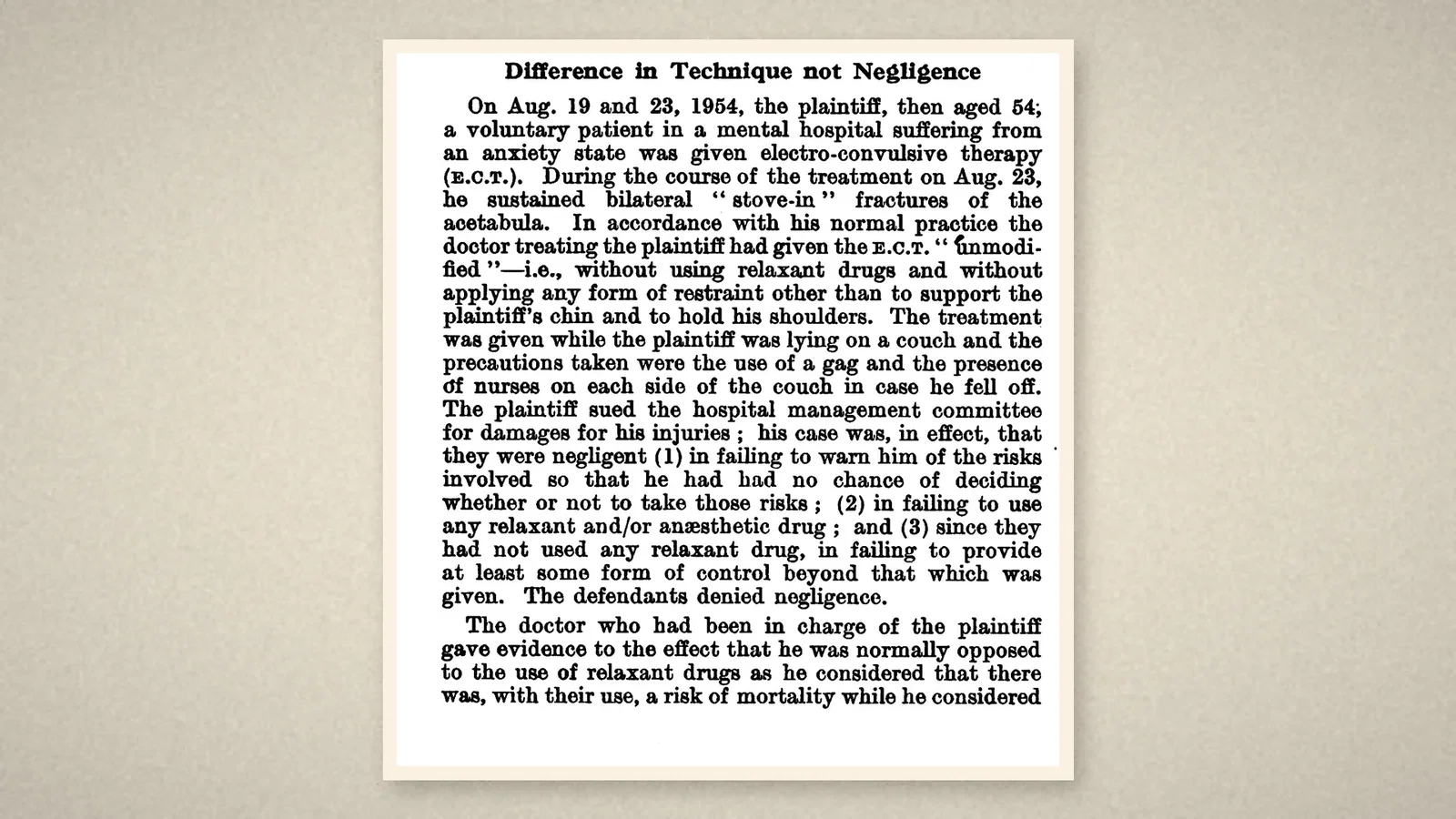
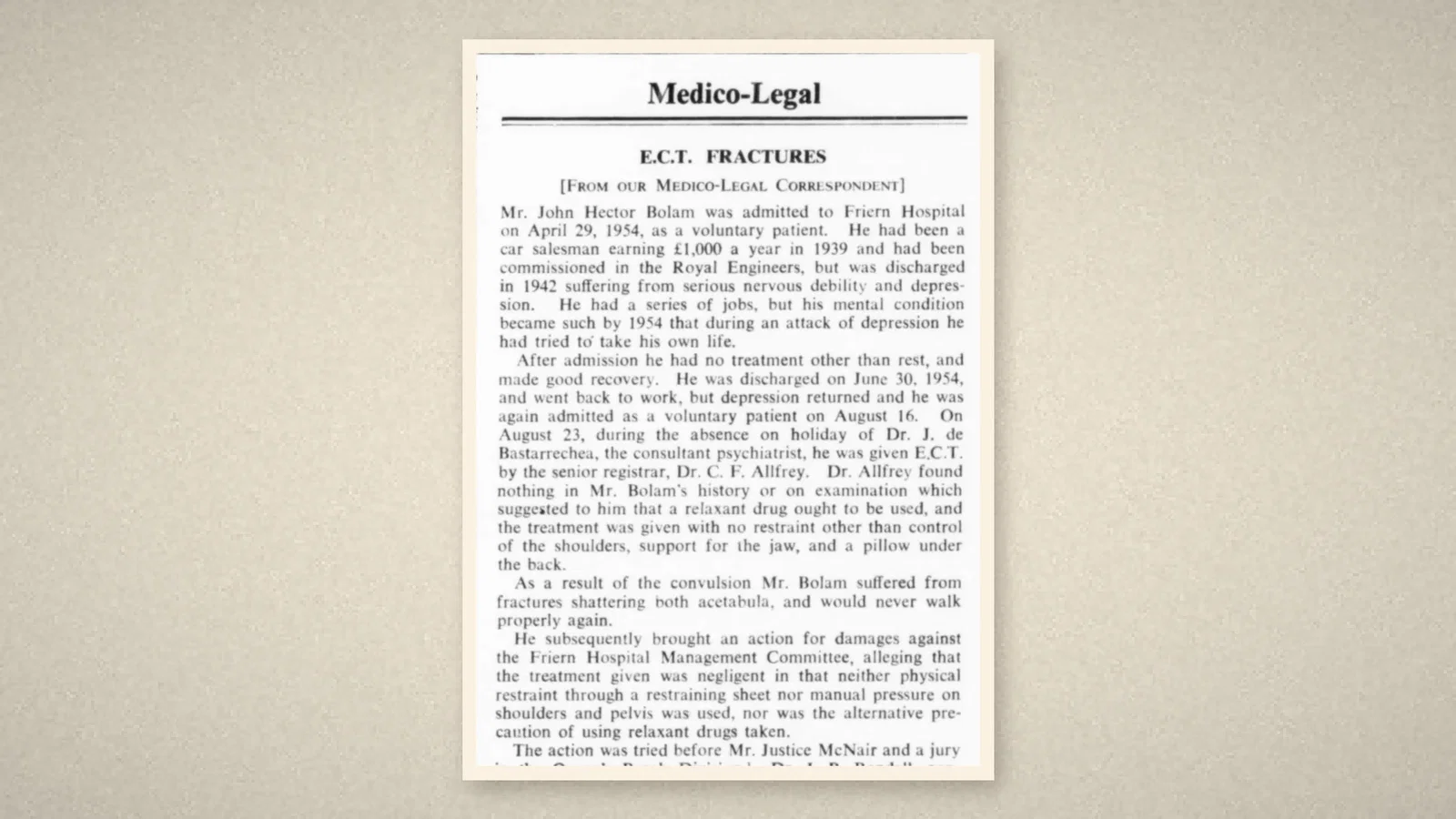
According to the BMJ's medico-legal correspondent, Mr John Hector Bolam was admitted to Friern Hospital "on April 29, 1954, as a voluntary patient" with depression. Discharged, he was readmitted in August. On 23 August, while the consultant was on holiday, the senior registrar, Dr C. F. Allfrey, gave him ECT. [1, p. 591] Dr Allfrey found nothing in the history or on examination "which suggested to him that a relaxant drug ought to be used". The treatment was given "with no restraint other than control of the shoulders, support for the jaw, and a pillow under the back". The convulsion caused "fractures shattering both acetabula", and the patient "would never walk properly again". [1, p. 591]
The Lancet described the same treatment as "unmodified". It was given without relaxant drugs and without restraint beyond supporting the chin and holding the shoulders, with a gag and a nurse on each side of the couch. [2, p. 524] The claim against the hospital management committee had three parts: failing to warn of the risks; failing "to use any relaxant and/or anaesthetic drug"; and, having used no relaxant, failing to provide any further control. [2, p. 524]
Relaxants on trial
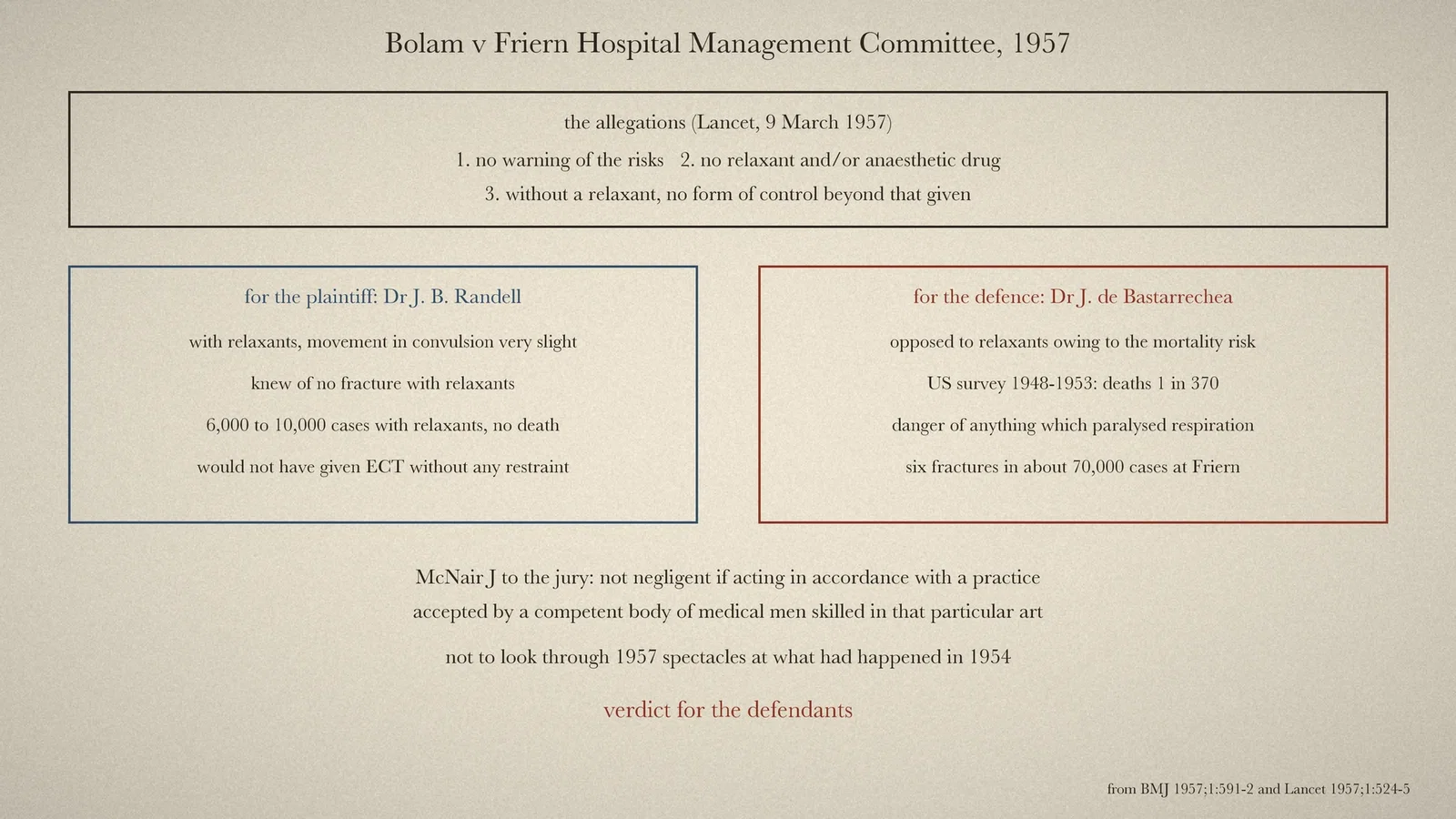
The medical evidence was an argument about relaxants. For the plaintiff, Dr J. B. Randell said that "when relaxants were used the movement in convulsion was very slight" and knew of no fracture with them. Relaxants had not been common in ECT "until 1946 or 1947", and the early drugs were "dangerous and unpredictable". [1, p. 591] In cross-examination Randell agreed that there were "real dangers in the use of relaxant drugs coupled with anaesthetics, which should be used in conjunction with them". Even so, there had never been a death in the 6,000 to 10,000 cases in which Randell had used them. Randell also accepted that a large body of opinion thought it wiser to give ECT without relaxants. [1, p. 591]
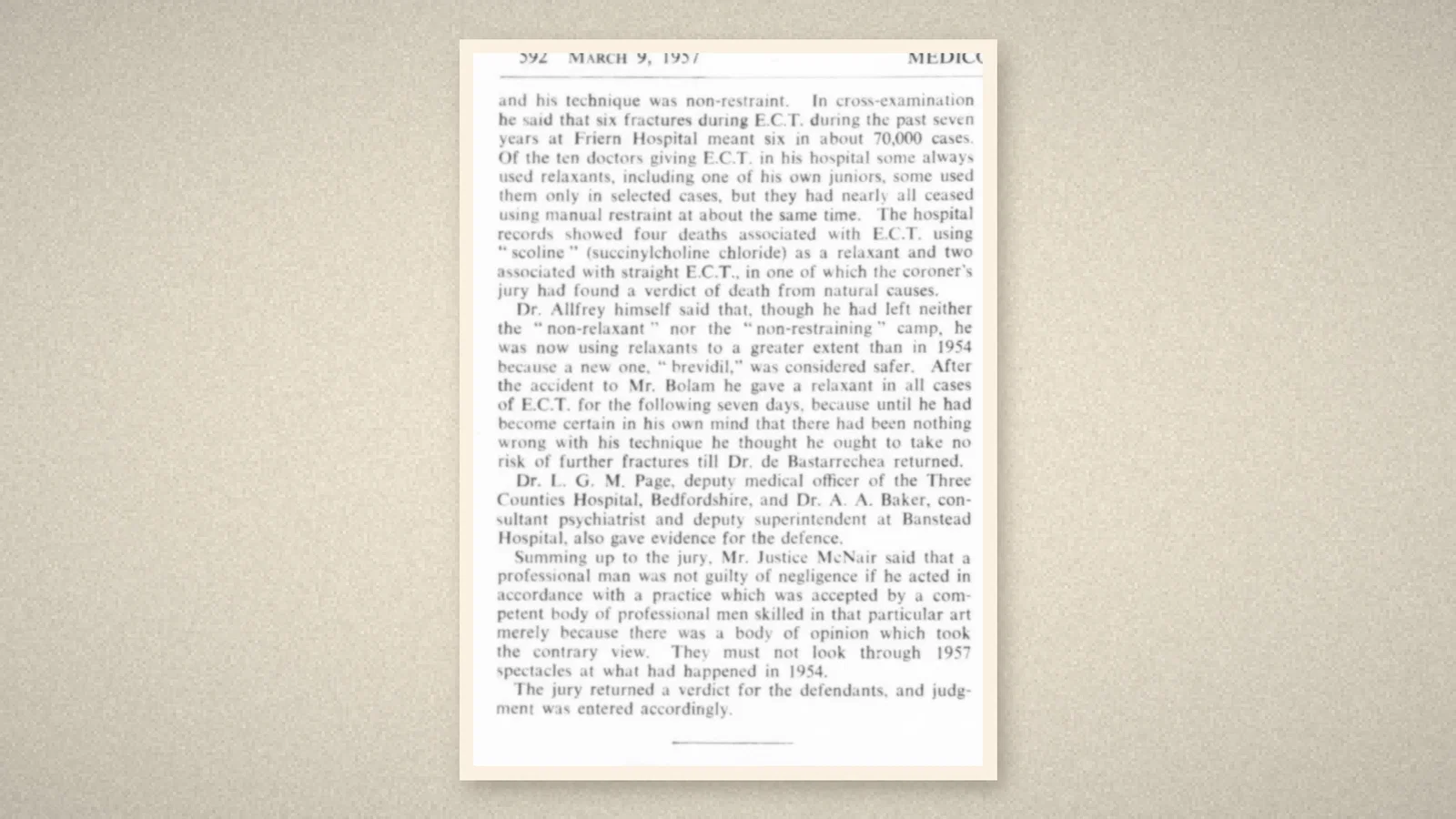
For the defence, the consultant, Dr J. de Bastarrechea, was "opposed to the use of relaxant drugs in E.C.T. owing to the mortality risk". The consultant cited an American survey of 1948-1953 showing deaths "at the rate of 1 in 370", and spoke of "the danger involved in the use of anything which paralysed respiration". [1, p. 591] Six fractures in seven years at Friern meant "six in about 70,000 cases". The hospital's records showed four deaths with ECT using scoline (suxamethonium) as a relaxant and two with straight ECT. [1, p. 592] Dr Allfrey was now using relaxants more, because a new one, "brevidil", was considered safer. After the accident Allfrey had given a relaxant in every ECT for seven days, until certain that nothing had been wrong with the technique. [1, p. 592]
The direction to the jury
Summing up, Mr Justice McNair told the jury, in the Lancet's account, to remember the "enormous benefits" of ECT, and that there might be no settled technique on which all competent doctors agreed. Where opinion differed, "a doctor was not negligent if he acted in accordance with a practice accepted by a competent body of medical men skilled in that particular art". That did not mean that a doctor could "obstinately and pig-headedly carry on with some old technique" proved contrary to "substantially the whole body of medical opinion". [2, p. 524] On the warning, the jury might think that a doctor treating a mentally ill patient, who believed ECT to be the only hope, should not be criticised for not stressing dangers believed minimal. [2, p. 524] In the BMJ's version, the jury "must not look through 1957 spectacles at what had happened in 1954". [1, p. 592] "The jury found for the defendants." [2, p. 525]
Afterwards
The Australian Society of Anaesthetists' timeline lists the "Bolam principle in English Tort Law" under 1957. It describes the case as "ECT without muscle relaxants or restraints resulting in significant skeletal fractures". It also quotes Lord Scarman's later summary in Sidaway (1985) that "the standard of care is a matter of medical judgment", and points forward to Rogers v Whitaker in 1992. [3, PDF p. 64]
What the record shows
The test that bears the patient's name came from a dispute between doctors who feared fractures more and doctors who feared paralysing respiration more. The disputed drugs were a relaxant and the anaesthetic it needed. The judge did not settle which camp was right, and told the jury that belonging to either was not negligence.
Sources and reading limits
Read: the BMJ report "E.C.T. Fractures" (9 March 1957, pp. 591-592) and the Lancet report "Difference in Technique not Negligence" (9 March 1957, pp. 524-525), in full; the ASA timeline entry for 1957.
Not covered: the official law reports and a transcript of the summing-up. The judge's words are known here only through the two journals' paraphrases, which differ slightly and are not verbatim. The Times reports on which the BMJ drew were not read, and neither were the later cases the timeline mentions. The Lancet gives ECT on 19 and 23 August 1954 and the patient's age as 54; the BMJ names the doctors and gives the admission dates. Both are reported as they stand.
One illustration is a summary drawn from the two reports; three are crops of their pages.
- E.C.T. fractures [Medico-Legal]. Br Med J. 1957;1(5018):591-2. Internet Archive
- Lamb JF. Difference in technique not negligence [Medicine and the Law]. Lancet. 1957;1:524-5. Internet Archive
- Australian Society of Anaesthetists. Anaesthesia History Timeline. 2024. PDF
Continue exploring
Related reading connects shared questions and contexts; it does not by itself establish historical influence.
Anesthesia Epochs · The Source Room · About & Editorial Method
Published November 2, 2026. Sources and reading limits are stated above. Illustrations are labelled as original source images or AI-made. Historical accounts are educational; they are not current treatment instructions.