The 'Insufficient anaesthesia' correspondence in the BMJ, January-March 1950: one case of awareness and seven doctors' replies.
Reading Library · Anesthesia Epochs · 中文版
Watch the education video (for clinicians)
1950: Awareness Under Curare — Winterbottom's Letters · Anesthesia Epochs Education Series
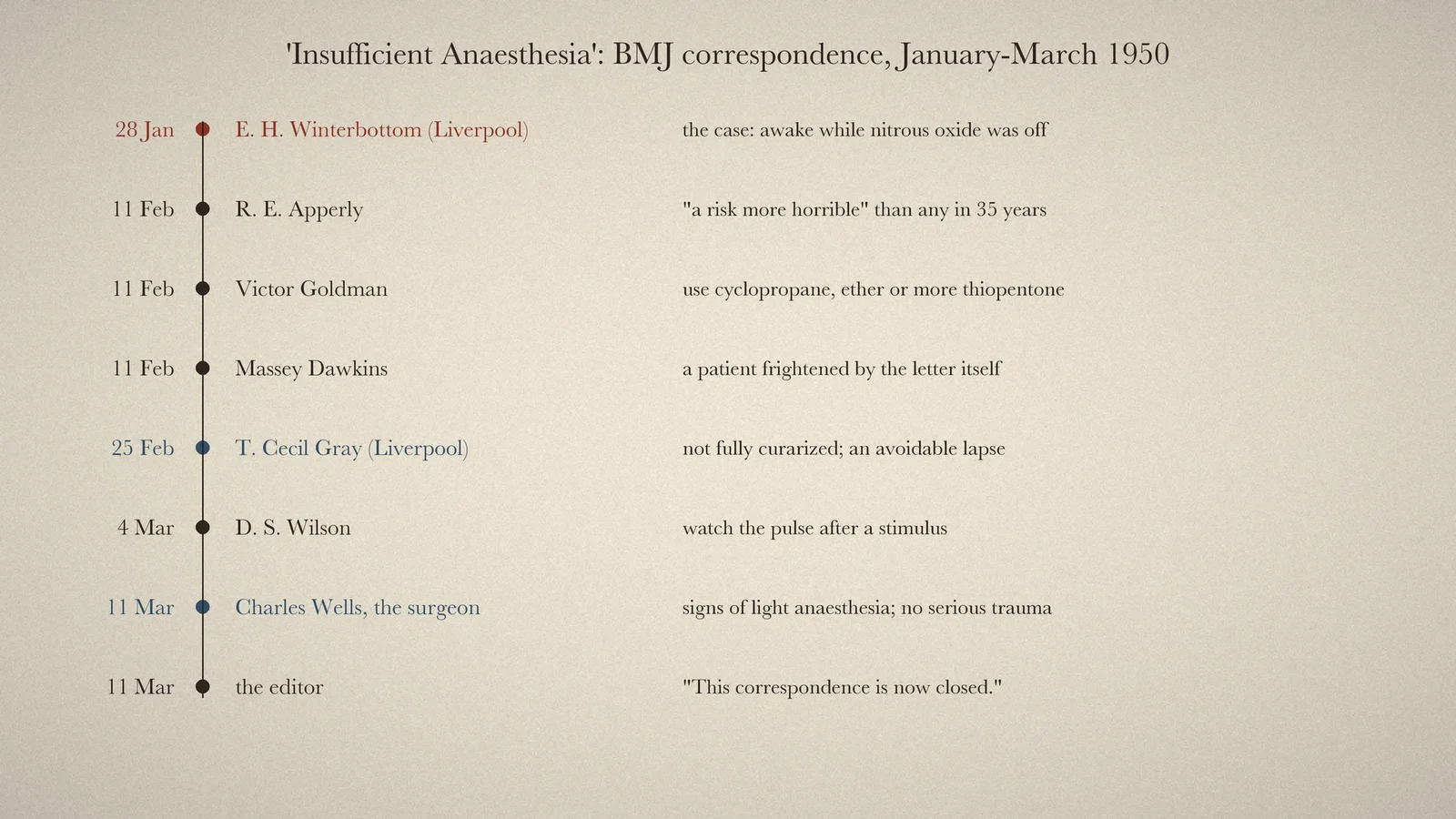
By January 1950, a Liverpool anaesthetist wrote, long abdominal operations were commonly done with heavy curarization and very light anaesthesia. In a letter to the British Medical Journal that month the same anaesthetist reported what the technique could cost when the anaesthesia became too light. For six weeks other doctors answered, and the letters show anaesthetists arguing in public about a paralysed patient who had been awake.
The case
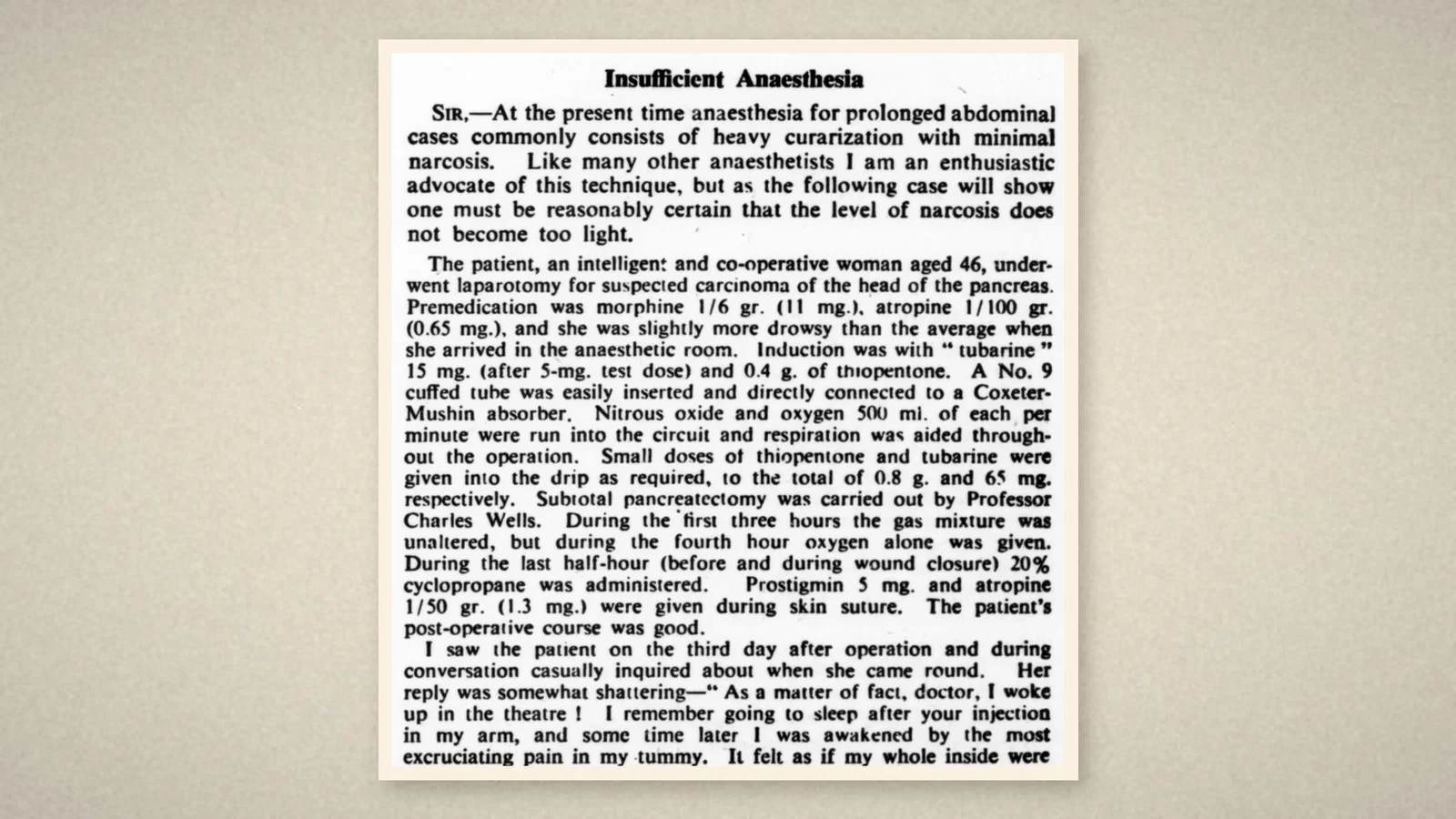
E. H. Winterbottom began with the method: "At the present time anaesthesia for prolonged abdominal cases commonly consists of heavy curarization with minimal narcosis." Winterbottom was an enthusiast for it, but warned that one must be reasonably certain the level of narcosis did not become too light. [1, p. 247] The patient was "an intelligent and co-operative woman aged 46", undergoing laparotomy for suspected carcinoma of the head of the pancreas. After morphine and atropine, she was induced with tubocurarine ("tubarine") and thiopentone, intubated, and connected to a closed absorber with equal flows of nitrous oxide and oxygen; respiration was assisted throughout, and small further doses of both drugs were given. Professor Charles Wells performed a subtotal pancreatectomy. During the first three hours the gas mixture was unchanged, but "during the fourth hour oxygen alone was given"; cyclopropane was given in the last half-hour. [1, p. 247]
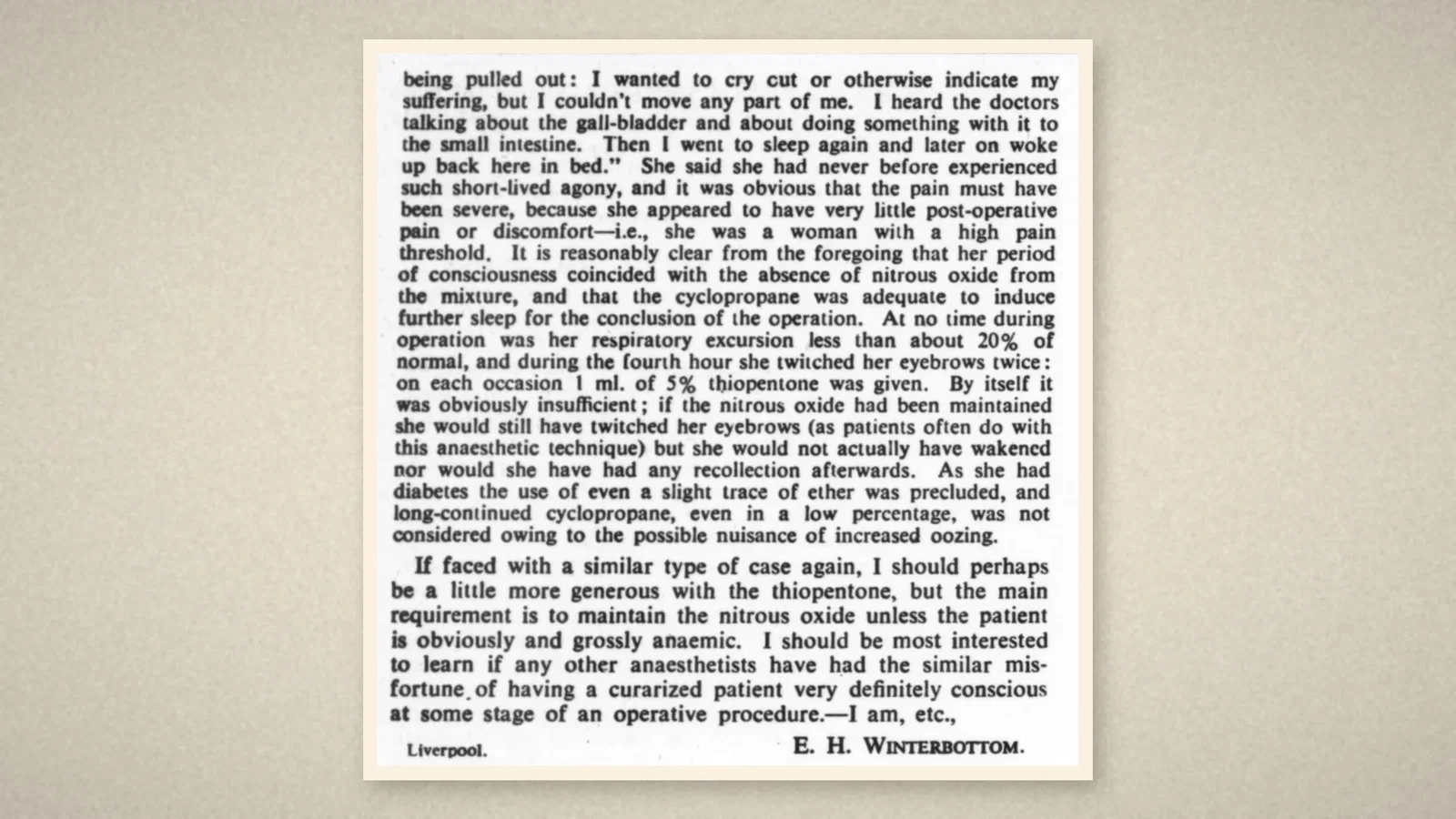
On the third day Winterbottom asked her casually when she had come round. Her reply: "As a matter of fact, doctor, I woke up in the theatre!" She had been woken by "the most excruciating pain in my tummy"; she wanted to cry out, "but I couldn't move any part of me", and heard the doctors talking about the gall-bladder. [1, p. 247-248] Winterbottom concluded that her period of consciousness coincided with the absence of nitrous oxide, and that cyclopropane had put her to sleep again. Her respiratory excursion had never fallen below about 20% of normal, and twice in the fourth hour she twitched her eyebrows and was given a small dose of thiopentone, which was "obviously insufficient". The main requirement, Winterbottom wrote, was "to maintain the nitrous oxide", and the letter ended by asking whether others had had "a curarized patient very definitely conscious" during an operation. [1, p. 248]
The replies
On 11 February three letters appeared. R. E. Apperly of Painswick had asked anaesthetist friends for three years about this possibility and "always been answered that such a condition could not arise"; it was, Apperly wrote, a risk "more horrible to contemplate than any I can recall" in 35 years of practice. [2, p. 373] Victor Goldman of London argued that with tidal air greatly reduced, nitrous oxide and oxygen could not maintain adequate oxygenation, and kept patients asleep with cyclopropane, ether or repeated thiopentone. [2, p. 373] Massey Dawkins of London reported a side effect of the letter itself: a patient due for hysterectomy had read it and was so frightened that the anaesthetist had to give "the most solemn promise that curare would not be used". Curare, Dawkins wrote, "may smooth the furrow" but "does not eliminate the agony". [2, p. 374]
On 25 February T. Cecil Gray, Winterbottom's Liverpool colleague, objected that the patient was not "fully curarized"; at the time she was aware she was moving enough for the surgeon to ask the anaesthetist to do something about it. "Stop the anaesthetic and the patient will wake up," Gray wrote; in "well over two thousand administrations" of the technique nothing like this had been seen, and the incident should not jeopardise it. [3, p. 487-488] On 4 March D. S. Wilson of Londonderry wrote that adequate curarization and adequate anaesthesia were "entirely separate" things, and suggested watching for a rise in pulse rate after a stimulus as a sign of light anaesthesia in the curarized patient. [4, p. 548]
The surgeon closes it
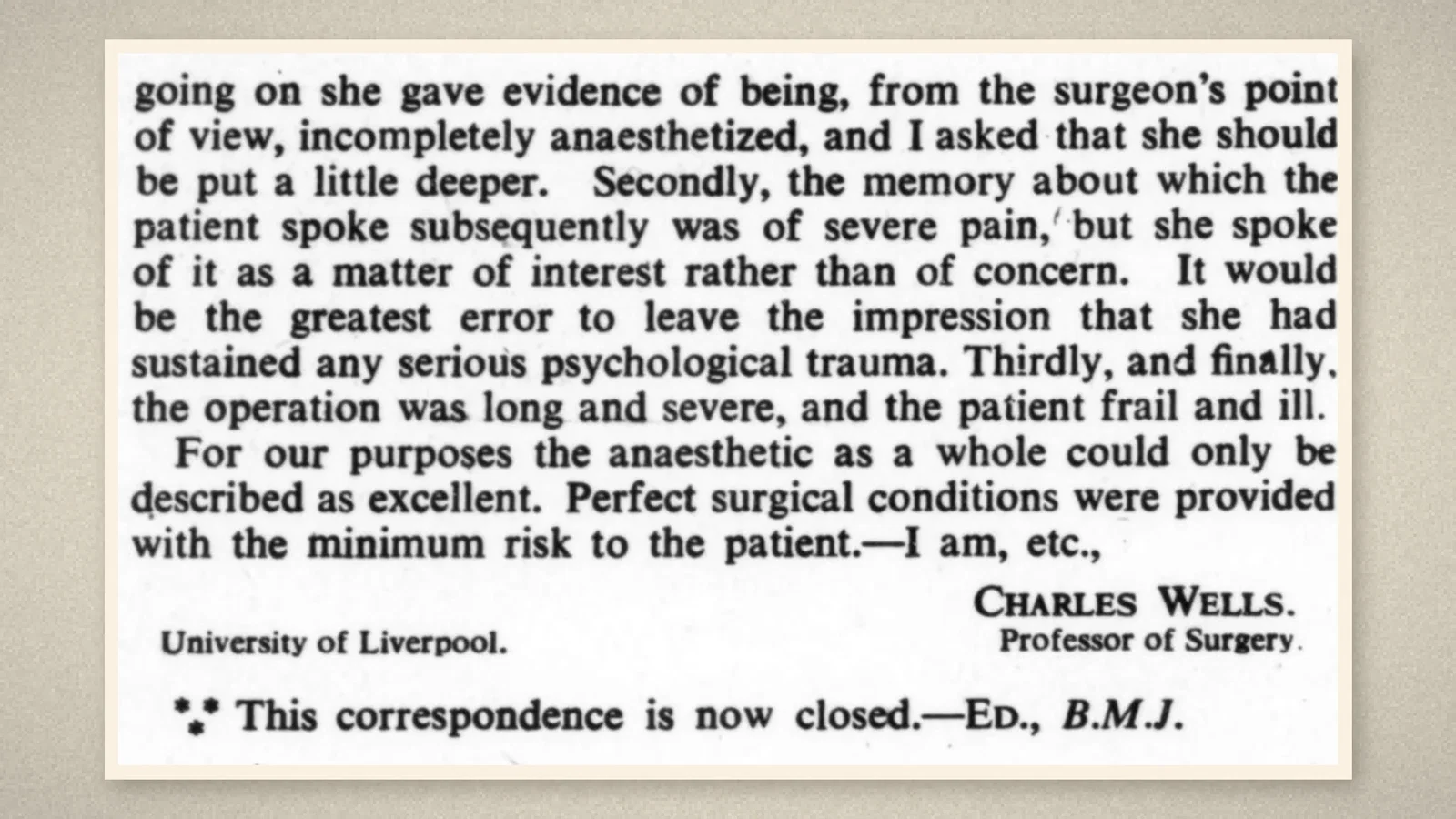
On 11 March the surgeon wrote. Charles Wells, professor of surgery at Liverpool, said that when the patient became aware she had shown signs of being "incompletely anaesthetized", and that the surgeon had asked for her to be put deeper; she had spoken of the pain afterwards as a matter of interest rather than concern, and it would be wrong to suggest she had "sustained any serious psychological trauma". For the operation as a whole, the anaesthetic had been excellent. An editor's note followed: "This correspondence is now closed." [5, p. 610]
What the record shows
One patient's sentence started the discussion. The replies set out the positions that would shape later debate: that a paralysed patient could be awake without anyone knowing; that the remedy was more anaesthetic, not less relaxant; that signs other than movement were needed; and that a valuable technique should not be abandoned for one avoidable lapse. The letters also record a fear that spread beyond the profession as soon as patients read about it.
Sources and reading limits
Read: the BMJ correspondence "Insufficient Anaesthesia" of 28 January, 11 February, 25 February, 4 March and 11 March 1950.
Not covered: two other letters printed on 11 March and a second letter of 25 February were read only in passing and are not described. Massey Dawkins's earlier communication cited in the letter, and later studies of awareness, were not read. The case is known only from Winterbottom's letter and Wells's reply, which differ in emphasis; both are reported. No correspondent gave any figure for how often awareness occurred, and none is given here. Drug doses in the letters are not repeated.
One illustration is drawn from the letters; three are crops of BMJ pages.
- Winterbottom EH. Insufficient anaesthesia [letter]. Br Med J. 1950;1(4647):247-8. Internet Archive
- Apperly RE; Goldman V; Massey Dawkins. Insufficient anaesthesia [letters]. Br Med J. 1950;1(4649):373-4. Internet Archive
- Gray TC, et al. Insufficient anaesthesia [letters]. Br Med J. 1950;1(4651):487-8. Internet Archive
- Wilson DS. Insufficient anaesthesia [letter]. Br Med J. 1950;1(4652):548. Internet Archive
- Wells C. Insufficient anaesthesia [letter]. Br Med J. 1950;1(4653):610. Internet Archive
Continue exploring
Related reading connects shared questions and contexts; it does not by itself establish historical influence.
- 1940–1952: From Curare to Succinylcholine in Convulsive Therapy
- 1949: Decamethonium and Gallamine Tried in Man
Anesthesia Epochs · The Source Room · About & Editorial Method
Published November 2, 2026. Sources and reading limits are stated above. Illustrations are labelled as original source images or AI-made. Historical accounts are educational; they are not current treatment instructions.