Forty years after anaesthetists gained a Faculty inside the Royal College of Surgeons of England, they became a 'College within a College' in 1988; refused Royal status until it separated completely, the College bought its own house in 1992 and received a Royal Charter.
Reading Library · Anesthesia Epochs · 中文版
Watch the education video (for clinicians)
1972–1993: The College of Anaesthetists — Leaving the Surgeons · Anesthesia Epochs Education Series
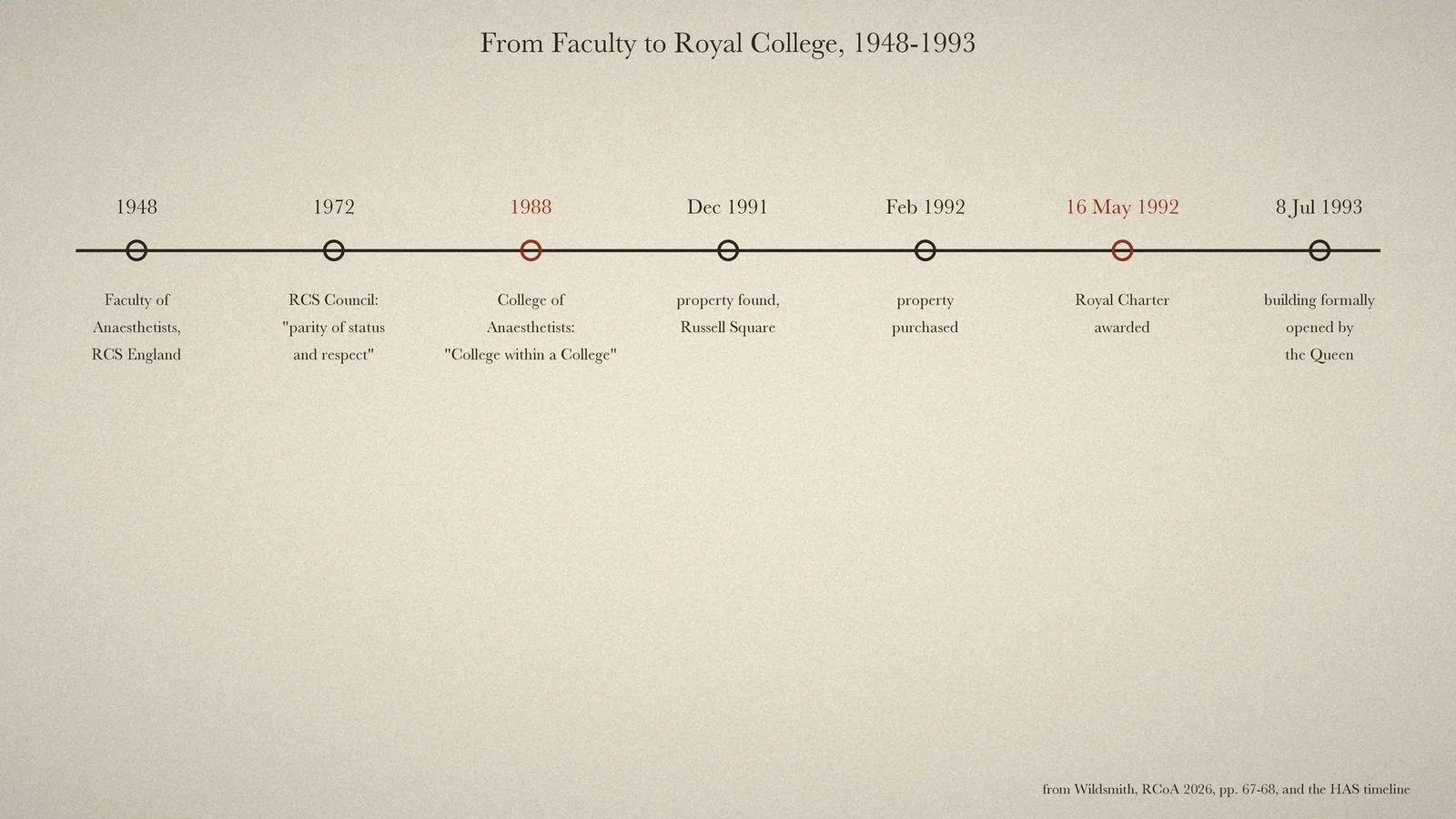
The History of Anaesthesia Society's timeline records under 1988: "College of Anaesthetists is founded replacing the Faculty of Anaesthetists of the Royal College of Surgeons of England. A Royal Charter was granted in 1992." [4] An earlier article in this series covers the founding of that Faculty in 1948. This one follows how, four decades later, British anaesthetists left the surgeons' college. The main source is a 2026 history written for the Royal College of Anaesthetists (RCoA) by J. A. W. Wildsmith, a former Honorary Archivist of the College. [1, p. 1]
Parity on paper
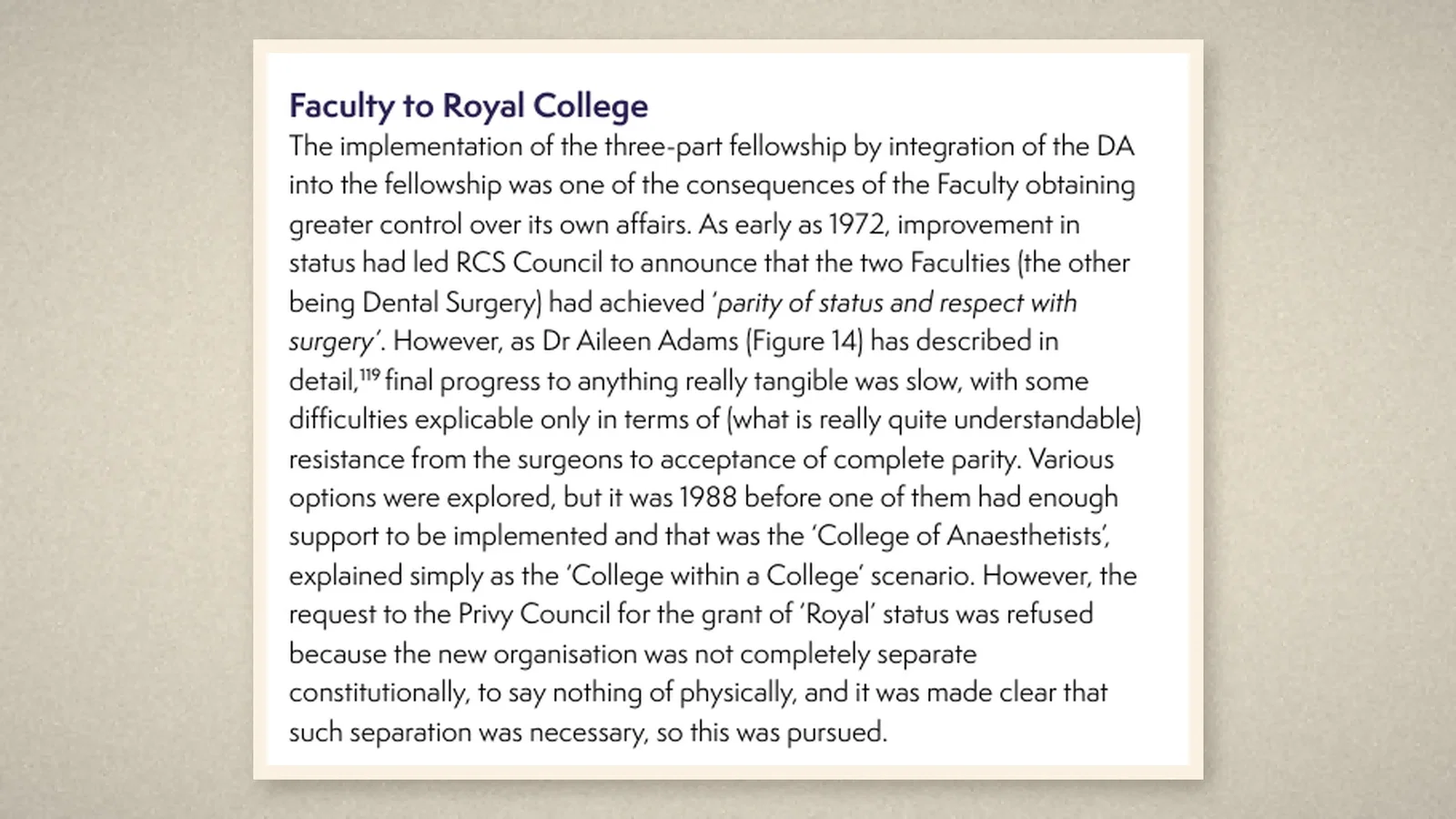
Wildsmith begins the section "Faculty to Royal College" in 1972. In that year, according to Wildsmith, improved status had led the council of the Royal College of Surgeons (RCS) to announce that its two Faculties, anaesthesia and dental surgery, had achieved "parity of status and respect with surgery". [1, p. 67] Progress towards anything "really tangible" was slow, however. Wildsmith puts some difficulties down to the "really quite understandable" resistance of surgeons to complete parity. [1, p. 67] Wildsmith refers readers to the detailed account by Aileen Adams. [1, p. 67] Adams, Dean of the Faculty in 1985 and later Honorary Archivist and Curator of the College, published "From Faculty to Royal College" in the Annals of the Royal College of Surgeons of England in 1998, at the Faculty's golden jubilee. [2, 3] That article could not be read for this article.
1988: a college inside a college
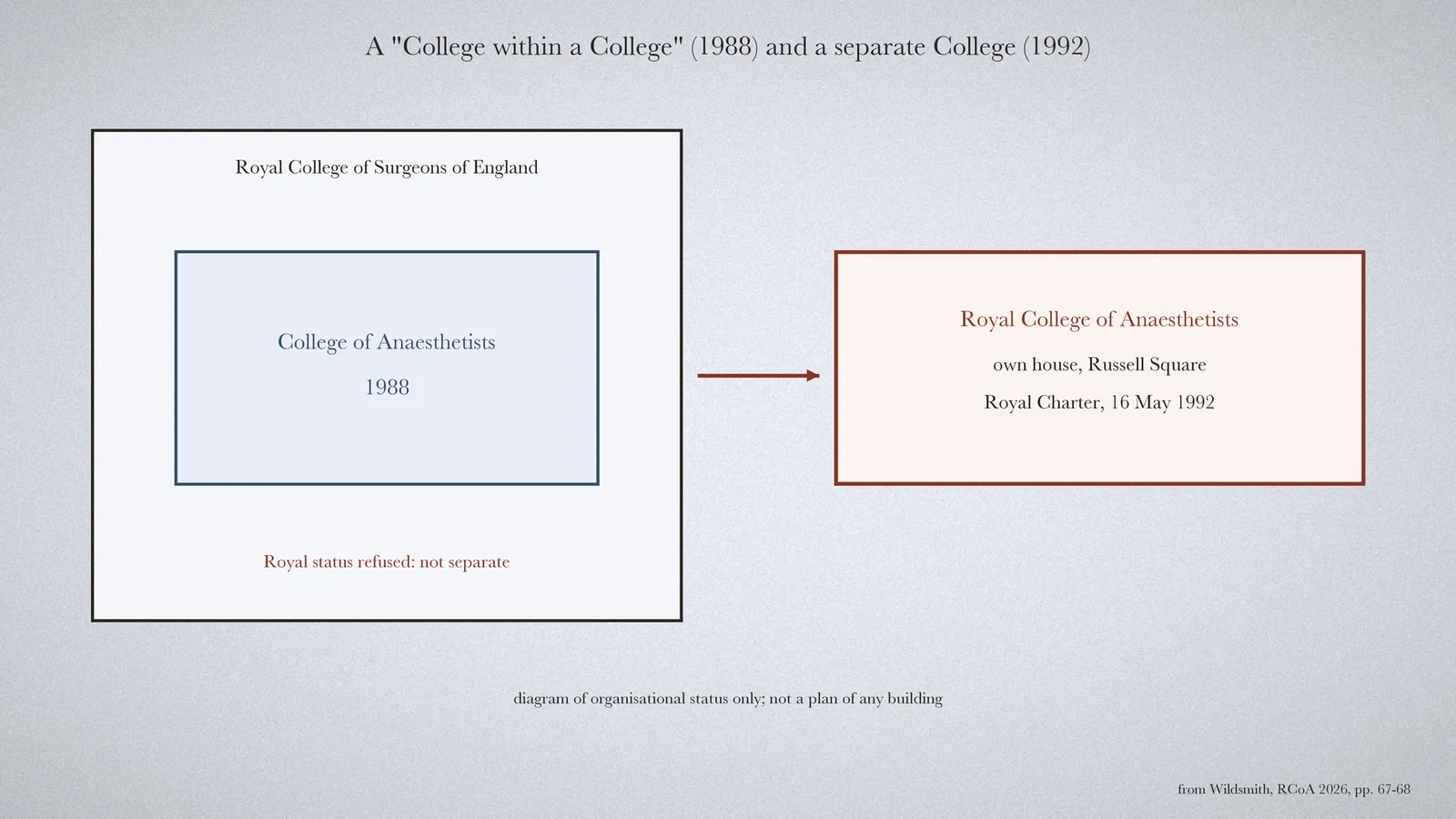
"Various options were explored, but it was 1988 before one of them had enough support to be implemented." That option was the "College of Anaesthetists", "explained simply as the 'College within a College' scenario". [1, p. 67] It did not settle the question. The new College asked the Privy Council for "Royal" status, and the request was refused because the organisation "was not completely separate constitutionally, to say nothing of physically". The College was told that such separation was necessary, and set about achieving it. [1, p. 67]
1991-1993: a house and a charter
Late in December 1991 a property was found in Russell Square, London. It was bought in February 1992, a new "Royal" charter was awarded on 16 May, and the new premises opened on 5 October. [1, pp. 67-68] On 8 July 1993 Queen Elizabeth II formally opened the building. In Wildsmith's words, "anaesthesia in the UK was, at last, a fully independent specialty". [1, p. 68] As the College grew it later needed more space and moved to a second home in Red Lion Square, London. [1, p. 68]
For the Diploma in Anaesthetics, the subject of Wildsmith's book, neither change of status made any difference: the people, the regulations and the postnominal letters stayed the same. [1, p. 68] The book's own chronology puts the end of the Faculty in 1993, when it was "replaced by fully independent Royal College of Anaesthetists". [1, p. 11] Depending on the source, then, the independent College dates from 1988, from the charter of 1992, or from the opening of its building in 1993.
The arms
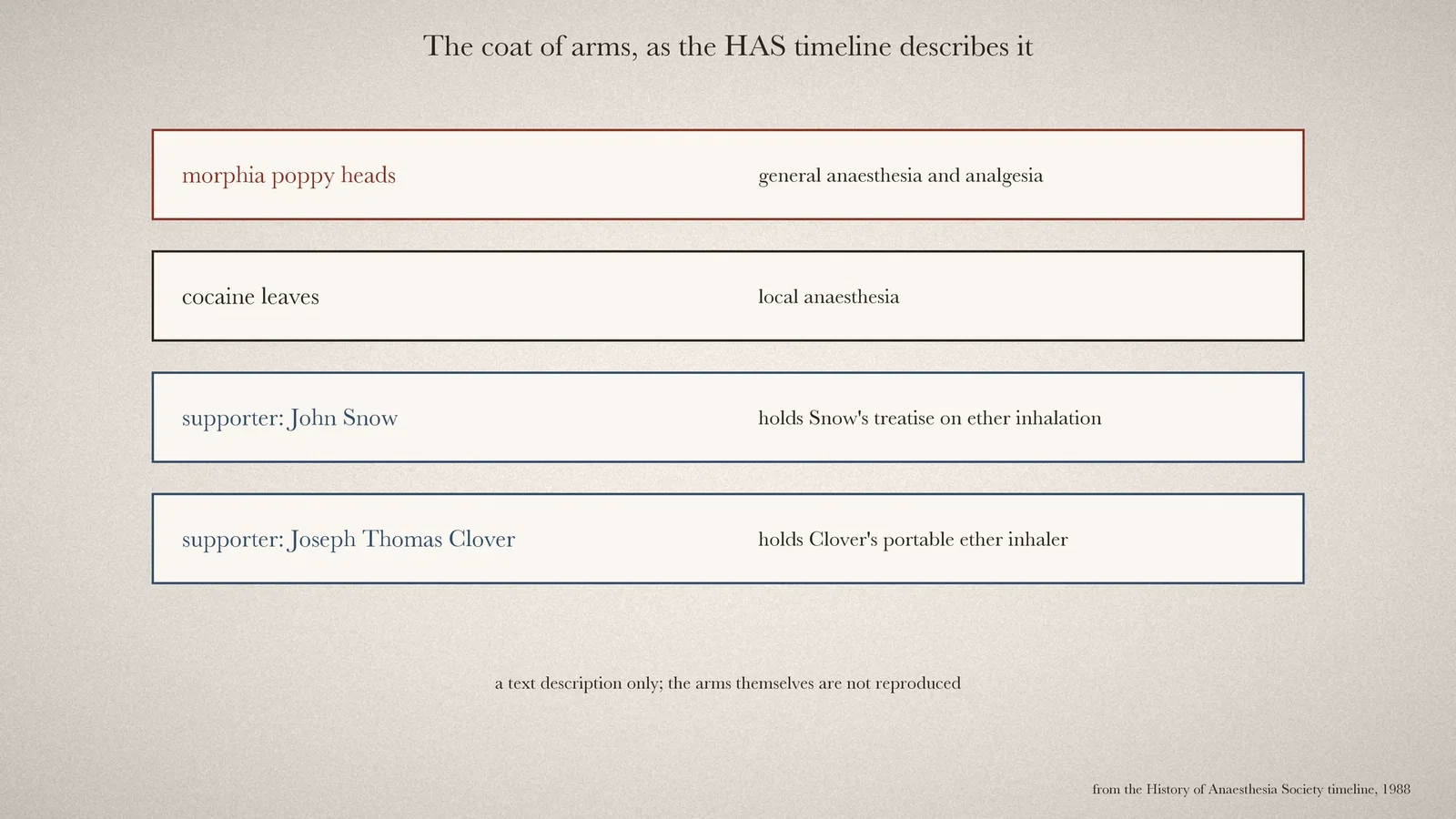
The HAS timeline describes the coat of arms of the Royal College of Anaesthetists. It shows "morphia poppy heads to symbolise general anaesthesia and analgesia" and "cocaine leaves to represent local anaesthesia". Its supporters are John Snow, holding Snow's early treatise on ether inhalation, and Joseph Thomas Clover, holding Clover's portable ether inhaler. [4]
What the record shows
The Faculty created in 1948 gave anaesthetists an examination and a place in the surgeons' college. The College of 1988 gave them a name, but not independence. Royal status came only after the anaesthetists separated completely, with their own constitution and their own building. The two steps, in 1988 and 1992, show that for a specialty, equal status meant having an institution of its own.
Sources and reading limits
Read: Wildsmith's 2026 RCoA history of the Diploma in Anaesthetics, pp. 67-68 by text and page image, with its chronology (p. 11) and references (p. 80); the HAS timeline; the PubMed records of Adams 1998 (title) and Adams 1996 (author information).
Not covered: Aileen Adams's 1998 article in full, which could not be accessed; the College's heritage web pages, which could not be accessed; the 1988 and 1992 constitutional and Privy Council documents; contemporary reports in the journals. The charter date of 16 May 1992 is Wildsmith's. The coat of arms is described only as the HAS timeline describes it and is not reproduced. Wildsmith's book was obtained from the College's website.
One illustration is a crop of Wildsmith's text, without the portrait beside it; three are drawn from the sources.
- Wildsmith JAW. The UK Diploma in Anaesthetics: A world first in the path to an independent specialty. London: Royal College of Anaesthetists; 2026. PDF
- Adams AK. From Faculty to Royal College. The Golden jubilee of the Faculty of Anaesthetists of the Royal College of Surgeons of England. Ann R Coll Surg Engl. 1998;80(6 Suppl):273-5. PubMed
- Adams AK. The delayed arrival: from Davy (1800) to Morton (1846). J R Soc Med. 1996;89(2):96P-100P. PubMed
- History of Anaesthesia Society. Timeline. Website
Continue exploring
Related reading connects shared questions and contexts; it does not by itself establish historical influence.
Anesthesia Epochs · The Source Room · About & Editorial Method
Published November 2, 2026. Sources and reading limits are stated above. Illustrations are labelled as original source images or AI-made. Historical accounts are educational; they are not current treatment instructions.