A theoretical comparison under spontaneous breathing.
Reading Library · Anesthesia Epochs · 中文版
Watch the education video (for clinicians)
1954: Mapleson's Five Breathing Systems — Cardiff · Anesthesia Epochs Education Series
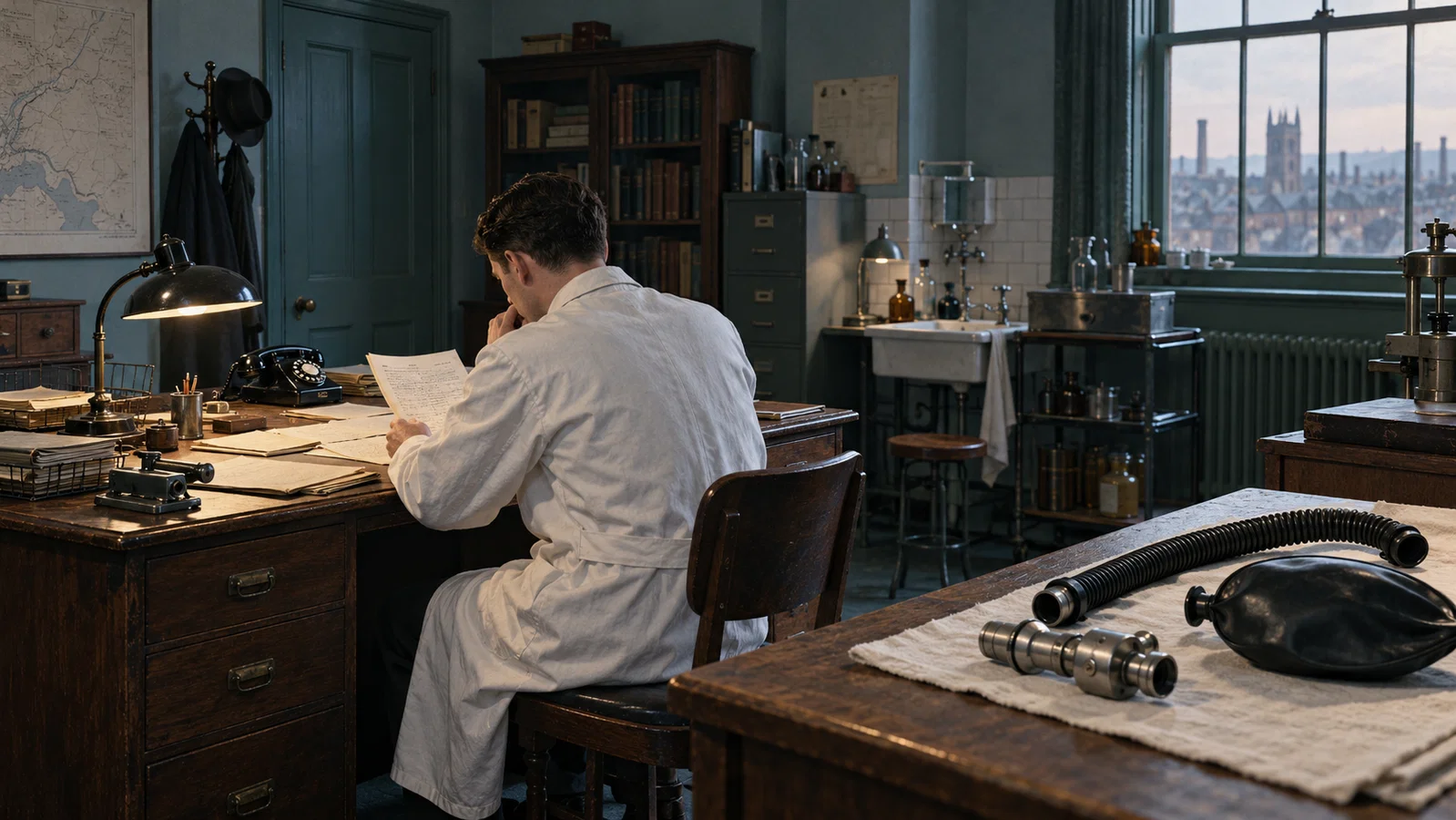
A reservoir bag, a tube, a valve and a supply of fresh gas could be arranged in different ways. How much did their positions matter? William W. Mapleson's 1954 paper made that question the subject of a systematic theoretical analysis. Writing from the Department of Anaesthetics in Cardiff, Mapleson considered five systems, labelled A to E.[1]
The letters did useful work. They allowed arrangements to be compared without treating a familiar name or a similar-looking collection of parts as a sufficient description. They did not mean that Mapleson had invented every system he discussed.
Follow the gas, not just the parts
In the original figure, system A placed its expiratory valve near the patient, with the reservoir bag and fresh-gas supply at the other end of a corrugated tube. System D brought fresh gas close to the patient and placed the bag and valve farther away. System E dispensed with both the reservoir bag and the expiratory valve.[1, pp.323,330]

Those differences changed where expired gas went and what might be drawn back on the next breath. The question was therefore more demanding than whether a circuit was open at one end. Breathing pattern, gas flow and the behavior of its components also mattered.
A drawing is not a measurement
Mapleson began with simplifying assumptions and then examined their limits. His discussion considered gas mixing, valve behavior and departures from an ideal breathing pattern. The second figure makes the status of the work especially clear: its solid line was theoretical, and its broken line was an assumed curve allowing for mixing. He said that rapid continuous gas analysis would be needed to establish the latter's exact form.[1, pp.324–327]
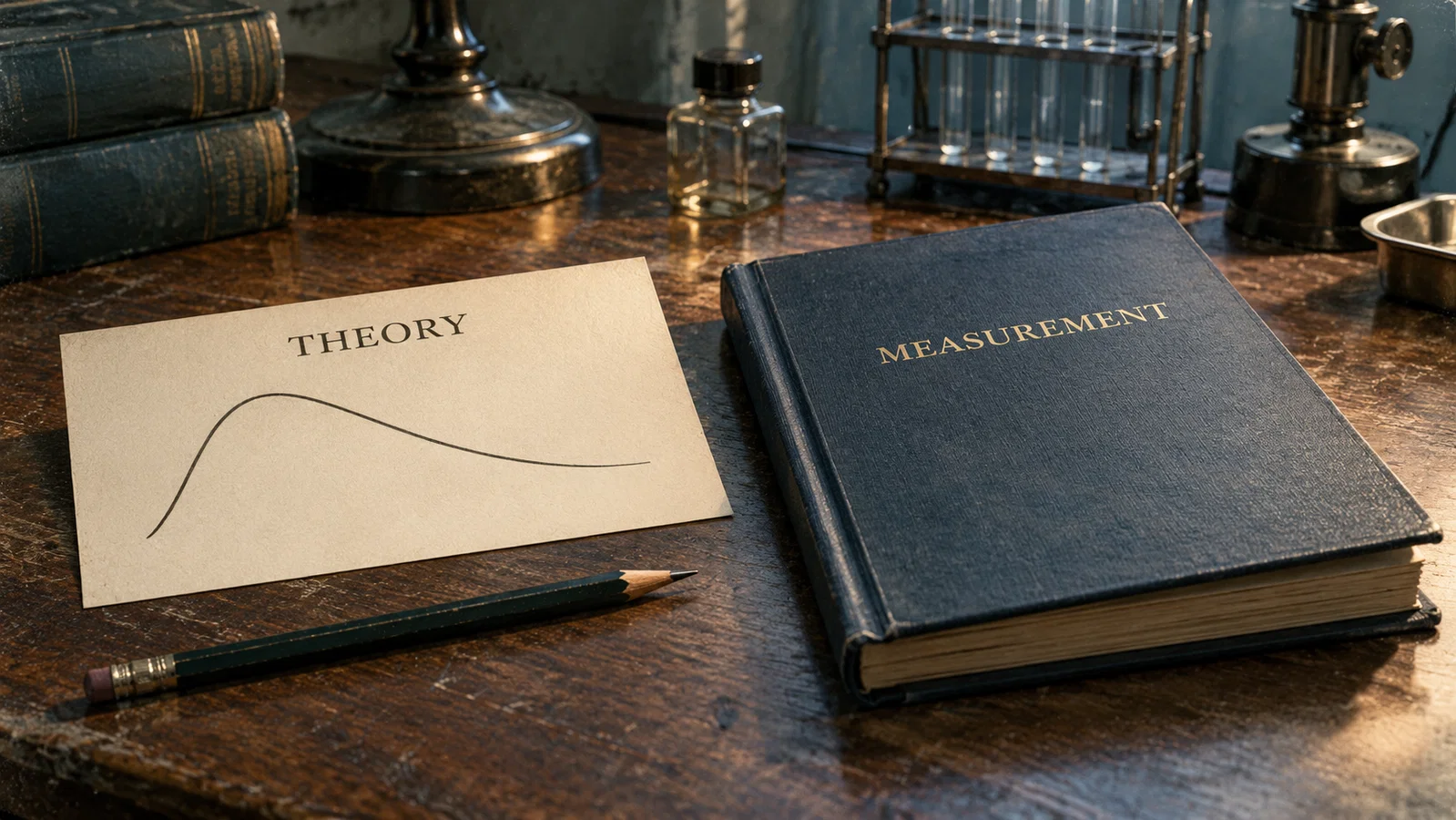
The graph is often easier to remember than its caption. Reading both prevents an attractive diagram from turning into an experiment that was never reported. This paper did not randomly assign patients to five circuits or demonstrate a reduction in mortality.
Economy and resistance
The conclusion distinguished advantages under the spontaneous-breathing conditions discussed: the gas economy of A and the low resistance of E. It did not supply one winner for every purpose or every mode of ventilation.[1, pp.331–332;2] The historical value lies in making the tradeoff explicit. The numerical flow relationships belong to the paper's assumptions and are not presented here as instructions for current practice.
In a later recollection, Mapleson described changes from B to A at Cardiff and placed work on controlled ventilation with Denys Waters in a separate, later investigation. The recollection was signed in August 1987 and published in 1988; neither date is the date of the original classification.[2] An author's memory helps explain how the work was received, while remaining a different kind of evidence from the 1954 analysis.
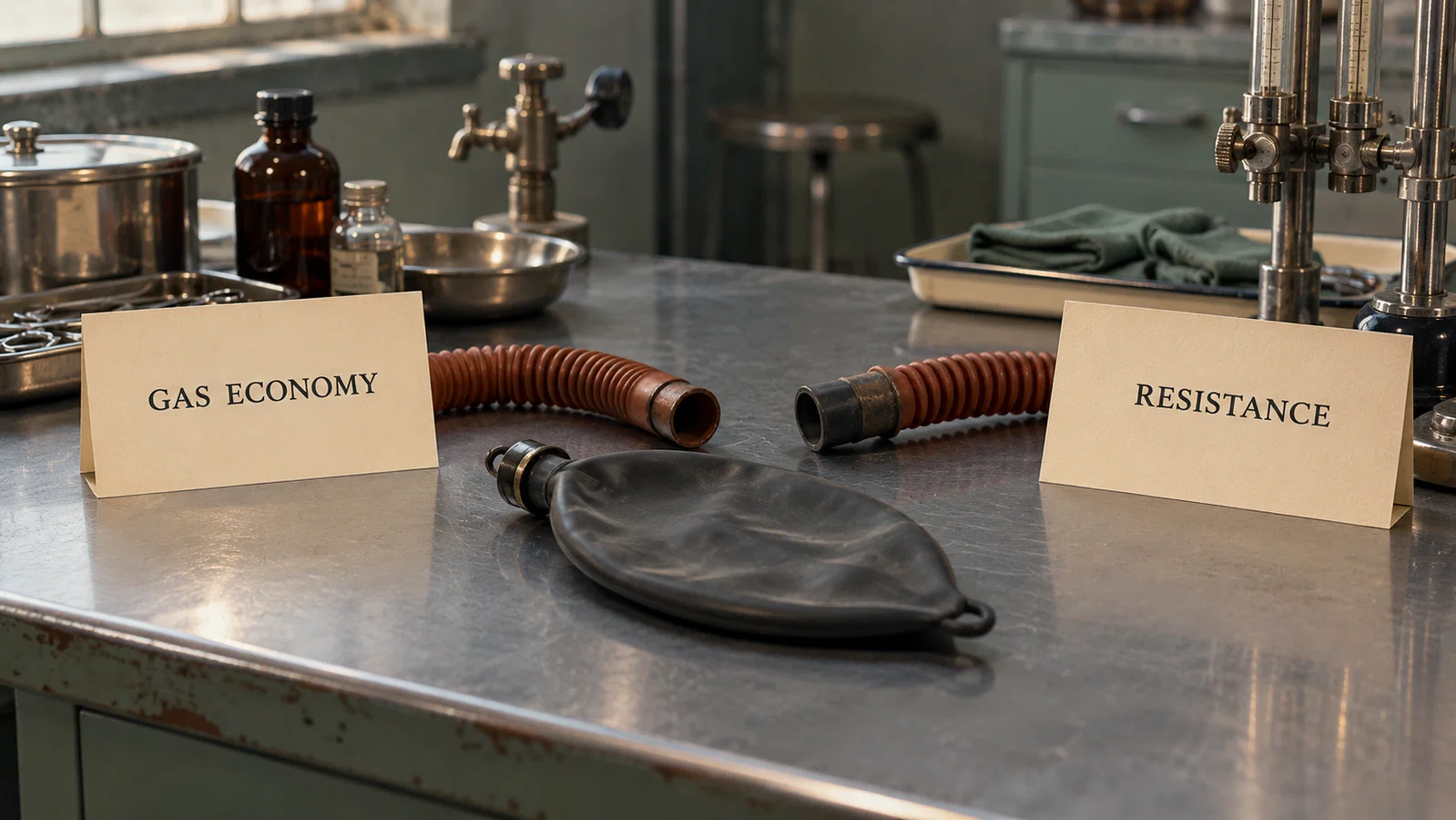
This site's Ayre T-piece article supplies a related engineering question: what does a patient have to breathe through? That is a useful comparison of structures and problems, without turning the two articles into proof of a direct chain of invention. Museum collections also show that later products and modifications have their own histories; they should not be read backward into the five drawings of 1954.[3]
Image note: four AI-generated modern editorial illustrations. People, papers and workspaces are imagined; the letter cards are not operating diagrams, and no pictured curve represents patient data.
Sources and reading limits
- Mapleson WW. The elimination of rebreathing in various semi-closed anaesthetic systems. Br J Anaesth. 1954;26(5):323–332. Publisher record and DOI; public mirror of all ten original pages. Entire article text read; figures 1–2, captions and the D/E page inspected in the original scan. This is theoretical analysis, not a comparative clinical trial.
- Mapleson WW. This Week's Citation Classic, commentary on the 1954 paper. Current Contents. 1988;6:20. Complete one-page commentary, signed August 5, 1987; fully read. Retrospective testimony by the same author, not independent validation.
- Wood Library-Museum. Vital Signs Baby Valve · Archived copy. Museum description read for collection context. Its generalization about expiratory valves does not override the original paper's explicit description of E.
Continue exploring
Related reading connects shared questions and contexts; it does not by itself establish historical influence.
Anesthesia Epochs · The Source Room · About & Editorial Method
Updated October 30, 2026. Sources and reading limits are stated above. Illustrations are labelled as original source images or AI-made. Historical accounts are educational; they are not current treatment instructions.