
In 1897 Mary E. Botsford of San Francisco began to specialize in anesthesia; Botsford trained at least 46 women physicians, became the first faculty anesthetist at the University of California in 1910 and a clinical professor in the early 1930s, and in 1935 published a paper on anesthesia in infant surgery with colleagues’ discussion.
Reading Library · Anesthesia Epochs · 中文版
Watch the companion film
1897: Mary Botsford and Anesthesia Teaching · Watch on YouTube
A 1935 journal article offers a useful way into Mary Botsford's career: not through a ceremonial title, but through a professional conversation.
Botsford’s paper, Anesthesia in Infant Surgery, appeared in the October issue of California and Western Medicine. It was followed by comments from colleagues. Weeks and Delprat raised the surgeon's concern about relaxation; Gelston discussed clinical judgment; Caroline Palmer added a further assessment. The printed exchange preserves distinct voices, not a consensus invented afterward.[4]
Before the title
To understand the career behind that paper, return to 1897. In a 1989 historical study, Selma Harrison Calmes dates Botsford's focus on anesthesia to that year. Afternoon general medical work initially helped support Botsford’s practice. A specialist interest did not instantly supply a secure, exclusively anesthetic job.[1]
Graduation was a different milestone: Calmes, the university memorial and UCSF's institutional history give 1896. Nor does 1897 mark a faculty appointment. Keeping these events apart makes the career more intelligible than compressing them into one founding date.[1–3]
Calmes’s wording on national priority was qualified: Botsford was “probably” the first woman physician anesthetist in America, and almost certainly the first Californian to specialize in anesthesia.[1]
Teaching as a relationship
Calmes traces a network through San Francisco's Children's Hospital: women physicians trained with Botsford and subsequently worked at other hospitals. Calmes counts at least 46 women trained in this way; they were not all colleagues in one department at the same time.[1]
The university's 1939 memorial also singles out the group trained under Botsford’s direction.[2] Teaching, then, is not merely a later label attached to Botsford’s clinical career. It is a relationship that appears in records of how colleagues remembered Botsford and how a historian reconstructed the professional community.
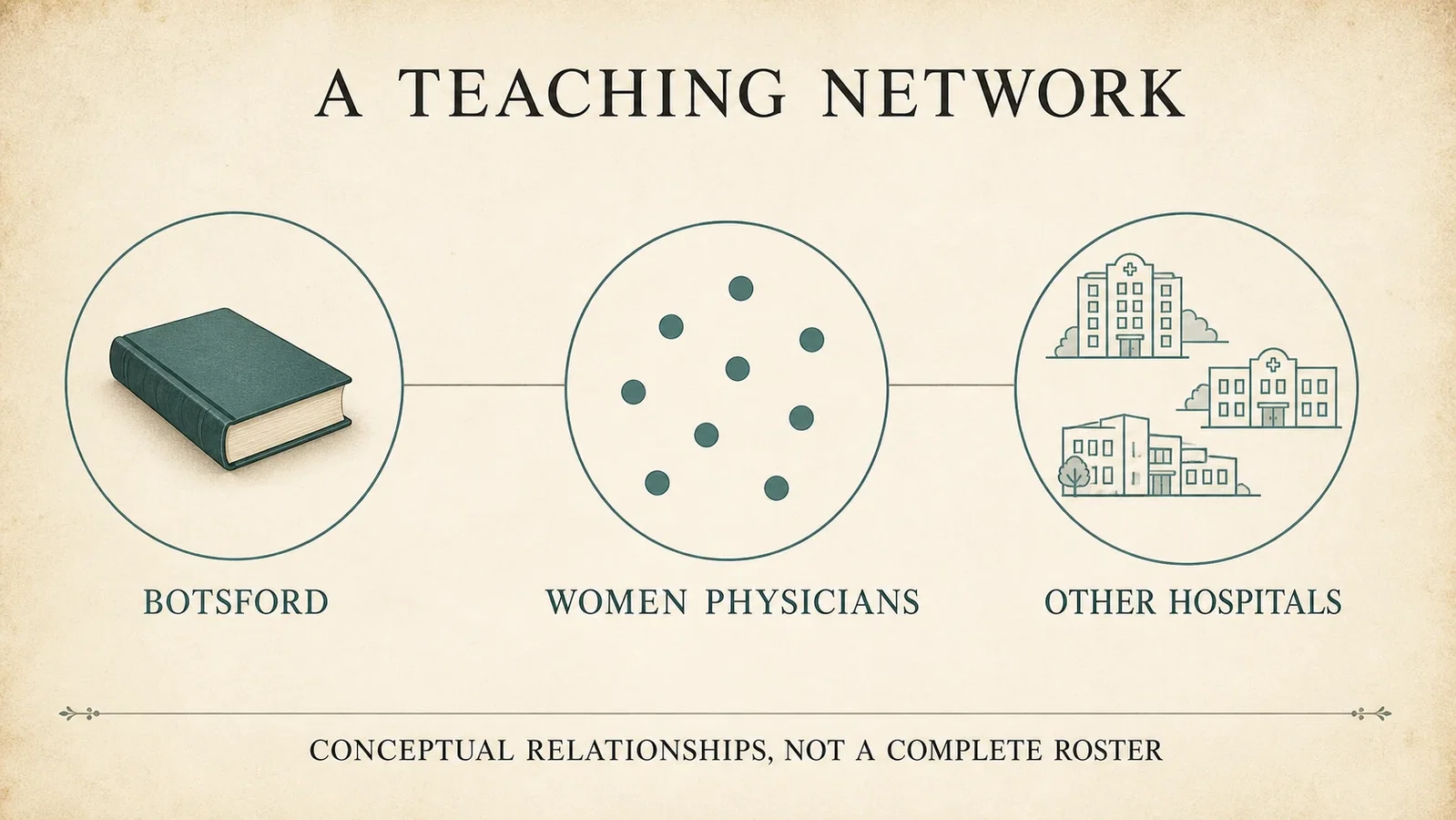
Modern editorial symbols, not a roster, literal hospital architecture or geographical map. The connecting line represents reported relationships, not a measured clinical effect.[1–2]
A memorial and a historical study ask different questions. Neither can isolate how much a teaching network, by itself, changed patient outcomes. Their importance here is documentary: they preserve evidence of training and its place in a professional life.
What institutional recognition does—and does not—date
UCSF's history identifies 1910 as the year Botsford became an assistant in surgery and anesthetist, its first faculty anesthesia position. That priority is institution-specific. Lectures, demonstrations and student teaching should not be confused with the later establishment of a formal local residency, an independent department or today's specialist credentials.[3]
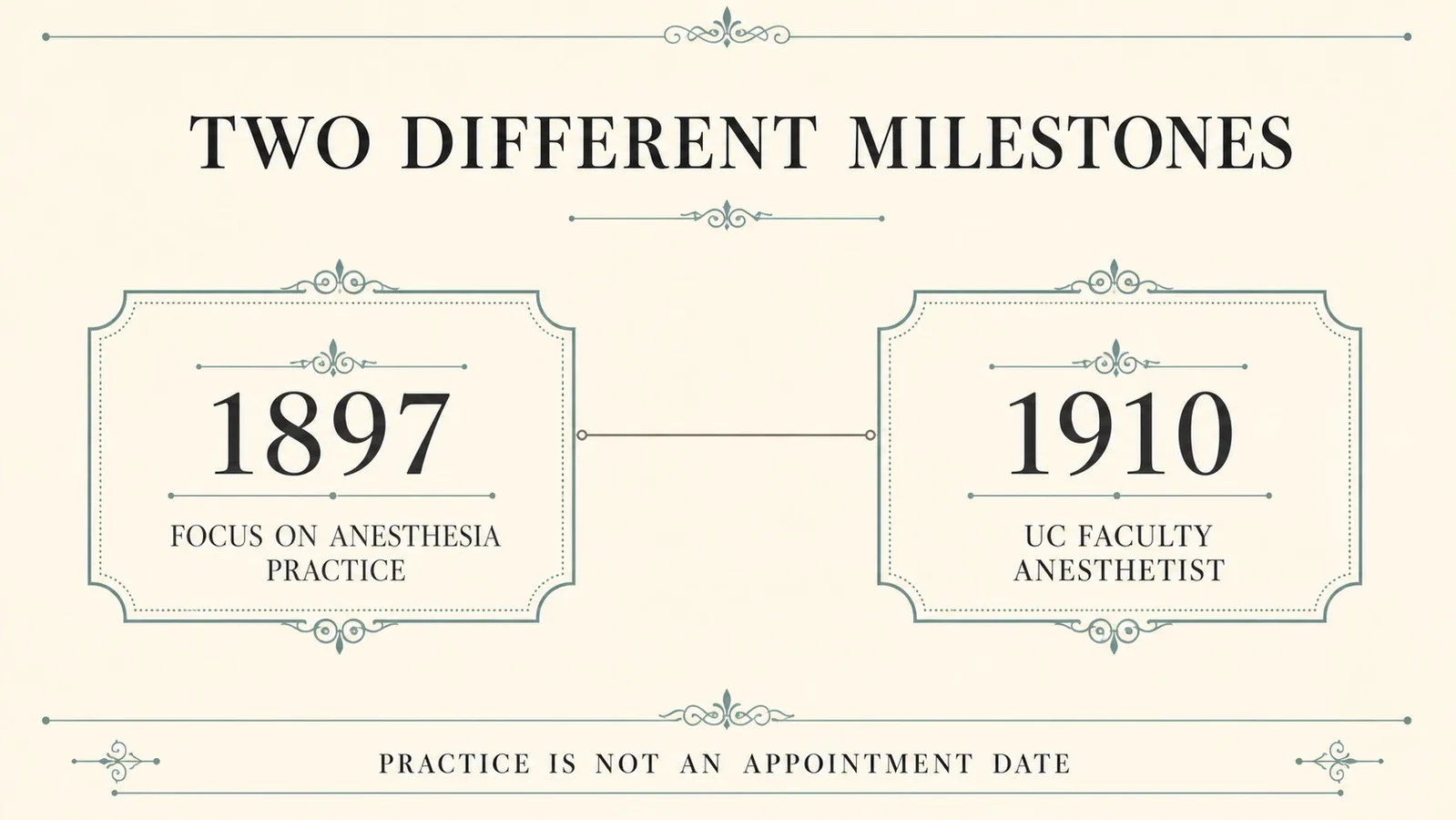
The first year marks a reported focus of practice; the second marks an institutional role. Neither is labeled a graduation date or a national first.[1,3]
Even the professorship has an unresolved date difference. The 1939 memorial says 1931; UCSF's current history says 1932. “The early 1930s” covers both.[2–3]
Returning to the published exchange
The 1935 paper's footnote places its presentation at a California Medical Association meeting held May 13–16, before the October publication. That range does not establish the exact day Botsford spoke.[4]
The clinical recommendations must also remain in their period. Its agents, age limits and physiological explanations belong to 1935, not to present-day practice. Experience reports and favorable comments are not controlled comparisons. They cannot establish that a historical method was universally safe.[4]
Blank pages and speech bubbles are reading aids, not journal facsimiles or three independent studies. Publication of a discussion does not validate every recommendation.[4]
This is a history of work becoming available to other people: through teaching, through colleagues taking their skills elsewhere, and through a paper that readers could discuss. It is a more concrete legacy than a disputed superlative—and one that leaves room to read the evidence critically.
Sources and reading limits
Read: Calmes’s 1989 chapter in full, with its tables; the University of California’s 1939 memorial entry for Botsford; the Botsford entries on UCSF’s History & Innovation page; Botsford’s 1935 paper with its published discussion.
Not covered: the trainee roster behind Calmes’s count of 46; Calmes’s 2014 chapter; the appointment documents, so the 1931 (memorial) and 1932 (UCSF) dates for the professorship both stand. UCSF’s page cites Calmes and is not independent for every detail.
- Calmes SH. The women physician anaesthetists of San Francisco, 1897–1940: the legacy of Dr Mary E Botsford (1865–1939). In: Atkinson RS, Boulton TB, eds. The History of Anaesthesia. 1989:547–550. Four-page chapter.
- University of California. Mary E. Botsford, Anesthesiology: San Francisco. In Memoriam 1939. Institutional digital transcription.
- UCSF. History & Innovation.
- Botsford ME. Anesthesia in Infant Surgery. Cal West Med. 1935 Oct;43(4):271–273. PMID 18743398; PMC record.
Continue exploring
Related reading connects shared questions and contexts; it does not by itself establish historical influence.
Anesthesia Epochs · The Source Room · About & Editorial Method
Sources and reading limits are stated above. Illustrations are labelled as original source images or AI-made. Historical accounts are educational; they are not current treatment instructions.