
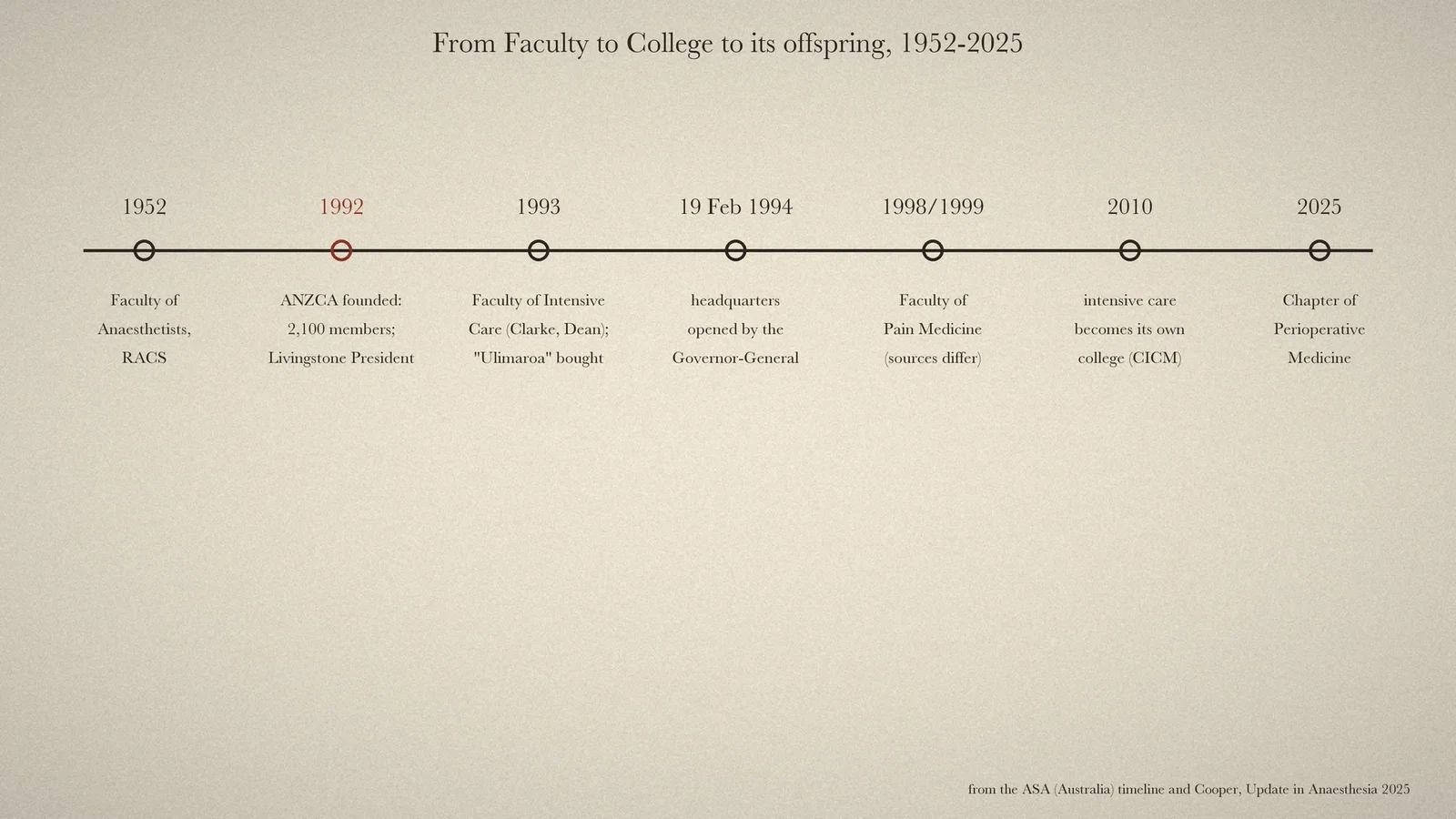
After forty years as a Faculty of the Royal Australasian College of Surgeons, the anaesthetists of Australia and New Zealand formed their own college in 1992, with 2,100 founding members, a faculty of intensive care and, from 1994, a headquarters in Melbourne.
Reading Library · Anesthesia Epochs · 中文版
Watch the education video (for clinicians)
1992: ANZCA — Anaesthetists Leave the College of Surgeons · Anesthesia Epochs Education Series
The New Zealand Society of Anaesthetists' history page sums up 1992 in one line: the Australian and New Zealand College of Anaesthetists (ANZCA) "formed, after 40 years operating under the" Royal Australasian College of Surgeons. [3] An earlier article in this series follows the British anaesthetists who left the Royal College of Surgeons of England in the same years. This one follows their colleagues in Australia and New Zealand, using two histories, the Australian Society of Anaesthetists (ASA) timeline and Michael G. Cooper's 2025 chapter for the World Federation of Societies of Anaesthesiologists (WFSA), and papers published as the change happened. ANZCA's own history pages could not be reached.
From Faculty to College
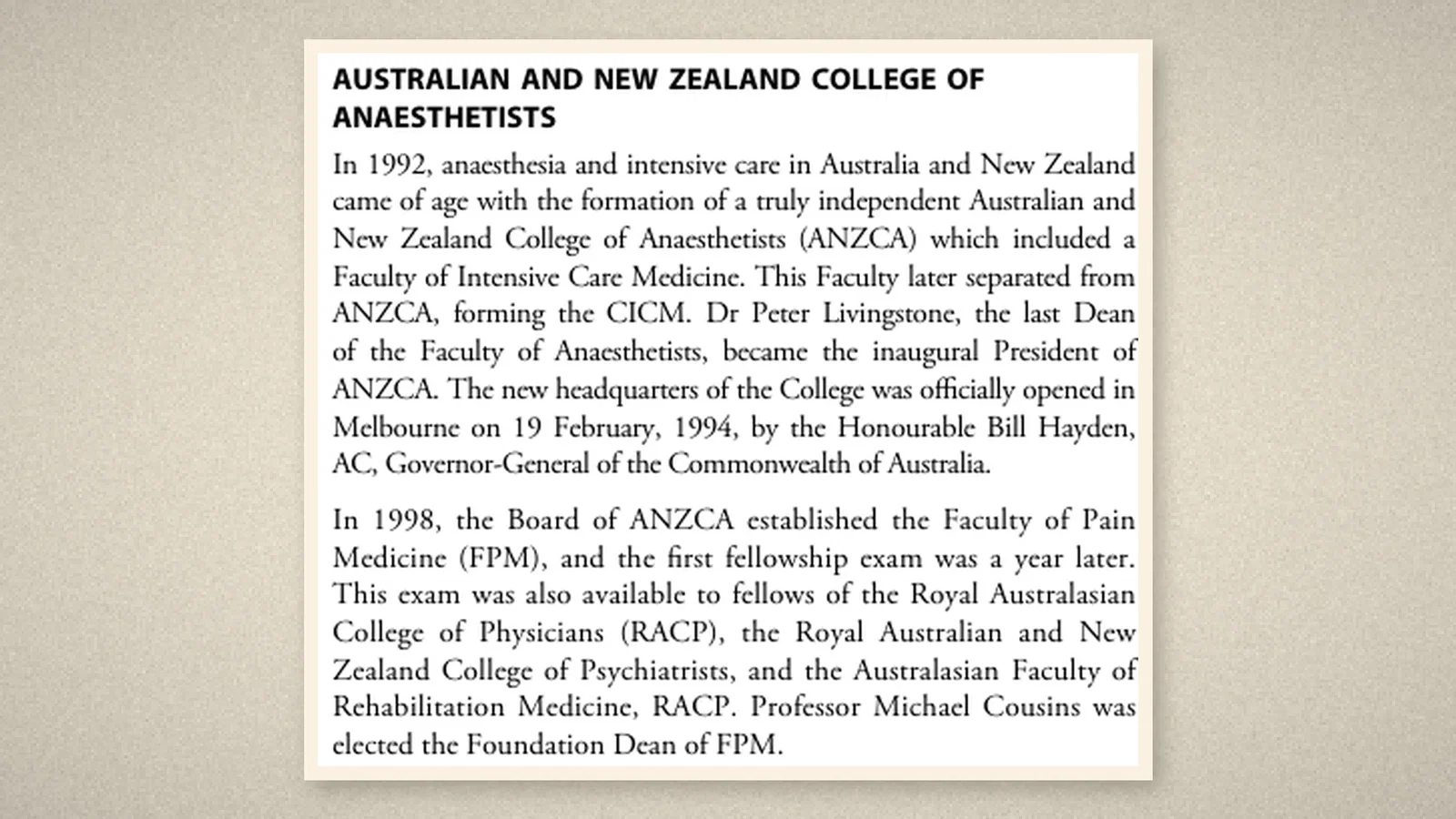
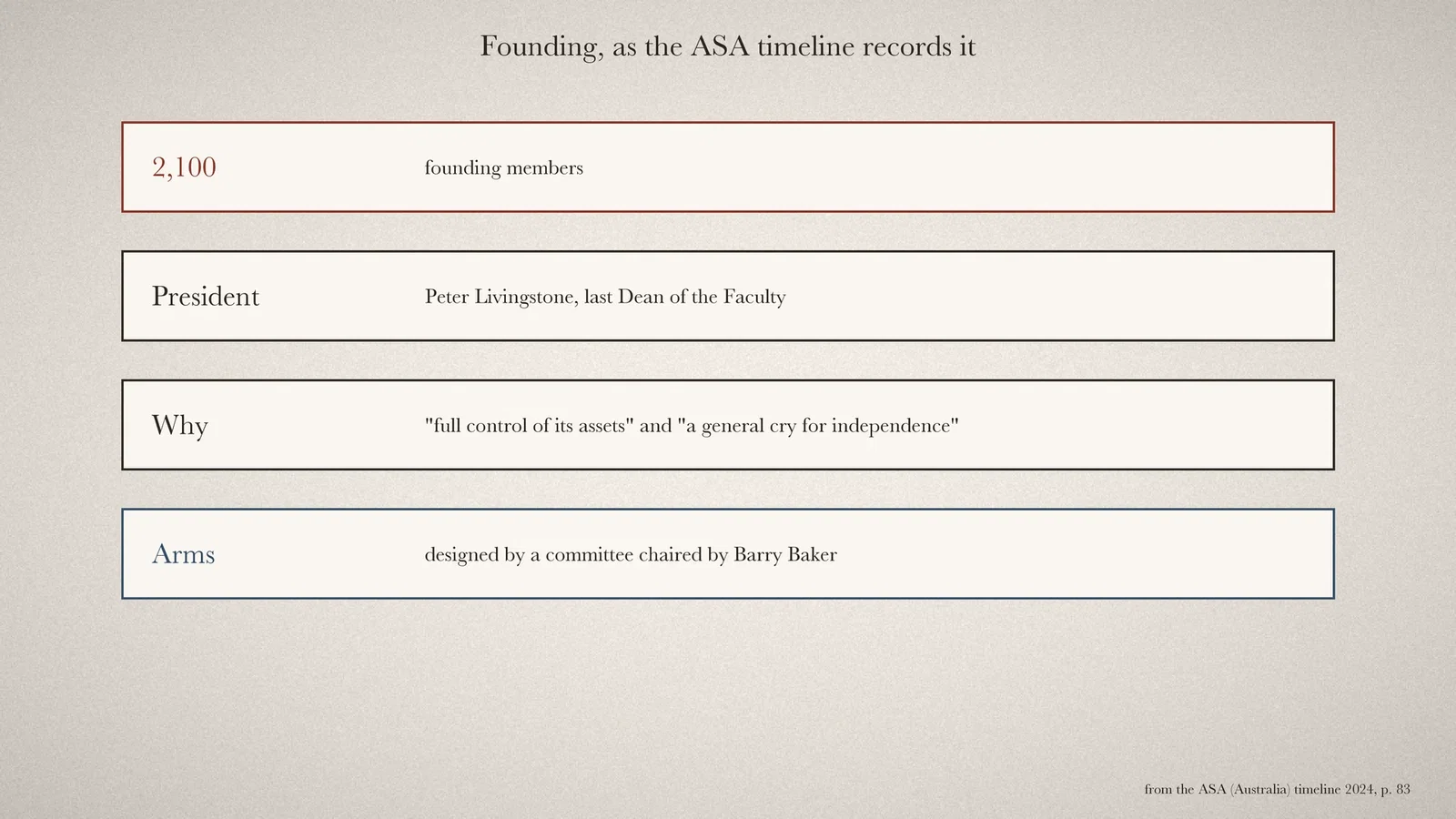
The Faculty of Anaesthetists of the Royal Australasian College of Surgeons was formed in 1952. [2, p. 16] In 1992, in Cooper's words, "anaesthesia and intensive care in Australia and New Zealand came of age with the formation of a truly independent Australian and New Zealand College of Anaesthetists (ANZCA) which included a Faculty of Intensive Care Medicine". Dr Peter Livingstone, the last Dean of the Faculty of Anaesthetists, became the College's first President. [2, p. 18] The ASA timeline adds that the College had 2,100 founding members and that it "was born mostly out of the need to take full control of its assets as well as a general cry for independence". [1, p. 83] Its coat of arms was designed by a committee chaired by Professor Barry Baker, whose members included Livingstone, Dr Peter Jones of the surgeons' college and Joan Sheales, ANZCA's Registrar and chief executive. [1, p. 83]
The change seen in the journal
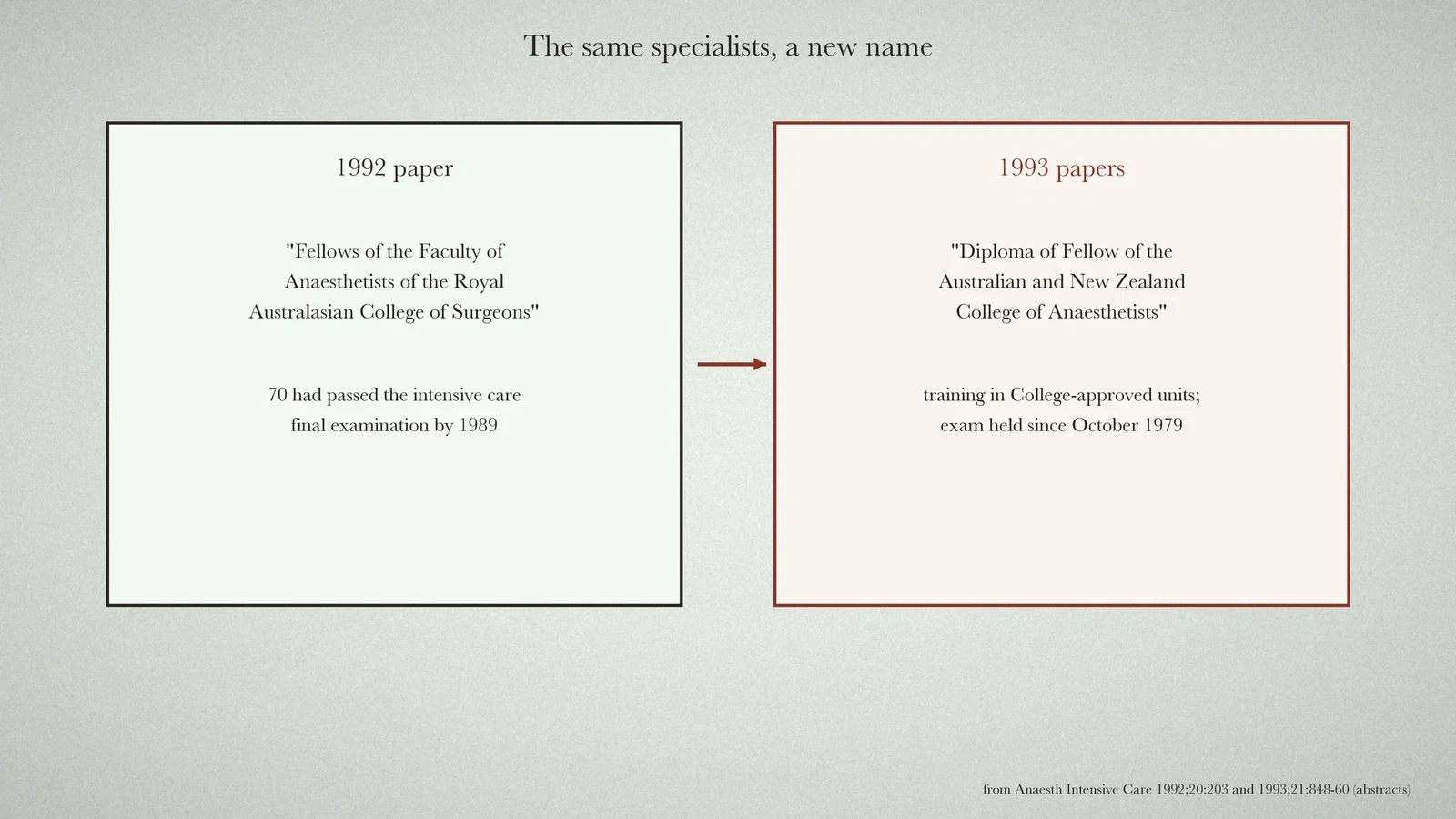
Papers in Anaesthesia and Intensive Care show the change of name. A survey published in May 1992 still described intensive care specialists as "Fellows of the Faculty of Anaesthetists of the Royal Australasian College of Surgeons". Of the 70 Fellows who had passed the Final Examination in Intensive Care by October 1989, 59 replied. [6] In December 1993 two papers described "The Training/Examination Programme in Intensive Care, Australian and New Zealand College of Anaesthetists". Training had to be done in intensive care units approved by the College, and the examination led to the "Diploma of Fellow of the Australian and New Zealand College of Anaesthetists". [4, 5] That examination had been held since October 1979, and by October 1992, 94 of 136 attempts by 107 candidates had succeeded. [5] The new College had inherited a training programme the Faculty had been running for more than a decade.
A house in Melbourne
In 1993 the ASA timeline records that ANZCA founded a Faculty of Intensive Care with Dr Geoffrey Clarke as its first Dean, and bought the historic house "Ulimaroa" in Melbourne for its headquarters. [1, p. 83] The building was officially opened on 19 February 1994 by Bill Hayden, Governor-General of Australia. [2, p. 18] Cooper dates the Faculty of Pain Medicine to 1998, with Professor Michael Cousins as its first Dean. The ASA timeline gives 1999. [2, p. 18; 1, p. 85] The intensive care faculty later separated to form the College of Intensive Care Medicine in 2010, and in 2025 ANZCA established a Chapter of Perioperative Medicine. [2, p. 16]
What the record shows
Within a few years of each other, anaesthetists in Britain and in Australia and New Zealand left the surgeons' colleges that had housed them since the middle of the century. In Australasia the new college took intensive care with it, and pain medicine soon followed. Each later became a specialty with its own faculty or college.
Sources and reading limits
Read: the ASA (Australia) history timeline, pp. 83 and 85 (with a page image of p. 83); Cooper's chapter in Update in Anaesthesia 2025;40, pp. 16 and 18 (with a page image of p. 18); the NZSA history page; the PubMed abstracts of three Anaesthesia and Intensive Care papers from 1992 and 1993.
Not covered: ANZCA's own history pages and Bulletin archive, which refused automated requests; the College's founding documents, the decision of the Faculty Board and the agreement with the Royal Australasian College of Surgeons; the exact date in 1992. The reasons given for independence are the ASA timeline's summary. The Faculty of Pain Medicine is dated 1998 by Cooper and 1999 by the ASA timeline. The NZSA's "40 years" is a round figure for 1952-1992.
One illustration is a crop of Cooper's chapter; three are drawn from the sources. No people or buildings are depicted.
- Australian Society of Anaesthetists. Anaesthesia History Timeline 2024. PDF
- Cooper MG. The development and heritage of anaesthesia in Australia. Update in Anaesthesia. 2025;40:16-. PDF
- New Zealand Society of Anaesthetists. History of anaesthesia. Website
- Clarke GM, Harrison GA. The Training/Examination Programme in Intensive Care, Australian and New Zealand College of Anaesthetists. 1. Training. Anaesth Intensive Care. 1993;21(6):848-53. PubMed
- Harrison GA, Clarke GM. The Training/Examination Programme in Intensive Care, Australian and New Zealand College of Anaesthetists: 2. Examination. Anaesth Intensive Care. 1993;21(6):854-60. PubMed
- Harrison GA, Byth PL. A survey of Fellows of the Faculty of Anaesthetists of the Royal Australasian College of Surgeons endorsed in intensive care by examination in the first 10 years of final examinations in intensive care. Anaesth Intensive Care. 1992;20(2):203-10. PubMed
Continue exploring
Related reading connects shared questions and contexts; it does not by itself establish historical influence.
Anesthesia Epochs · The Source Room · About & Editorial Method
Published November 2, 2026. Sources and reading limits are stated above. Illustrations are labelled as original source images or AI-made. Historical accounts are educational; they are not current treatment instructions.