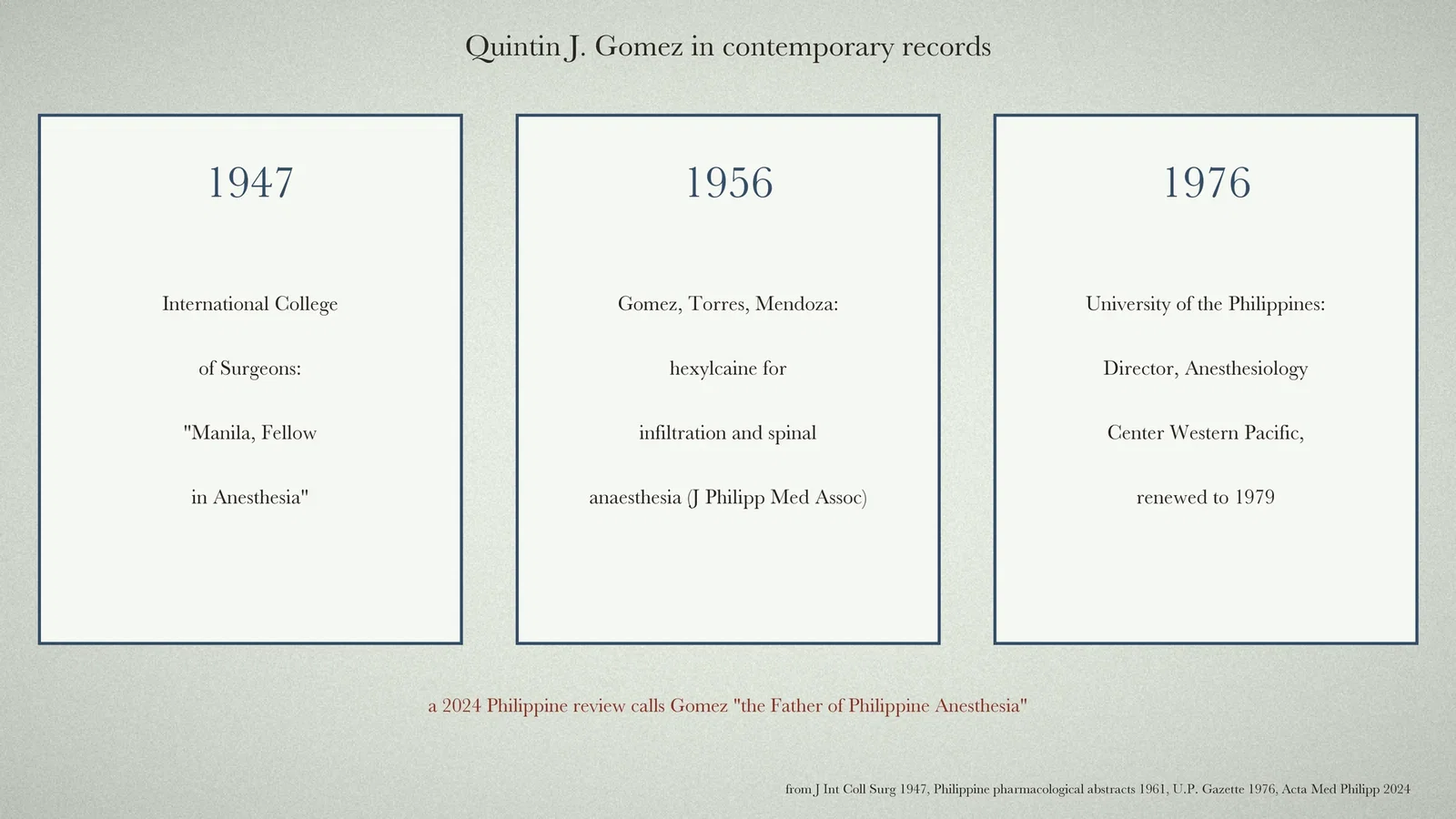
The WFSA had been led from Europe and North America since 1955; in 1976 it elected the Filipino anaesthetist Quintin J. Gomez, whose career can be traced in a 1947 surgical college list, a 1956 clinical paper and the University of the Philippines' 1976 appointments.
Reading Library · Anesthesia Epochs · 中文版
Watch the education video (for clinicians)
1976: Quintin Gomez — The WFSA Presidency · Anesthesia Epochs Education Series
The World Federation of Societies of Anaesthesiologists (WFSA), founded at Scheveningen in 1955, was led for its first two decades from Europe and North America. In 1976 that changed. This article follows the election of the Filipino anaesthetist Quintin J. Gomez as the federation's president, the Manila background that preceded it, and what contemporary records show of Gomez's career. No account of the 1976 election itself was found. The election is known from the WFSA's own timeline, and Gomez's career from scattered documents of 1947, 1956 and 1976.
The election
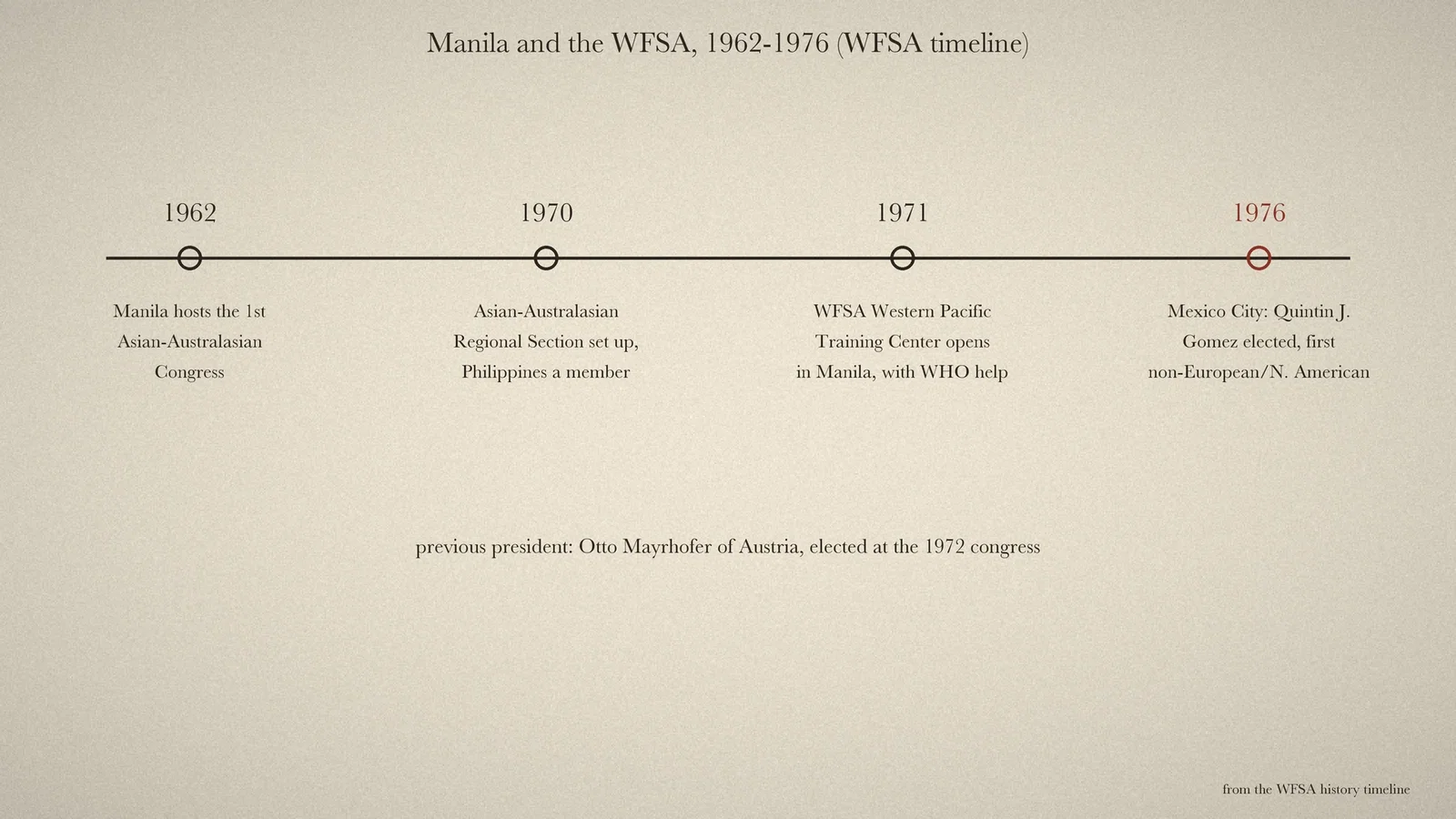
The WFSA timeline records that the 6th World Congress of Anaesthesiologists was held in Mexico City in 1976, with Guillermo Vasconcelos as congress president. At that congress came the "First non-European or North American President elected", "Quintin J Gomez from the Philippines". [1] Gomez followed "Otto Mayrhofer of Austria, newly elected President" at the previous congress in 1972. [1]
Manila in the federation
The choice had a background. The same timeline notes that the 1st "Asian-Australasian Congress of Anaesthesiology held in Manila" took place in 1962. In 1970 a "New Asian-Australasian Regional Section of WFSA set up", with the Philippines among its members. In 1971 came the "Opening of the WFSA Western Pacific Training Center in Manila", "with assistance from the Regional WHO Office". [1]
Gomez in the records
A 2024 Philippine review by Espina-Bertoso and Prudente sets Gomez among the pioneers of the post-war years. "Filipino anesthesiologists trained abroad, returned home" and introduced safer techniques. One of them was Gomez, "considered as the Father of Philippine Anesthesia", who brought modern practice to the country with an "army-type portable to-and-fro Heidbrink anesthesia machine". [2] The review does not say where Gomez trained.
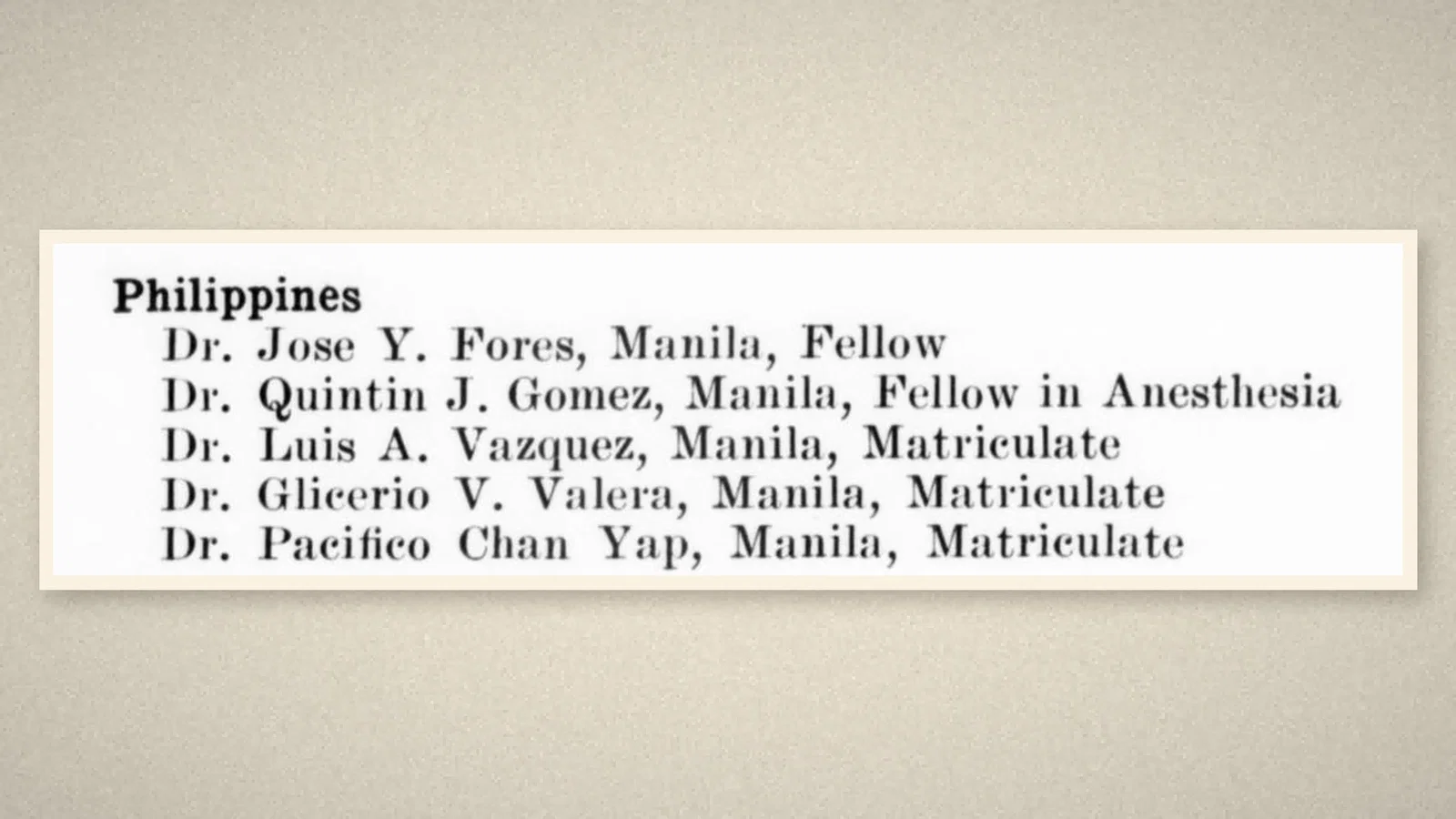
Contemporary documents fill in some of the picture. In late 1947 the Journal of the International College of Surgeons listed the new members admitted at its twelfth annual assembly. Under "Philippines" appears "Dr. Quintin J. Gomez, Manila, Fellow in Anesthesia", the only anaesthesia fellow in that national list. [3, p. 705]
In 1956 Gomez, with Luis I. Torres and Marina Mendoza, published "Clinical experiences with Hexylcaine" ("Cyclaine") for "topical infiltration and subarachnoid anesthesia" in the Journal of the Philippine Medical Association. The paper had been read at the association's convention in Baguio in May 1955 and was abstracted in a 1961 collection of Philippine pharmacology. [4]
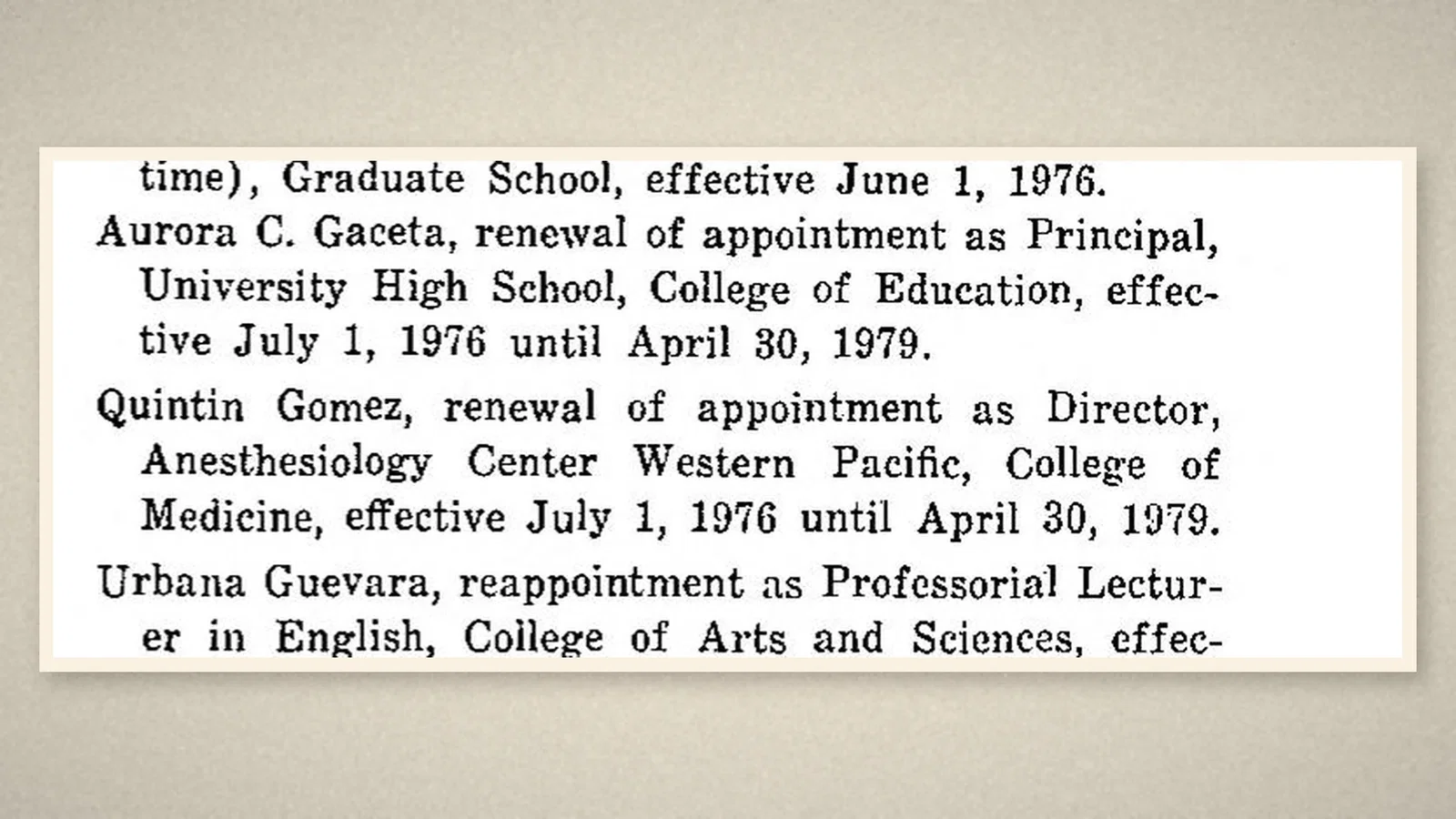
By the time of the WFSA election Gomez held a university post. The University of the Philippines Gazette for 1976 records the "renewal of supplementary appointment as Director, Anesthesiology Center Western Pacific, College of Medicine" from 1 December 1975. [5, p. 17] At its meeting of 24 June 1976 the Board of Regents approved "Quintin Gomez, renewal of appointment as Director" of the same centre, "effective July 1, 1976 until April 30, 1979". [5, p. 133] The centre also had its own lecturer-preceptors. [5, p. 17] In October 1976 Gomez was promoted to "Professor V of Surgery (part-time), College of Medicine". [5, p. 250]
The sources read do not say whether the university's "Anesthesiology Center Western Pacific" was the WFSA's "Western Pacific Training Center" of 1971 under another name. The two names are left as the sources give them.
What the record shows
Gomez came to the presidency of a world federation from a long local career: a fellowship in anaesthesia in 1947, clinical papers in the national journal, and the direction of a training centre in Manila. The election in Mexico City was the first time the WFSA chose its president from outside the countries that had founded it.
Sources and reading limits
Read: the WFSA history timeline; Espina-Bertoso and Prudente's 2024 review (introduction); the Journal of the International College of Surgeons, Nov-Dec 1947 (p. 705); the 1961 Philippine Pharmacological Abstracts (abstract 208); the University of the Philippines Gazette for 1976 (pp. 17, 133, 250).
Not covered: no account of the WFSA assembly of 1976, no WFSA newsletter of the period and no biography of Gomez were found. The Philippine Society of Anesthesiologists' website did not load. The "Father of Philippine Anesthesia" title and Gomez's training abroad come only from the 2024 review. The link between the university centre and the WFSA training center is not established. Gomez's dates of birth and death and the length of the presidency are not given in the sources read. The statement that the WFSA was founded in 1955 comes from an earlier article in this series.
Two illustrations are drawn from these sources; two are crops of the 1947 journal and the 1976 gazette.
- World Federation of Societies of Anaesthesiologists. WFSA history timeline. Website
- Espina-Bertoso SB, Prudente ES. Conquering pain: the evolution of regional anesthesia in the Philippines. Acta Med Philipp. 2024;58(9):5–6. DOI
- Twelfth annual assembly [list of fellows]. J Int Coll Surg. 1947;10(6):705. Internet Archive
- Philippine pharmacological abstracts. 1961. Abstract 208: Gomez QJ, Torres LI, Mendoza M. Clinical experiences with hexylcaine HCl (Cyclaine) for topical infiltration and subarachnoid anesthesia. J Philipp Med Assoc. 1956;32(2):73-81. Internet Archive
- The University of the Philippines Gazette. Vol. 7. 1976. Internet Archive
Continue exploring
Related reading connects shared questions and contexts; it does not by itself establish historical influence.
Anesthesia Epochs · The Source Room · About & Editorial Method
Published November 2, 2026. Sources and reading limits are stated above. Illustrations are labelled as original source images or AI-made. Historical accounts are educational; they are not current treatment instructions.