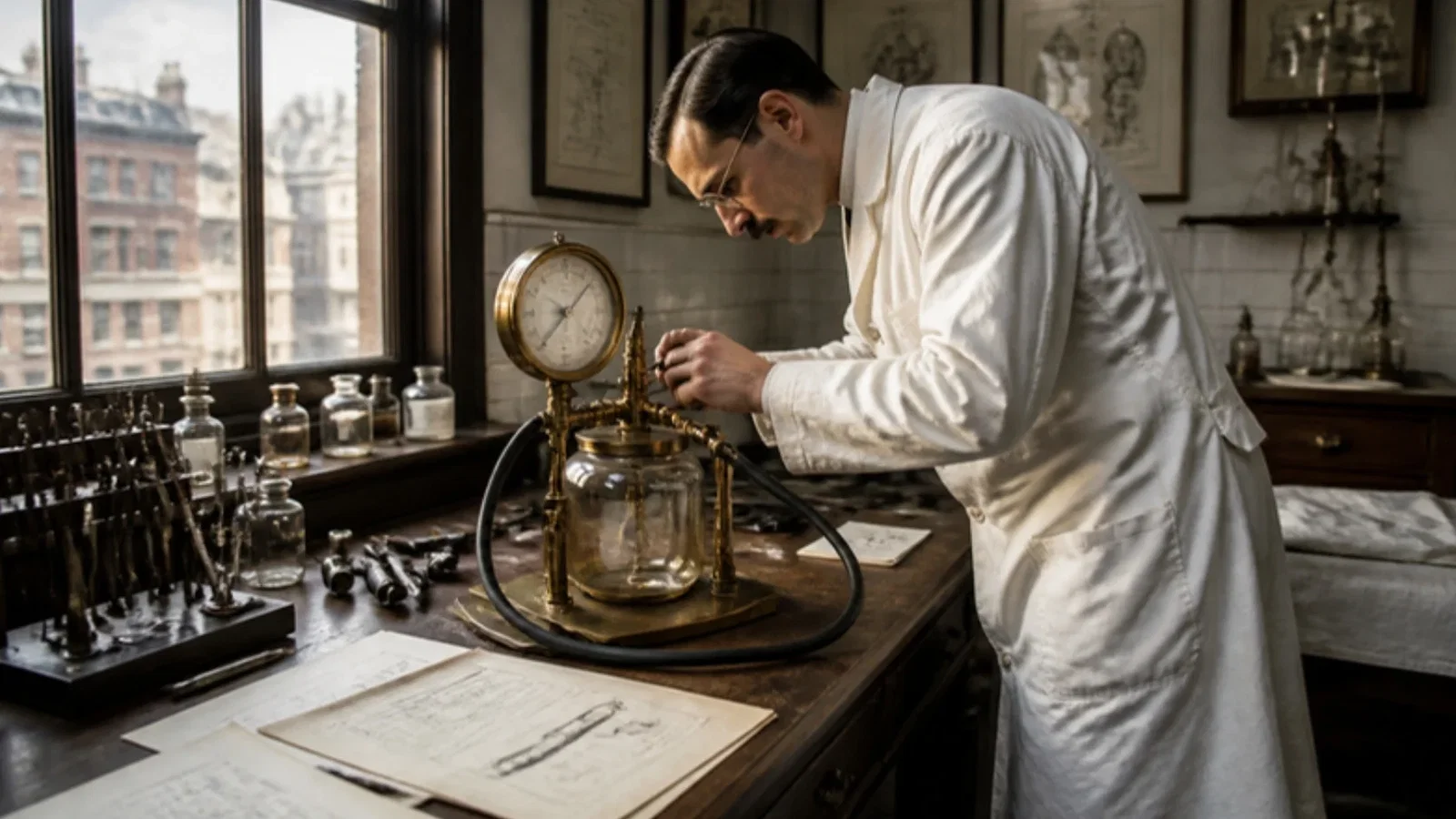
A Roosevelt Hospital surgeon coupled a gas meter to an ether pump so that each litre of air carried a set percentage of ether, and coined the word 'anaesthetometer' for the result.
Reading Library · Anesthesia Epochs · 中文版
Watch the education video (for clinicians)
1913: Connell's Anaesthetometer — A Meter to Dose Ether · Anesthesia Epochs Education Series
In August 1913 Surgery, Gynecology and Obstetrics published a long paper by Karl Connell, instructor in surgery at the College of Physicians and Surgeons, Columbia University, and assistant surgeon at Roosevelt Hospital, New York. Its title introduced a new word: "An apparatus - anaesthetometer - for measuring and mixing anaesthetic and other vapors and gases." [1] A footnote explained that the word had been coined, "in the lack of an existing term", for an instrument that automatically measured and mixed the vapours and gases of anaesthesia. [1] This article reads Connell's description and the first independent test of the machine.
The problem: the patient as the gauge
Connell began with a contrast. The need for exact dosage of drugs in solid and liquid form "has long been recognized", but with volatile and gaseous drugs dosage had remained inaccurate, "largely a matter of individual physiological experimentation", for want of a precise measuring instrument. In giving an inhaled anaesthetic, Connell wrote, "the patient has been used as the only available indicator" of the amount and concentration given. [1]
A gas meter that pumps ether
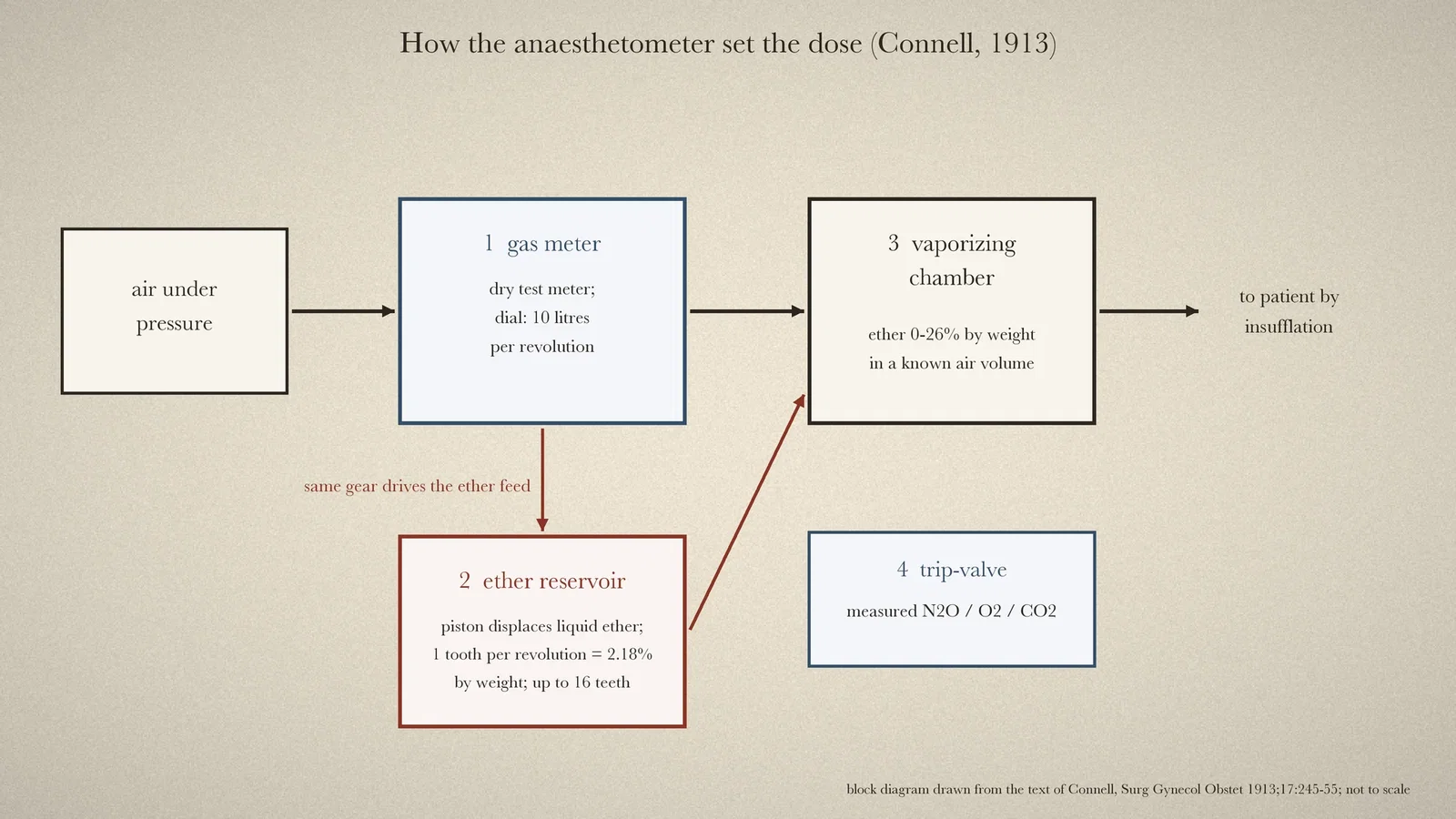
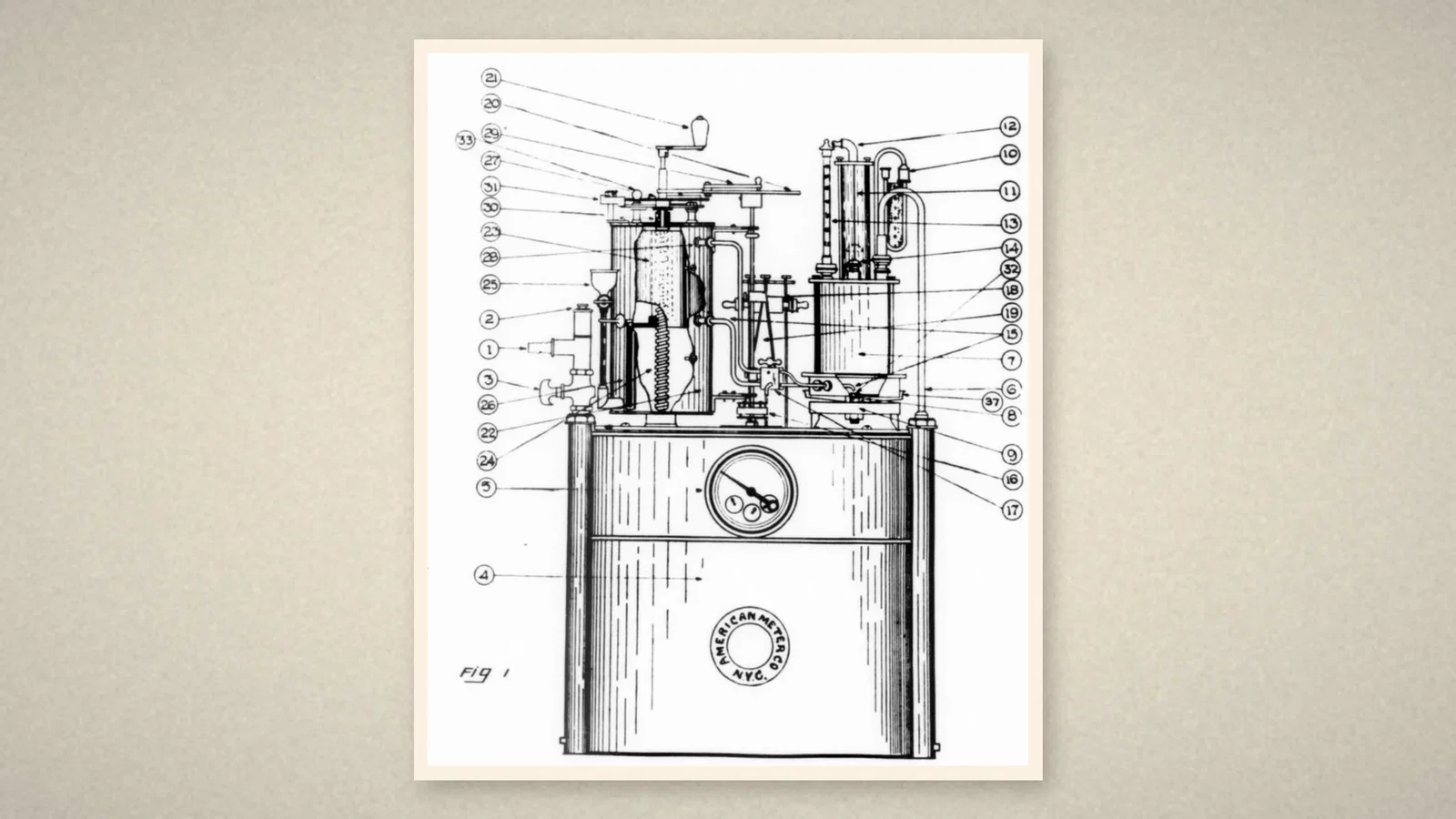
The answer came from an unexpected trade. The first of the apparatus's units was a dry gas meter, a modified "round, five-light, three diaphragm, dry, test meter", described by Connell as a development of the illuminating-gas industry. Air under pressure passed through it and turned the dial, ten litres to each revolution. The same gear also drove a ratchet and screw in the second unit, a one-litre ether reservoir, pushing a piston down to displace liquid ether into the third unit, the vaporizing chamber. Each tooth of the ratchet moved per revolution added enough ether to give 2.18% by weight of ether vapour in the air; by moving a pin, the setting could run from 0 to 26%. A fourth unit, a trip-valve, mixed nitrous oxide, oxygen or carbon dioxide in measured proportion. [1]
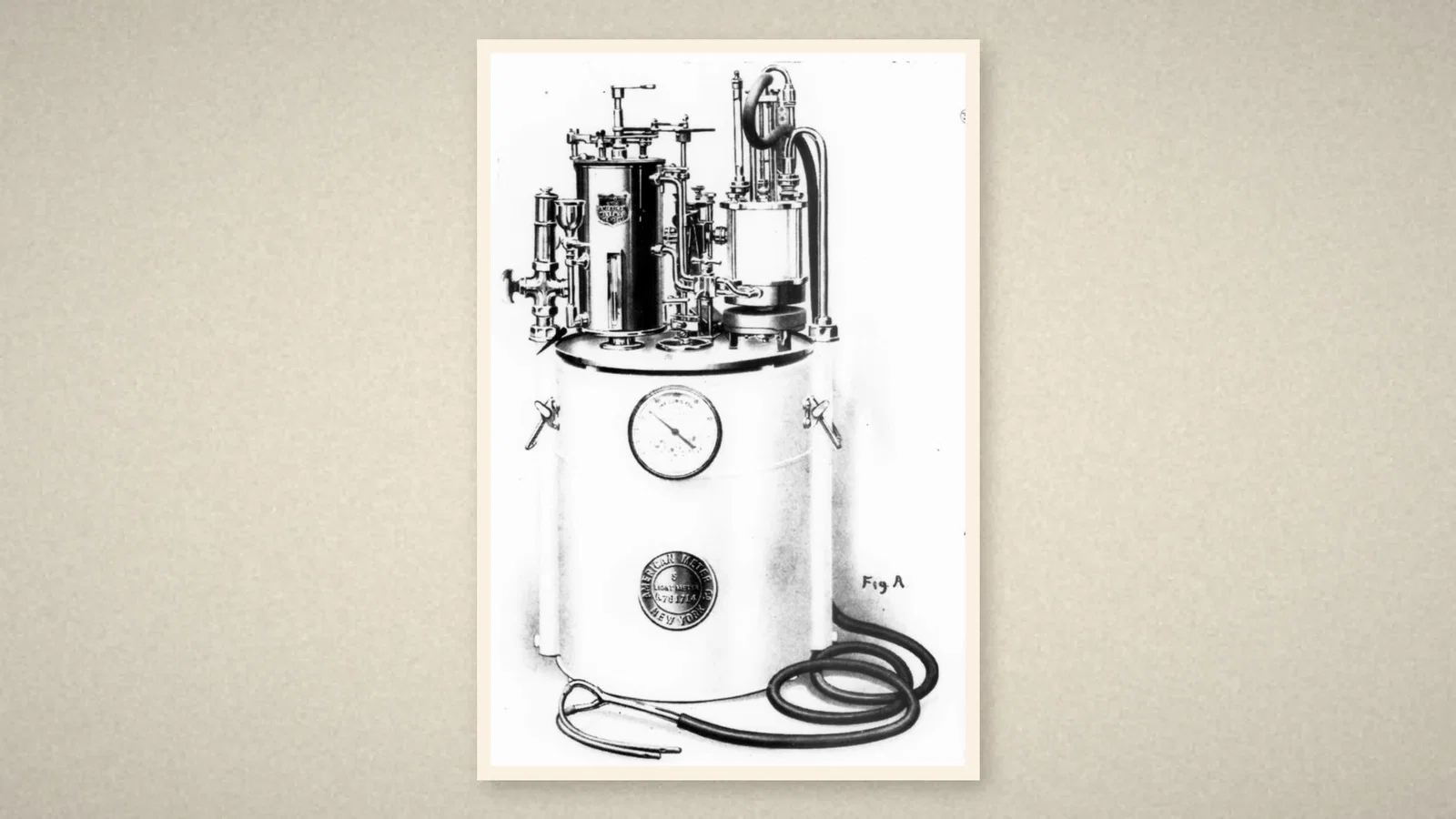
The design, Connell explained, came from several years' use of the Elsberg insufflation apparatus at Roosevelt Hospital and six months with a simpler "gas gauge vaporizer"; the instrument in its present form had been in continuous use at the hospital for six months. [1] Connell thanked Horatio B. Williams of Columbia for help with the physics, and Walter Boothby at Harvard for confirming the accuracy of the vapour percentages. [1]
Dosing by numbers
The paper gives the clinical recipe. Connell preferred delivery by insufflation rather than face mask and reported a technique developed in about 400 intratracheal and 500 intrapharyngeal cases on the surgical services of Charles H. Peck and Charles N. Dowd. After induction by mask and intubation, the patient received 21% ether vapour in 18 litres of air a minute, reduced in steps to 10-12% by the second hour; alcoholics, muscular people and athletic young patients might need 24% for a time. [1] Connell's summary promised that dosage would become "automatic, yet under the continuous observation and control of the operator", and that accurate data from such instruments would put anaesthesia on a scientific basis. [1]
Testing the machine
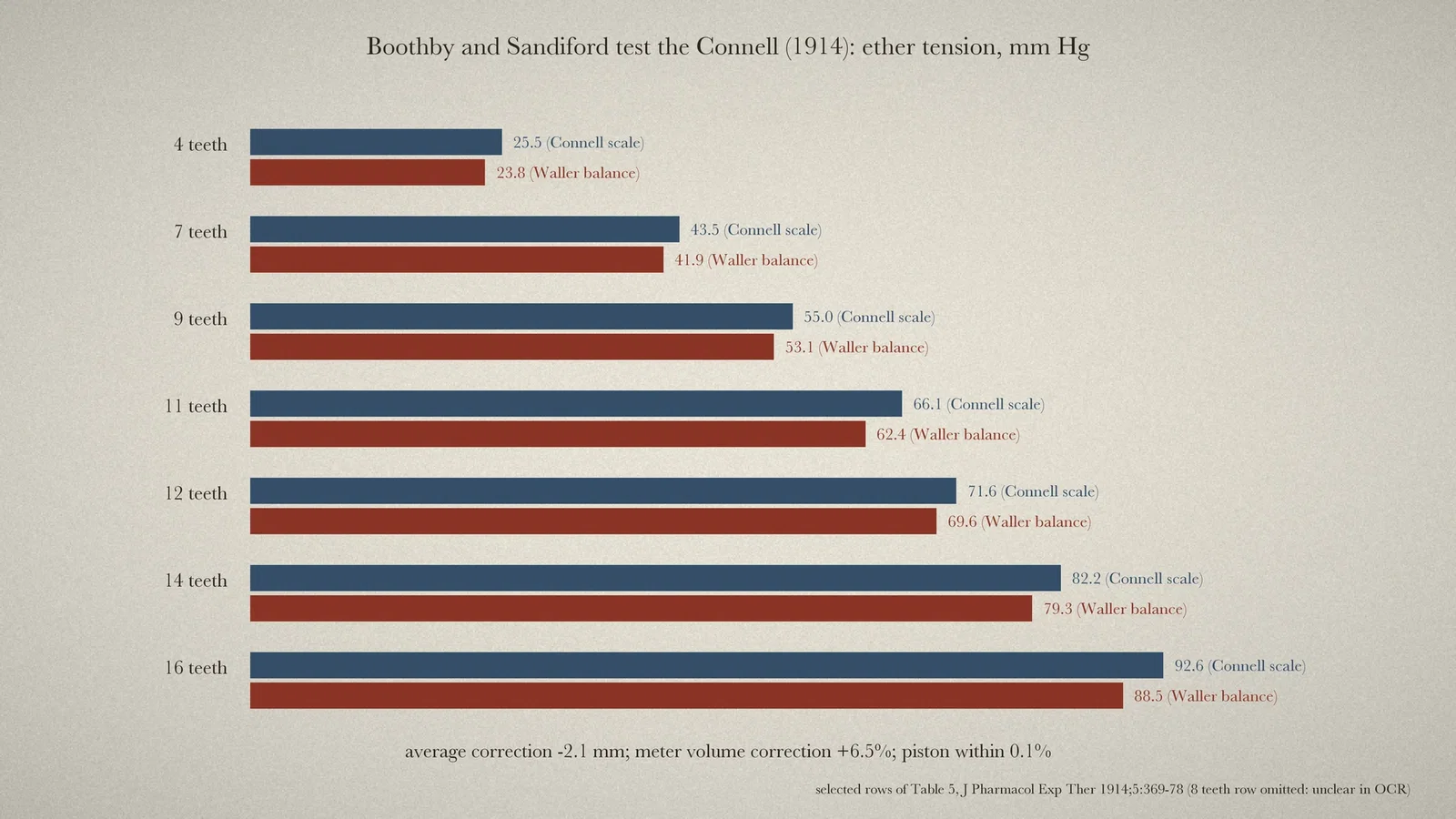
The first independent check came quickly. In March 1914 W. M. Boothby and I. Sandiford, working at the Peter Bent Brigham Hospital in Boston, reported that they had used the Connell anaesthetometer to study the anaesthetic tension of ether in man, and had first tested it with a Waller gas balance. They found that the meter under-recorded the volume passed by 6.5%, that the piston's ether displacement was within 0.1% of the theoretical amount, and that the delivered ether tension averaged 2.1 mm Hg below the Connell scale, with slight fluctuation. [2]
What the record shows
Connell's anaesthetometer turned the dose of an inhaled anaesthetic into a number set in advance rather than a judgment read from the patient. It was large and mechanical, borrowed from the gas industry, and depended on insufflation, but it made measured percentages of ether something a laboratory could check, and the first laboratory to check it found it close.
Sources and reading limits
Read: Connell's 1913 paper in full; Boothby and Sandiford's 1914 calibration paper in full (PDF reprint).
Not covered: Connell's earlier description in JAMA, cited in the 1913 paper; the description of the "gas gauge vaporizer"; Boothby's companion paper on the anaesthetic tension of ether; a Wood Library-Museum video on this subject; textbook and later historical accounts of the instrument; any surviving apparatus or record of how many were made. Connell's statements that the method reduced shock and the after-effects of ether are the inventor's own clinical claims. How widely the anaesthetometer was used outside these hospitals is not established here.
Two illustrations are crops of the 1913 article; two are drawn from the sources.
- Connell K. An apparatus - anaesthetometer - for measuring and mixing anaesthetic and other vapors and gases. Surg Gynecol Obstet. 1913;17(2):245-55. Internet Archive
- Boothby WM, Sandiford I. The calibration of the Waller gas balance and the Connell anaesthetometer. J Pharmacol Exp Ther. 1914;5(4):369-78. Internet Archive
Continue exploring
Related reading connects shared questions and contexts; it does not by itself establish historical influence.
Anesthesia Epochs · The Source Room · About & Editorial Method
Published November 2, 2026. Sources and reading limits are stated above. Illustrations are labelled as original source images or AI-made. Historical accounts are educational; they are not current treatment instructions.