
A four-page paper in the British Journal of Industrial Medicine, July 1945: twelve patients under anaesthesia, blood, urine and expired air afterwards, and evidence that an inhaled anaesthetic is partly metabolised in man; with Ostlere's 1953 monograph and a society timeline's claim.
Reading Library · Anesthesia Epochs · 中文版
Watch the education video (for clinicians)
1945: Joan Powell — Trichloracetic Acid After Trilene · Anesthesia Epochs Education Series
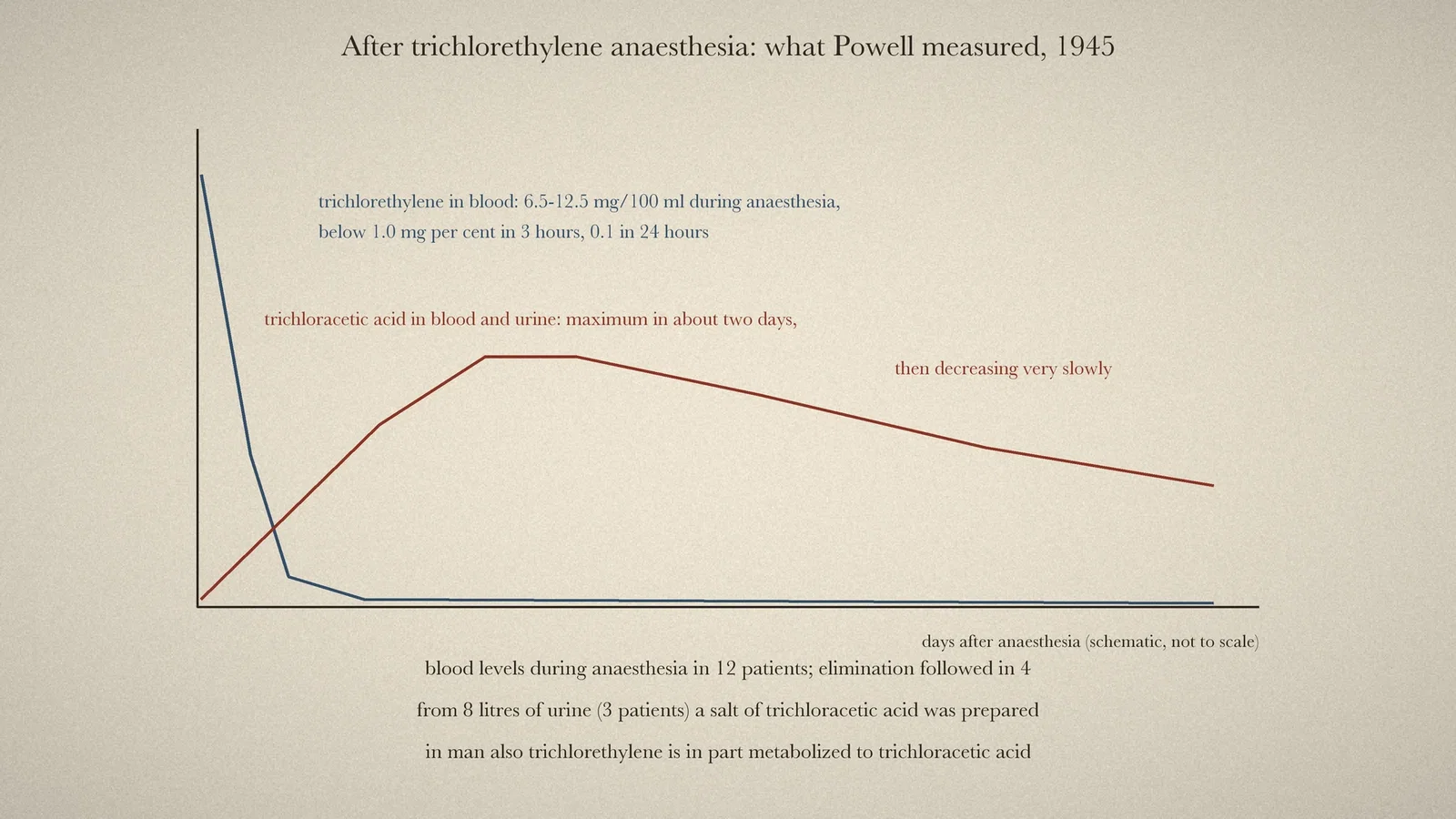
A society timeline suggests that inhaled anaesthetics were long assumed to leave the body the way they came in. It quotes John Snow describing ether as an agent "flying away every moment in the breath". [4, PDF p. 61] In July 1945 a four-page paper in the British Journal of Industrial Medicine showed that one of them did not entirely leave that way. The author was Joan F. Powell of the Nuffield Department of Clinical Medicine at Oxford, the anaesthetic was trichlorethylene, and the patients came from the Nuffield Department of Anaesthetics.
Why an industrial journal
The study began as industrial medicine. Powell's laboratory wanted quantitative methods for measuring exposure to chlorinated solvents, methods useful in industry and also "in studying the action and side effects of chloro-compounds used as anaesthetics". [1, p. 142] This was the third paper in a series and a detailed study of the absorption and elimination of trichlorethylene, which was chosen because "we were able to study human subjects to whom it was given as an anaesthetic". The same chemical, sold as Trilene, Westrosol or Crawshawpol, was used in industry in large quantities as a degreaser and dry-cleaning agent. [1, p. 142]
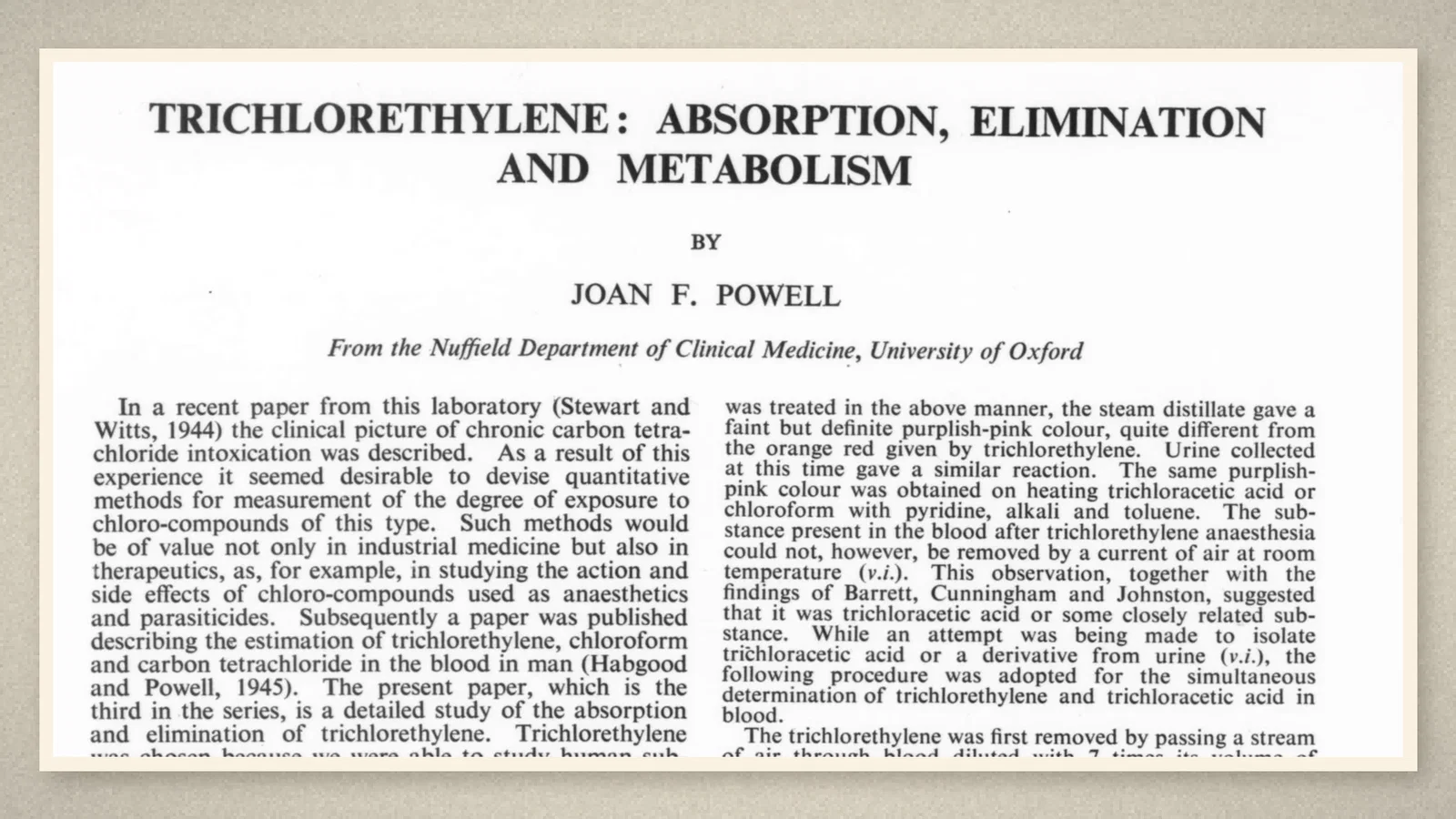
There was a lead. Barrett and Johnston in 1939 had recovered 5-8 per cent of the trichlorethylene absorbed by dogs during anaesthesia from their urine as trichloracetic acid, and the urine of people exposed to the vapour gave chemical reactions suggesting the same substance, "although the latter was not actually isolated". [1, p. 142]
What the measurements showed
In 12 patients who had breathed 1.5-2.5 per cent trichlorethylene from an Oxford vaporizer for at least half an hour, venous blood levels during anaesthesia were 6.5-12.5 mg per 100 ml. [1, p. 143] Afterwards the anaesthetic "disappeared very rapidly from the blood", falling below 1.0 mg per cent in three hours and to 0.1 in 24 hours; in expired air it "virtually ceases to be excreted via the lungs in 48 hours". [1, p. 144]
But blood taken a day or more after anaesthesia gave a "faint but definite purplish-pink colour" in the test, quite unlike the orange red of trichlorethylene, and urine did the same. [1, p. 142] This non-volatile substance, measured as trichloracetic acid, rose to a maximum in about two days and then fell slowly. One patient excreted 3.7 g in ten days. [1, p. 144]
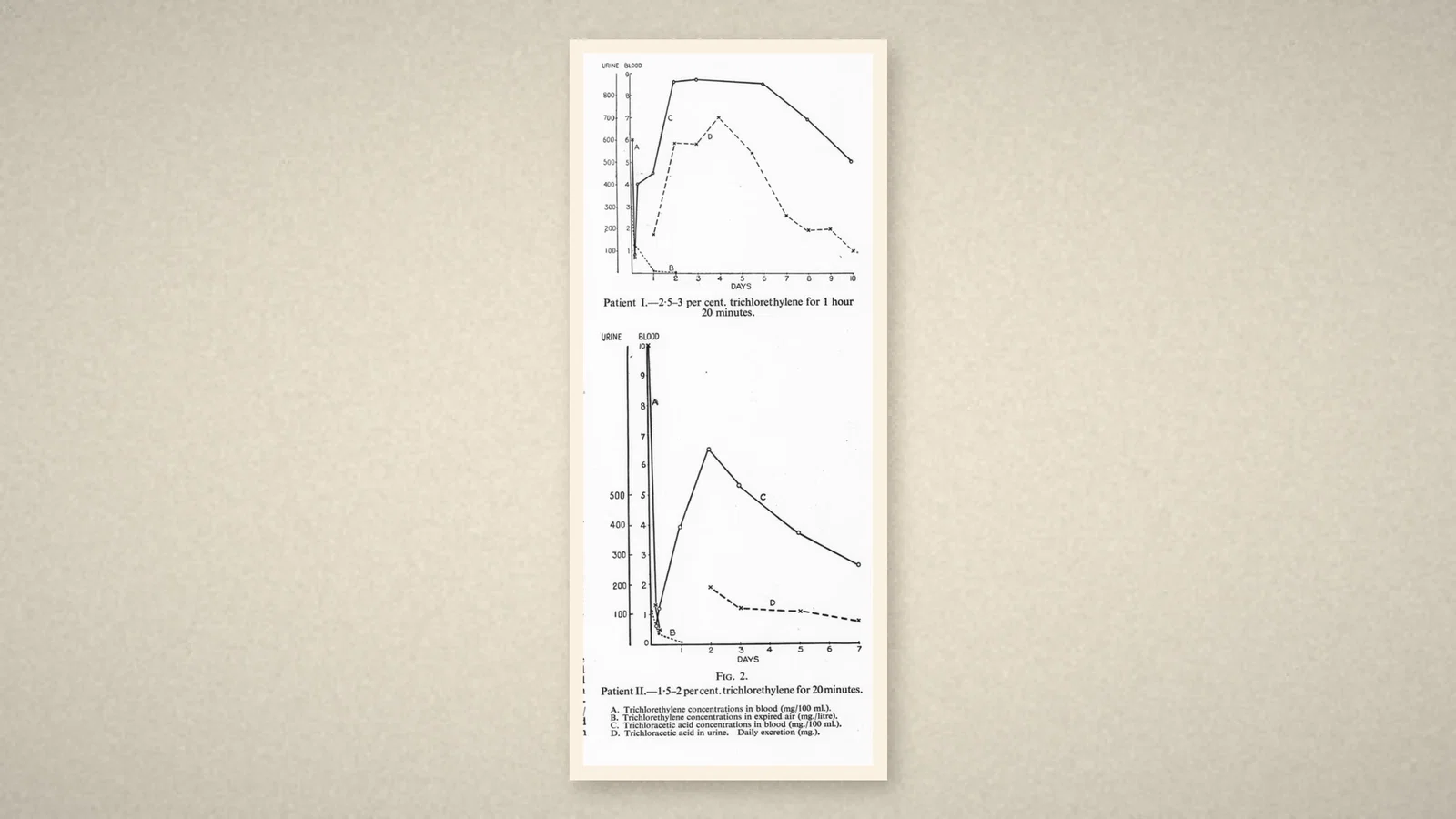
Powell then identified the substance. Eight litres of urine, collected from three patients 24-72 hours after trichlorethylene anaesthesia, were acidified and extracted with ether. The extract gave a piperazinium salt that melted at the same point as an authentic specimen of the salt of trichloracetic acid, and a sodium salt that gave the carbylamine reaction, "proof of the presence of chloroform formed by decomposition of the trichloracetate". [1, p. 143] The paper's conclusion was the sentence at the centre of this article: "We have been able to demonstrate that in man also trichlorethylene is in part metabolized to trichloracetic acid." [1, p. 142] The summary puts it plainly: "Part of the trichlorethylene absorbed is converted into trichloracetic acid." [1, p. 145]
Toxic or not?
Powell judged that trichlorethylene was probably not metabolized in the blood itself, and suggested that it was fixed and changed in some organ. [1, p. 144] Injections of sodium trichloracetate into animals and people suggested that its toxicity "at the concentrations found in the blood after trichlorethylene anaesthesia is negligible". [1, p. 144] The cranial nerve palsies then reported after trichlorethylene had occurred where the vapour passed through soda lime, which was thought to form dichloracetylene. [1, p. 145] Still, "the mechanism of conversion", with the possibility of toxic intermediates, "remains a matter for conjecture". There was no evidence that the metabolite was toxic, "but the possibility seems worthy of further exploration". [1, p. 144-145] The paper ends by thanking the Nuffield Department of Anaesthetics "for their co-operation in providing cases of trichlorethylene anaesthesia". [1, p. 145]
The 1953 monograph and the timeline
In 1953 Gordon Ostlere's Trichlorethylene Anaesthesia appeared, an 83-page book from Livingstone. W. W. Mushin in the BMJ called it "a complete review of all that has been said and written about trichlorethylene", covering history, pharmacology and clinical use. [2, p. 770] The Australian and New Zealand Journal of Surgery noted that trichlorethylene came into British anaesthesia as quick analgesia for men wounded inside tanks, that Langton Hewer had pioneered its anaesthetic use in 1939, and that it was "not an easy anaesthetic to administer skilfully". [3, p. 158]
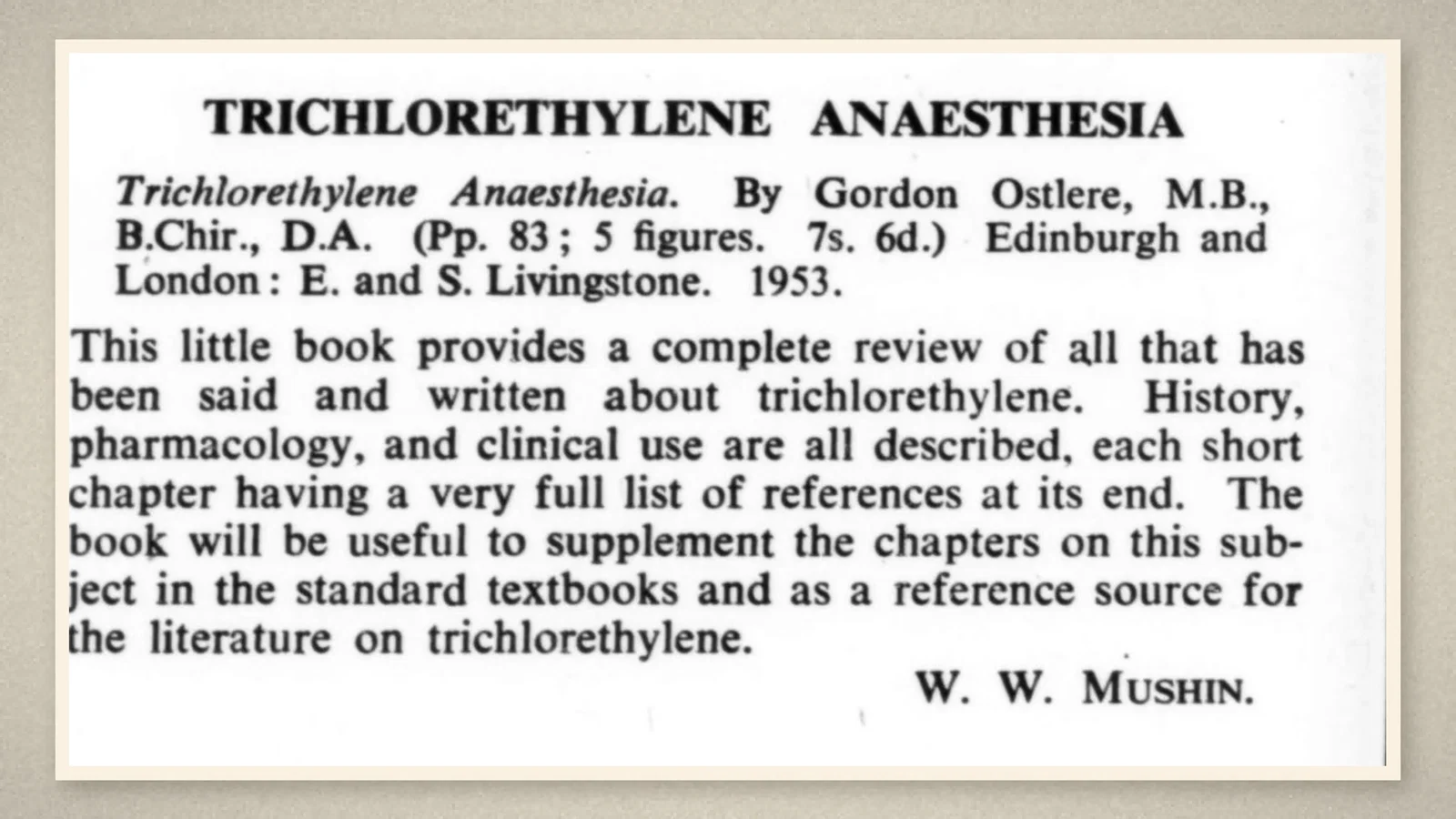
The Australian Society of Anaesthetists' timeline gives Ostlere's 1953 monograph as "the first publication to mention the metabolism of inhalational anaesthetics in humans". It notes the Oxford study by Joan Powell in 1945, "using dogs and later humans", and its citation in Anaesthesia in 1950 by Helliwell and Hutton. It still says that before Ostlere no one had addressed the possibility of inhalational agents "being metabolized by the body". [4, PDF p. 61] Powell's paper does not fit that account. It studied human patients, cited the dog work to Barrett and Johnston, and stated the metabolism in man in so many words. [1, p. 142]
What the record shows
An inhaled anaesthetic was shown in 1945 to leave a chemical trace in the body for days. The evidence was measured in anaesthetised patients by a laboratory interested in solvents at work. The paper did not claim harm. It left the question of toxic intermediates open.
Sources and reading limits
Read: Powell's paper, Br J Ind Med 1945;2:142-145, in full; Mushin's review of Ostlere's book in the BMJ, 4 April 1953, p. 770; the review in the Australian and New Zealand Journal of Surgery, November 1953, p. 158; the ASA timeline entry for 1953.
Not covered: Ostlere's monograph itself is not covered, so what it says about metabolism is unknown here; neither review mentions metabolism. Helliwell and Hutton (Anaesthesia, 1950) and Barrett and Johnston were not read. The PubMed Central copy of Powell's paper was not used because its download sits behind a bot check; the Internet Archive scan of the same issue was read instead. The disagreement between the timeline and the 1945 paper is reported, not resolved.
One illustration is a schematic following the paper's text; three are crops of the 1945 paper and the 1953 review.
- Powell JF. Trichlorethylene: absorption, elimination and metabolism. Br J Ind Med. 1945;2(3):142-5. Internet Archive
- Mushin WW. Trichlorethylene Anaesthesia [review of Ostlere G. Edinburgh: Livingstone; 1953]. Br Med J. 1953;1(4813):770. Internet Archive
- Trichlorethylene Anaesthesia [review of Ostlere G. Edinburgh: Livingstone; 1953]. Aust N Z J Surg. 1953;23(2):158. Internet Archive
- Australian Society of Anaesthetists. Anaesthesia History Timeline. 2024. PDF
Continue exploring
Related reading connects shared questions and contexts; it does not by itself establish historical influence.
Anesthesia Epochs · The Source Room · About & Editorial Method
Published November 2, 2026. Sources and reading limits are stated above. Illustrations are labelled as original source images or AI-made. Historical accounts are educational; they are not current treatment instructions.