
Winslow renamed the intercostal nerve chain the 'great sympathetic'; in 2009 a Guedel Center essay asked whether anaesthesiologists had become 'sympathetic-ologists'.
Reading Library · Anesthesia Epochs · 中文版
Watch the education video (for clinicians)
1732: Winslow Names the Sympathetic Nerves · Anesthesia Epochs Education Series
In 2009 Merlin D. Larson asked, in the Guedel Center column of the CSA Bulletin, how anaesthesiologists had become "sympathetic-ologists", and whether they deserved the role. [2] A 2008 review in Anesthesiology had stressed the sympathetic nervous system's importance in clinical anaesthesia. [3] Larson's answer began with a word. This article follows the word back to the anatomy book that fixed it, and forward to the beta-blocker debate of 2008.
The naming
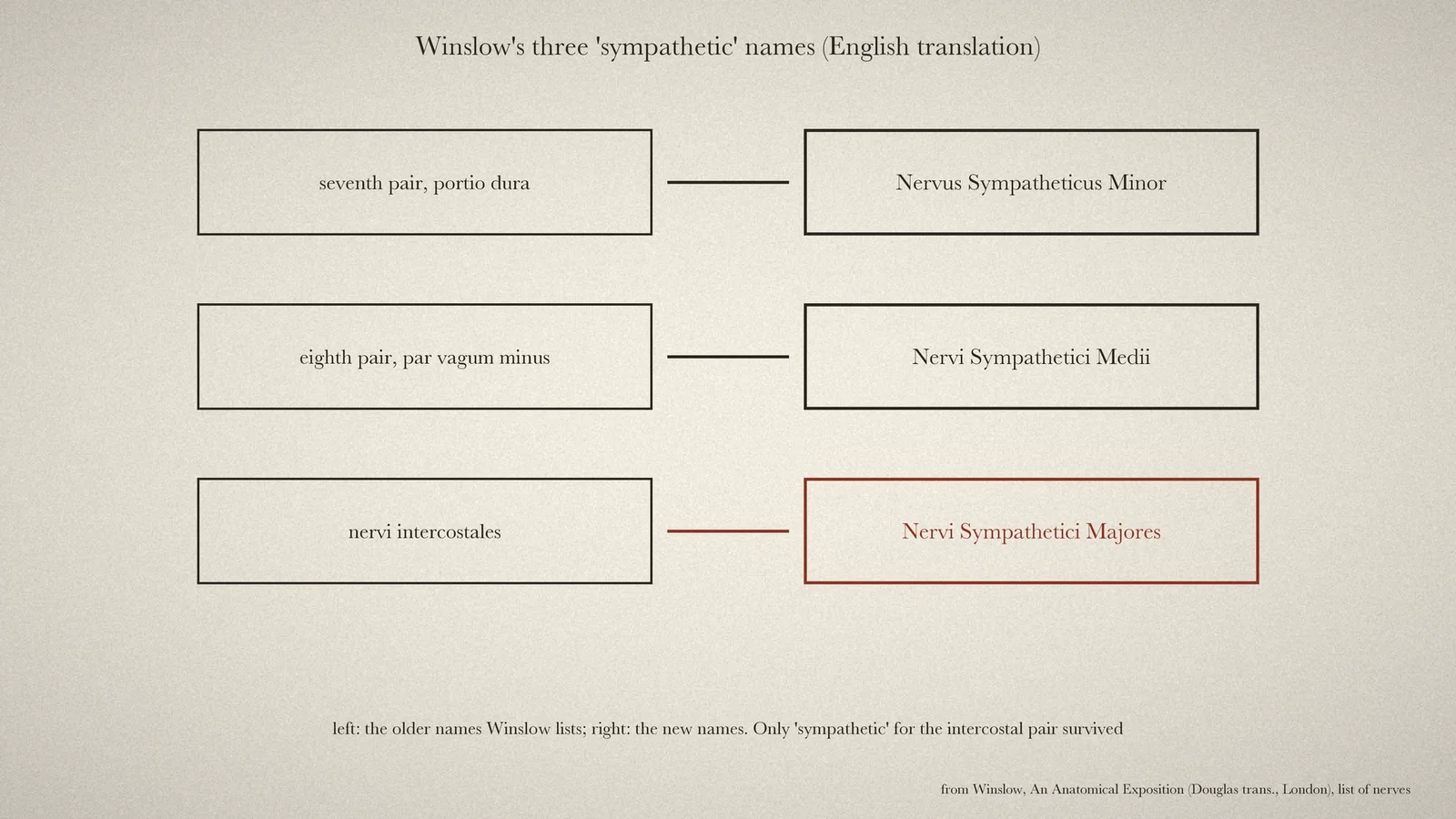
According to Larson, it was in 1732 that the Paris anatomist Winslow attached the word "sympathetic" to the chain of ganglia beside the spine. [2] The English translation of Winslow's Exposition anatomique, made by G. Douglas and printed in London with a title page dated 1734, shows how deliberately it was done. [1] The title page calls the author "James Benignus Winslow, professor of physick, anatomy and surgery in the University of Paris". [1] In the "Description of the Nerves", where Winslow lists the nerves of the medulla oblongata, the portio dura of the seventh pair becomes the nerve "to which I give the name of Nervus Sympatheticus Minor", and the eighth pair, "Par Vagum Minus", is the one "which I call Nervi Sympathetici Medii". [1] Among the nerves of the spinal marrow comes "One Pair commonly called Nervi Intercostales, which I name Nervi Sympathetici Majores". [1]
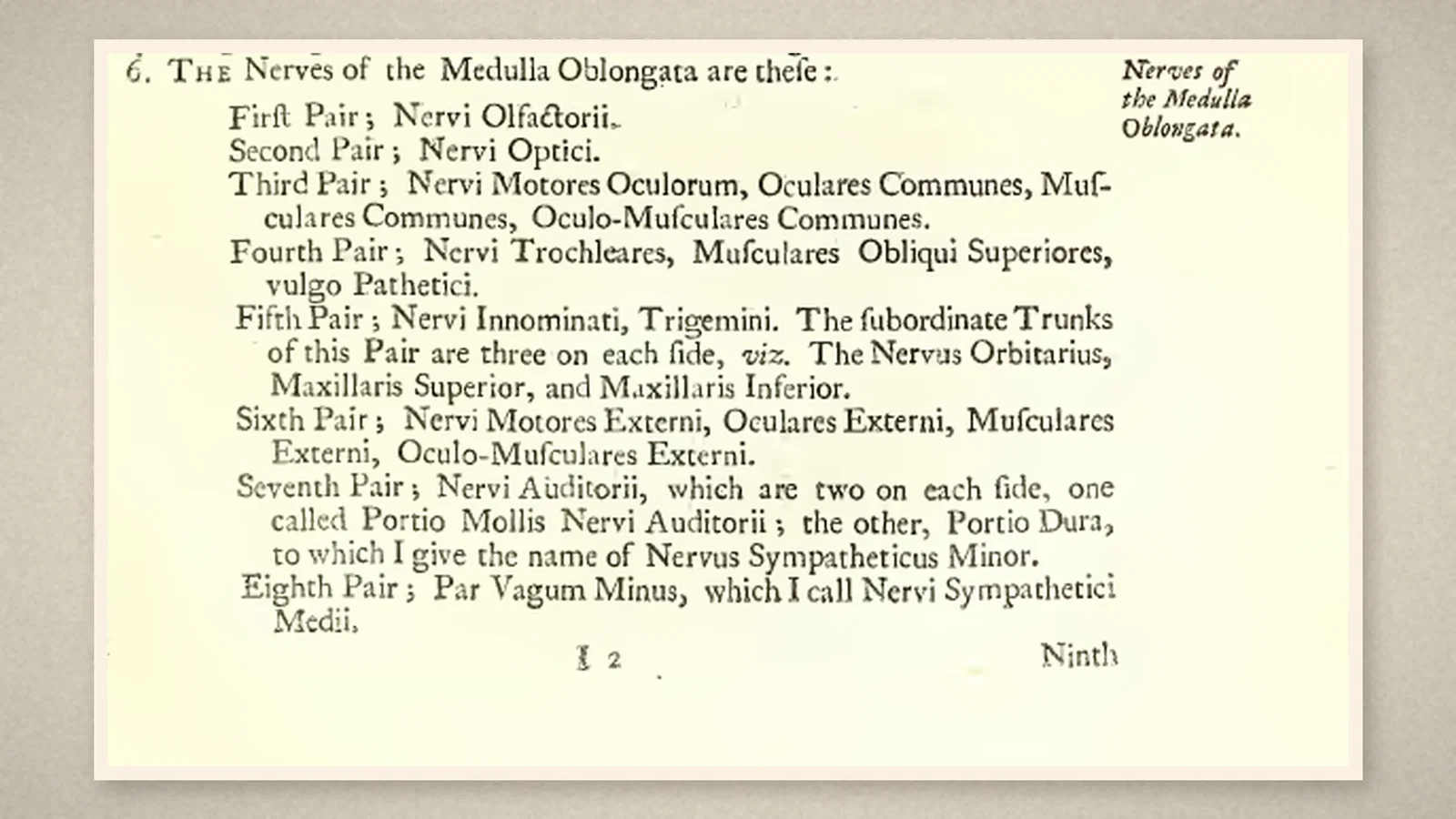
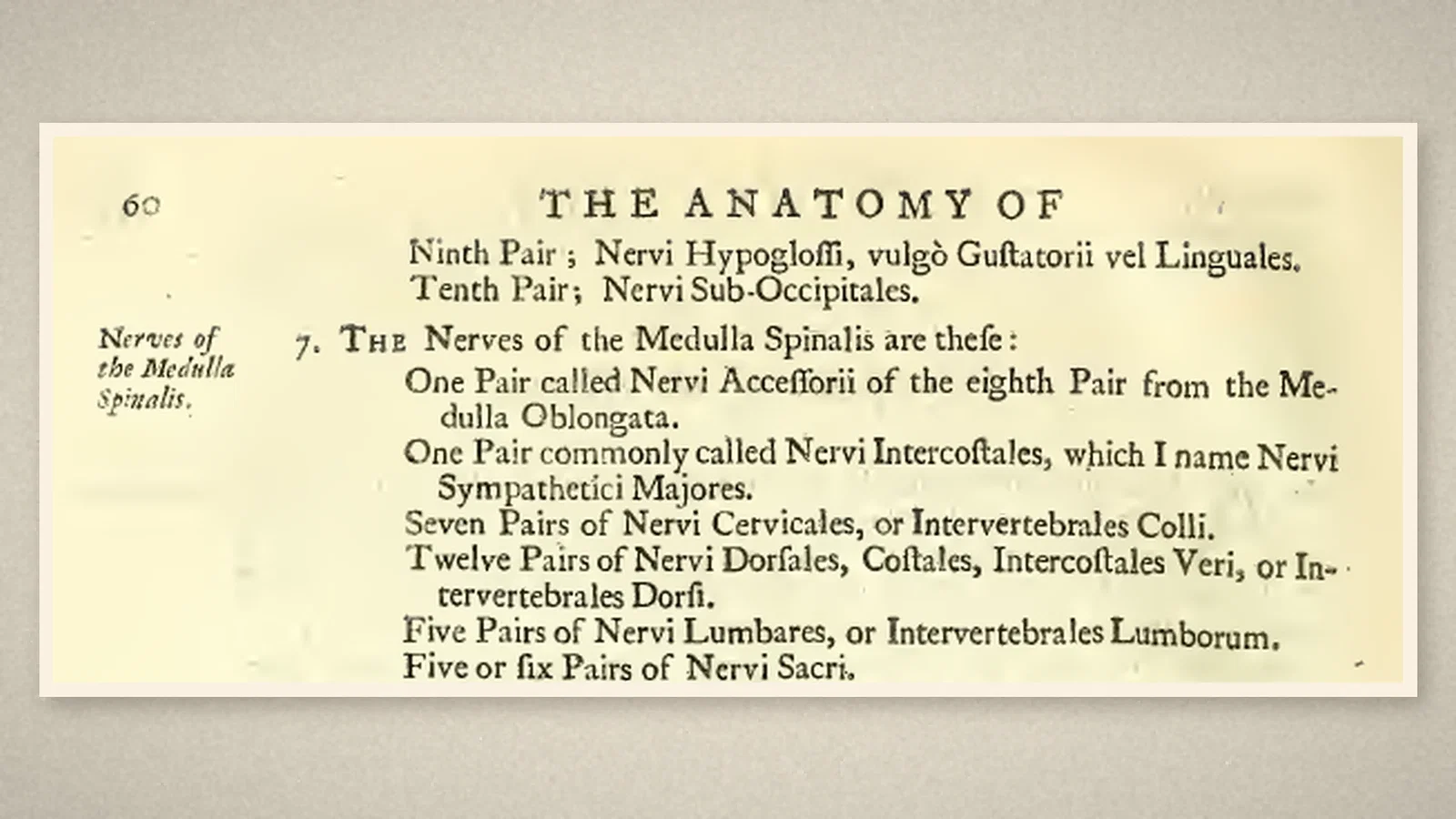
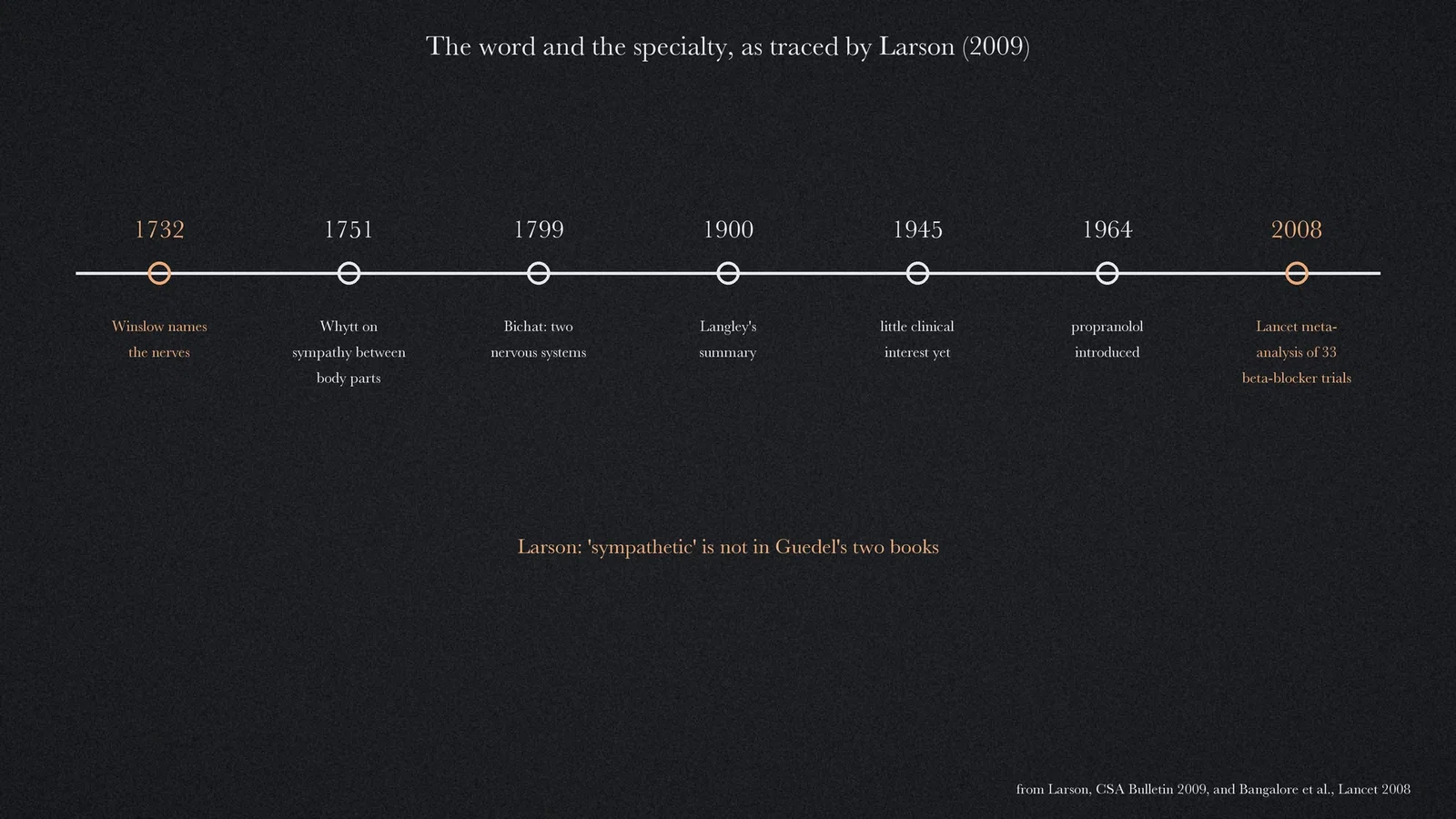
Only the last of the three names lasted. Larson explains the choice through the older meaning of "sympathy", the effect of disease in one part of the body on another, and writes that Winslow saw the ganglia were connected and thought they might provide for unconscious "sympathy" between distant parts. [2] Robert Whytt's essay of 1751 described sympathy between body parts as reflex action through the nerves; Xavier Bichat in 1799 divided the nervous system in two, with the ganglia as "little brains"; and John N. Langley's summary of 1900 remained the standard account for much of the twentieth century. [2]
Absent from the early anaesthesia books
Larson's surprise was that the anaesthetists of the Guedel era paid the system little attention. The word "sympathetic", Larson writes, does not appear in either of Guedel's two books, and is rarely mentioned in Gwathmey's, Lundy's or Cullen's textbooks, mostly in connection with hypotension after spinal anaesthesia. [2] By 1945 the system had been well described by physiologists but had generated little interest among clinicians, even though ether and nitrous oxide were known to activate it. [2]
That changed with drugs. Propranolol was introduced in 1964, and Larson describes how anaesthesiologists took up perioperative beta blockade, thoracic epidurals, high-dose opioids and deliberate sympatholysis to protect the heart, until, by Larson's count, the word appeared 58 per cent more often in the leading anaesthesia textbook than in the leading textbook of medicine, and 48 per cent more often than in the leading textbook of emergency medicine. [2]
The 2008 question
Larson's essay appeared just after a meta-analysis in The Lancet had tested one of those habits. Across 33 trials and 12,306 patients, perioperative beta blockers in non-cardiac surgery "were not associated with any significant reduction in the risk of all-cause mortality", reduced non-fatal myocardial infarction and ischaemia, increased non-fatal strokes, and carried a high risk of bradycardia and hypotension needing treatment; the authors concluded that the evidence did not support their use for preventing perioperative outcomes. [4] Meanwhile the 2008 review described a system studied for more than a century and measurable directly through muscle sympathetic activity, with general anaesthesia itself serving as a tool to study cardiovascular control. [3] Larson's conclusion was blunt: either the specialty learns the system's full complexity, or it should "follow Guedel's example and not use the word at all". [2]
What the record shows
A word coined to describe a hypothesis of bodily "sympathy" outlived the hypothesis and became a working tool of anaesthesia. Winslow's renaming is a reminder that clinical vocabulary carries old theories with it, and Larson's essay a reminder that a specialty can adopt a word before it understands what the word refers to.
Sources and reading limits
Read: the list of nerves and the title page in the English translation of Winslow's Exposition anatomique; Larson's five-page 2009 essay, read as page images because the archived PDF has no text layer; the PubMed abstracts of Neukirchen and Kienbaum (2008) and Bangalore et al. (2008).
Not covered: the 1732 French original (its date comes from Larson); any passage in which Winslow explains the name (Larson's explanation is reported as Larson's); Whytt, Bichat, Langley and the early anaesthesia textbooks, known here only through Larson; the data behind Larson's word counts. The English translation's title page reads 1734, although the scanned copy is catalogued as 1733. The names Winslow replaced are given as Winslow lists them; modern equivalents are not asserted.
Two illustrations are crops of Winslow's list of nerves; two are drawn from the sources.
- Winslow JB. An anatomical exposition of the structure of the human body. Douglas G, translator. London: Bettesworth and Hitch; 1734. Internet Archive
- Larson MD. "Sympathetic-ologists". CSA Bull. 2009 Spring:81-5. Internet Archive PDF
- Neukirchen M, Kienbaum P. Sympathetic nervous system: evaluation and importance for clinical general anesthesia. Anesthesiology. 2008;109(6):1113-31. PubMed
- Bangalore S, Wetterslev J, Pranesh S, Sawhney S, Gluud C, Messerli FH. Perioperative beta blockers in patients having non-cardiac surgery: a meta-analysis. Lancet. 2008;372(9654):1962-76. PubMed
Continue exploring
Related reading connects shared questions and contexts; it does not by itself establish historical influence.
Anesthesia Epochs · The Source Room · About & Editorial Method
Published November 2, 2026. Sources and reading limits are stated above. Illustrations are labelled as original source images or AI-made. Historical accounts are educational; they are not current treatment instructions.