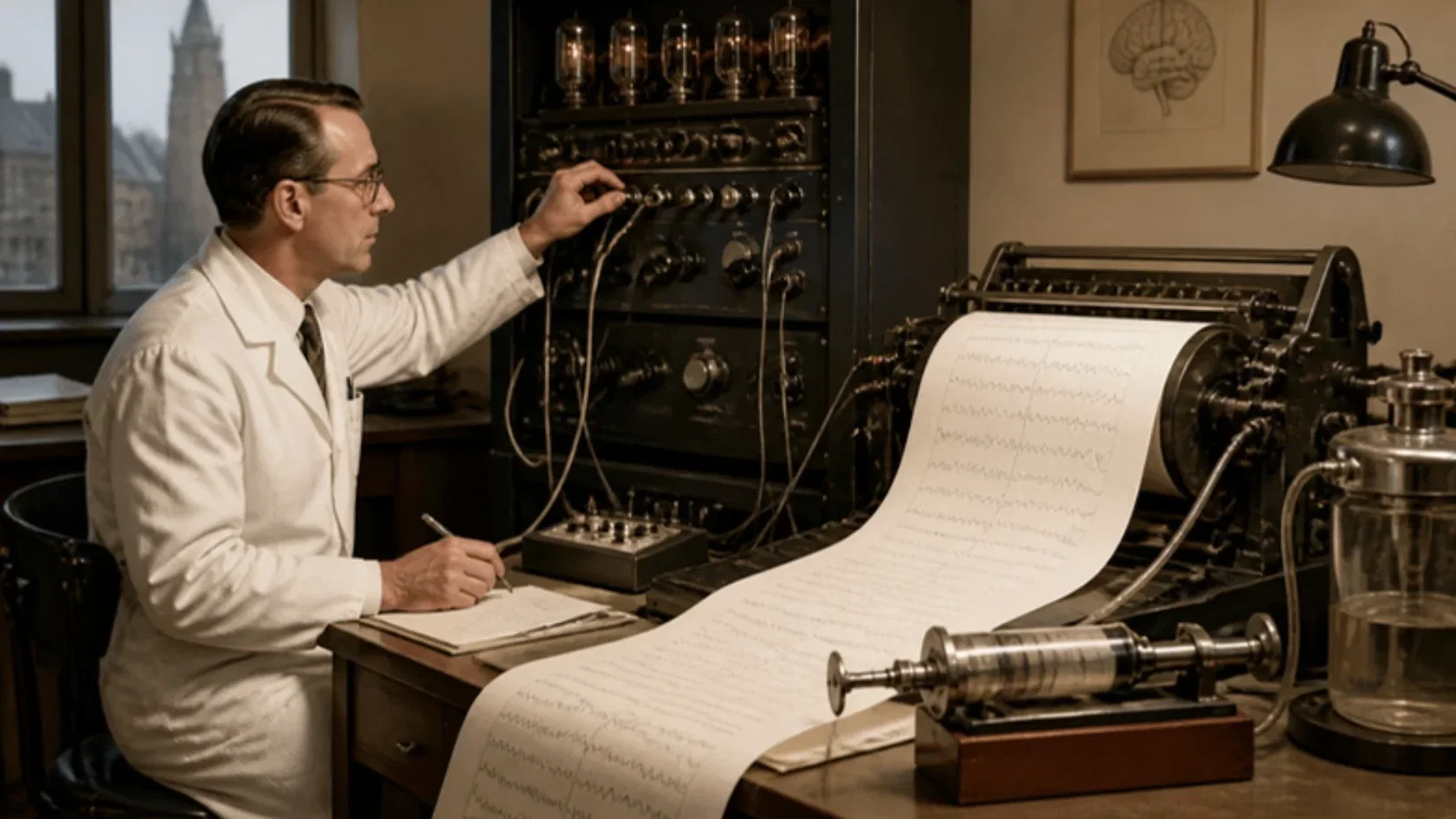
A Mayo Clinic patent filed in November 1950 described a closed loop in which the patient's integrated brain-wave signal drove a syringe or ether pump; in 1957 Bellville and Attura called it the first automatic control of anaesthetic depth and built a servo version.
Reading Library · Anesthesia Epochs · 中文版
Watch the education video (for clinicians)
1950: Bickford's EEG-Driven Anaesthesia — A Closed-Loop Patent · Anesthesia Epochs Education Series
In 2009 Merlin Larson, writing for the Guedel Center column of the CSA Bulletin, traced what Larson called "robot anesthesia" back to the Mayo Clinic in 1950. [3] The primary record is a patent. On 13 November 1950 Reginald George Bickford of Rochester, Minnesota, assignor to Research Corporation of New York, applied for US Patent 2,690,178, "Automatic Apparatus for Administering Drugs"; it was granted on 28 September 1954. [1] This article reads the patent, the 1957 Science paper that built on it, and Larson's account.
What the patent claimed
The patent's general object was "a method and apparatus for administering drugs to a patient in response to a signal produced by or in consonance with a function or functions of the patient". [1] Its examples were anaesthetics such as ether or barbiturates, and anticonvulsants for continuous seizures. A further object was an apparatus in which the anaesthetic was given "at a rate proportional to the variation of the brain potential signal from an established potential so as to provide an error-actuated system". [1] The patent notes that the underlying work was done at the Mayo Clinic. [1]
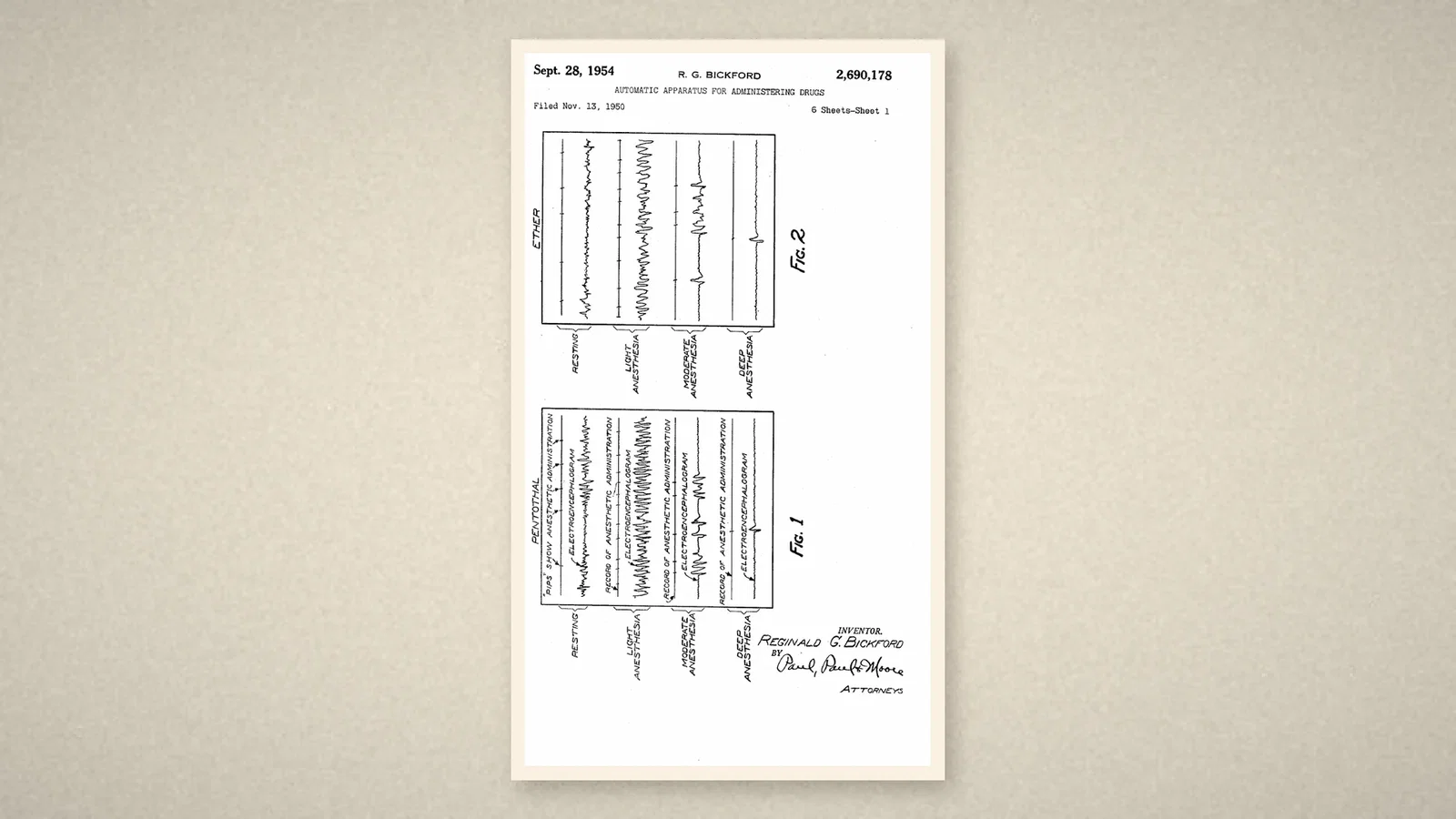
The first drawing sheet shows why the idea seemed workable. Electroencephalogram tracings under Pentothal and under ether, at rest and in light, moderate and deep anaesthesia, change in a regular way as the patient goes deeper, and small vertical "pips" above each trace mark the doses given. [1]
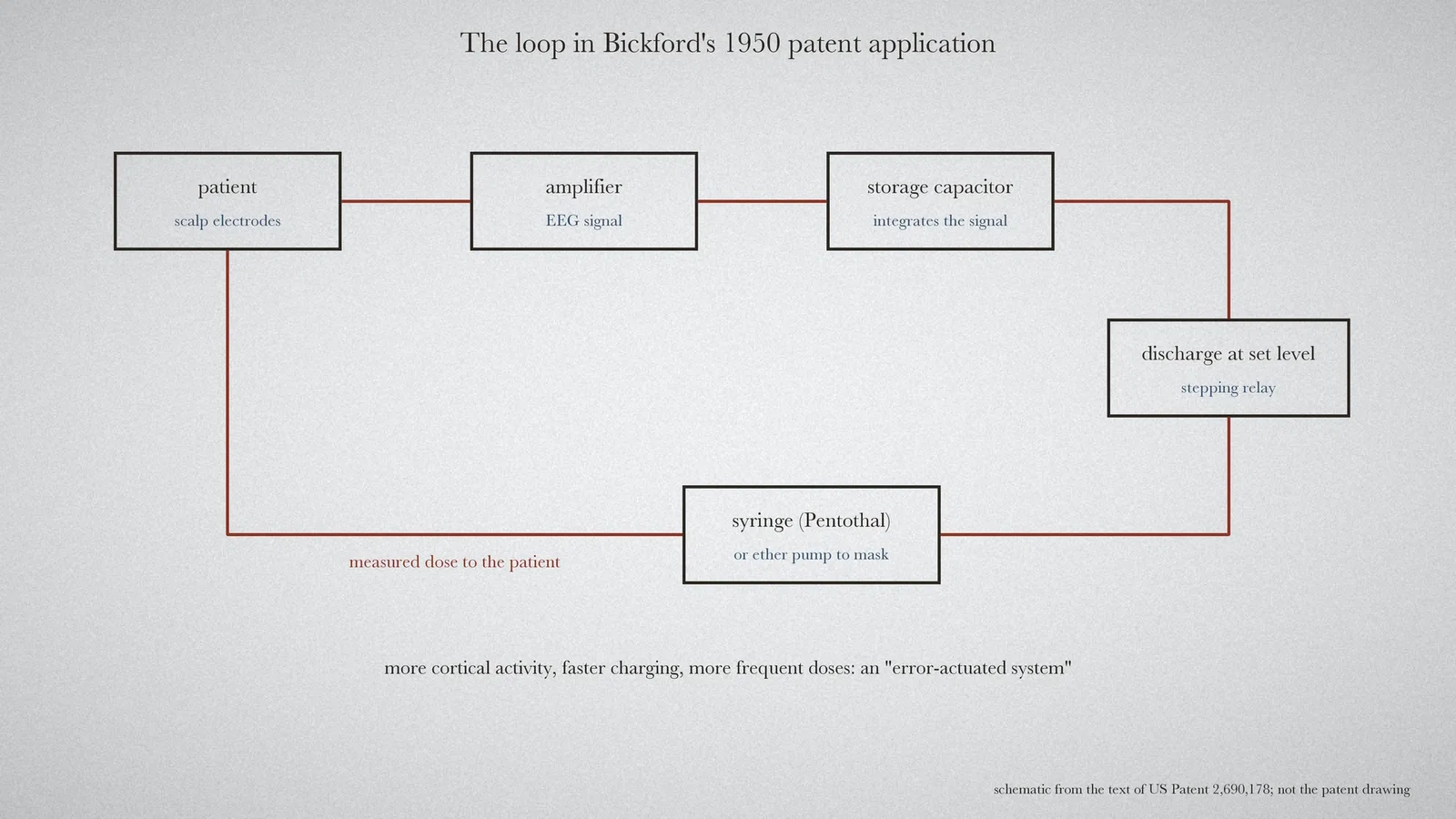
The mechanism was simple. The amplified brain-wave signal charged "a storage capacitor which accumulates and hence integrates the amplified brain wave signal"; whenever its voltage reached a set level it discharged, and a stepping relay advanced a syringe by one measured dose. [1] For ether, a pump could deliver the liquid "by a tube to the sponge in the respiratory mask of the patient". [1] The more electrical activity the cortex showed, the faster the capacitor charged and the more often a dose followed.
Bellville and Attura, 1957
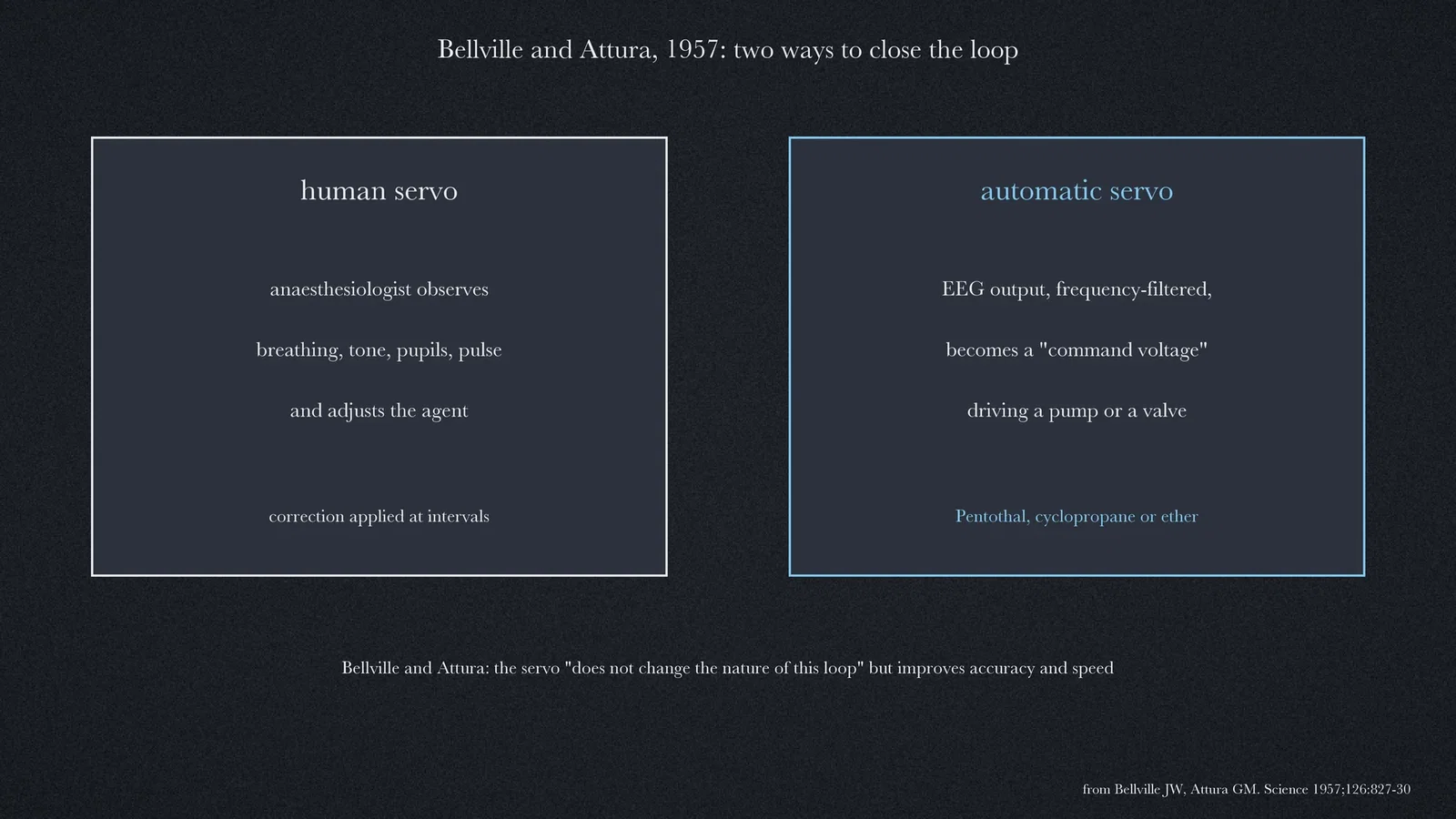
Seven years later J. Weldon Bellville, of the Memorial Center for Cancer and Allied Diseases and Cornell, and George M. Attura, chief engineer of the Industrial Control Company, described a servo version in Science. [2] They began with the anaesthesiologist. In ordinary practice the anaesthesiologist estimates depth from breathing, muscle tone, blood pressure, pulse, pupils and reflexes and adjusts the agent at intervals; "It might be called a human servo". [2] Defining depth by the cortical potential, they wrote that "the first system designed to control the depth of anesthesia automatically was described by Bickford in 1950", in which a fixed amount of Pentothal or ether was given in response to integrated cortical activity, and that in 1952 Bickford had described a frequency-based method. [2] Their own device turned a frequency-filtered EEG output into a "command voltage" that drove a pump for Pentothal or a valve for cyclopropane or ether. Adding the servo, they argued, did not change the nature of the loop; it improved the accuracy and speed with which depth was sensed and corrected. [2]
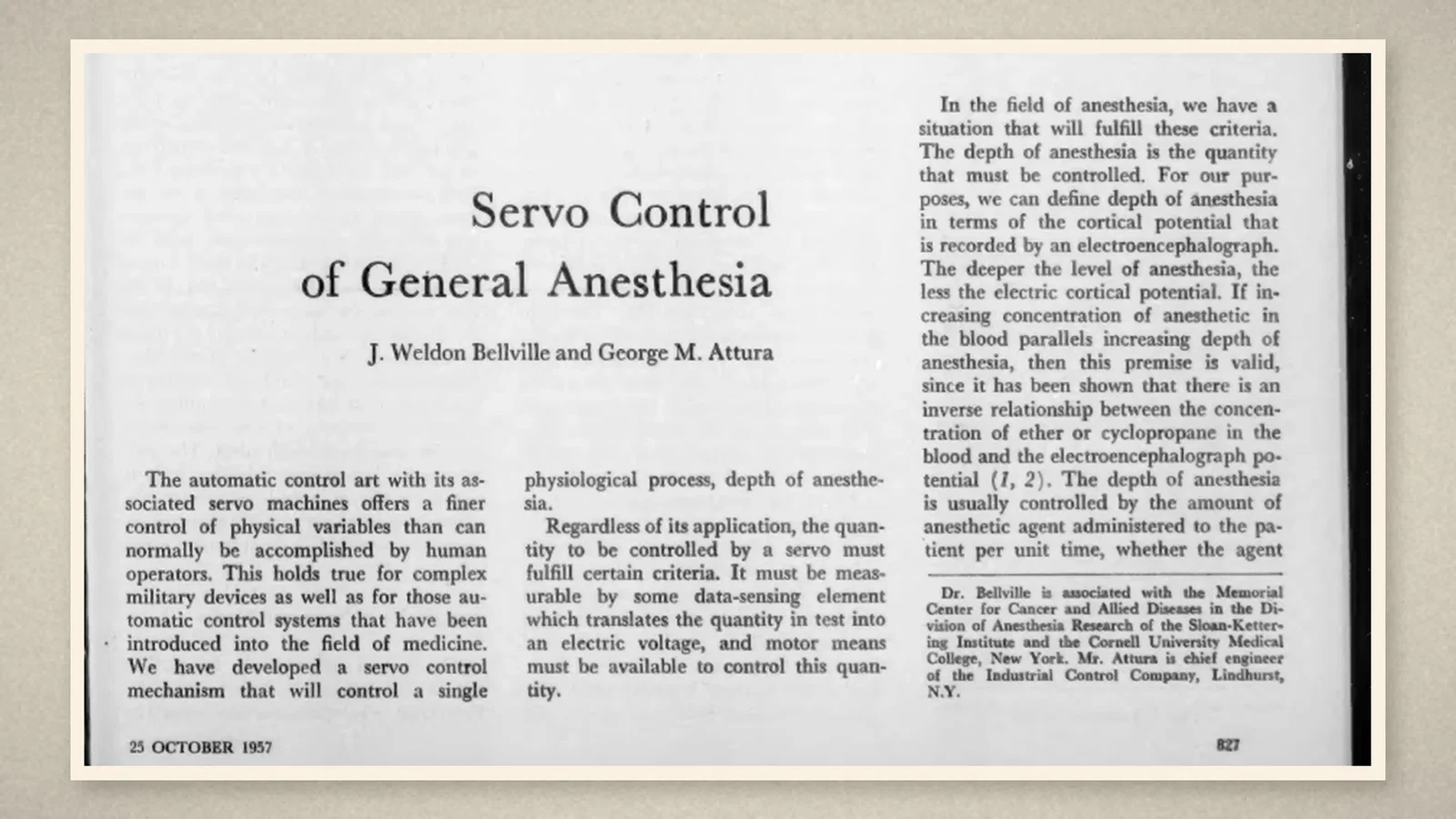
Larson adds two details. Bickford, Larson writes, was not an anaesthesiologist, but was impressed enough by the EEG changes reported by Courtin, Bickford and Faulconer in 1950 to propose controlling ether or thiopental from the EEG alone; and by 1969 Bellville was working on a project to send EEG and other signals by radio to a control room where two or three anaesthesiologists might manage eight to ten anaesthetics at once. [3]
What the record shows
The 1950 application put on paper an idea that later monitoring and computer-controlled infusion would return to: let a signal from the patient's brain decide how much anaesthetic to give. Bellville and Attura's phrase "human servo" is the more lasting part. It described what the anaesthesiologist already did, and showed that an automatic system would change the speed and accuracy of that loop, not the loop itself.
Sources and reading limits
Read: US Patent 2,690,178 as the printed specification with drawings and as Google Patents text; Bellville and Attura's 1957 Science paper from the Internet Archive scan; Larson's 2009 article, read as page images because the archived PDF has no text layer.
Not covered: Courtin, Bickford and Faulconer's 1950 Mayo Clinic paper and Bickford's own 1950-1952 papers on automatic EEG control; any record of clinical use of the patented apparatus beyond what Bellville and Attura state; the 1969 project, known only from Larson. Larson prints the patent number as "26901787"; the patent itself reads 2,690,178. "First" is Bellville and Attura's word.
Two illustrations are crops of the patent and the 1957 paper; two are drawn from the sources.
- Bickford RG, inventor; Research Corporation, assignee. Automatic apparatus for administering drugs. US Patent 2,690,178. 1954 Sep 28. Google Patents
- Bellville JW, Attura GM. Servo control of general anesthesia. Science. 1957;126(3278):827-30. Internet Archive
- Larson M. Robot anesthesia. CSA Bull. 2009 Fall:45-9. Internet Archive PDF
Continue exploring
Related reading connects shared questions and contexts; it does not by itself establish historical influence.
Anesthesia Epochs · The Source Room · About & Editorial Method
Published November 2, 2026. Sources and reading limits are stated above. Illustrations are labelled as original source images or AI-made. Historical accounts are educational; they are not current treatment instructions.