
Instead of paying abstractors to read charts, the Anesthesia Quality Institute collected the electronic files that anaesthesia practices already produced for billing and quality capture, and within four years held about 16 million cases.
Reading Library · Anesthesia Epochs · 中文版
Watch the education video (for clinicians)
2009: The AQI and NACOR — A Registry of Every Anaesthetic · Anesthesia Epochs Education Series
Anaesthesia's success makes it hard to study. In 2014 R. P. Dutton, writing from the Anesthesia Quality Institute (AQI), put the problem in numbers: serious intraoperative adverse events occur in "fewer than 1 case in 200", so the records needed to show a trend are enormous. Specialties such as cardiac surgery had built registries by having trained staff abstract a manageable number of charts. For anaesthesia, which touches almost every patient in every kind of facility, that approach "would be prohibitively expensive". [1] This article is about the American Society of Anesthesiologists' (ASA) answer: a registry fed by the electronic files that practices already produced.
An institute and a registry
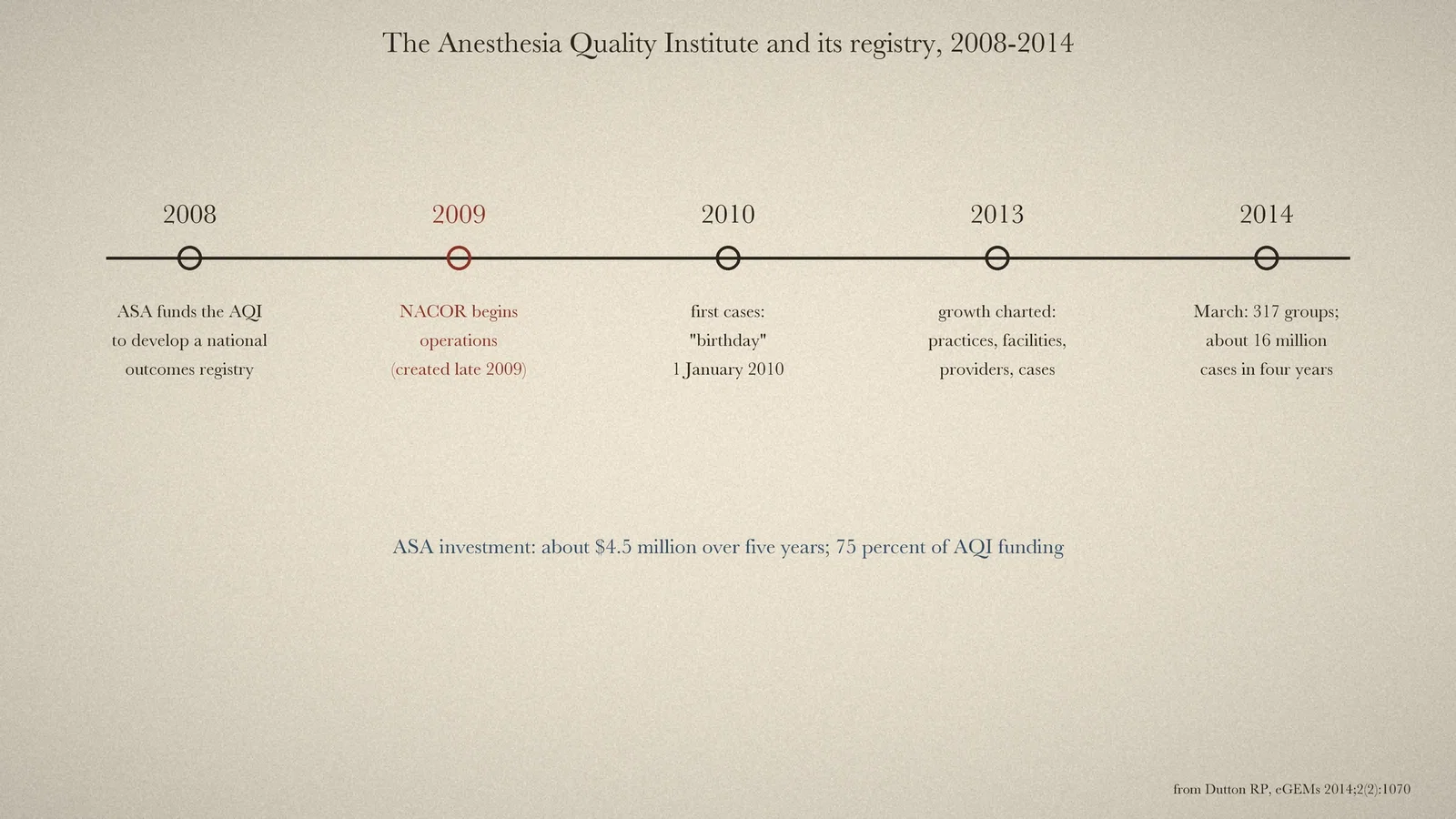
According to Dutton, the ASA "addressed this challenge in 2008 by funding a related organization", the AQI, to develop the National Anesthesia Clinical Outcomes Registry (NACOR). [1] A 2015 technical description says the AQI was "chartered in 2008". [3] The AQI was a 501(c)(3) nonprofit housed at ASA headquarters in suburban Chicago, with about a dozen employees in 2014; its early papers give its address as Park Ridge, Illinois. [1,2,4] NACOR began operations in 2009; it "was created in late 2009, and the first cases were entered in January, 2010". The AQI called 1 January 2010 the registry's "birthday" and asked new members for records back to that date where their software held them. [1]
Every case, every day
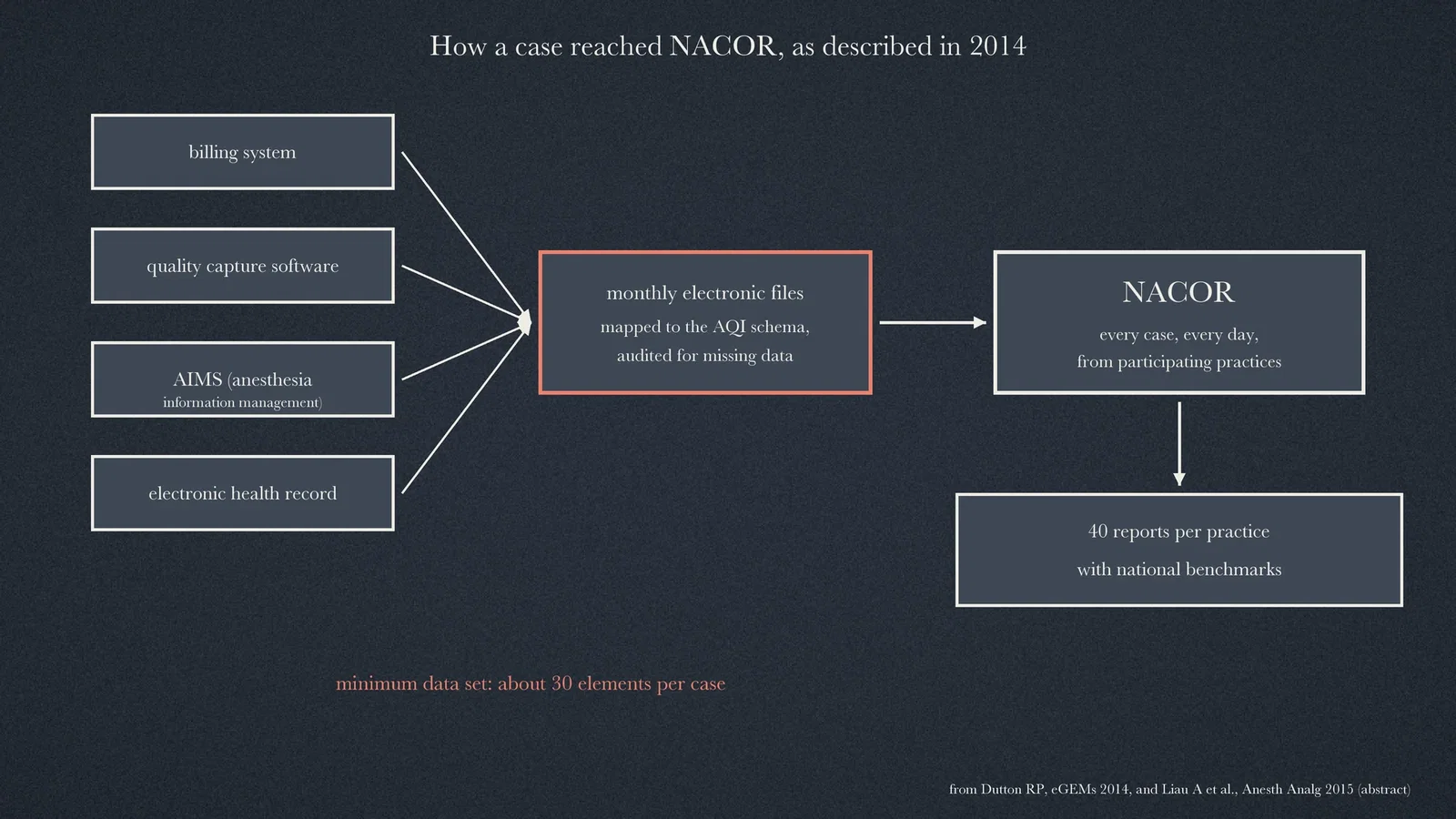
The design was the point. NACOR did not depend on abstractors reading charts. Practices sent periodic electronic files, typically monthly, generated by billing, quality capture, anaesthesia information management and electronic record software. [1,3] A 2011 description by Dutton and A. Dukatz lists the same sources and says the aim was national and cohort-specific benchmarks, returned to practitioners in private reports. [2] Because transmission was passive, the registry was a census rather than a sample: it held "every case, every day" from participating practices. The minimum data set was about 30 elements per case, all already present in an anaesthesia bill, so joining required no extra documentation. Practices with AIMS records could send thousands of data points per case, including vital signs every minute. [1]
Growth
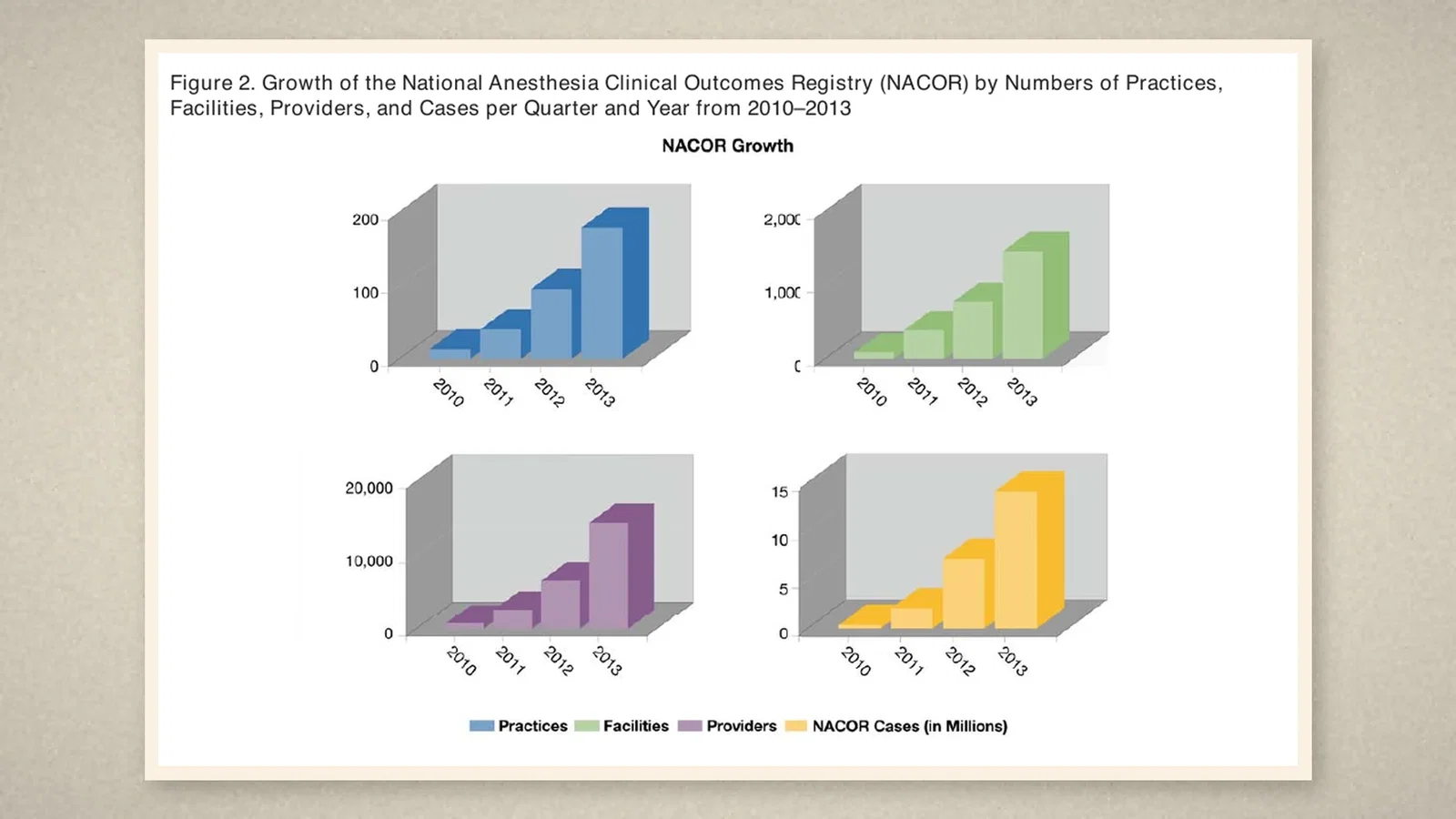
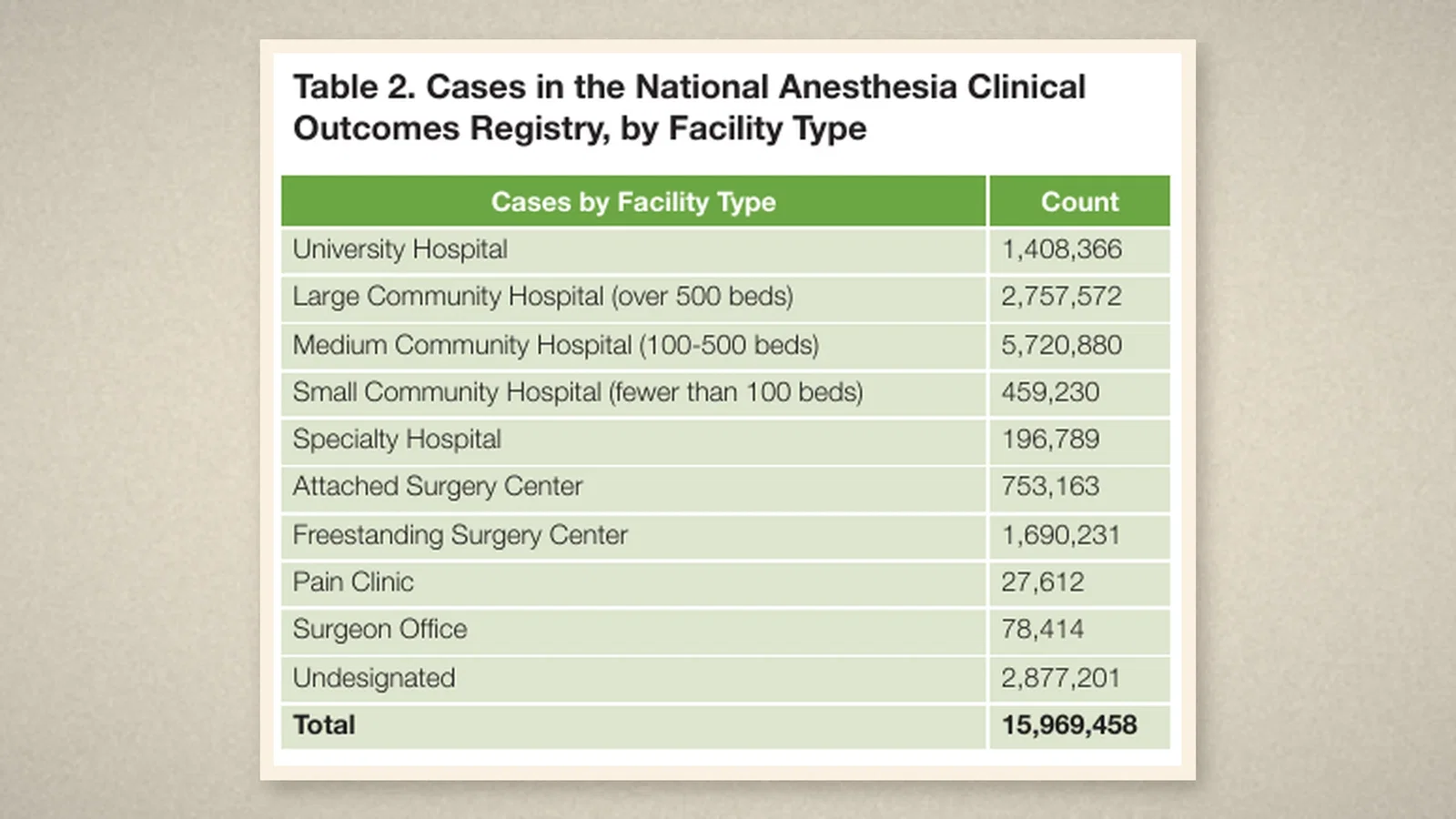
By March 2014, 317 anaesthesia groups had contracted with NACOR and 195 were "in production". The practices included 13,905 physician anaesthesiologists, 9,324 nurse anaesthetists and more than 3,500 residents and nurse trainees, which Dutton estimated at 20-25% of the national workforce. Each day 20,000 to 100,000 cases arrived, and the registry held about 16 million records from four years. [1]
The money came mainly from the ASA: 75% of AQI funding was an annual ASA grant, and the society's investment had reached about $4.5 million over five years. Groups whose members all belonged to the ASA paid nothing to join; non-ASA providers paid $500 a year. [1] The AQI also ran the Anesthesia Incident Reporting System and the Closed Claims Project registry, and became a federally designated Patient Safety Organization. In spring 2014 NACOR was designated a Qualified Clinical Data Registry for federal quality reporting, which Dutton expected to drive participation. [1]
What the data were used for
Practices could log in to 40 reports on their own data, with national benchmarks where appropriate. [1] Researchers at participating institutions could request a deidentified case-level file. [3] Early papers used it to describe office-based anaesthesia and to estimate perioperative cardiac arrest: 5.6 per 10,000 cases in reports from 2010 to 2013. [5,6]
Problems named by the builders
Dutton called the approach "Ready, Fire, Aim" and was frank about its costs. Data were often missing, usually because a practice's software did not capture or transmit an element. Definitions varied: postoperative nausea and vomiting, for example, was recorded differently from practice to practice, so the AQI held annual definitions conferences with vendors. And about half of practices did not contact patients after discharge from the recovery room, so outcomes after that point were simply absent. [1] The ASA today calls NACOR "the largest anesthesia registry in the world by case volume". [7]
What the record shows
NACOR was the ASA's bet that a specialty could measure itself by collecting the data it already generated, rather than by building a research staff to read charts. The bet bought scale quickly. Whether scale without consistent definitions or long-term follow-up was enough to improve care is a question the sources read here do not answer.
Sources and reading limits
Read: the full text of Dutton 2014 in eGEMs (open-access PDF, with Table 2 and Figure 2 as page images); the PubMed abstracts of Dutton and Dukatz 2011, Liau et al. 2015, Shapiro et al. 2014 and Nunnally et al. 2015; the PubMed record of Dutton's 2014 review of AQI registries (no abstract); the current ASA page on the AQI.
Not covered: ASA board or House of Delegates records of the 2008 decision; the AQI's own website, which did not respond; the Wood Library-Museum timeline entry dating this development to 2009, which could not be accessed; the full texts of the 2011 and 2015 descriptions. Almost every source here was written by authors affiliated with the AQI. No independent evaluation of NACOR's effect on care was found. Participation figures are those of March 2014.
Two illustrations are crops of Dutton 2014; two are drawn from the sources.
- Dutton RP. The National Anesthesia Clinical Outcomes Registry: a sustainable model for the information age? EGEMS (Wash DC). 2014;2(2):1070. DOI
- Dutton RP, Dukatz A. Quality improvement using automated data sources: the Anesthesia Quality Institute. Anesthesiol Clin. 2011;29(3):439-54. PubMed
- Liau A, Havidich JE, Onega T, Dutton RP. The National Anesthesia Clinical Outcomes Registry. Anesth Analg. 2015;121(6):1604-10. PubMed
- Dutton RP. Registries of the Anesthesia Quality Institute. Int Anesthesiol Clin. 2014;52(1):1-14. PubMed
- Shapiro FE, Jani SR, Liu X, Dutton RP, Urman RD. Initial results from the National Anesthesia Clinical Outcomes Registry and overview of office-based anesthesia. Anesthesiol Clin. 2014;32(2):431-44. PubMed
- Nunnally ME, O'Connor MF, Kordylewski H, Westlake B, Dutton RP. The incidence and risk factors for perioperative cardiac arrest observed in the National Anesthesia Clinical Outcomes Registry. Anesth Analg. 2015;120(2):364-70. PubMed
- American Society of Anesthesiologists. Anesthesia Quality Institute. Website
Continue exploring
Related reading connects shared questions and contexts; it does not by itself establish historical influence.
Anesthesia Epochs · The Source Room · About & Editorial Method
Published November 2, 2026. Sources and reading limits are stated above. Illustrations are labelled as original source images or AI-made. Historical accounts are educational; they are not current treatment instructions.