In April 1996 the ASA and the SCA published a practice guideline for perioperative TEE that graded each use by the evidence and expert opinion behind it and set out basic and advanced levels of operator skill.
Reading Library · Anesthesia Epochs · 中文版
Watch the companion film
1996: ASA/SCA — Guidelines for Perioperative TEE · Watch on YouTube
Historical anchor: 1996. Date details and source qualifications are explained below.
April 1996 · A historical guideline and its evidence boundaries
A cardiac image can change a discussion in the operating room. Whether it improves outcomes, who can interpret it and when it should be used are separate questions. The joint ASA/SCA practice guideline on perioperative transesophageal echocardiography (TEE) appeared in April 1996, after approval by the societies’ relevant bodies in 1995. The ASA web print preserved in a hospital archive carries a 2002 print date; that later date does not redefine the original publication.[1, PDF pp.1,20;2]
The report presented scientific evidence and expert opinion separately. Category I could reflect the strongest evidence or expert opinion; Category II combined weaker evidence with expert consensus. Category III had little scientific or expert support, often because studies were absent. Category I therefore did not invariably mean benefit established by randomized trials, and Category III did not simply mean demonstrated ineffectiveness. The authors also distinguished adaptable guidelines from mandatory standards.[1, PDF p.2]
Its valve recommendations make the historical categories concrete: valve repair was Category I, while valve replacement was Category II. When a TEE assessment would determine the surgical plan, the report called for advanced expertise or timely access to consultation. These were the distinctions of the 1996 document. The 2010 update used different wording for adult cardiac surgery, which should not be read back into the first report.[1, PDF pp.5,17;3, PDF p.3]
Training occupied a substantial part of the first report. Basic skills emphasized recognition of major abnormalities and their use in monitoring; advanced skills extended to fuller quantitative and diagnostic assessment. Acquisition, interpretation, documentation, communication and recognition of limits belonged to the same framework. Rather than prescribe one training duration or examination count for every institution, the report emphasized objective assessment and continuing quality assurance. Introductory exposure during residency did not itself establish basic competence.[1, PDF pp.14–15,18–19]
The report offers a specific comparison with the 1970: Swan and Ganz Bring Pulmonary Artery Pressure to the Bedside. It discussed images of ventricular size and function alongside pressure information from pulmonary artery catheters and other methods. Its proposed advantages of end-diastolic volume for assessing preload appeared under expert opinion. This comparison concerns the information used in clinical judgment; it does not establish that TEE had been proved to replace pulmonary artery catheterization.[1, PDF pp.1,4]
Recommendation strength and outcome evidence were not interchangeable. The ischemia-monitoring section described little direct evidence of improved outcomes. Experts considered benefit plausible in part from indirect evidence. The report thus preserved a distinction that matters to its history: detecting an abnormality, changing management and demonstrating better patient outcomes are different claims.[1, PDF p.3]
Later documents developed different parts of the framework. The 2010 update focused on surgical or potentially surgical patients before, during and immediately after an operation, and did not address training, credentialing or quality assurance in that document. The 2013 ASE/SCA basic-examination consensus placed the 1996 basic/advanced distinction, the 1999 comprehensive-examination guidance and the 2002 training document at separate points in its history. Its discussion of an eleven-view basic examination belongs to 2013, not 1996.[3, PDF p.1;4, printed pp.444–445]
The historical contribution of the 1996 guideline lies in bringing clinical circumstances, the basis of a recommendation and operator competence into one decision framework. An image still required an account of what it could support and who was qualified to interpret it. Reading the original report alongside explicitly dated later documents preserves that development without treating publication of a guideline as proof of reduced mortality.[1, PDF pp.2–5,14–19;3, PDF p.1;4, printed p.445]
Images
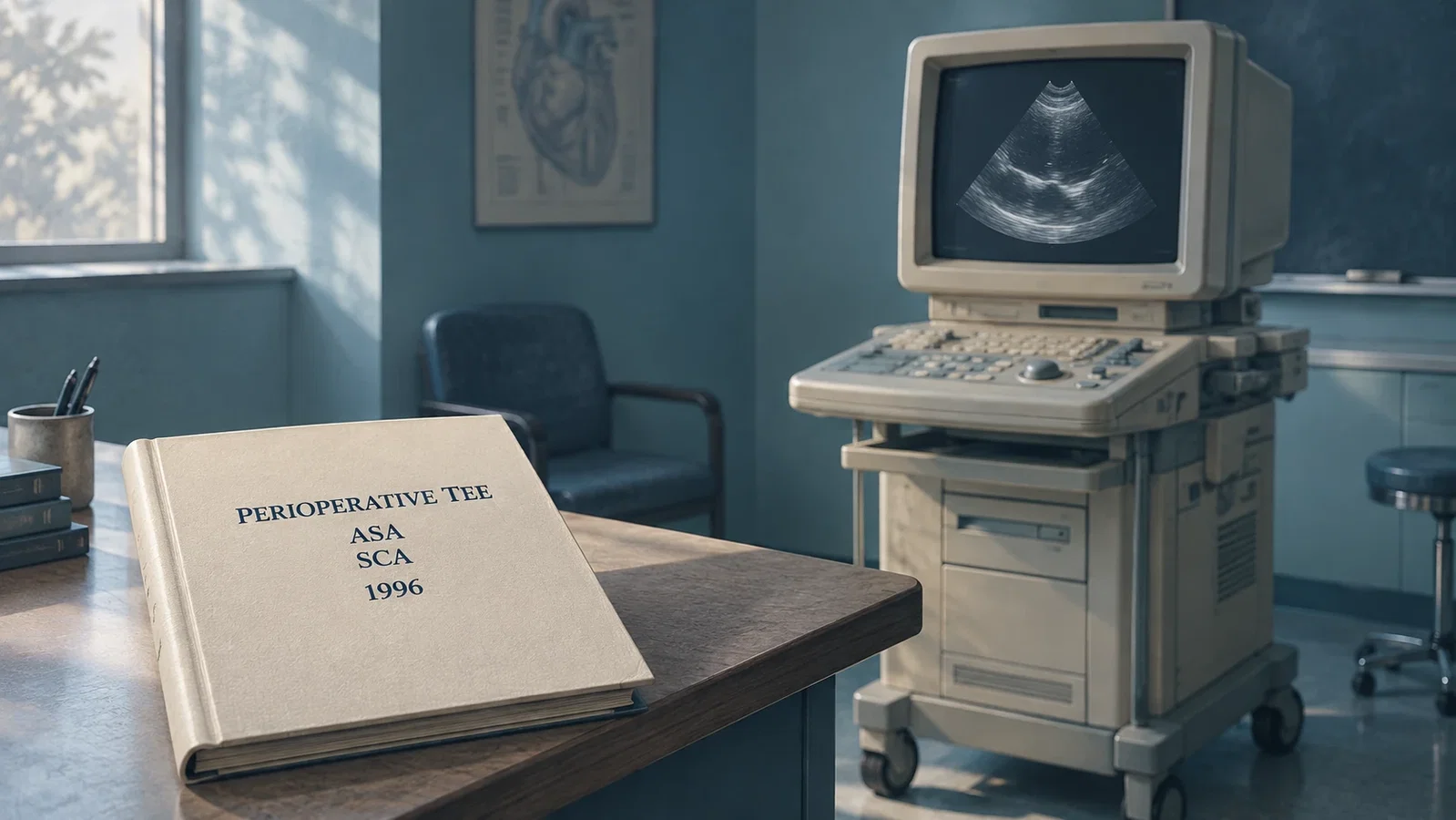
Modern conceptual reconstruction of a 1990s-style ultrasound station and guideline; not a photograph of a documented event.
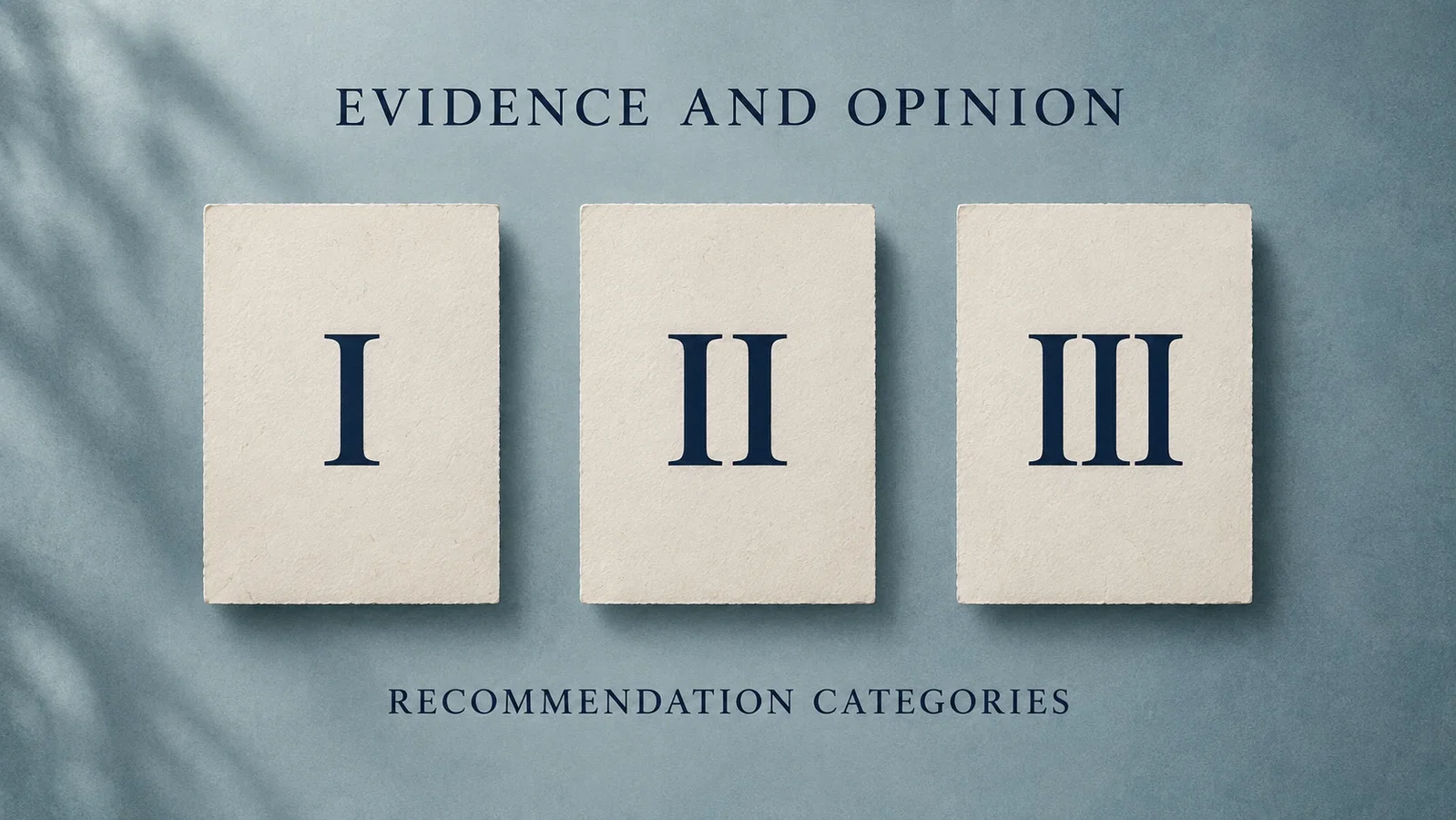
Editorial concept: recommendation categories and evidence strength require separate interpretation.
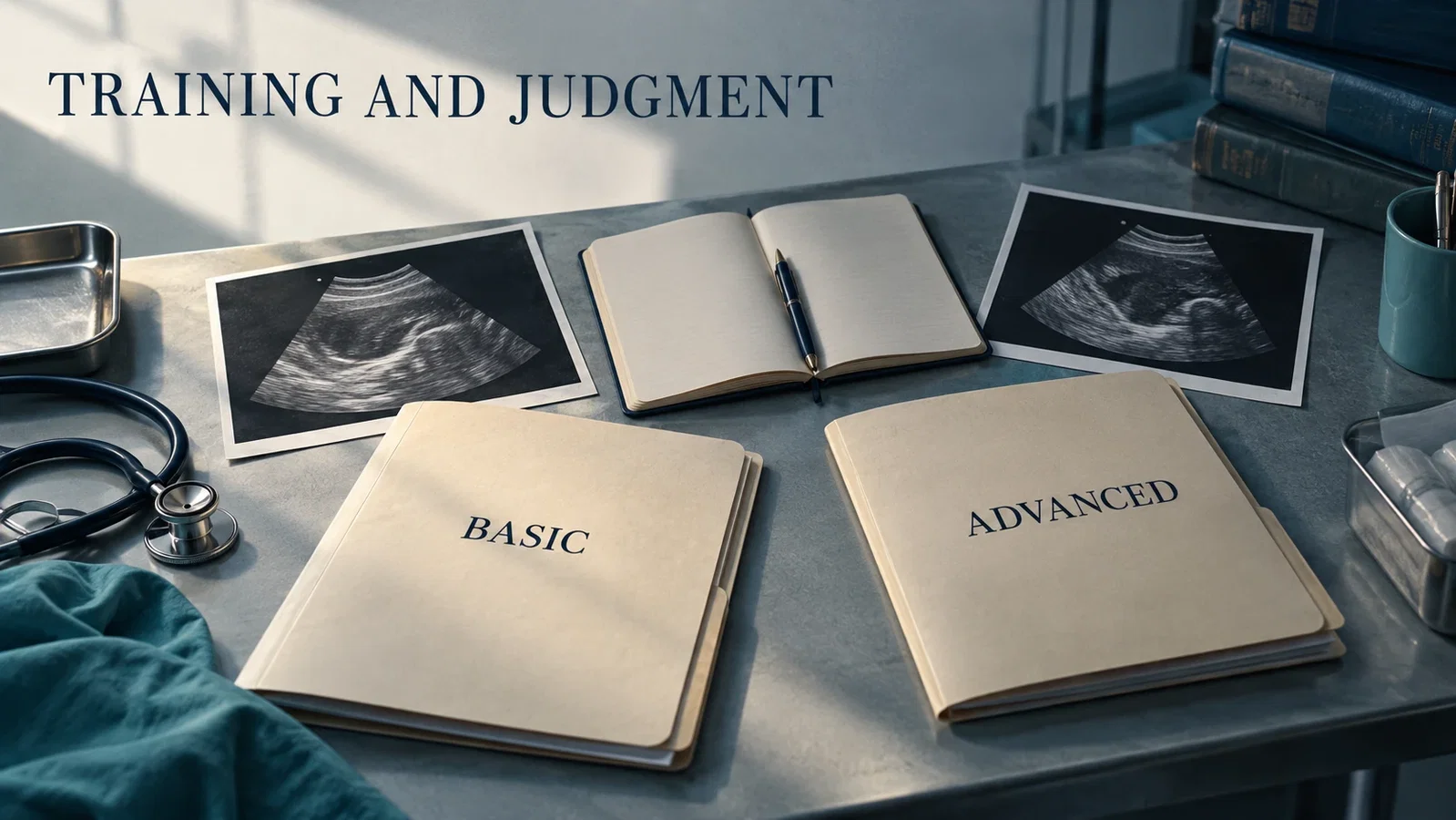
Editorial concept: basic and advanced competence, including recognition of limits and consultation.
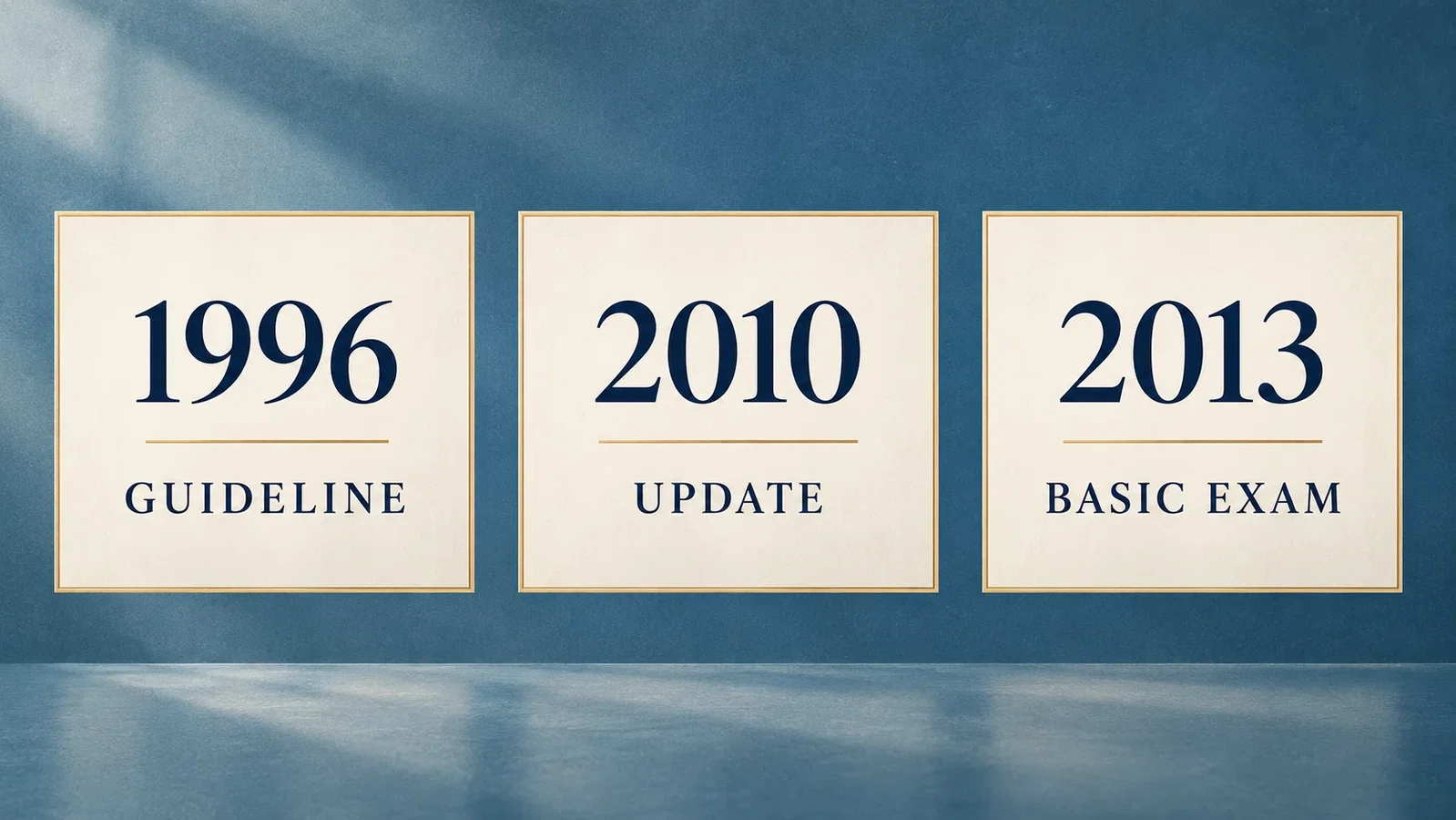
Editorial timeline separating the 1996 report, 2010 update and 2013 basic-examination consensus.
Sources and reading limits
- ASA/SCA Task Force. Practice guidelines for perioperative transesophageal echocardiography. Anesthesiology. 1996;84:986–1006. ASA web print archived by BIDMC. Selected PDF pp.1–5,13–20; 20-page reformat, not original journal pagination.
- NLM PubMed 8638856. Bibliographic record: April 1996;84(4):986–1006. Metadata only.
- ASA/SCA Task Force. Practice guidelines for perioperative transesophageal echocardiography: updated report. 2010. Official ASA PDF. Selected PDF pp.1–3 of 13, pre-pagination version; final citation 112:1084–1096 is corroborated in reference 4.
- Reeves ST et al. Basic perioperative transesophageal echocardiography examination: ASE/SCA consensus. J Am Soc Echocardiogr. 2013;26:443–456. DOI:10.1016/j.echo.2013.02.015. Official ASE PDF. Selected printed pp.443–445, not the full consensus.
Reading scope: nineteen individual pages across three documents. The 1996 source is an archived ASA web print; the journal-typeset PDF and separate literature monograph are not covered. Only selected pages of the 2010 and 2013 documents were read. Their reference lists do not imply reading of all underlying studies. Historical recommendations are not presented as current clinical instructions. Images are modern editorial concepts in the original landscape format.
Continue exploring
Related reading connects shared questions and contexts; it does not by itself establish historical influence.
The Source Room · About & Editorial Method
Sources and reading limits are stated above. Illustrations are labelled as original source images or AI-made. Historical accounts are educational; they are not current treatment instructions.