Reading an ancient word through two passages of the Timaeus.
Reading Library · Anesthesia Epochs · 中文版
Watch the education video (for clinicians)
4th Century BCE: Plato's Anaisthēsia — One Word in Two Settings · Anesthesia Epochs Education Series

A familiar medical word can make an old passage unexpectedly difficult to read. We recognize its descendant and begin supplying a setting that the text itself never provides.
The Greek noun ἀναισθησία, transliterated as anaisthēsia, appears in different inflected forms at 52b and 74e of Plato’s Timaeus. One passage concerns the apprehension of place; the other concerns bodily construction and sensation. Reading both simply as “anesthesia” would obscure what each passage is doing.[1, 52a–52d, 74b–75c]
This article places the dialogue within the fourth century BCE. It does not turn the approximate date around 350 BCE used in historical timelines into a securely established year of composition, or treat two surviving uses as proof of who coined the word.
At 52b, an object beyond the senses
Around 52a, the dialogue distinguishes an unchanging Form, the generated things apprehended through sensation, and a third kind that provides room for things that come into being. Bury’s English translation calls this third kind Place. At 52b it is approached through an unusual form of reasoning, with μετʼ ἀναισθησίας rendered as “by the aid of non-sensation.”[1, 52a–52b]
The question is how something can be apprehended. The passage introduces no patient, drug, incision or method of relieving pain. Translating the phrase as “under anesthesia” would import a clinical situation into an argument about knowledge.
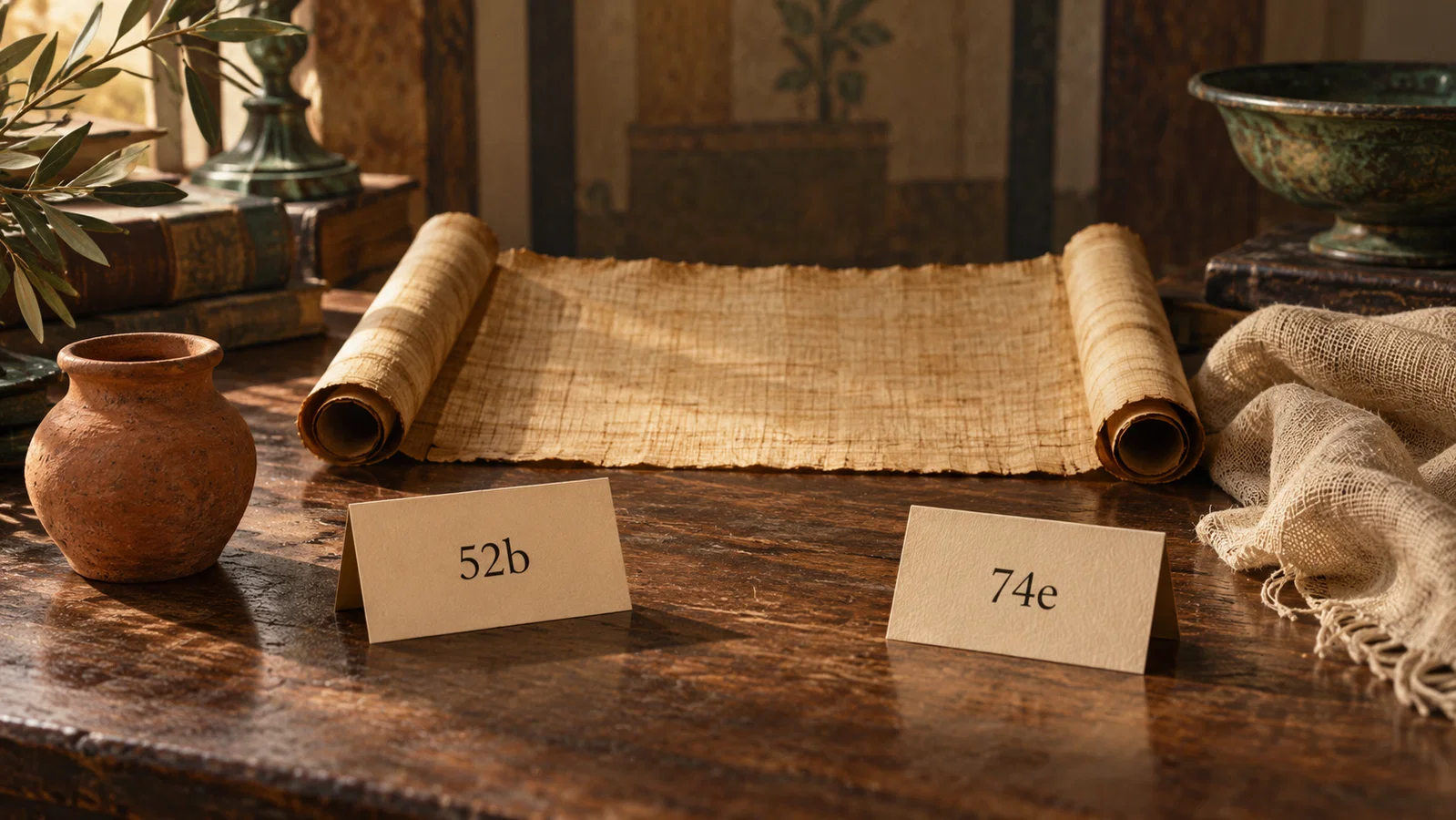
The discussion continues through 52c–52d with images, what truly exists, and the place in which becoming occurs. The word therefore has to be read along that line of thought. Resolving every philosophical dispute about Place lies beyond this article; recognizing the passage as an account of perception and reasoning is enough to prevent a misleading medical translation.[1, 52c–52d]
At 74e, the cost of bodily protection
The setting changes by 74b. The speaker explains how sinews connect the limbs and allow them to bend, while flesh protects against heat and cold and cushions a fall. At 74e, excessive flesh around the joints threatens movement. Its thickness, density and rigidity may also produce insensitivity, with consequences for memory and thought. Here ἀναισθησίαν becomes “insensitiveness” in Bury’s translation.[1, 74b–74e]
This passage concerns bodily sensation, but it remains part of the dialogue’s account of how human bodies were fashioned. It records no administration of a drug and offers no method for performing surgery. The explanation belongs to the text’s account of bodily design; it should not be presented as experimentally established physiology.
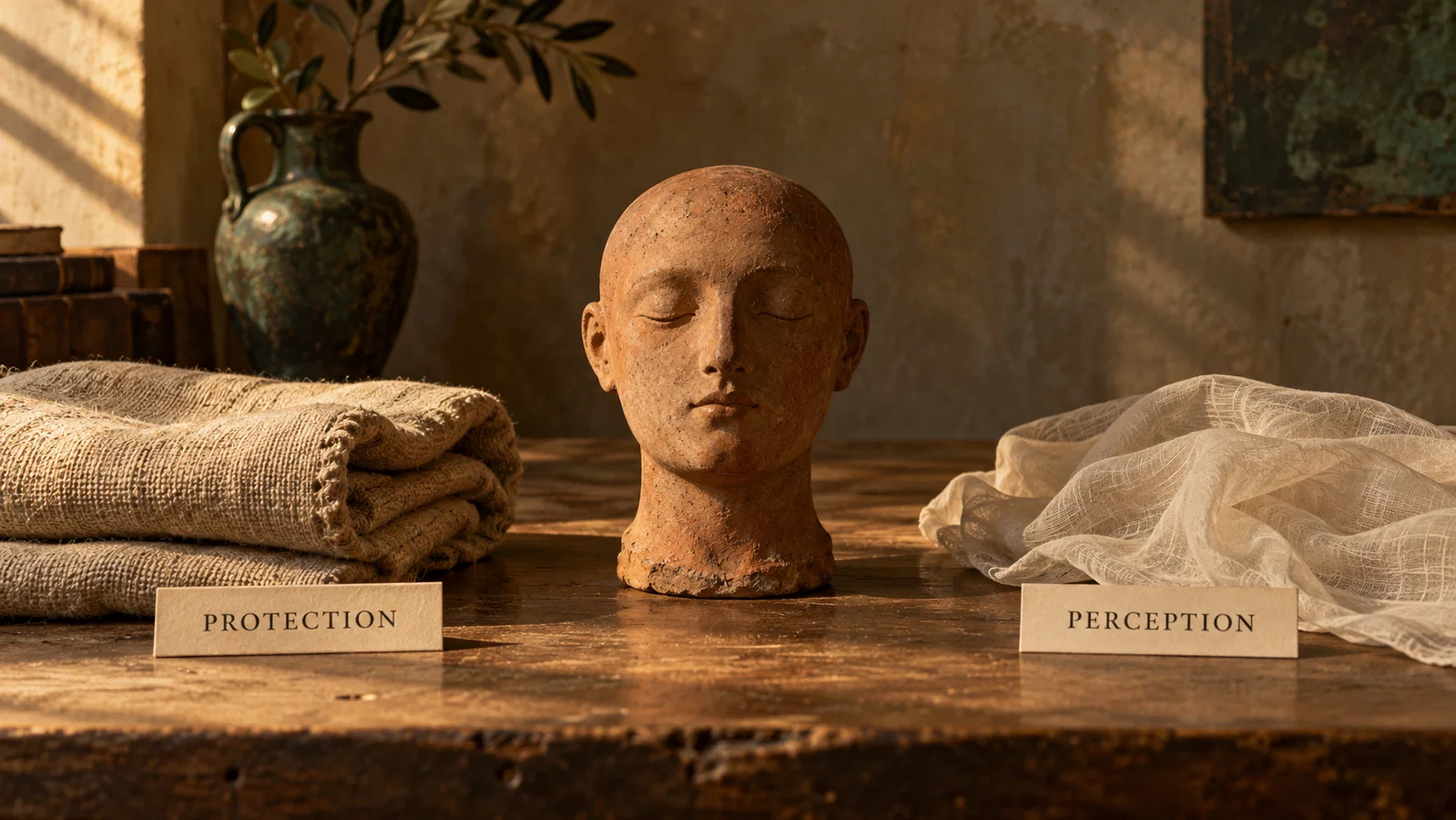
At 75b–75c, the tradeoff becomes explicit. If dense bone and abundant flesh could coexist with sharp perception, the head could have been stronger. In the dialogue, however, its makers choose a different arrangement: greater perceptiveness and intelligence accompany greater vulnerability. This is the immediate intellectual setting of the word at 74e.[1, 75b–75c]
How later histories looked back
In The History of Surgical Anesthesia, Thomas Keys mentions Plato while discussing Holmes’s naming proposal. His account reports Osler reporting Withington’s observation about the word in the Timaeus. That is a later chain of scholarly testimony. Its upstream documents were not separately inspected for this article, and the chain cannot certify an exhaustive claim about the earliest Greek use.[3, p. 30]
A different, directly locatable witness is the letter printed by Edward Warren in 1847. Dated November 21, 1846, it proposes Anæsthesia for the state then under discussion and explicitly refers to page 259 of Good’s nosology. Plato is not named in the printed letter.[2, p. 79]

That omission does not establish that Holmes had never read Plato. It identifies the reference visible in this particular letter. The existence of an ancient word and a later writer’s direct borrowing from a particular ancient passage are separate historical questions.
Set beside the 1846 proposal, the two passages make the history more precise. Apprehension without sensation, bodily insensitivity, and a name for a newly discussed state each have their own setting. A word could acquire new medical work without every earlier appearance becoming an origin story for surgical anesthesia.
Image note: all four images are AI-generated modern editorial reconstructions or conceptual still lifes. Figures are anonymous; scrolls, letter paper, the terracotta head and reading cards are not authenticated objects or facsimiles. The images depict no ancient anesthetic procedure and establish no direct transmission from Plato to Holmes.
Sources and reading limits
- Plato. Timaeus. Greek text edited by John Burnet, Platonis Opera, vol. 4, 1905; English translation by R. G. Bury, Plato in Twelve Volumes, vol. 9, 1929. Perseus Project Greek digital transcription and English digital transcription. Read: sections 52a–52d and 74b–75c, with attached short notes. The entire dialogue, ancient manuscripts and scans of these printed editions were not independently inspected.
- Warren E. Some Account of the Letheon; Or, Who was the Discoverer? Second edition, 79-page issue. Boston; 1847:79. Original-edition scan · Library copy. Read: this complete page; it is a printed witness to the letter, not Holmes’s autograph. The entire pamphlet was not reread.
- Keys TE. The History of Surgical Anesthesia. Wood Library-Museum, 1996 reprint:30. Library scan · Archived copy. Edition information, relevant preface material and page 30 text read; not the entire 276-page scan container. The cited Osler and Withington materials were not separately obtained.
Continue exploring
Related reading connects shared questions and contexts; it does not by itself establish historical influence.
Anesthesia Epochs · The Source Room · About & Editorial Method
Updated October 30, 2026. Sources and reading limits are stated above. Illustrations are labelled as original source images or AI-made. Historical accounts are educational; they are not current treatment instructions.