A contemporary review records the clinical framework of a diagnostic monograph.
Reading Library · Anesthesia Epochs · 中文版
Watch the companion film
1966: Plum and Posner — Stupor and Coma · Watch on YouTube
Historical anchor: 1966. Date details and source qualifications are explained below.
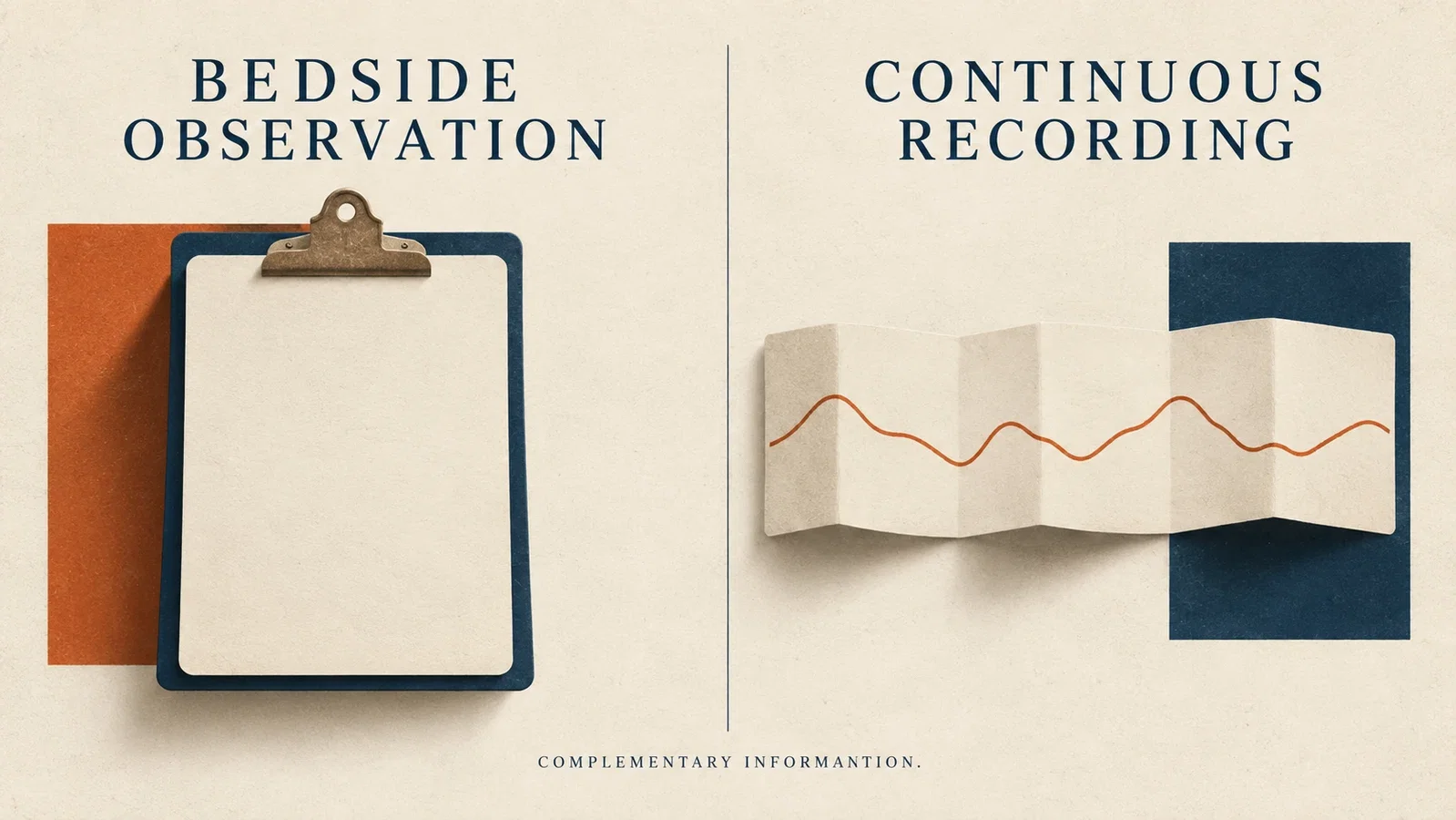
A clinical examination and a continuous recording do different kinds of work. One gathers findings at the bedside; the other follows a signal between observations. Two publications from the 1960s offer a useful historical comparison: Plum and Posner’s diagnostic monograph, published in 1966, and a report of a cerebral function monitor three years later. The comparison concerns their methods of observation, not an established line of invention.[1,2,4]

The earlier work was The Diagnosis of Stupor and Coma, by Fred Plum and Jerome B. Posner, published by F.A. Davis in Philadelphia. “Treatment,” familiar from the title of a later edition, was absent from that first title.[1,3] The surviving public title and copyright pages establish the book’s identity, although the accessible scan is a later printing of the first edition.
How did a contemporary reader describe its purpose? In a 1967 review, P. K. Thomas emphasized the book’s clinical orientation. He outlined a progression from the pathophysiology of coma to supratentorial and subtentorial lesions, followed by the longest chapter, on metabolic brain disease. He singled out its discussions of eye movements and respiration.[2] That account gives us a contemporary description of the framework; it does not substitute for reading every chapter of the original book.

The framework treated coma as a starting point for diagnostic reasoning. Findings had to be interpreted in relation to anatomy and disease processes. Thomas understood the monograph as an attempt to bring knowledge of the nervous system into clinical work.[2] His favorable judgment documents reception by one reviewer. It is not evidence that publication itself improved patient outcomes.
A much later edition looked back on this clinical tradition. The preface to the fifth edition, published in 2019, traced the first three editions to Plum and Posner’s experience and described the continuing importance of bedside examination as imaging changed the diagnostic setting.[3] The date matters: later authors were reflecting on the earlier work, not reproducing its entire 1966 content.
The fifth edition also provides a carefully bounded historical claim about the locked-in syndrome. On page 6, it dates the use of that name to the 1966 first edition while acknowledging descriptions of the clinical condition in the nineteenth century.[3] Naming the syndrome is therefore distinct from being the first to recognize such patients. The same page cautions against treating loss of motor response as a straightforward measure of impaired consciousness. Both statements here are attributed to the 2019 text; the relevant first-edition passage was not available for direct reading.

Continuous recording addressed another problem. In 1969, D. Maynard, Pamela F. Prior and D. F. Scott described a cerebral function monitor for use alongside intermittent conventional EEG examinations. Their apparatus produced a prolonged record of processed electrical activity.[4] One illustrated case, following barbiturate overdose, showed changes in the recording before corresponding clinical changes became apparent. An example of differing time courses was not a validated prognostic rule for every unresponsive patient.
Read together, the book’s diagnostic framework and the monitor report show two ways of obtaining and organizing information when a patient cannot respond normally. The relationship is an editorial comparison of bedside interpretation and continuous observation. Neither source establishes that Plum and Posner invented the monitor or that their book directly caused its development.
The 1966 publication can thus be located precisely without assigning it every later development in the field. Its title and contemporary review record an effort to organize the diagnosis of stupor and coma around clinically useful questions. Later editions and instruments belong to the continuing history of those questions.
Source and image note: Only public title and copyright pages of the first edition were directly read; its body is not covered. The account of its structure comes from a complete contemporary review. Later-edition testimony is dated and attributed. All four images are modern editorial interpretations, not original book illustrations, archival scenes or clinical instructions.
Sources and reading limits
- Plum F, Posner JB. The Diagnosis of Stupor and Coma. Philadelphia: F.A. Davis; 1966. Internet Archive public preview; WorldCat 712048. Only the public title and copyright pages were read from a later printing of the first edition. The copy records a third printing in June 1969. The first-edition body is not covered.
- Thomas PK. Book Review: The Diagnosis of Stupor and Coma. Proc R Soc Med. 1967;60(6):613. Publisher record and DOI. The complete Thomas review on p. 613 was read through the web-accessible text of the original journal page. Original PDF and page images are not covered.
- Posner JB, Saper CB, Schiff ND, Claassen J. Plum and Posner’s Diagnosis and Treatment of Stupor and Coma. 5th ed. Oxford University Press; 2019. Official sales preview. Title, copyright, preface p. xi and p. 6 were read. The preface is dated November 29, 2018; the edition was published in 2019. This is later testimony, not the 1966 text.
- Maynard D, Prior PF, Scott DF. Device for continuous monitoring of cerebral activity in resuscitated patients. Br Med J. 1969;4(5682):545–546. DOI; PMC original scans. Both original scanned pages, including the article text and figures, were read. The originals are page images, not a PDF.
Continue exploring
Related reading connects shared questions and contexts; it does not by itself establish historical influence.
The Source Room · About & Editorial Method
Sources and reading limits are stated above. Illustrations are labelled as original source images or AI-made. Historical accounts are educational; they are not current treatment instructions.