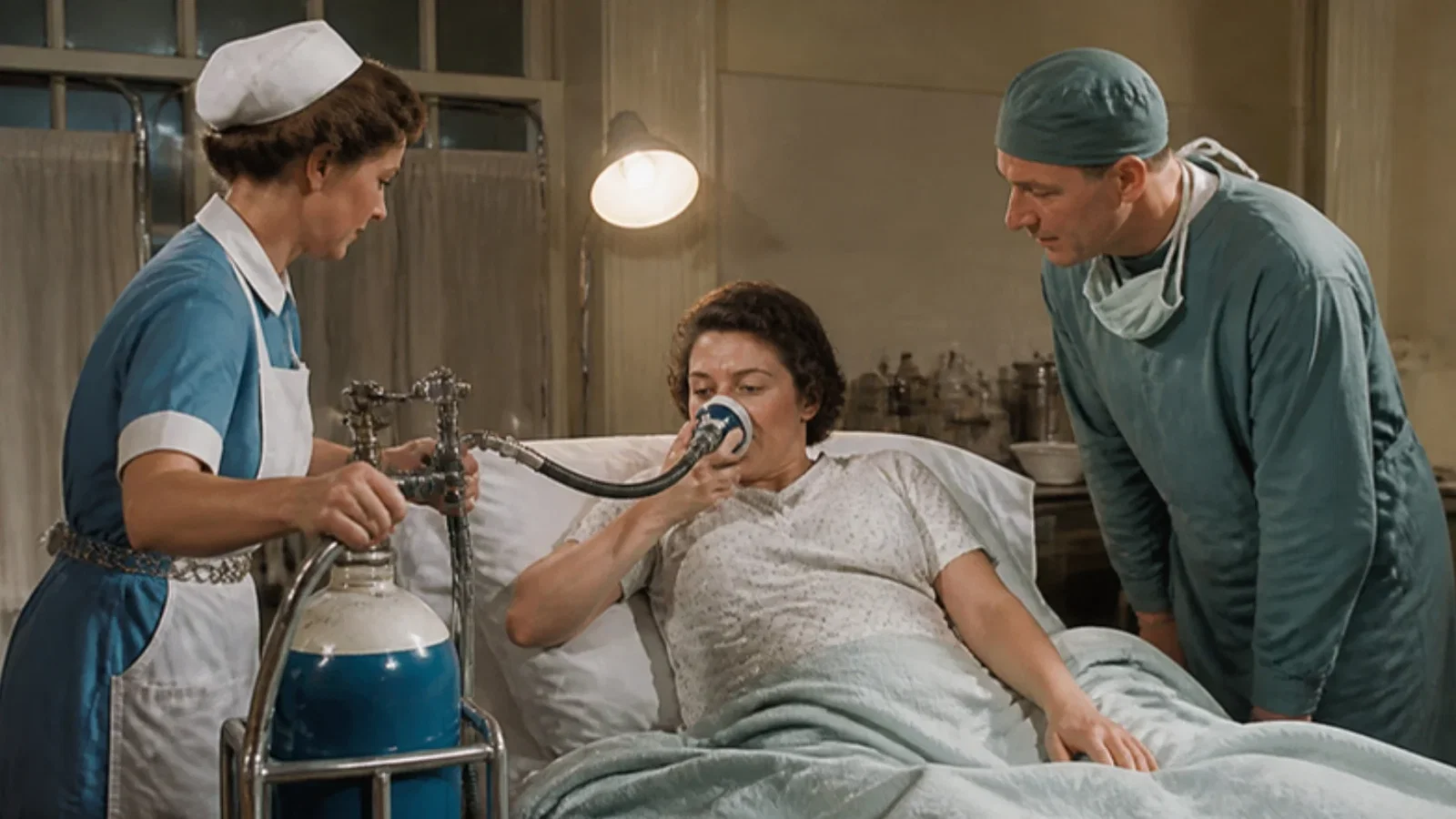
A short communication in the Lancet of 28 October 1961: 50% nitrous oxide and 50% oxygen remain a single gas phase under pressure (the Poynting effect) and were used for labour pain at St Mary's Hospital, Portsmouth; the BMJ follow-ups of 1963-64 on cooling and on midwives; later mass-produced as Entonox.
Reading Library · Anesthesia Epochs · 中文版
Watch the education video (for clinicians)
1961: Tunstall's Entonox — Nitrous Oxide and Oxygen in One Cylinder · Anesthesia Epochs Education Series
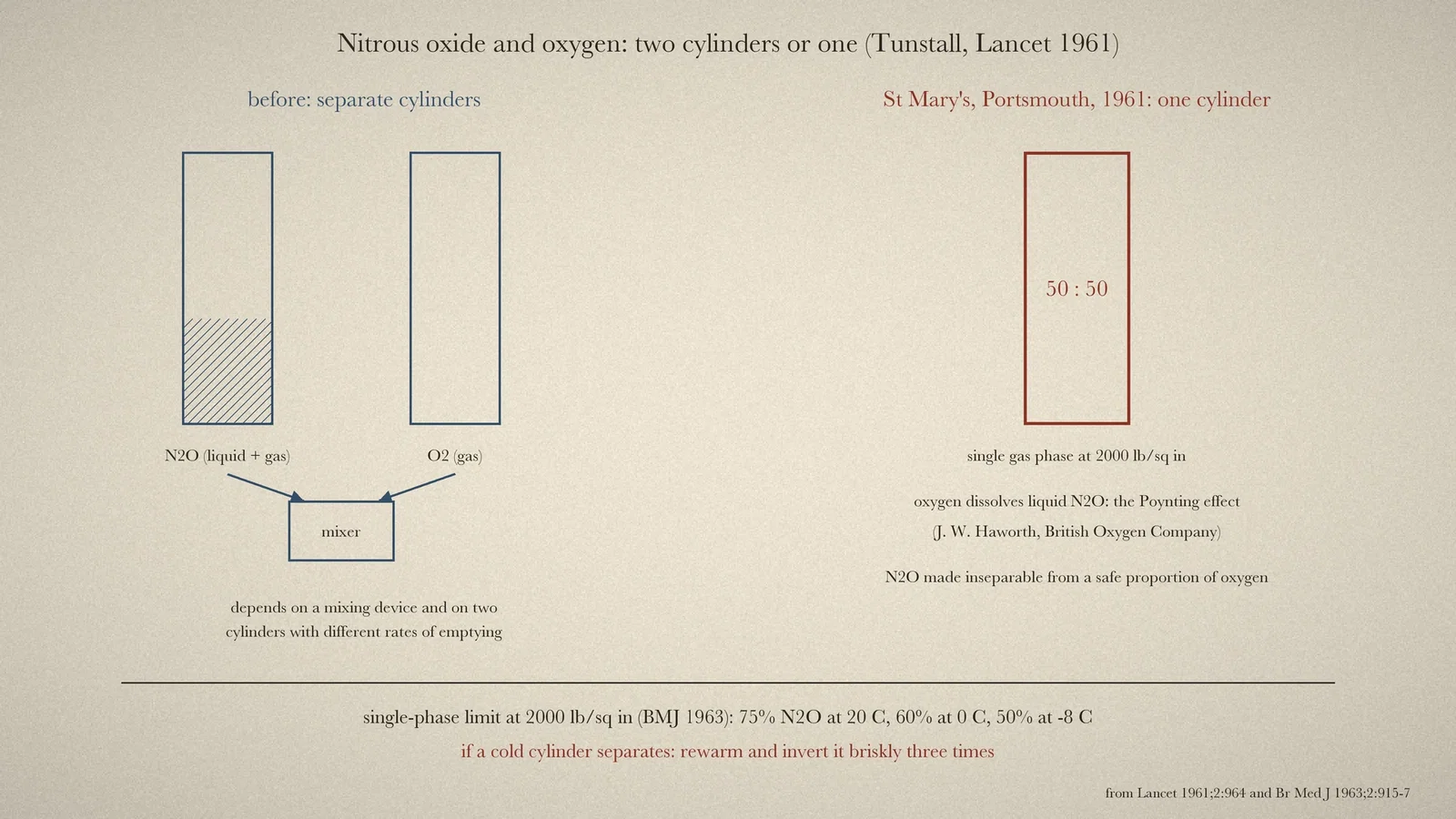
Nitrous oxide is stored as a liquid under pressure, oxygen as a gas, so the two were normally given from separate cylinders through a mixing device. On 28 October 1961 a short note in The Lancet announced that they could share one cylinder. Its author was M. E. Tunstall, an anaesthetist at St Mary's Hospital, Portsmouth, and the mixture it described is the one later sold as Entonox. This article reads that note, the two follow-up papers in the British Medical Journal in 1963 and 1964, and what they show about how a laboratory fact became a gas for labour wards and midwives.
Three hundred words in the Lancet
Tunstall's "preliminary communication", headed "Obstetric analgesia", was written "to publicise the fact that clinically useful mixtures of nitrous oxide and oxygen exist as a single gas phase at 2000 pounds per square inch" on the gauge. Until then, Tunstall wrote, "theoretical considerations seem to have discouraged research" into the possibility. [1, p. 964]
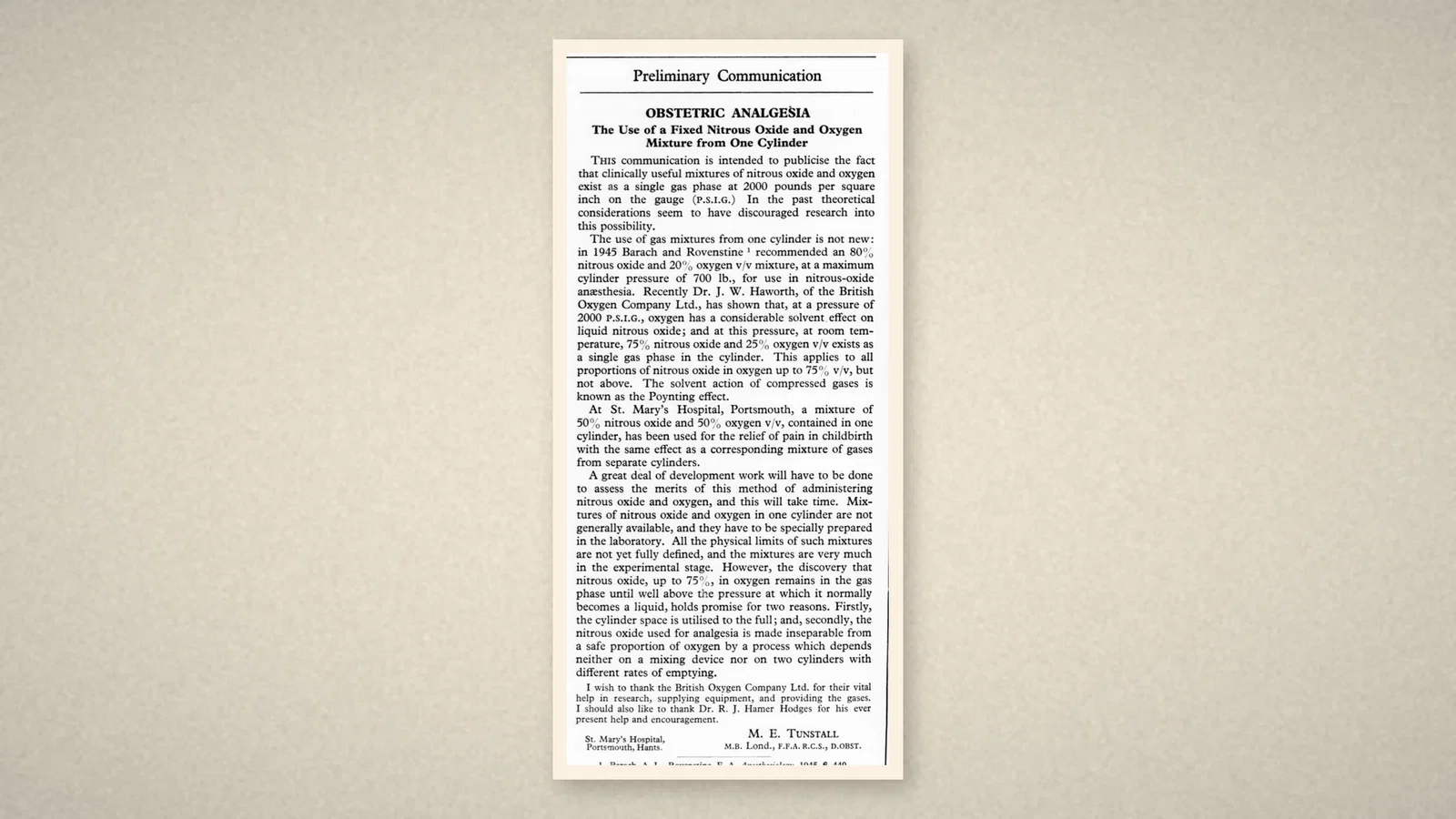
Mixed cylinders were not new: in 1945 Barach and Rovenstine had recommended an 80/20 mixture at no more than 700 lb for nitrous oxide anaesthesia. What was new came from industry. J. W. Haworth of the British Oxygen Company had shown that at 2000 lb per square inch "oxygen has a considerable solvent effect on liquid nitrous oxide". At room temperature, a mixture of 75% nitrous oxide and 25% oxygen therefore "exists as a single gas phase in the cylinder", and so does any lower proportion, but not a higher one. "The solvent action of compressed gases is known as the Poynting effect." [1, p. 964]
At St Mary's a 50/50 mixture in one cylinder "has been used for the relief of pain in childbirth" with the same effect as the same gases from separate cylinders. Tunstall was careful: a great deal of development work remained, the cylinders had to be specially prepared in the laboratory, and the mixtures were "very much in the experimental stage". The promise lay in two things. The cylinder space was used to the full, and the nitrous oxide was "made inseparable from a safe proportion of oxygen", by a process that depended "neither on a mixing device nor on two cylinders" emptying at different rates. [1, p. 964] The note thanks the British Oxygen Company for research, equipment and gases, and Dr R. J. Hamer Hodges for encouragement. [1, p. 964]
The cold problem
The weak point appeared quickly. In 1963, by then in the Department of Anaesthetics at Aberdeen Royal Infirmary, Tunstall reported that the only safety problem in clinical use came from full cylinders exposed to temperatures around 0 °C or below. [2, p. 915] P. V. Cole had pointed out (in a personal communication of 1962) that if a 50/50 cylinder was cooled to -8 °C, nitrous oxide began to collect as a liquid at the bottom. A cylinder brought in from a freezing yard might then deliver a weak mixture at first and, as it emptied, a dangerously strong one. [2, p. 915] Tunstall ran 21 cooling experiments, measuring the oxygen in the gas leaving the valve. [2, p. 915-916]
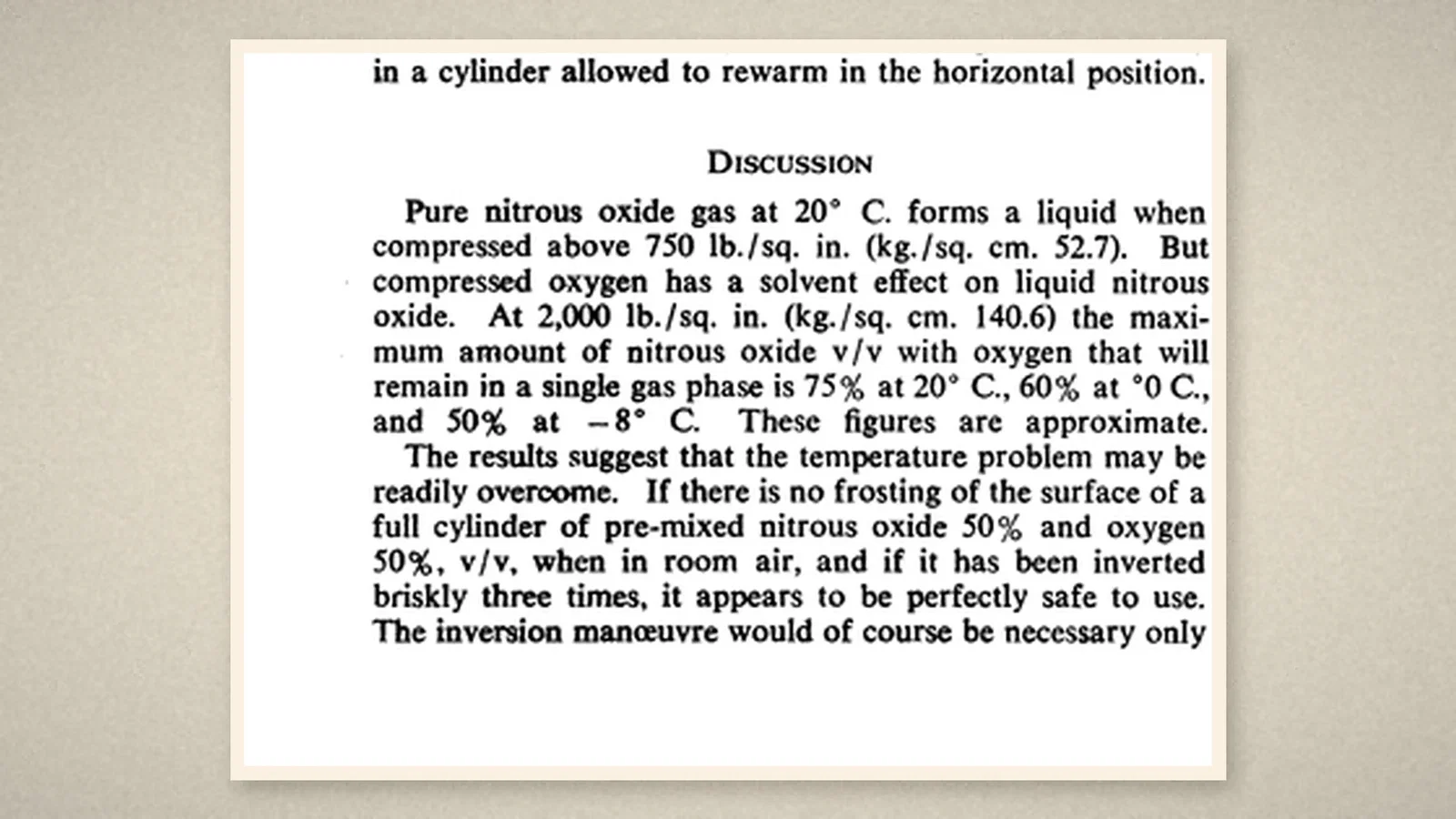
Tunstall's discussion gave the limits. At 2000 lb per square inch the most nitrous oxide that stays in one gas phase is about 75% at 20 °C, 60% at 0 °C and 50% at -8 °C. The remedy was simple: if a full 50/50 cylinder showed no frost and had been "inverted briskly three times", it appeared safe to use. Tunstall concluded that premixed gas for pain relief in home confinements "appears to be practical". [2, p. 917]
For midwives
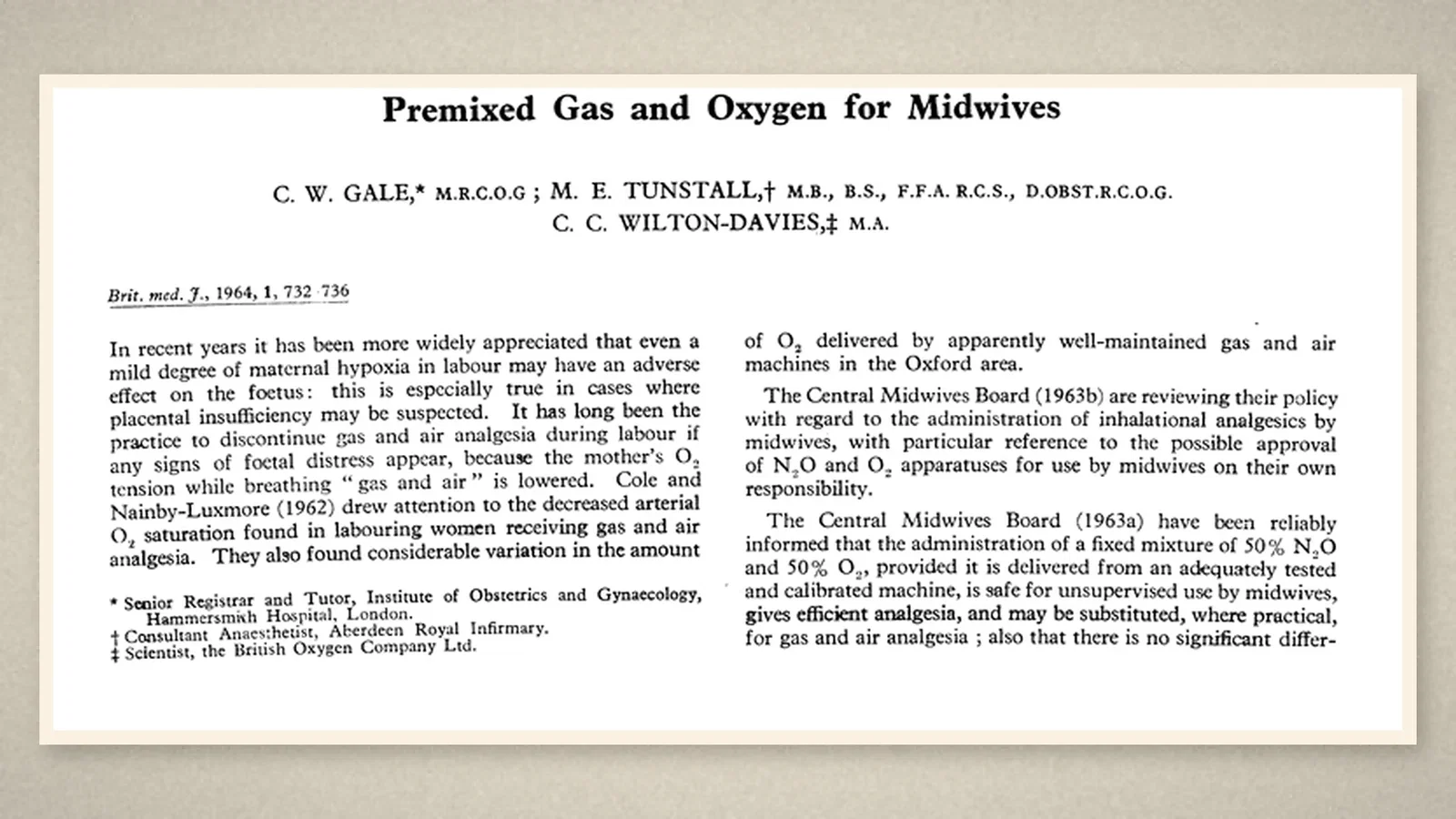
In 1964 Tunstall, now a consultant anaesthetist in Aberdeen, wrote with C. W. Gale of the Institute of Obstetrics and Gynaecology in London and C. C. Wilton-Davies, a scientist at the British Oxygen Company. [3, p. 732] Their paper is indexed in the BMJ volume as "premixed nitrous oxide and oxygen for midwives". [4] It cites the Central Midwives Board, which had been informed that a fixed 50/50 mixture, delivered from a tested and calibrated machine, was safe for unsupervised use by midwives and could replace gas and air. [3, p. 732] The authors explained the physics with a cylinder that had transparent windows, built by the British Oxygen Company so that liquid levels could be watched. They warned that a cylinder cooled below about -8 °C behaved differently, and that its last fraction could contain as little as 2% oxygen. They judged that the conditions needed were unlikely in practice and that warming and agitating the cylinder would prevent the danger. [3, p. 733, 736]
A name
None of these three papers uses the word Entonox. Two history timelines supply it. The Australian Society of Anaesthetists' timeline says Entonox, "a 50-50 mixture of nitrous oxide and oxygen", was introduced into clinical practice in 1961, developed by Michael Eric Tunstall for obstetrics at St Mary's, and "eventually mass-produced by the British Oxygen Company" after the Lancet note. [5, p. 67] The History of Anaesthesia Society's timeline puts it in one line: "Michael Tunstall in Portsmouth developed Entonox, produced by the British Oxygen Company." [6]
What the record shows
Tunstall's contribution was to see what a fact of gas physics, worked out at the oxygen company, could do in a labour ward. Once the nitrous oxide could not come out without its oxygen, the safety of the mixture was built into the cylinder. The cold problem was found and answered within two years, and by 1963 the aim had widened to use by midwives in women's homes.
Sources and reading limits
Read: Tunstall's communication in The Lancet, 28 October 1961, in full; Tunstall's cooling paper, BMJ 12 October 1963, pp. 915-917, in full; Gale, Tunstall and Wilton-Davies, BMJ 21 March 1964, pp. 732-736 (pp. 732, 733 and 736 read closely); the BMJ 1964 index; the ASA and History of Anaesthesia Society timelines.
Not covered: Haworth's work at the British Oxygen Company is known only from Tunstall's sentence. Cole's 1962 communication and the paper by Cole and Nainby-Luxmoore were not read. The Central Midwives Board's statements are known only as Gale and colleagues quote them. When the name Entonox was first used was not established. The experimental details on pp. 734-735 of the 1964 paper are not summarised.
One illustration is a schematic drawn from the 1961 and 1963 papers; three are crops of the papers.
- Tunstall ME. Obstetric analgesia: the use of a fixed nitrous oxide and oxygen mixture from one cylinder. Lancet. 1961;2(7209):964. Internet Archive
- Tunstall ME. Effect of cooling on pre-mixed gas mixtures for obstetric analgesia. Br Med J. 1963;2(5362):915-7. PMC
- Gale CW, Tunstall ME, Wilton-Davies CC. Premixed gas and oxygen for midwives. Br Med J. 1964;1(5385):732-6. PMC
- British Medical Journal. 1964, vol. 1, index. Internet Archive
- Australian Society of Anaesthetists. Anaesthesia History Timeline 2024. PDF
- History of Anaesthesia Society. Timeline. Website
Continue exploring
Related reading connects shared questions and contexts; it does not by itself establish historical influence.
Anesthesia Epochs · The Source Room · About & Editorial Method
Published November 2, 2026. Sources and reading limits are stated above. Illustrations are labelled as original source images or AI-made. Historical accounts are educational; they are not current treatment instructions.