An early emergency resuscitation trial and its subsequent evaluation.
Reading Library · Anesthesia Epochs · 中文版
Watch the companion film
2001: Rivers — Early Goal-Directed Therapy for Sepsis · Watch on YouTube
Historical anchor: 2001. Date details and source qualifications are explained below.
November 8, 2001 · Emergency resuscitation, guideline adoption and later testing
The first hours of resuscitation begin while a patient is still in the emergency department. In 2001, Emanuel Rivers, Bryant Nguyen, Suzanne Havstad and colleagues reported a randomized trial asking whether organizing that early care around specified physiological targets could improve outcomes in severe sepsis and septic shock. Their intervention concerned the delivery of care before inpatient admission, rather than the introduction of a new drug.[1, pp1368–1370]
The study recruited adults at Henry Ford Hospital in Detroit from March 1997 through March 2000. It randomized 263 patients: 130 to early goal-directed therapy (EGDT) and 133 to standard therapy. Eligibility combined the contemporary systemic inflammatory response criteria with hypotension after a fluid challenge or an elevated lactate concentration. Later sepsis definitions should not be substituted for those original entry criteria. Although 236 patients completed the initial six-hour period, all 263 were included in the intention-to-treat analyses.[1, pp1369–1372, Figure1 and Table1]
Patients receiving standard therapy also underwent monitoring, catheterization and treatment. The EGDT group received at least six hours of protocolized care in the emergency department, using measures including central venous pressure, mean arterial pressure, urine output and central venous oxygen saturation. The last measure, ScvO₂, differs from both pulmonary-artery mixed venous saturation and pulse oximetry. Fluids, vasoactive drugs, red-cell transfusion and inotropic support formed a combined intervention; the trial did not establish the separate efficacy of every component.[1, pp1370–1371, Figure2; p1376]
The reported in-hospital mortality was 30.5% with EGDT and 46.5% with standard therapy, with P=0.009. A footnote to Table3 matters: these percentages are Kaplan–Meier estimates. They should neither be presented as simple divisions of death counts by group size nor relabeled as 28-day mortality. The paper reports its 28-day and 60-day outcomes separately.[1, p1374, Table3]
The positive result also came with design limits. This was an open, partially blinded trial: the clinicians who subsequently took over inpatient care were unaware of allocation, but the initial treating team was not. The authors acknowledged possible bias from investigators' direct involvement and from changes in care in the control group. A single-center trial of a combined intervention cannot isolate a catheter or an individual monitoring target as the explanation for its overall effect.[1, pp1370,1376]
Its connection with the Surviving Sepsis Campaign is documented. The 2004 guidelines explicitly cited Rivers 2001 in support of their initial six-hour resuscitation recommendations. They also distinguished the campaign's first phase, launched with the Barcelona Declaration in October 2002, from the second phase of guideline development. This provides a traceable example of a trial entering recommendations. It does not establish that one paper alone caused the campaign to begin, or make the 2004 guidelines a document issued in 2002.[3, pp537–539,551, reference5]
The claim was tested further. Published in 2017, PRISM combined individual patient data from three later multicenter randomized trials: ProCESS, ARISE and ProMISe. It did not pool the original 263 Rivers participants into that analysis. After excluding the additional protocol-based standard-therapy arm of ProCESS, the comparison contained 3,763 randomized patients; 3,723 contributed to the primary 90-day outcome analysis, across 138 hospitals in seven countries.[2, online pp2–5]
At 90 days, deaths occurred in 462/1,852 EGDT patients (24.9%) and 475/1,871 usual-care patients (25.4%). The adjusted odds ratio was 0.97, with a 95% confidence interval of 0.82–1.14 and P=0.68. PRISM did not demonstrate a mortality benefit from EGDT over the usual care provided in those trials. The effect measure here is an odds ratio, not a risk ratio, and failure to demonstrate superiority does not establish equivalence in every setting.[2, online pp6–8, Table2 and footnotes]
An essential feature of the later comparison is easily missed: early recognition, intravenous fluids and antimicrobial treatment were promoted in both groups. The question was whether a fixed EGDT package added benefit in that context. The trials did not show that delayed care was harmless. The PRISM authors considered advances in general care a possible explanation for some or all of the difference in findings, while acknowledging unblinded designs, small subgroups and limits to representation across health systems.[2, online pp2,11–12]
Rivers 2001 made the timing, targets and organization of early resuscitation a testable outcomes question. Guideline adoption and subsequent multicenter evaluation belong to the same history, including both the initial positive result and the later limits on its interpretation. In-hospital mortality in 2001 and 90-day mortality in 2017 remain outcomes from different studies; they cannot be joined into a causal curve of treatment effects across time.[1–3]
Images

A modern editorial reconstruction of emergency care around 2001. The people, room and equipment layout are illustrative, not a photograph of Rivers, an enrolled patient or the study site.
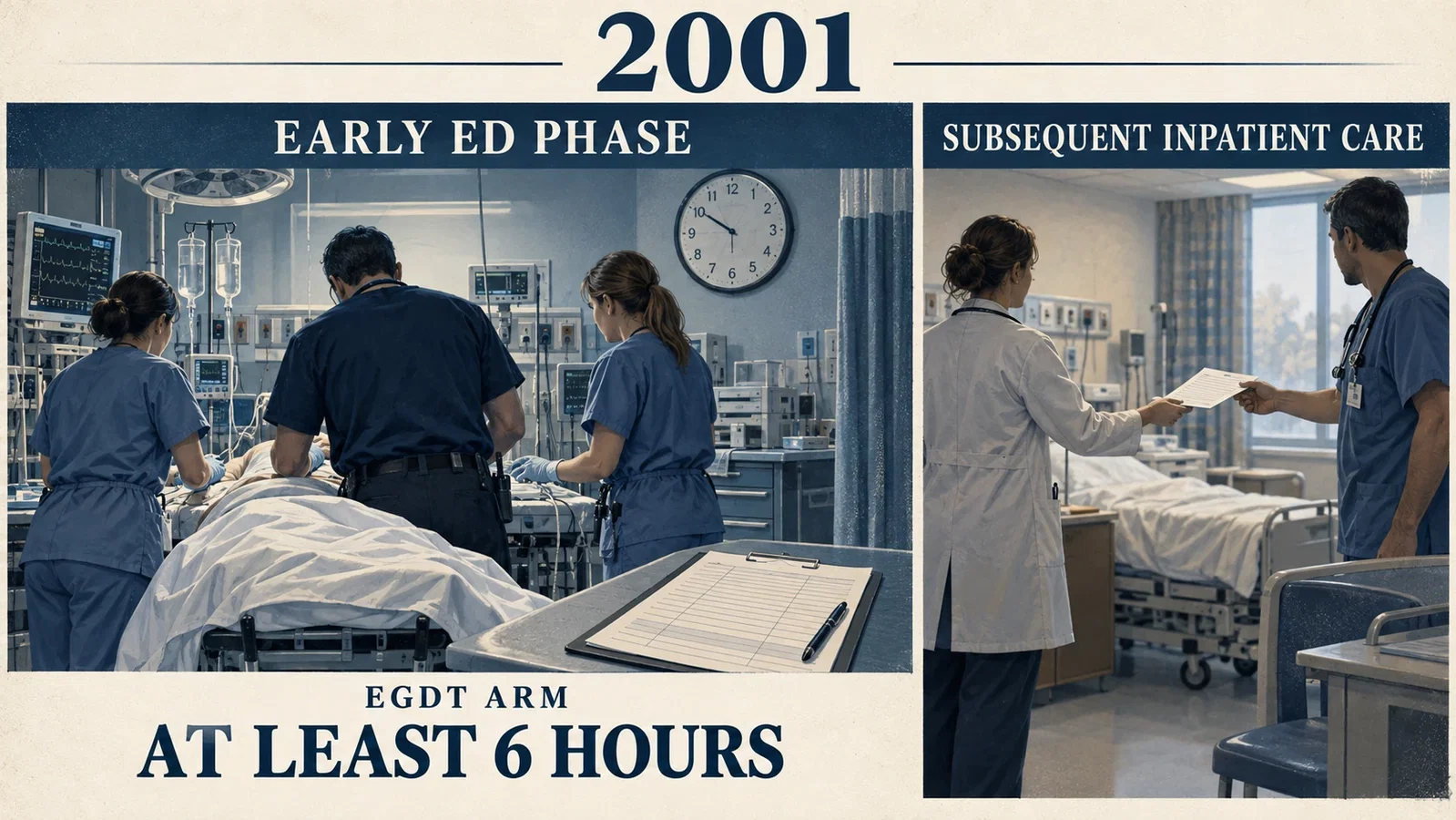
The early emergency phase and subsequent inpatient care as distinct periods. This explains the study design, not a current treatment pathway.
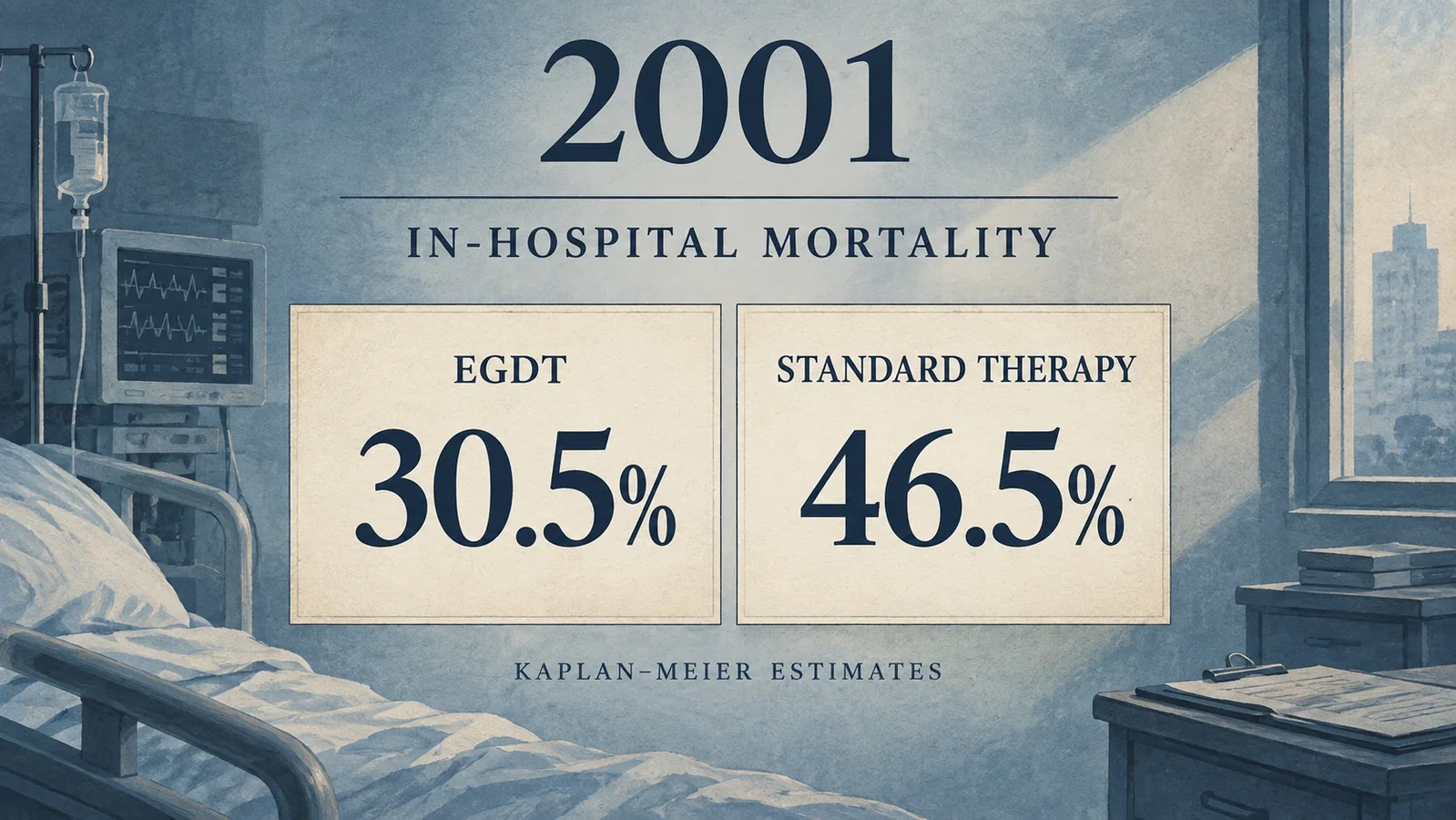
In-hospital Kaplan–Meier mortality estimates within the 2001 trial. The percentages are not unadjusted death-count proportions.
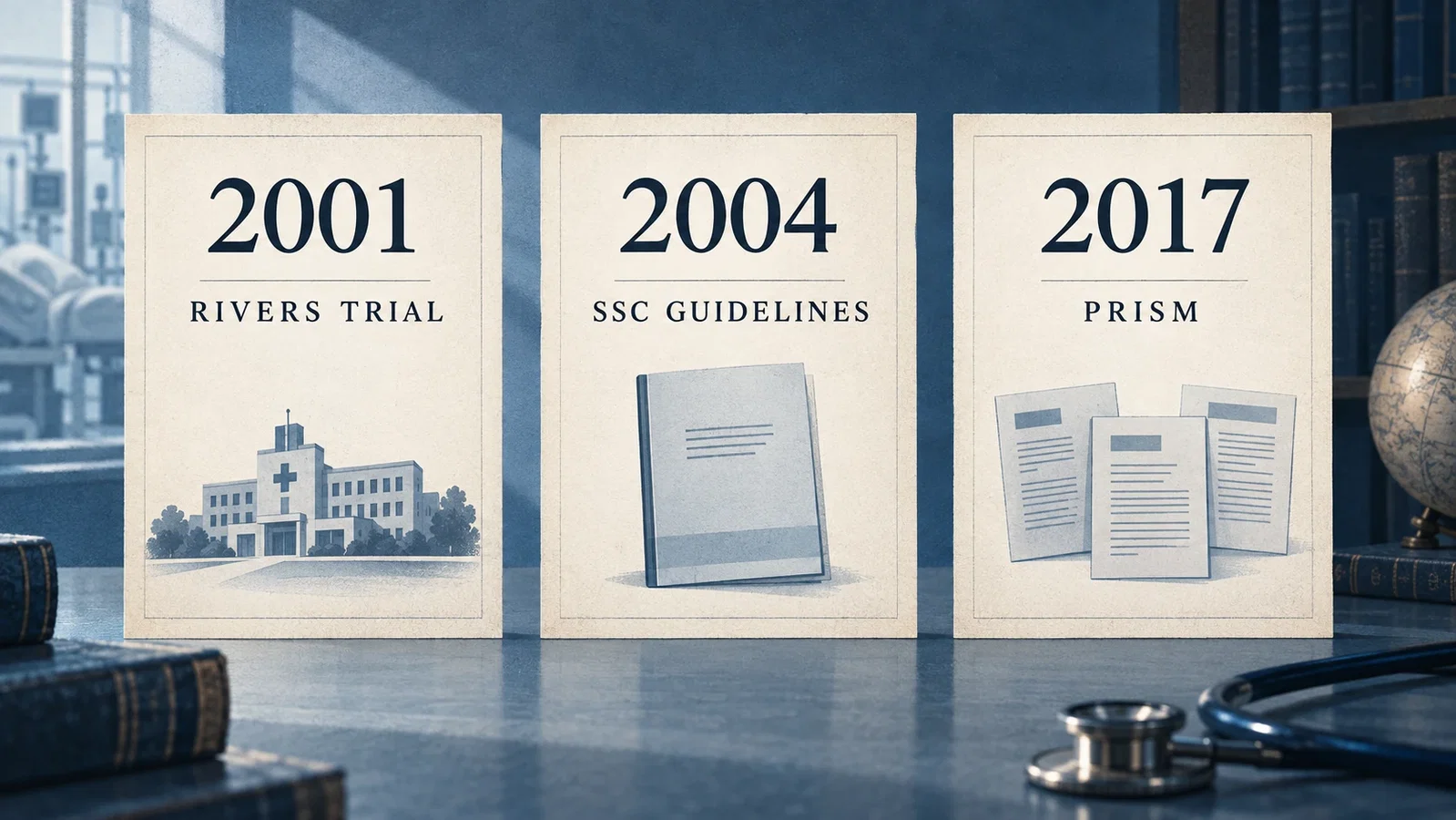
The 2001 trial, its citation in the 2004 guidelines and the 2017 reassessment, arranged by publication year. Their sequence is not a cross-study causal comparison of effects.
Sources and reading limits
- Rivers E, Nguyen B, Havstad S, et al. Early goal-directed therapy in the treatment of severe sepsis and septic shock. N Engl J Med. 2001;345:1368–1377. DOI:10.1056/NEJMoa010307; PMID11794169. University-archived original PDF. All ten pages, including figures, tables, appendix and references, were read.
- PRISM Investigators. Early, goal-directed therapy for septic shock—a patient-level meta-analysis. N Engl J Med. 2017;376:2223–2234. DOI:10.1056/NEJMoa1701380; PMID28320242. Journal record. The public archive copy read contains the March 21, 2017 early online article, pages 1–12, with pre-existing highlights and annotations. It also contains a 50-page supplement: only its cover was read for identification; the remaining 49 pages were not read. The full results of the three constituent trials are not independently cited here.
- Dellinger RP, Carlet JM, Masur H, et al. Surviving Sepsis Campaign guidelines for management of severe sepsis and septic shock. Intensive Care Med. 2004;30:536–555. DOI:10.1007/s00134-004-2210-z. Nursing-association archive PDF. Jointly published with Critical Care Medicine. Six pages, 536–539 and 550–551, were read for the campaign's phases and its citation of Rivers; the complete 20-page guideline was not reviewed.
These are historical materials. Correction records exist for the 2004 CCM co-publication, but their full texts and the listed commentaries are not covered. This article supplies neither guideline drug doses nor current treatment recommendations. Mirrors, bibliographic records and guideline citations are not independent replications of a trial. All four illustrations are modern editorial work in the original landscape format.
Sources and reading limits are stated above. Illustrations are labelled as original source images or AI-made. Historical accounts are educational; they are not current treatment instructions.
Continue exploring
Related reading
Related reading connects shared questions and contexts; it does not by itself establish historical influence.